
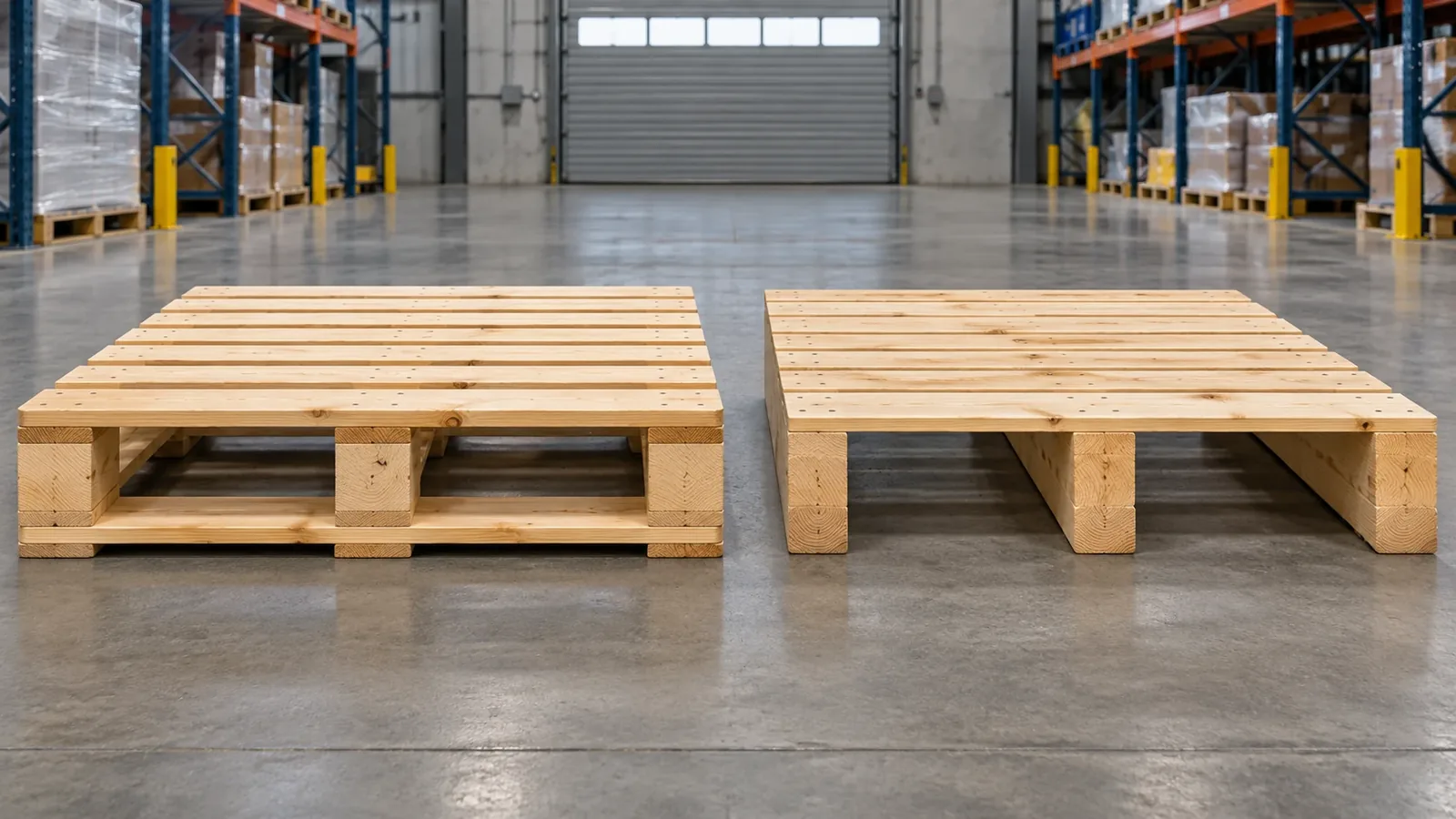
Pallet vs skid is best resolved by inspecting the actual platform underside and the handling equipment that must interface with it. In one equipment maker’s terminology, a skid has a top deck and runners but no bottom deck, while a pallet includes bottom deck boards. Other businesses may use the words differently, so the label alone is not a complete shipping specification. For bathroom and home-storage hardware importers, show the top deck, supports, bottom structure, fork-entry direction and receiver requirements on the approved packaging or logistics record before shipment.
The distinction can affect how a warehouse machine approaches a load, but it does not automatically determine strength, safety, rackability or suitability for every pallet jack. A buyer should confirm the construction of the exact platform and the compatibility requirements of the carrier, warehouse and receiving equipment. The source’s equipment example is specific to its own models; use the selected equipment manufacturer’s current instructions for an actual handling decision.
What is the difference between a pallet and a skid?
The simplest physical distinction in the cited equipment-maker convention is the underside. A skid has a top deck supported by runners without a lower deck. A pallet has a top deck, supports and a bottom-deck arrangement. The words are sometimes used interchangeably in trade conversation, so buyers should verify the construction rather than infer it from a quote line or packing-list label.
In its one-page comparison, InnoLIFT describes skids as having no bottom boards and pallets as including bottom deck boards. The same document also explains how those details relate to its open-bottom and straddle loader designs. That is useful evidence of why the underside can matter to a particular machine. It is not a universal naming code or a general statement that every pallet has a fixed board count, every skid has one specific shape, or one design is always stronger.
| Feature to inspect | Typical description in the cited convention | Buyer’s practical check |
|---|---|---|
| Top deck | Boards or platform supporting the cartons | Confirm the load footprint and carton contact area |
| Supports | Runners or stringers beneath the top deck | Identify their direction and spacing in the actual platform |
| Bottom deck | Present on the pallet example; absent on the skid example | Photograph or draw the underside instead of relying on a name |
| Entry interface | Fork access may depend on geometry and equipment | Confirm the selected machine’s required approach and clearance |
| Platform material | May be wood or another specified construction | Record the material and condition required by the shipment plan |
This is a descriptive comparison, not an engineering drawing or load-rating table. Actual designs vary, and a platform’s capacity cannot be read from the word “pallet” or “skid.”
Why should importers inspect the underside before shipment?
The underside is where the deck, supports and handling interface become visible. A receiving team may need to know whether lower boards interfere with a specific loader, whether forks can enter from the expected direction, or whether the carrier’s handling plan requires a particular platform. Those are equipment-specific questions. The label can help start the conversation, but the actual structure closes it.
For example, a shipment of metal storage baskets may be placed on a platform with cartons arranged in a defined footprint. The receiver may use a particular truck, jack or conveyor interface. If the lower deck or runner layout differs from the agreed arrangement, equipment compatibility should be reviewed before the load is handled. This does not prove that a load will fail or that the platform is unsafe; it identifies a mismatch to resolve with the responsible logistics and equipment parties.
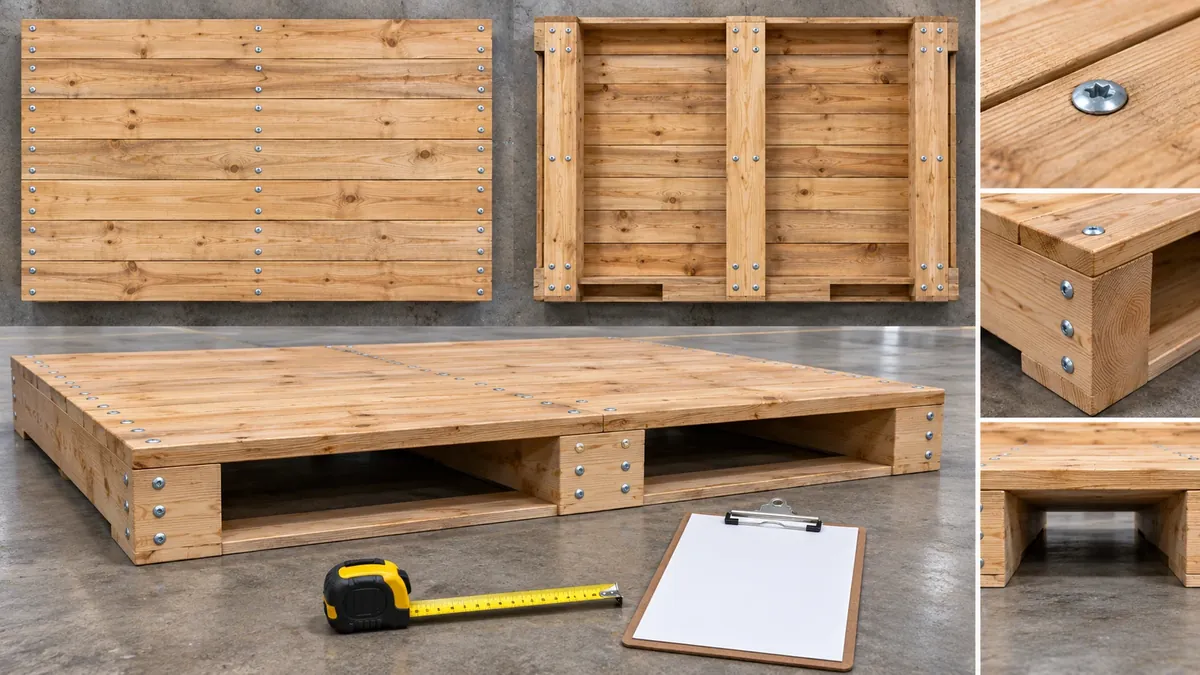
Ask the shipper or packaging supplier for a top view and underside view of the proposed platform. Record the overall footprint if it is part of the receiver’s requirement, the direction of supports, the available entry sides and any bottom boards. If the platform is a reusable asset or a supplier standard, identify it by a drawing, photo or internal item code. The buyer should avoid relying on a shorthand description when receiving equipment or carrier instructions specify a different interface.
Do two-way or four-way entry labels answer the pallet-versus-skid question?
No. Entry direction and bottom-deck construction are related but separate attributes. A platform described as two-way or four-way refers to access arrangements under a particular construction. That label alone does not tell the buyer whether bottom boards are present, how the runners are positioned, or whether the intended handling equipment can use the platform.
The same applies to material and appearance. A wood platform, plastic platform or metal stillage may be described in ways that do not use the pallet/skid distinction consistently. A buyer should list the physical facts that affect the handling or storage plan rather than infer them from a category word. If a warehouse requires a particular opening, support arrangement or footprint, state that requirement and have the packaging or logistics provider confirm the proposed construction.
An equipment vendor may use a specific term in a specific manual or product configuration. InnoLIFT’s document says its open-bottom loader and straddle models have different interactions with bottom boards. Follow the exact equipment supplier’s documentation and current model limits. Do not copy a compatibility instruction from a different machine, platform size or shipment context. A pallet that works with one piece of equipment may not be compatible with another, and a skid is not automatically accepted by every operation.
How can the platform design affect carton support?
The platform’s top deck and support arrangement determine where cartons contact the platform and how the load is presented for handling. Those details may matter for a shipment containing metal racks, wire baskets or multiple retail cartons. The buyer can review the carton footprint, gaps between support surfaces, platform overhang and restraint method with the packaging and logistics providers. This is a coordination review, not a capacity or stacking analysis.
If cartons rest across open spaces, the packaging team may need to evaluate how the carton bottoms behave under the actual packed load. That review should use the real carton construction and platform design. A photo of an unloaded pallet does not prove the loaded shipment is suitable for compression, transport or repeated handling. Conversely, a gap in a deck does not by itself prove that damage will occur. The relevant product, carton, packing pattern and carrier requirements should be considered together.
For a private-label bathroom hardware shipment, a buyer can ask for the planned platform footprint, the orientation of cartons, the number of cartons per layer if specified, and the locations where restraints or edge protection will be used. Avoid inserting a generic “palletized” phrase as the only packaging description if the delivery site has defined constraints. Keep product cartons, transport packaging and platform construction as separate specification layers.
| Shipment element | What to document | Why the distinction matters |
|---|---|---|
| Retail or inner package | Product protection and presentation | It is not the same as the transport platform |
| Shipping carton | Carton size, orientation and label location | Cartons form the load pattern on the deck |
| Platform | Top deck, supports, bottom deck and material | The actual underside interfaces with equipment |
| Load restraint | The agreed method and points of contact | Restraint must fit the specific load and packaging plan |
| Handling equipment | Required entry and clearance conditions | Equipment rules are model-specific |
The table helps buyers collect the right information; it does not prescribe a pallet pattern or restraint method.

What should a receiving team check when a load arrives?
The receiver should compare the delivered platform with the agreed shipment description and the receiving operation’s handling requirements. The check should be performed by trained personnel using the applicable workplace procedure. This article is not a forklift instruction or a load-handling safety policy.
Before unloading or moving a load, the logistics team can verify the shipment identifier, visible platform construction, access sides and any evident mismatch with the receiving plan. If the platform type or condition differs from the documents, the receiver should follow the site’s escalation and safety process. Do not try to compensate for an unknown mismatch by improvising equipment use or by assuming the load will behave like another platform.
Record the actual configuration with photographs when permitted. Capture the top deck and underside, identify the direction of the runners, and note any bottom deck boards or visible damage. Share the observation with the shipper or packaging owner. The evidence can help determine whether the discrepancy is a documentation error, a substituted platform or a new packing configuration. It does not by itself establish the platform’s rated capacity or structural adequacy.
How should buyers specify pallet or skid requirements in an RFQ?
Describe the required construction and interface in plain terms, then attach an illustration or reference photo. If a specific customer, warehouse or carrier requires a platform standard, quote the exact requirement and ask the responsible logistics party to confirm it. The word “pallet” may not be enough when suppliers use terminology differently.
A useful RFQ note can state:
- Whether the platform requires a lower deck or an open underside.
- Which sides need to permit equipment entry, if the receiving plan specifies this.
- The required overall footprint and any relevant overhang constraints.
- The carton arrangement and any defined load restraint requirements.
- The material or reuse condition if required by the buyer or receiver.
- The receiving equipment or facility requirement that the packaging supplier must confirm.
- The drawing or photo revision that represents the approved platform.
Do not invent a board count, platform dimension, load capacity or machine compatibility statement. If a receiver gives a constraint, transfer it exactly and have the packaging supplier propose a design for confirmation. The final shipping record should refer to the accepted configuration, not only to a generic noun.
What pallet and skid mistakes can create avoidable confusion?
Most misunderstandings happen when a name stands in for a construction drawing. A supplier may say “skid” based on its own convention, while the receiver expects a particular machine interface. Another party may call a platform a pallet without identifying bottom boards or entry layout. Those differences can be resolved before shipment by asking for an underside view and a handling review.
Avoid these shortcuts:
- Treating pallet and skid as globally fixed terms. Ask how the supplier defines the term and inspect the platform.
- Assuming entry count reveals the lower deck. Record both entry geometry and bottom construction.
- Copying one machine’s loading rule. Verify the exact equipment model and current instructions.
- Assuming a skid is always easier to drag or a pallet always more stable. Such generalizations are not established for every design and application.
- Using a platform label as proof of a load rating. Obtain the applicable supplier specification when capacity matters.
- Waiting until the warehouse to resolve a mismatch. Confirm the receiver’s interface before packing and dispatch.
- Confusing retail cartons with transport packaging. Record product protection, carton arrangement and platform construction separately.
These are communication risks, not predictions that a shipment will be damaged. The buyer should route equipment questions to the receiver and equipment maker, while the packaging supplier confirms the actual platform.
How does this relate to Koitor hardware packaging?
Koitor Hardware supplies custom bathroom and home-storage hardware products. Product packaging may include retail packaging, cartons and a transport arrangement, but the specific platform design should be confirmed for the buyer’s shipment and receiver. This article does not claim that Koitor makes pallets or controls third-party warehouse equipment.
When a buyer is developing a private-label metal basket or bathroom accessory, packaging requirements can be included in the RFQ alongside the product dimensions, finish, quantity and labeling needs. The buyer should identify which requirements are mandatory for the final destination and which are proposed by the logistics provider. If a warehouse specifies a certain underside, the buyer can share that instruction with the packaging owner before sample approval.
Koitor’s Informations sur le matériel de stockage domestique OEM et private-label bathroom accessory information provide context for the product side of a sourcing project. Buyers should separately confirm the transport platform with the packaging supplier and receiving operation.
How should packaging records describe the platform?
The packaging record should make the actual platform recognizable to the shipper and receiver. A single word can be ambiguous, especially when a buyer, carrier, warehouse and supplier use pallet and skid differently. Include a drawing or photograph showing the top deck and underside, and annotate only the features that the logistics parties have confirmed. If a facility has a defined entry or footprint requirement, identify its source and version.
The record can separate product carton, transport carton, pallet or skid, and final load arrangement. This helps the team track who supplies each component and who approves the transport configuration. If the platform is reused, the buyer can also identify whether the delivered unit is a returnable asset or a one-way shipping component. That detail is operational and should be agreed with the receiving party rather than inferred from the material.
Any dimension, load limit, board arrangement or compatibility requirement should come from the responsible source. A warehouse may specify a maximum footprint; an equipment manual may show a required entry condition; a packaging supplier may propose a construction. Keep those sources separate in the approval file. Do not copy a measurement or board pattern from a general article or an unrelated platform.
For mixed-SKU hardware, identify whether different cartons share one platform or are shipped separately. A platform that fits one carton pattern may not be the same configuration used for a mixed layer. The buyer can ask for the proposed pattern and review labels, orientation and product protection as part of the shipping plan. This does not prescribe stacking height, restraint or handling behavior; those decisions belong to the shipper, receiver and their applicable procedures.
What should happen when the delivered platform differs from the approved record?
Treat a mismatch as a documentation and receiving issue to resolve through the site’s procedure. A receiver should not assume that an alternate platform is acceptable because it carries the same product cartons or because a supplier calls it by a familiar name. Record the observed difference, identify the shipment, and notify the responsible logistics or packaging contact before handling decisions are made.
The discrepancy might be a terminology mismatch, an approved substitution that was not recorded, or an unapproved change. The buyer should compare the delivered platform with the accepted photograph or drawing and ask the supplier to explain the difference. If the receiving site or equipment maker must confirm compatibility, obtain that confirmation from the correct party. Keep the resolution with the shipment record so future orders do not repeat the ambiguity.
This article does not tell warehouse personnel how to move a load or whether an unexpected platform can be used. Follow workplace procedures, trained personnel and equipment manufacturer instructions. If there is uncertainty about safe handling, route it to the designated safety and logistics owner rather than improvising from the pallet-versus-skid label.
For a buyer asking “pallet vs skid?”, this checklist should be applied to the named sample, assembly or supplier record.
Buyer checklist before confirming a shipment platform
- Obtain a top view and underside view of the proposed platform.
- Confirm whether bottom deck boards are present.
- Identify the runners or supports and their direction.
- Record the required entry sides from the receiver’s instructions.
- Check the platform footprint against the agreed shipment plan.
- Review carton orientation and contact with the deck as a packaging question.
- Confirm that the selected handling equipment is compatible through its current instructions.
- Keep the carrier, warehouse and supplier requirements distinct and traceable.
- Record the approved platform photo or drawing revision.
- Escalate an unexpected platform mismatch through the receiving site’s procedure.
Foire aux questions
A useful “pallet vs skid?” answer states the comparison boundary and points to the product-specific evidence.
Is a skid the same as a pallet?
The terms are sometimes used interchangeably. In the cited equipment-maker convention, a skid has no bottom deck while a pallet has a lower-deck arrangement. Verify the actual construction and the supplier’s terminology.
Does every pallet have bottom boards?
Do not use a general article as a universal construction standard. Confirm the specific platform design with a drawing, photograph or supplier specification.
Is a skid stronger than a pallet?
This comparison does not establish a strength ranking. Capacity depends on the actual platform design, material, condition, load and applicable specification.
Does a two-way or four-way label settle equipment compatibility?
No. Entry geometry is one attribute. The actual underside and the selected equipment’s current requirements must also be reviewed.
Can I tell a supplier to use a skid without a drawing?
You can begin the request with that term, but attach a photo or state the required bottom-deck and entry arrangement so the supplier and receiver share the same definition.
Does this article provide forklift operating guidance?
No. Follow trained personnel, site procedures and the equipment manufacturer’s instructions for all handling decisions.
Add the Platform Definition to the Packaging Approval Record
A platform decision is easier to control when the packaging record describes the physical interface instead of relying on a single noun. For a metal storage shipment, the buyer can request a dimensioned drawing or clear underside photographs, then record the platform length and width, deck arrangement, entry direction, clearance, and the surfaces intended to contact the load. These details let the packaging supplier explain the design and let the warehouse compare the delivered platform with the approved version.
Keep the product and platform decisions linked but distinct. The hardware buyer may specify a carton or unitized load, while a packaging supplier chooses or proposes the support structure. The receiving operation then determines whether its equipment and storage layout accept that structure. A platform name on a purchase order does not prove all three parties use the term the same way. The approval record should therefore identify who owns the platform design, who confirms equipment compatibility, and who accepts a substitution.
If a shipment changes from one platform design to another, treat the change as a packaging revision. Ask for the revised drawing or underside view, compare the contact and entry features, and determine whether carton placement, strapping, stacking, or warehouse handling assumptions also changed. Do not infer that an alternative is equivalent merely because its supplier calls it a pallet or skid. A visual check can confirm visible construction; it cannot, by itself, establish rated capacity, damage tolerance, or suitability for a particular rack or handling system.
For repeat orders, preserve the approved platform reference alongside the carton and labeling specifications. Include a revision identifier or dated approval image so procurement, the packer, and the receiving team can distinguish the current instruction from an earlier shipment. If the platform is supplied by a logistics or packaging partner, record that boundary explicitly; the hardware manufacturer should not be assumed to control a third party’s platform design. This simple documentation step makes a terminology difference actionable without turning it into an unsupported safety or strength claim.
Source note
The construction comparison is based on InnoLIFT’s one-page pallet-versus-skid equipment guide. Its compatibility example applies to its own equipment configurations and should not be generalized to every platform or machine.
Collaborez avec Koitor Hardware
Planning Packaging for a Metal Storage Product?
Share your hardware drawing, sample, carton plan and shipment requirements with Koitor. Confirm platform construction and handling compatibility with the packaging supplier, carrier and receiving facility responsible for those details.
Fabrication pour compte de tiers / Marque de distributeur
Transformez ce guide d'approvisionnement en cahier des charges
Indiquez-nous le produit souhaité, ses dimensions, sa finition, la quantité commandée et vos exigences en matière d'emballage. Votre équipe recevra une analyse pratique de la faisabilité de la fabrication avant l'établissement du devis.



 English
 Español
 Português
 Français
 Deutsch
 العربية