
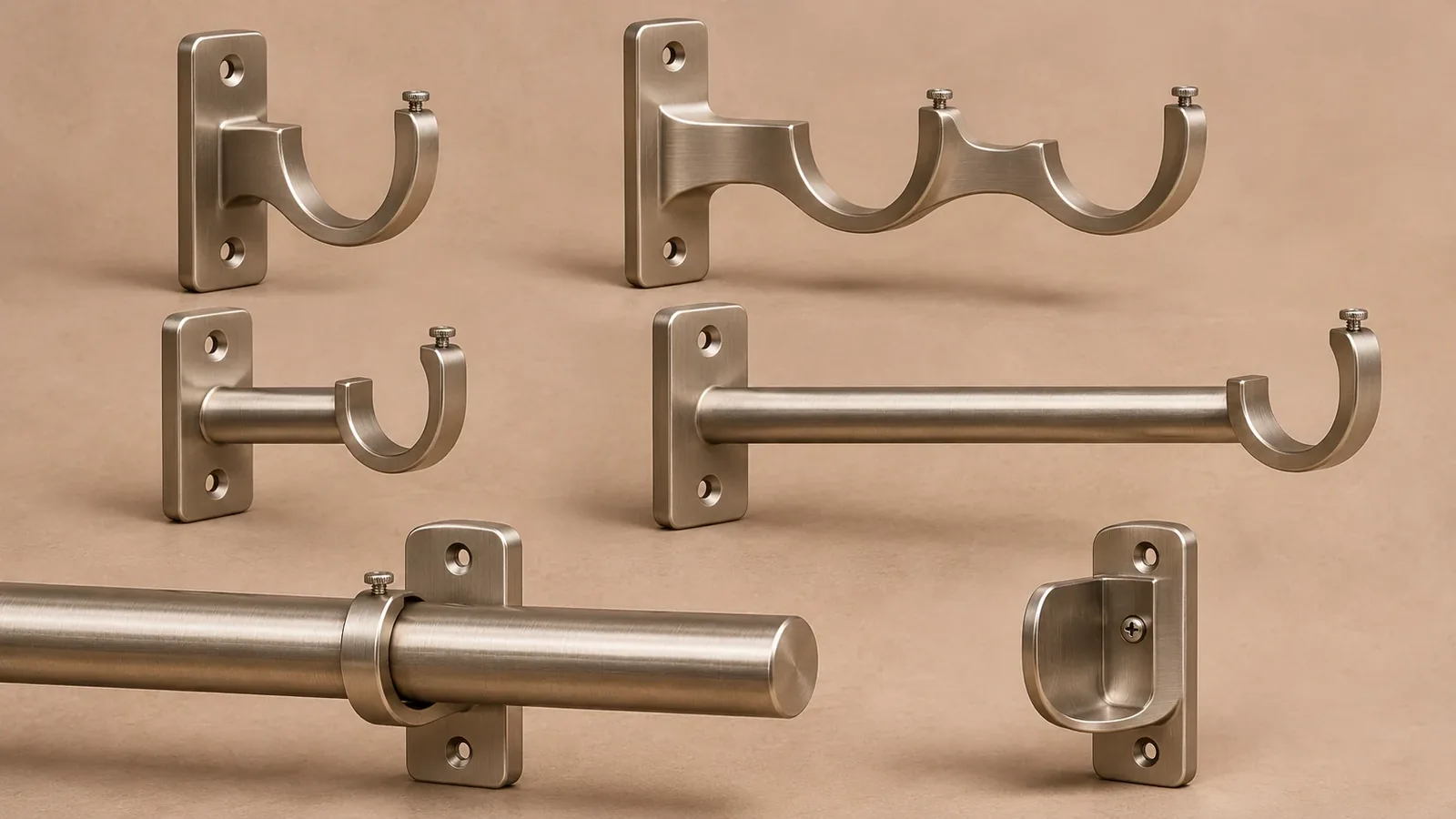
The main types of curtain rod brackets describe different attributes rather than one mutually exclusive list. A single bracket supports one rod line; a double bracket supports two rod lines. A center support describes where a bracket sits and the role it performs, while an adjustable bracket describes a change in projection from its mounting surface. An elbow connector may join rods at an angle without serving as a wall support. Buyers should identify rod count, support position, projection, mounting interface and rod fit separately before choosing or sourcing a bracket.
That distinction helps prevent a catalog label from being mistaken for a complete specification. “Center support” does not automatically mean a double bracket, and “adjustable” does not say which rod diameter or wall interface is compatible. For an importer or product manager, the practical task is to state what the bracket must support and how it interfaces with the selected rod and mounting surface, then verify the exact product documentation and sample.
What are the main types of curtain rod brackets?
Curtain rod bracket names often mix the number of rod channels, the location of the support and the bracket’s physical arrangement. A single bracket has one rod cradle; a double bracket has two. A center-support bracket is placed along a longer rod span to provide an intermediate support point. An elbow connector guides rods around an angle. An adjustable bracket changes the distance between the mounting surface and rod within the maker’s design.
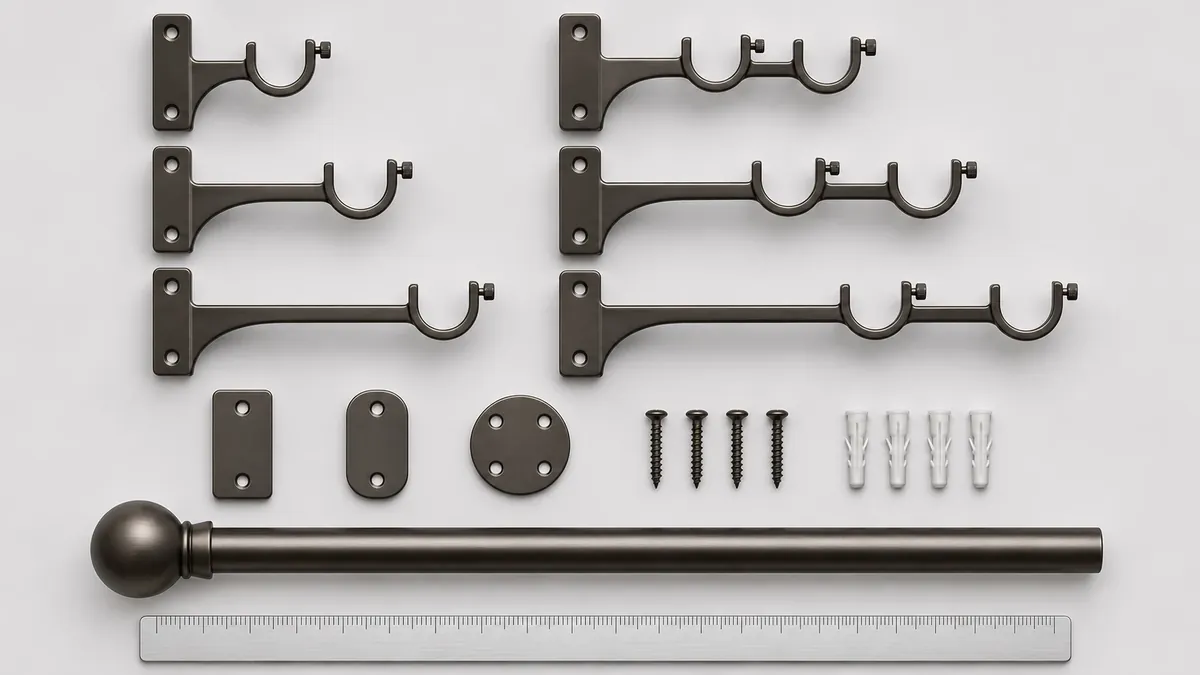
Kwik-Hang’s bracket guide provides a useful maker-specific taxonomy: single, double, center-support, elbow and adjustable. It also emphasizes that double brackets hold two rods for layered curtains, while an elbow component supports an angled layout. Those categories help illustrate roles, but the product’s dimensions, installation conditions and load recommendations belong to that particular maker’s system. They should not be transferred to a different brand or bracket construction.
| Attribute | Typical meaning | What a buyer should still confirm |
|---|---|---|
| Single | One rod line or cradle | Exact rod diameter and mounting interface |
| Double | Two rod lines or cradles | Inner and outer rod fit, clearances and projection |
| Center support | Intermediate position along a span | Compatible single- or double-rod arrangement and maker guidance |
| Elbow connector | Joins or routes rod sections around an angle | Whether it is a connector only or includes a separate support function |
| Adjustable projection | Changes the rod’s distance from the mounting surface | Adjustment range, locking method and mounting requirements |
This is a classification aid, not a universal product standard. A particular catalog may combine roles or use a different name. The drawing, part description and installation instructions should control the actual product choice.
Does single or double refer to curtain panels or rod lines?
Single and double usually describe the number of rod positions supported, not the number of fabric panels. Two curtain panels can hang on one rod; that remains a one-rod arrangement. A double bracket supports two rods, often so a buyer can arrange two separate curtain layers. The exact arrangement depends on the selected rod and bracket system.
This point matters in product selection and in a sourcing file. A buyer might request “double brackets” because a window will carry a sheer layer and a heavier outer curtain. Another buyer may have two panels that meet at the center but use one rod. Those are different hardware needs. If a product brief says only “two curtains,” clarify whether it means two panels on one line or two parallel rod lines.
For an importer building a retail assortment, the product name should match the customer’s likely question. Product photographs and package diagrams can show one or two rod channels, while specifications state rod diameter and projection as applicable. A supplier should not infer these features from a generic label. If the package illustrates two rods, the included brackets and fittings should align with that illustration and the approved product configuration.
What does a center-support bracket do?
A center support is an intermediate bracket location along a curtain rod span. It can help support a longer rod according to the specific system’s design, and it may be made for a single or double arrangement. It does not define the number of rod lines by itself. A buyer must choose the version that matches the rod layout and follow the exact maker’s installation and spacing recommendations.
Kwik-Hang’s guide, for example, separates a center support for single rods from one for double rods and gives window-width thresholds for its own products. Those numeric recommendations apply to that maker’s system. They are not universal thresholds for all curtain materials, spans, rods, mounting surfaces or bracket designs. This article does not provide universal support spacing or a load rule.
When comparing suppliers, identify the rod material and length, bracket type, support position, mounting substrate and any maker-specified span guidance. Ask whether a center bracket is a separate item, included in a set or available as an accessory. Make sure the product description shows what is included. A center support should not be assumed to fit every double-rod or single-rod arrangement just because the mounting plate looks similar.
When is an adjustable projection bracket useful?
An adjustable projection bracket changes the distance between a rod and its mounting surface. The adjustment may help a buyer clear nearby window hardware or accommodate a particular layout, but the result depends on the bracket’s actual design and adjustment range. A catalog photograph cannot establish how far the bracket adjusts or how that setting is secured.
Kwik-Hang’s maker guide describes adjustable brackets as changing rod projection to clear blinds or deeper window hardware. It also tells buyers to review the adjustment range, mounting requirements and weight rating for its product. That illustrates the questions a buyer should ask, not the answer for another model. Do not copy a dimension, load figure or trim condition from that vendor’s product into another supplier’s drawing.
For a product comparison, record the mounting surface, rod centerline, nearby obstruction and desired clearance as separate dimensions. The supplier can then identify the relevant bracket model and provide its current drawing or instructions. If the bracket’s adjustment changes the product envelope, record the selected position for the approved sample and installation plan.
An adjustable feature also creates a buyer-side question about what is being adjusted. Is the arm telescoping? Does the mounting plate have more than one position? Does a separate spacer set the projection? The label alone does not answer that. The product drawing should show the adjustable interface and the range supported by the manufacturer. Avoid advertising a bracket as universally adjustable if the movement and compatibility are bounded by a specific design.

Is an elbow bracket the same as a support bracket?
Not necessarily. An elbow connector may join rod sections or route a curtain rod around a corner. A wall support bracket carries a rod at a mounting point. Some product catalogs may use similar words for components that combine functions, but the buyer should confirm the actual geometry and load path from the maker’s drawing.
The distinction matters because a connector at a corner may not be designed to attach to a wall or carry a support load. Conversely, a support bracket may hold a rod but not create an angled connection. If the product uses a bay window, a wraparound layout or an inside corner, the buyer should state the angle, rod arrangement, support points and mounting constraints. The selected manufacturer’s system determines which connector and support parts are compatible.
For sourcing teams, itemized BOMs reduce confusion. List corner brackets, center supports, elbow connectors, rods, end caps and fasteners as separate component families unless the chosen set combines them. The packaging and instruction sheet should identify included parts and their intended positions. This prevents an importer from treating a connector as a mounting support based only on a marketplace label.
How should buyers confirm rod and bracket fit?
Confirm the rod interface from the selected supplier’s specifications. Bracket size commonly refers to the rod size a bracket accepts in a particular catalog, not to a window width. However, buyers should rely on the maker’s definition rather than assuming that every supplier uses the same size convention. The rod’s outside dimension, cradle shape, retainer and projection all affect fit.
A buyer can request a drawing or sample that shows:
- Rod outside dimension and the bracket’s intended interface.
- Number of rod positions and their relative location.
- Mounting plate shape and fastener positions.
- Projection from the mounting surface to the rod centerline.
- Any adjustment mechanism and its stated range.
- Compatible corner, center-support or connector components.
- Finish and visual reference for the selected assortment.
The supplier should identify compatibility across its own system. A similar finish or shape does not prove that a rod from another supplier will fit the cradle. If the buyer intends to mix brands, request confirmation and test the actual combination. Do not infer cross-brand compatibility from images or a nominal “one-inch” description.
For private-label programs, compare a sample with the drawing and intended rod before finalizing packaging. Check whether the bracket rests correctly on the rod, whether the intended position is stable under the maker’s instructions, and whether the included components match the product page. These are sample review checks, not a load test or installation recommendation. Any load, fastener or substrate requirement must come from the selected maker and applicable installation documentation.
How should buyers compare curtain rod bracket products?
Compare products by their actual function and interface, not by the number of type names in a catalog. One supplier may describe a bracket by rod count; another may use a style name. Translate both catalogs into the same fields: rod lines, support position, connector role, projection, mounting interface, finish and included parts.
| Comparison field | Supplier A | Supplier B | Evidence to request |
|---|---|---|---|
| Rod lines | One or two | One or two | Product drawing or sample |
| Support role | End, center or connector | End, center or connector | Layout diagram |
| Projection | Fixed or adjustable | Fixed or adjustable | Dimensioned model drawing |
| Rod interface | Maker-defined size and form | Maker-defined size and form | Exact rod and cradle data |
| Mounting system | Surface and fastener conditions | Surface and fastener conditions | Current maker instructions |
| Set contents | Brackets and accessories included | Brackets and accessories included | BOM and package check |
This matrix avoids false equivalence. Two items called “double brackets” may still have different rod spacing, mounting plates and finish options. Two items with different names may provide the same arrangement, but that should be confirmed by documentation rather than assumed.
What mistakes should an importer avoid?
The buyer should avoid treating a bracket type as a complete fit or installation specification. Type names are helpful for describing a general role, but the exact product’s interface and instructions determine compatibility.
Common mistakes include:
- Counting curtain panels instead of rod lines. Clarify whether the layout uses one rod or two.
- Assuming every center support belongs to a double rod. Confirm which rod arrangement the model supports.
- Treating an elbow connector as a wall support. Verify its role from the drawing.
- Using projection and rod diameter as interchangeable dimensions. Record each separately.
- Copying a vendor’s dimensions or support spacing. Keep recommendations attached to the exact model and instructions.
- Assuming a finish match means mechanical compatibility. Confirm rod and cradle fit.
- Comparing package sets without checking included parts. Review the BOM and sample against the listing.
These errors can be prevented by documenting the product family and its exact variant before ordering. If the buyer changes rod material, length or configuration, review whether the selected bracket system remains applicable. A revised sample or supplier confirmation may be required.
What should a curtain rod bracket RFQ include?
An RFQ should state the intended rod layout and require the supplier to propose the compatible bracket model. Buyers do not need to invent dimensions that the supplier’s system must confirm. Start by explaining the target arrangement, then request the drawings, included parts and current instructions that substantiate the proposed fit.
Include these project details where known:
- Number of rod lines and intended curtain layers.
- Straight, corner or angled layout.
- Rod dimensions and material, or a supplier-provided model reference.
- Fixed or adjustable projection requirement.
- Mounting surface and the responsible installation requirements.
- Finish, color and visual sample reference.
- Single or double center-support needs as confirmed by the selected system.
- Package quantity, component list, labels and instructions.
- Market or channel requirements that affect the product presentation.
Ask the supplier to mark open fields instead of filling them with assumed values. If an importer is comparing an alternative supplier, request a side-by-side mapping of the proposed bracket to the actual rod. A clear response prevents a product name from doing the work of a fit review.
How does Koitor fit into a related hardware sourcing project?
This article explains curtain rod bracket classifications; it does not state that Koitor manufactures curtain rod brackets. Koitor Hardware is a family-owned custom metal hardware factory specializing in bathroom and home-storage hardware. For a project within that product scope, buyers can share a drawing, sample, finish target and quantity for a manufacturing discussion. Do not extend that positioning to an adjacent product unless Koitor’s approved product information confirms it.
The bracket comparison can still help a product manager standardize attributes across a hardware assortment. A similar discipline applies when comparing custom bathroom or home-storage components: record function, mounting interface, dimensions and finish separately, then validate the exact sample. For Koitor product inquiries, use the relevant product scope on the custom bathroom hardware page or the OEM home-storage hardware page.
How should a buyer map bracket names to a product assortment?
An assortment plan should use a common set of attributes even when suppliers use different catalog names. This is especially useful when an importer compares products for multiple rod lengths, room layouts or package configurations. Instead of copying each vendor’s type label into a spreadsheet, map every proposed item to rod count, support role, projection, mounting interface, finish and included components.
For example, one supplier may call a part a “double bracket,” while another uses a style name that does not reveal its two rod positions. The buyer can compare the actual drawing and determine whether each has two cradles, the same projection, compatible rod interfaces and equivalent mounting plates. The labels may describe similar functions, but the physical specifications may still differ. Only the supplier’s documentation can resolve that.
The product record should also identify which item is the end bracket and which is the intermediate support. A photograph of a set can hide how many components are included. A parts list helps the product manager verify the set against the package artwork, instructions and online listing. If a customer expects one set for a window, the contents must be clear from the product documentation rather than guessed from the catalog image.
When a supplier changes a bracket design or finish, preserve the prior approved item reference and review what changed. A new finish can alter the visual assortment without changing the mounting geometry; a new arm or cradle can alter the product interface. The buyer should record the affected attribute and decide whether a new sample review is needed. This is ordinary product-change control, not a claim that every minor revision requires a full redesign.
What should a sample kit include for comparison?
A useful comparison kit includes the actual bracket variants and a rod sample compatible with the proposed system. If the buyer is comparing single, double, center-support and adjustable products, each part should be identified by supplier part number and drawing revision. Keep the mounting plates and included accessories with the item they belong to. Loose samples without identifiers are difficult to compare and can be mistaken for a different variant.
Review the bracket from the side and front so that projection, cradle count and rod interface can be seen. If an adjustment feature exists, ask the supplier to show the intended range using its current product instructions. Do not force an adjustment or use a rod that the manufacturer has not identified as compatible. The test setup should reflect the exact system under evaluation.
Record visible finish, package contents, fit with the referenced rod and any open dimensional question. If the buyer needs an installation or load claim, request the maker’s current technical information; a tabletop fit check does not establish wall performance. Keep product appearance review separate from mounting approval.
Buyer checklist before choosing a bracket type
- Define whether the setup uses one or two rod lines.
- Separate rod count from the number of curtain panels.
- Identify whether the part is an end support, center support or connector.
- State whether projection is fixed or adjustable.
- Confirm the selected rod’s actual dimensions and bracket interface.
- Review the mounting plate and instructions for the exact system.
- Verify center-support compatibility and placement through the maker’s guidance.
- Confirm finish, package quantity and included fasteners or accessories.
- Compare the sample, drawing, BOM and packaging description.
- Treat load or installation guidance as model-specific information from the manufacturer.
Foire aux questions
What are the types of curtain rod brackets?
Common catalog types include single, double, center-support, elbow and adjustable brackets. These labels describe different attributes and can overlap, so confirm the exact role and interface in the supplier’s drawing.
What is the difference between single and double brackets?
A single bracket supports one rod line, while a double bracket supports two. Two fabric panels hanging from one rod still use a single rod line.
What does a center support bracket do?
It provides an intermediate support point along a rod span in a specific manufacturer’s system. The compatible single- or double-rod version and placement should follow that maker’s instructions.
What is an elbow curtain rod bracket?
An elbow component may connect or route rod sections around an angle. Confirm whether the item is a connector, a support or a combined component before sourcing it.
What does adjustable projection mean?
It means the rod’s distance from the mounting surface can be changed within the product’s design. Ask for the exact range, interface and locking details for the selected model.
Does a bracket size refer to window width?
Not necessarily. A catalog may use bracket size to identify a rod interface. Check the supplier’s definition and record window, rod and projection dimensions separately.
Source note
The taxonomy examples are informed by Kwik-Hang’s curtain rod bracket guide. Its dimensions, installation conditions and support recommendations apply to the maker’s own products and are not presented here as universal rules.
Collaborez avec Koitor Hardware
Discuss a Custom Bathroom or Home-Storage Hardware Project
For products within Koitor’s bathroom and home-storage hardware scope, share your drawing, sample, finish target and order quantity for an OEM discussion. Product fit and installation requirements should be confirmed with the supplier of the exact bracket system.
Fabrication pour compte de tiers / Marque de distributeur
Transformez ce guide d'approvisionnement en cahier des charges
Indiquez-nous le produit souhaité, ses dimensions, sa finition, la quantité commandée et vos exigences en matière d'emballage. Votre équipe recevra une analyse pratique de la faisabilité de la fabrication avant l'établissement du devis.


 English
 Español
 Português
 Français
 Deutsch
 العربية