

For a shower door seal replacement, select a part for a specific enclosure, edge position, glass thickness, opening movement, gap and profile—not by glass thickness or a front-view photograph alone. For a distributor, the practical job is to identify whether the part is a bottom sweep, hinge-side seal, magnetic closure, vertical edge profile or another design; collect a cross-section, model reference or physical sample; and ask the responsible seal supplier to confirm the match. A seal that appears close can still interfere with closing, leave an uncontrolled gap or direct water the wrong way. Treat fit as an assembly decision and approve a representative sample in the intended configuration.
Why is a replacement shower door seal an assembly-fit question?
“Shower door seal” is a broad name rather than a complete specification. The seal may sit below a moving door, along its hinge edge, between a fixed panel and a door, at a wall, at a threshold, or in a sliding overlap. Each position addresses a different interface. A bottom sweep may use a flexible lip to direct water toward a tray, while a glass-to-glass closure may use paired magnetic profiles. A hinge-side profile must clear the movement path as the panel swings. These parts are not interchangeable simply because they are transparent or fit over glass.
The full enclosure determines what the seal can do. Relevant components include the glass panel, hinge or roller hardware, fixed panel, wall, tray or threshold, adjacent seals and the direction in which the door opens. A profile that works on one arrangement may collide with a hinge, drag across a surface, prevent a latch from engaging or leave a gap on another. The buyer should identify the enclosure and the specific edge before requesting a quote.
The product name is also not enough to identify a profile. Suppliers may use different names for a sweep, drip rail, fin, wipe, magnetic strip, jamb seal or screen seal. A retail listing may describe its own part as “universal,” but that claim applies only within the listing’s stated conditions. A distributor should translate names into observable evidence: where it sits, which surfaces it contacts, how it attaches, the cross-section and what movement it must allow.
A supplier’s current product literature demonstrates the range of inputs involved. GoldRays, for example, presents separate options for bottom, vertical, magnetic, sliding, bifold and curved applications and requests information such as glass thickness, door movement, mounting position, gap, water-flow direction, length and material preference. Those are that supplier’s selection inputs, not a universal standard or a statement about Koitor’s product range. Its current bottom-seal page also says final model suitability and availability are confirmed after review. The useful purchasing lesson is to send the whole fit context rather than selecting from one dimension.
For B2B sourcing, there are usually three different cases. First, a known replacement part has a model number and controlled drawing. Second, a discontinued or unmarked part needs a profile match from a sample or dimensioned cross-section. Third, a new enclosure needs an application review or custom profile. Keep these routes distinct in the catalog and RFQ so a buyer does not mistake a visual guess for an approved cross-reference.
In a shower door seal replacement program, the distributor should also define the service scope. Is the order for a continuous length to be cut by the enclosure maker, a pre-cut part for a named model, a pair of magnetic profiles, or a complete set of seals? The part count, orientation, labeling and package requirements change with that answer. If the source of the original part is unknown, state that openly and identify the evidence used to propose a replacement.
What should a buyer measure and photograph?
Start with the location and installed orientation. Photograph the full enclosure from inside and outside, then take close views of the seal in place, the glass edge and the adjacent wall, tray or panel. Record which side faces the wet area, which way the door swings or slides, and whether the seal is on the moving door or a stationary panel. A picture from the front can hide a return lip, slot, barb, magnet, fin or attachment channel, so include an end-on view of the profile.
Measure the glass thickness at an accessible edge using a method appropriate to the installation. Record the measured value and where it was taken. Do not infer the original glass specification from a seal’s nominal range, and do not force a tool between installed parts. The responsible installer or product owner should decide whether the measurement can be taken safely. If the pane is inaccessible or the value is uncertain, mark it as unknown and request supplier guidance rather than guessing.
Measure the gap the seal must address separately from the glass thickness. For a bottom profile, that may be the clearance below the moving panel to the tray or threshold. For a vertical profile, it may be the space between the glass edge and a wall or another panel. For a magnetic closure, the relevant geometry may include the closing angle, contact faces and alignment of the paired profiles. Avoid recording one generic “gap” without naming its location and the door position at which it was measured.
Preserve the old seal’s orientation before removal if removal is permitted by the enclosure instructions. Mark top, bottom, wet side, door side and any left/right orientation. An old part can deform, yellow, split or lose a lip, so its present shape is evidence but not necessarily its original production geometry. If the seal is damaged, capture its cross-section from the least-distorted area and tell the supplier what is damaged.
| Avis des acheteurs | How to record it | Pourquoi est-ce important ? |
|---|---|---|
| Enclosure identity | Brand, model, series, revision, purchase record or service reference | Connects the replacement to the original system |
| Seal position | Bottom, hinge edge, wall edge, glass-to-glass, sliding overlap or other | Defines the interface being replaced |
| Door movement | Swing, sliding, bifold, fixed panel or curved movement | Helps screen for interference and contact |
| Glass thickness | Measured value, location, method and confidence | One fit dimension; not the entire selection |
| Gap | Exact location, door position and adjacent surface | Helps evaluate reach and clearance |
| Profile | End-on photo, dimensions, drawing or intact sample | Captures lips, channels, magnets and orientation |
| Length | Required finished length and whether continuous stock is being considered | Prevents confusing supply length with part fit |
| Environment | Market, enclosure location, cleaning context if specified | Flags requirements the supplier must review |
| Evidence status | Confirmed, measured, estimated, or unknown | Prevents assumptions from entering the approved record |
The supplier needs enough information to distinguish the cross-section from a similar-looking option. Include a ruler or scale reference in the profile photo, but do not treat a perspective image as a dimensional drawing. When dimensions control the fit, send a dimensioned sketch, CAD section or intact sample. State which features are critical: glass channel width, barb location, lip reach, magnetic face, mounting slot, overall depth or another interface. Let the profile supplier confirm the dimensions and tolerances it can support.
Length should be specified separately from cross-section. A catalog may supply stock lengths, cut lengths or model-specific pieces. A long length that can be cut down commercially is not automatically suitable for field alteration by an installer or end user. Confirm the supplier’s allowed cut method, end treatment, orientation and packaging only for the named part and application. This guide does not provide a generic trimming instruction.
If the enclosure is curved, record the curve and installed orientation. A straight profile can lift, wrinkle or leave a changing gap on a curved edge. Do not assume that a flexible material will follow every radius or remain properly seated. Provide the screen drawing, radius information if known, a representative sample and photographs that show the entire curve. Ask the manufacturer to evaluate the intended assembly.
How do profile, position and door movement affect compatibility?
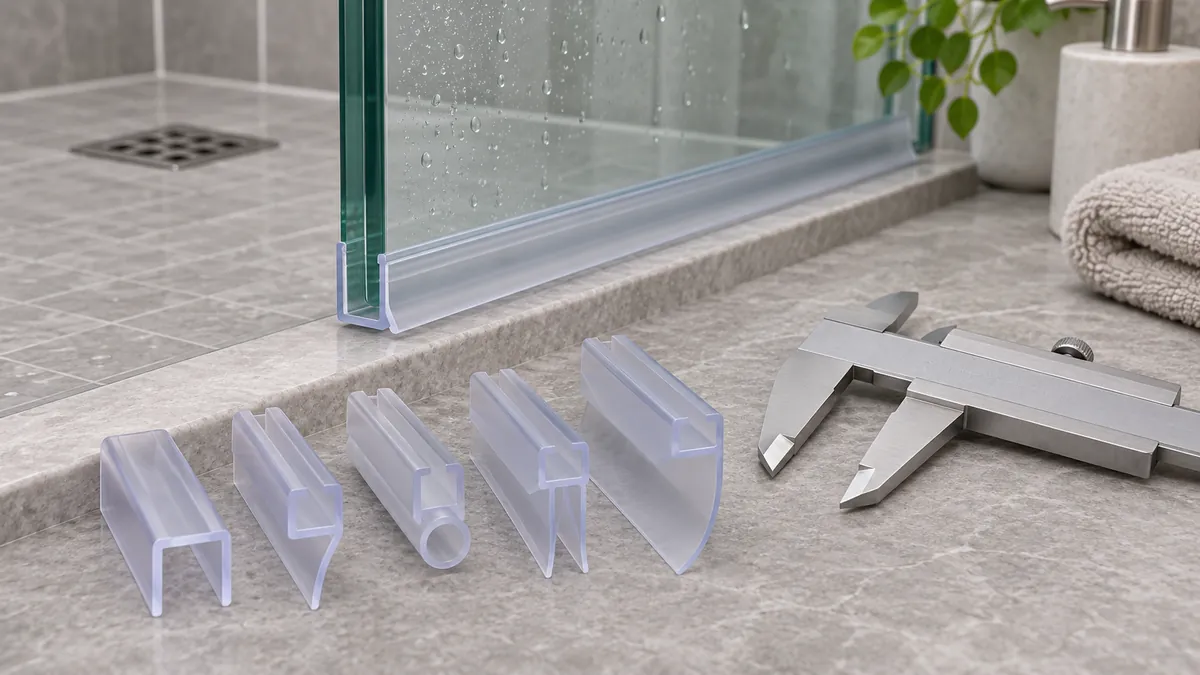
The profile cross-section describes how the part meets the glass and surrounding surfaces. A glass channel may grip the pane, a projecting fin may contact a wall or another panel, and a flexible lip may meet a tray or threshold. Small changes in these features can alter insertion, retention, clearance and contact. A profile drawing should label the dimensions that locate it on the glass and the features that perform the intended sealing or guiding function.
The location changes the design question. A bottom seal may need to reach a lower surface without obstructing door movement. Some profiles have a deflector or lip whose orientation affects how water is directed. A hinge-side profile has a moving clearance problem. A fixed-panel edge may need to meet a wall or a door seal without binding. A glass-to-glass seal may rely on the position and angle of both panels. These are broad application descriptions; the responsible enclosure manufacturer must confirm the correct part for the actual system.
Door movement should be evaluated across its operating path, not only when closed. A swing door rotates through an arc; a profile can contact adjacent hardware or a wall before the intended stop. A sliding panel follows a track and may overlap another panel. A bifold arrangement changes the relationship between connected glass edges as it folds. A static photo cannot establish all those clearances. The fit approval should cover normal opening and closing, the intended final position and any adjacent latch or panel.
Glass thickness is important because the attachment interface has to engage the pane as designed. But a thickness match alone does not establish the right channel geometry, retention, lip direction, gap coverage or clearance. Suppliers may offer profiles for more than one nominal glass thickness, but the buyer should use the specific supplier’s current model drawing and fit directions. Do not transfer a size range from one supplier’s catalog to another manufacturer’s profile.
A magnetic pair has a different review path from a simple wipe. The buyer should identify both mating profiles, the panel arrangement, the closing angle and the correct facing orientation. A magnet that closes on one configuration may not align with another. Check polarity or pair identity according to the manufacturer’s system, and request the matched components as a set when necessary. Do not infer compatibility from color or a photograph of one half.
A curved screen, unusual threshold, overlapping sliding panel or nonstandard gap may need supplier engineering review. This does not automatically mean custom tooling is required. First ask whether an existing profile and approved orientation fit the documented geometry. If the supplier proposes a custom profile, request the drawing, material and tooling assumptions, sample plan, ownership terms, MOQ, lead time and change-control expectations in writing. Do not assume that a custom option is commercially or technically suitable until the buyer approves the details.
A useful fit decision records both what is known and what remains unverified. For example, the glass thickness may be measured while the original model is unidentified; the gap may be approximate because the panel is misaligned; or the supplied profile may fit the glass but have unconfirmed clearance. Mark each item as confirmed, supplier-proposed, sample-checked or unresolved. This keeps the purchase order from converting a preliminary match into an unsupported promise.
How should the buyer work with a seal supplier?
Send the same structured brief to each supplier being compared. Include the application, seal position, enclosure model if known, glass arrangement, movement, thickness, gap, cross-section, orientation, finished length, sample or drawing and destination market. State quantity by model and whether the order is for stock, a service-parts program, a project or a new product. If a requirement is uncertain, label it rather than silently filling the blank.
Ask the supplier to identify the proposed profile by its own model or drawing revision. Request a cross-section and call out the exact dimensions used for the match. Ask whether the profile is an existing standard item, a modified profile or a custom development. A supplier catalog may contain many similar profiles, but a catalog match is only a proposal until the fit conditions are reviewed. Preserve the supplier’s written confirmation with the buyer’s part record.
Request a sample that represents the proposed part and its orientation. Where feasible, assess it in the actual enclosure or in a representative assembly using the supplier’s approved process. Check that the seal engages as intended, remains in its intended position, does not obstruct door movement and meets the adjacent surfaces in the way the design requires. The responsible product maker or installer should define any functional or water-control acceptance test; a buyer should not invent a pass/fail test from a visual impression.
Record what the sample proves and what it does not prove. A piece that fits onto the glass demonstrates that particular interface on that sample; it does not prove suitability for every glass thickness, model, installation, gap or door condition. A dry fit is not automatically proof of water management. A fit on a stationary sample assembly does not prove clearance during full door travel. Keep the approval scoped to the actual model, profile revision and conditions reviewed.
During shower door seal replacement, ask the source manufacturer whether the original part is still available and whether it has superseded the model. A superseding part may have different geometry or installation directions. If the maker is unavailable, a specialist supplier may offer a candidate match from a sample, but the distributor should describe it as a reviewed replacement for the documented application rather than as an original part. Distinguish “OEM original,” “approved supersession,” “supplier-matched replacement” and “unverified visual alternative” in internal records and customer-facing listings.
Compare commercial terms on equal scope. Suppliers may quote per length, meter, set or piece; confirm the unit and usable quantity. Separate sample charges, profile tooling, minimum order, color, material, cutting, labeling, inner packaging and freight. One current B2B supplier page, for example, publishes a guideline MOQ and sample offer for its own range, while noting that project terms depend on details. Those numbers are supplier-specific and can change; they should not be copied as an industry benchmark. Ask each supplier for current written terms for the exact profile and destination.
What belongs in the product listing and service-parts record?
A distributor’s listing should state the fit scope in a way a buyer can verify. Identify the part number, profile revision, supplier, seal position, compatible model numbers and exclusions. State the supported glass thickness only when the supplier confirms it for that profile. Where fit depends on a gap, panel configuration or orientation, include the relevant condition and a link to the approved drawing or instructions. Avoid “fits all,” “universal” or “watertight” unless the manufacturer has substantiated the exact claim and its scope.
Separate physical dimensions from compatibility statements. A listing might show profile dimensions and required length, but those figures do not independently establish which enclosure accepts the part. A compatibility table should state its evidence source, such as manufacturer cross-reference, validated sample or controlled drawing revision. A user-submitted image or a single fit report can suggest a lead for investigation; it is not proof of every model in the same brand family.
Use traceable service-part identification. A SKU record can connect the supplier model, buyer code, drawing version, product family, profile orientation, package quantity, barcode, replacement status, date checked and approval owner. If there are multiple colors, lengths, magnetic pairs or left/right variants, code them so warehouse staff can distinguish them without relying on appearance alone. Keep superseded versions searchable, but mark them so an old fit record is not mistaken for a current one.
Packaging should protect the profile and preserve its orientation. The buyer should agree how continuous or cut parts are coiled, supported, separated, labeled and kept clean, based on the supplier’s material and product guidance. Long flexible parts may be bent or compressed in transit; the acceptable packaging and recovery condition must come from the responsible supplier. Do not invent a minimum bend radius or storage duration. Ask for photos or a sample package if deformation could affect the product.
Customer-service instructions should tell the buyer what evidence to gather when a part does not fit: enclosure model and revision, seal SKU, glass thickness, gap location, profile end view, installed position and photos of the door at open and closed positions. Ask the service team to distinguish wrong length, wrong cross-section, wrong orientation, installation issue, damaged profile and enclosure mismatch. A return reason coded only as “doesn’t fit” cannot reliably improve the compatibility matrix.
When a supplier changes a profile, material, color, extrusion source or packaging, decide whether the original fit approval remains valid. Request a change notice and compare the revision drawing. Depending on which interface changed, the buyer may need another sample or a narrower compatibility statement. Keep claims tied to the version actually reviewed. Do not let a new product revision inherit an old fit badge automatically.
What should the RFQ and sample approval checklist include?
Before requesting a quote, the buyer should gather the information available and label gaps clearly. A complete package need not pretend every measurement is already known. It should make it easy for the supplier to say what it can match, what must be measured, what sample is needed and what assumption would affect the quote.
| RFQ field | Buyer should provide or request |
|---|---|
| Enclosure identity | Brand, model, series, revision and original part number if known |
| Seal location | Bottom, hinge, wall, glass-to-glass, sliding overlap or other |
| Movement | Swing, sliding, bifold, fixed or curved arrangement |
| Glass | Measured thickness, location and confidence |
| Gap | Measurement point, door position and adjacent surface |
| Reference | Intact sample, damaged sample, drawing, cross-section and photos |
| Orientation | Wet side, top/bottom, left/right, door/fixed panel |
| Proposed profile | Supplier part code, drawing revision and material description |
| Length and scope | Continuous stock, pre-cut part, pair or complete kit |
| Validation | Representative assembly, fit points, movement and responsible approver |
| Commercial scope | MOQ, sample, tooling, unit basis, lead time, packaging and freight |
| Service control | Compatible model list, exclusions, warranty owner and change notice |
At sample approval, identify the exact enclosure or representative assembly used. Record the glass thickness, gap, orientation, profile code and revision, sample lot or date, and person approving it. State whether the sample was checked for dimensional fit, retention, movement clearance, pair alignment, water direction or another defined requirement. Do not write “approved” without saying which condition was reviewed.
If the buyer cannot access the actual enclosure, the approval should be limited. A drawing review may confirm that dimensions appear compatible, but it does not demonstrate the installed fit. A cut profile sample may reveal cross-section and engagement, but may not represent length, curvature or full door movement. A supplier’s assurance can support the decision, but the buyer should retain the evidence and the limits of that assurance.
Set a change trigger before repeat orders. Changes to the profile, tooling, material, color, supplier, length, packaging or compatible enclosure model may require review. The buyer and supplier can define which changes need a new drawing, sample, fit check, or only a notice. The trigger should be proportionate to the risk and tied to specific design features rather than a blanket statement that every change is identical.
What errors should distributors avoid?
The first error is choosing by glass thickness alone. The seal can accept the glass but still have the wrong profile, gap reach, orientation or door clearance. Treat thickness as one field in a fit record, not as the entire selection rule.
The second error is sending only a front photograph. A front image may hide the profile cross-section, side lips, channel, magnet and attachment feature. Add end-on images, measured dimensions, a drawing or sample.
The third error is confusing seal positions. Bottom sweeps, hinge-side seals, wall seals, magnetic closures and sliding profiles solve different interface questions. Use a named position and describe the enclosure geometry.
The fourth error is treating a supplier’s word “universal” as a compatibility standard. Ask which glass, gap, panel configuration and models the claim covers, and retain the supplier’s current directions. If evidence does not cover the buyer’s exact product, narrow the listing claim.
The fifth error is assuming a similar profile is equivalent. Two transparent profiles can differ in channel size, lip, angle, material or orientation. Compare the current drawing and sample, not just color or silhouette.
The sixth error is assuming a visual match proves water performance. Water behavior depends on the assembled enclosure and its installation as well as the seal. Let the responsible product maker define the test and intended performance; do not promise complete containment based on a photograph.
The seventh error is making a generic field-cutting recommendation. Cutting, drilling, heating or forcing a seal may damage the part or conflict with the maker’s instructions. Refer the buyer to the exact product directions and a qualified installer where appropriate.
The eighth error is omitting orientation and wet-side information. A profile can be installed upside down, on the wrong panel or with the deflector facing the wrong direction. Mark orientation on the drawing, sample or package.
The ninth error is allowing a replacement part to inherit compatibility with a whole product family without evidence. Model revisions, hinge changes, glass changes and enclosure tolerances may matter. Maintain specific references and exclusions.
The tenth error is presenting one supplier’s commercial terms as a market norm. MOQ, tooling, lead time, samples and material options vary by supplier, profile, quantity and destination. Reconfirm them at quote time.
The final error is losing the source of approval. Keep the drawing, sample identity, fit record, supplier email and approved listing together. Without traceability, a later reorder may use a similar but different profile, and customer-service teams may be unable to explain a fit decision.

Buyer checklist for a replacement shower door seal
- Identify the enclosure model, revision and original seal code where available.
- Name the exact edge and position where the seal is installed.
- Record whether the panel swings, slides, folds, remains fixed or follows a curve.
- Measure glass thickness and state where and how it was measured.
- Measure the relevant gap and record the door position during measurement.
- Photograph the complete enclosure, installed seal and profile cross-section.
- Preserve an old part’s wet side, top/bottom and left/right orientation.
- Send a dimensioned drawing or intact sample when the cross-section controls fit.
- Ask the supplier to identify the proposed part and current drawing revision.
- Confirm length, material, orientation, application and any model exclusions.
- Approve a representative sample in a named assembly or state review limitations.
- Define what the sample actually demonstrates and what remains unverified.
- Compare MOQ, sample, tooling, cutting, packaging, lead time and freight on equal terms.
- Use specific compatibility claims supported by the supplier’s evidence.
- Record change triggers, service ownership, return reason and reorder references.
This checklist is a sourcing aid, not an installation manual or a guarantee of a watertight enclosure. If the model or interface remains uncertain, the next step is supplier or enclosure-maker review, not an unsupported fit promise.
Foire aux questions
Does matching the glass thickness guarantee that a shower door seal fits?
No. Glass thickness is only one factor. The profile cross-section, seal location, gap, orientation, door movement and adjoining surfaces also affect compatibility. Confirm the exact model or review a sample and drawing.
Can I use a photograph to order a replacement seal?
A photograph can help identify the enclosure and installed position, but it may not show the full cross-section or critical dimensions. Provide an end-on profile image with a scale, measurements, drawing or physical sample where possible.
Are shower door seals and shower screen seals different products?
The terms overlap across markets and suppliers. Either phrase can refer to seals at different positions. Specify the application and interface rather than relying on the product name alone.
Can a replacement seal be cut to length?
Follow the product maker’s instructions for the exact seal. Do not assume every profile can be cut or that field cutting preserves fit. Ask the supplier about supplied lengths, approved cutting and end treatment.
Does a bottom sweep make an enclosure completely watertight?
No single profile should be treated as a guarantee of complete containment. Fit depends on the enclosure, alignment, gap, tray or threshold, adjacent hardware and installation. The responsible manufacturer should define the performance requirement.
What is the difference between an existing profile and a custom profile?
An existing profile is a supplier’s current model that may be reviewed against the application. A custom profile is developed for a defined requirement and may involve tooling or other commercial conditions. The supplier must confirm whether either route is suitable.
What should a distributor do with an unmarked discontinued seal?
Capture its complete cross-section, glass thickness, installed location, orientation and enclosure photos. Ask a specialist profile supplier to review a sample or drawing. List any resulting match with its evidence and limitations.
Does Koitor manufacture shower door seals?
The approved Koitor information confirms metal bathroom and home-storage hardware capabilities, not shower-seal extrusion or a current seal product line. This guide describes buyer-side sourcing and does not claim Koitor supplies or tests these seals.
Technical references
- GoldRays: Shower screen seal supplier for OEM and wholesale projects — current supplier example of profile types and requested fit inputs; its commercial terms are supplier-specific.
- GoldRays: Shower door bottom seals and sweeps — model-specific examples, cross-section references and buyer information requests; confirm current drawings and availability with the supplier.
- Shower Hardware: Product catalog — assortment context for related shower hardware; does not establish Koitor capability.
- Koitor Hardware OEM information — verified metal-hardware and sample-based OEM context.
Discuss Your Bathroom Hardware Sourcing Requirements
Share the product drawing, sample, interface dimensions and target application for a capability review. A specialist seal supplier should confirm profile selection, fit and seal performance.
Fabrication pour compte de tiers / Marque de distributeur
Transformez ce guide d'approvisionnement en cahier des charges
Indiquez-nous le produit souhaité, ses dimensions, sa finition, la quantité commandée et vos exigences en matière d'emballage. Votre équipe recevra une analyse pratique de la faisabilité de la fabrication avant l'établissement du devis.


 English
 Español
 Português
 Français
 Deutsch
 العربية