
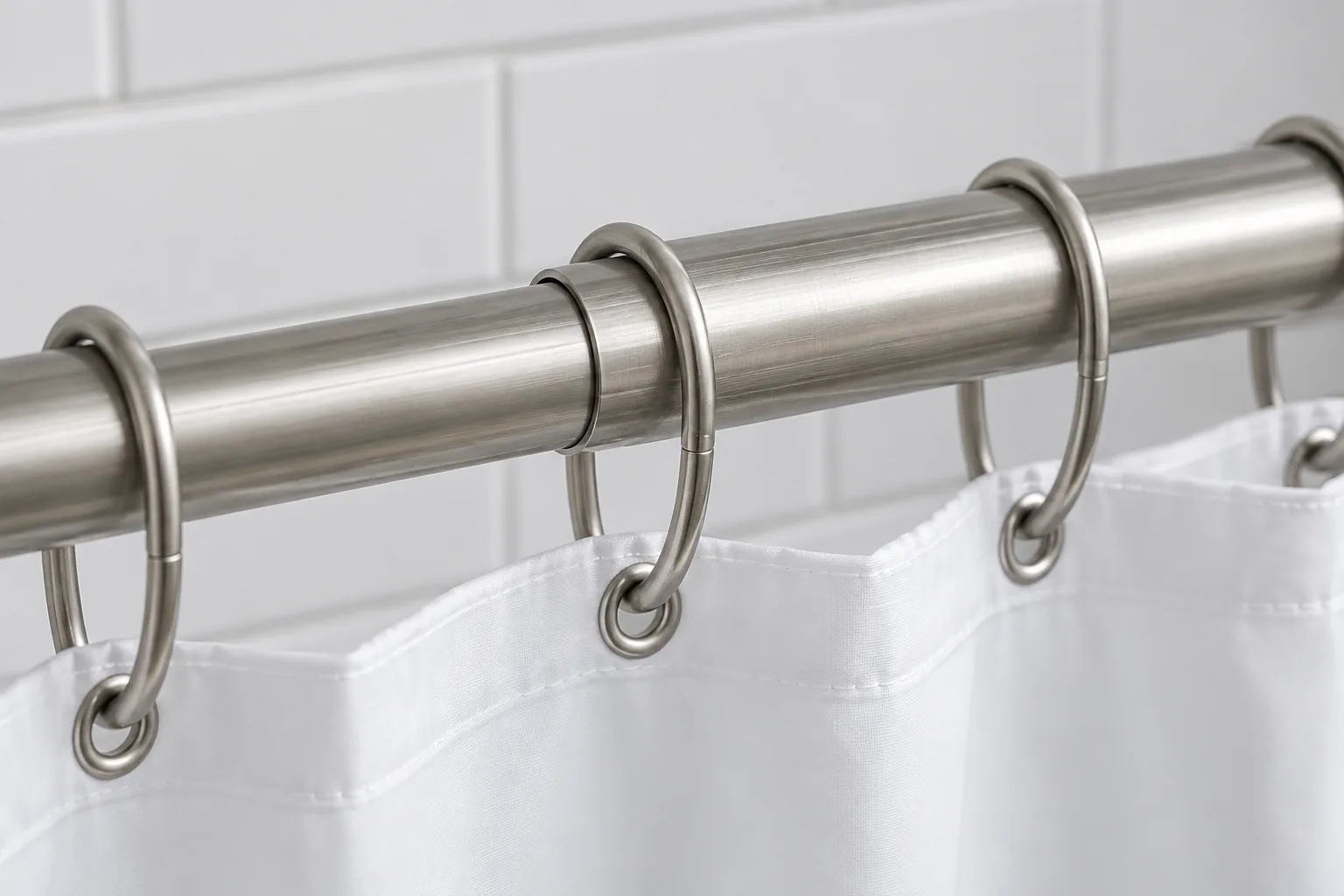
A set of shower curtain roller rings should be approved on the actual telescopic rod, especially where the inner tube meets the outer tube. A ring that clears the rod’s straight section may still hesitate at the overlap, shoulder, exposed edge or change in surface. For importers, the useful approval question is not simply “What is the ring diameter?” It is: “Does this ring-and-curtain combination travel over the worst joint on the specified rod, in both directions, under the buyer’s defined sample conditions?”
The joint is only one part of the interface. Rod outside diameter, ring opening, ring cross-section, roller or insert geometry, joint step, extension position, curtain attachment and end hardware all affect the assembled path. Those details vary among products. A product sheet for one commercial ring family, for example, lists different ring forms and inside dimensions for a stated rod size. That is evidence that the product options are model-specific; it is not a universal dimension or a compatibility guarantee.
This guide helps bathroom accessory importers document the complete interface before approving a sample or publishing a fit claim. It does not confirm that Koitor currently sells shower-curtain rings, rollers, bearings or telescopic rods. The images are conceptual examples, not catalog products.
Why can rings catch at a telescopic rod joint?
A ring can catch when its contact surface meets a change in the rod’s outside profile. In a telescopic construction, one tube overlaps another, and the transition may create a step, edge, gap or change in surface. Whether a particular ring pauses depends on the actual dimensions and construction of both components.
A ring’s nominal inside diameter is only a starting measurement. A plain ring, a hinged hook, a roller assembly and a ring with an insert do not contact the rod in the same way. A larger opening may provide clearance on a straight tube, but it does not prove that a roller, seam, connector or ring body will clear the joint. Conversely, a joint that looks prominent in a photo may pass a particular ring without difficulty. Visual inspection alone cannot establish travel behavior.
Other details can change the test result:
- The rod may be tested fully extended, partly extended or at another buyer-approved length.
- The joint may face a different direction after installation or rotation.
- A ring may be loaded by a curtain, liner, sewn grommet or multiple fabric layers.
- The ring may approach the joint from the larger tube toward the smaller tube, or in reverse.
- A rod finish, joint sleeve or end fitting may differ between samples or production revisions.
Treat a reported snag as a useful problem signal, not proof that every telescopic rod or ring has the same issue. A user discussion and a product review can reveal questions to test, but neither establishes a population failure rate or predicts the performance of a different kit.
Which dimensions should buyers put in the RFQ?
Specify the rod and ring as a matched interface, not as two unrelated line items. The supplier needs to know which rod model, ring type and curtain configuration the buyer intends to approve.
Start with the rod’s outside diameter on the straight inner and outer tube sections. Record the telescoping transition: the overlap length if available, any shoulder or sleeve dimensions, exposed edge, gap and orientation. Ask the rod supplier for a dimensioned drawing or provide a controlled sample. If the joint changes when the rod is extended, identify the intended installation range and select the most demanding position for the sample review.
For each ring option, record the inside opening and the portion that actually contacts or rolls on the rod. If the design includes a roller, bead, plastic insert, hinge, seam or opening gate, document that construction and its supplier or part revision. Do not infer a plastic or bearing component’s material or performance from appearance alone. If the ring supplier publishes an inside diameter, retain the model number and drawing revision with the quote.
| Interface item | What to record | Why it matters to approval |
|---|---|---|
| Rod straight section | Outside diameter of each tube and the selected rod model | Establishes the ring’s basic running clearance |
| Telescoping transition | Step, sleeve, gap, exposed edge and orientation | Identifies the feature the ring must cross |
| Ring construction | Opening, cross-section, hinge, insert or roller details | Defines the contact path, not just the nominal opening |
| Curtain arrangement | Grommet or hole size, layer count and intended sample | Adds the load and attachment used in the actual kit |
| Installation condition | Extension setting and end fittings | Keeps the approved setup reproducible |
| Acceptance record | Direction, passes, hang-ups, jumps and reset condition | Turns “moves smoothly” into an observable buyer decision |
Published dimensions are useful for screening, but compare dimensions from the same product revision and measurement definition. “Inside diameter” can describe a different feature from a roller’s effective contact opening. Ask the supplier to identify the measurement shown on a drawing rather than combining measurements from unrelated listings.
How should importers test rings over the joint?
Run a combined ring, rod and curtain sample through the complete travel path. Testing a loose ring on a straight tube cannot reproduce the telescoping transition, and testing an empty rod does not reproduce the curtain attachment or chosen ring arrangement.
Use this sample-approval sequence:
- Freeze the configuration. Record rod supplier and model, ring type and part number, curtain or liner sample, end fittings, extension setting and joint orientation.
- Inspect the interface before movement. Check for an exposed sharp edge, loose sleeve, burr or visible damage. Record observations without treating a visual check as proof of hidden material or finish performance.
- Attach the intended curtain. Use the grommet, hole or attachment arrangement that matches the planned assortment. Do not substitute an unusually light sample if a heavier liner is part of the intended offer.
- Move the curtain in both directions. Bring each ring across the transition in one direction, return it in the opposite direction and observe the same joint at the selected extension.
- Repeat the agreed travel. The buyer and supplier should set the number of passes and acceptance criteria before the review. Record any pause, catch, jump, separation, ring opening or need to lift the curtain manually.
- Repeat after reassembly or rotation if relevant. A rod that is commonly adjusted or rotated should be checked in the corresponding configuration.
- Identify what is being approved. Save photographs, sample labels, the drawing revision, test notes and any approved exception with the purchase specification.
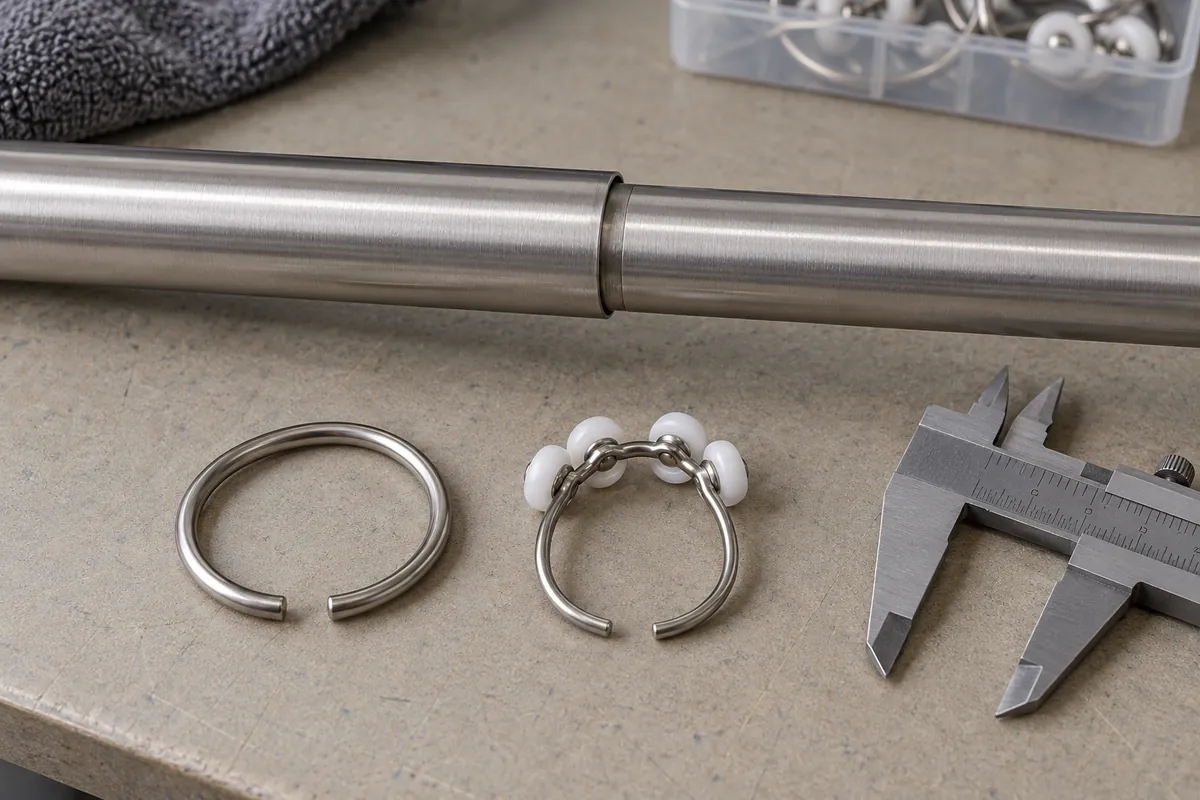
Conceptual sample-review scene: compare the actual ring opening and contact construction with the rod’s joint transition.
Do not create an acceptance rule after seeing a failure just to make the sample pass. If the ring pauses or jumps, decide whether the issue is acceptable for the intended curtain movement. The response might be a revised ring, a changed joint detail, another rod model or a written use limitation. Any change should be retested as a new configuration; a result for one ring and rod pair does not automatically cover a different size or supplier revision.
Should buyers choose sliding rings or roller rings?
Compare shower curtain roller rings by their contact design on the actual rod system and user requirement. A roller-style ring may be designed to roll on a straight section, while a plain ring slides along the rod. That design description does not establish that the roller will traverse a telescoping step better. The roller may meet the transition differently from a smooth ring body, and inserts, seams or geometry can alter the contact. Test the candidate options on the production-intent rod.
Compare more than the product name:
- Opening and clearance: Does the ring fit the largest straight rod diameter and pass the transition?
- Contact shape: Which surface reaches the step first: a rounded body, a seam, an insert or a roller?
- Curtain attachment: Can the selected ring close or attach around the intended grommet without interfering with movement?
- Service and assembly: Can the buyer or end user install the ring without damage, and can any hinged gate remain closed in use?
- Sourcing responsibility: Which supplier controls the ring, insert, roller and rod, and who handles revisions?
- Evidence: Is the conclusion based on the tested sample, or only on a catalog description?
Use a comparison test with the same rod, extension, curtain and travel path. Otherwise a difference attributed to the ring could come from changing another part of the setup. If both styles work, the buyer can then weigh appearance, user preference, assembly, cost and packaging as separate commercial decisions.
What should a supplier sample and drawing package include?
A useful approval package makes the sample reproducible. Save the actual rod and ring identifiers, a joint close-up, a measurement sketch and the test record. If the rod, ring, insert or roller is sourced from different suppliers, list the responsibility for each component. This becomes especially important when an approved sample is used as the visual or fit reference for a later purchase order.
Ask the supplier to show the rod’s tube diameters and transition details, plus the ring’s measurement definition and construction. Mark the intended curtain or liner and any relevant grommet size. Identify the extension position used during approval. If the rod is adjustable across a range, explain whether all positions were checked or only the buyer’s specified setup.

Illustrative travel check: test the selected curtain-and-ring configuration in both directions.
Keep change control explicit. A changed rod supplier, tube diameter, joint sleeve, ring opening, roller or insert can alter the interface even if the marketing name remains the same. Require a new sample review when a change affects the running path or contact geometry. For private-label kits, the packaging list and instructions should match the approved parts; a correct ring on a different rod does not validate the bundled combination.
Koitor Hardware is a family-owned factory and custom metal hardware manufacturer focused on bathroom and home storage hardware. A buyer developing a metal component can share drawings or physical samples for a manufacturing discussion, but this article does not claim a currently confirmed Koitor curtain-ring or telescopic-rod product. For a broader OEM conversation, see the custom bathroom hardware manufacturer page. Confirm any component, finish, minimum order, testing or capability against the actual project before making a product commitment.
What does a product data sheet prove?
A data sheet can identify a model’s listed dimensions, material description or intended configuration, depending on what its publisher provides. It cannot establish that a different rod-and-ring combination will clear a joint. For example, the Inpro product listing presents product-specific ring options and rod fit information, while its technical data sheet lists dimensions by model. Read those details as specifications for the listed products.
A separate ring supplier’s size listing illustrates that inside diameter varies by option. A roller-ring product sheet describes one product design. Neither publication replaces testing the buyer’s selected ring, telescoping rod, joint and curtain together.
Use source documents to screen candidates and prepare questions. Then use a labelled sample to verify the specific combination. Avoid broad claims such as “fits all telescopic rods,” “never snags,” or “rolls smoothly for life” unless there is a defined test basis that supports the exact claim and configuration.
What should importers checklist before approval?
Before signing off, make sure the specification and sample record answer the following:
- Which rod model, tube diameters, joint geometry and extension setting are approved?
- Which ring style, inside opening, contact element and component revision are included?
- Which curtain or liner, grommet and attachment arrangement were used?
- Did the ring cross the joint in both directions under the agreed travel conditions?
- Were pauses, catches, jumps, opened gates or manual lifts recorded?
- Does the package contain the same combination as the reviewed sample?
- Which changes require a new sample and reapproval?
- Are compatibility statements limited to the tested rod and ring models?
A “yes” to these questions creates a usable record. It does not mean every ring or rod in the market is compatible. The claim should name the approved combination and any operating conditions that matter.
Foire aux questions
Do shower curtain roller rings fit every telescopic rod?
No. Ring opening, contact construction and the rod’s transition geometry vary. Check the actual dimensions, then move the ring-and-curtain sample over the specified joint.
Is a larger ring opening always better?
No. Clearance on a straight tube is only one consideration. The ring still needs a suitable attachment and a contact shape that can pass the selected transition. Confirm fit on the complete assembly.
Are roller rings guaranteed to pass a telescoping joint more easily?
No. “Roller” describes a construction, not a universal result at a step or gap. Compare candidate ring types on the same rod, joint, extension and curtain arrangement.
How many passes should a buyer require?
Set the travel count and acceptance rule with the supplier before the sample test. There is no universal pass count in this guide; the buyer should choose a repeatable protocol appropriate to the product and intended use.
Can a supplier’s published inside diameter replace a sample test?
No. A dimension helps shortlist options, but published measurement definitions and actual contact features can differ. Preserve the drawing revision and verify the assembled interface.
What if the ring passes one way but catches on the return?
Record direction as part of the result. Recheck joint orientation and the ring’s contact geometry, then agree whether to revise a component or limit the approved configuration. Retest any change.
If you are developing a bathroom or home-storage hardware assortment, share the intended application, drawings or physical samples and the changes you need to evaluate. A project discussion should confirm which metal components Koitor can manufacture and which accessories would come from other suppliers.
Discuss a Bathroom Hardware Drawing or Sample
Share your drawing, sample and buyer requirements with Koitor Hardware to discuss product scope, manufacturing questions and next steps. Any accessory or capability should be confirmed for the actual project.
Fabrication pour compte de tiers / Marque de distributeur
Transformez ce guide d'approvisionnement en cahier des charges
Indiquez-nous le produit souhaité, ses dimensions, sa finition, la quantité commandée et vos exigences en matière d'emballage. Votre équipe recevra une analyse pratique de la faisabilité de la fabrication avant l'établissement du devis.

 English
 Español
 Português
 Français
 Deutsch
 العربية