

Here is how to calculate CBM: multiply a master carton’s outer length, width and height in meters to get its cubic meters, then multiply by the number of cartons. A carton measuring 60 cm × 40 cm × 30 cm is 0.6 × 0.4 × 0.3 = 0.072 CBM, and 50 of them total 3.6 CBM. The figure is only useful if the dimensions are measured, the count matches the packed quantity, and rounding happens once.
CBM, cubic meters, is the volume figure that freight forwarders, consolidators and container planners use for ocean freight. Importers use it to compare quotes, plan containers and check landed cost. Because so many decisions use it, a small error in the carton size or count spreads into every document.
This guide is written for importers, distributors and private-label teams who receive CBM figures from suppliers or calculate them for their own shipments of hardware. It covers the arithmetic, the unit conversions, the rounding rule and how to reconcile CBM with the packing list. It does not give freight rates or container capacity promises.
Koitor Hardware is a family-owned China OEM manufacturer of custom metal bathroom and home storage hardware, including towel racks, shower caddies and wire baskets. Master cartons for those products vary widely in size, which is why we treat CBM as a document that has to be reproducible, not a number someone typed once.
How to calculate CBM for one carton
Measure the outside of the sealed master carton, convert each dimension to meters and multiply. Length × width × height in meters equals CBM per carton. Use the outer dimensions because the carton’s outside, not the product inside, takes up space in the container or on the pallet.
Measure a packed, sealed carton rather than a flat blank or the carton drawing alone. Corrugated board has thickness, flaps add height, and a full carton can bulge. Measure each dimension at the widest point, edge to edge, with a rigid rule or a tape held straight. A carpenter square at the corner helps keep the measurement square.
Record the unit you measured in. Most factories in Asia measure in centimeters or millimeters. Many US buyers think in inches. Mixing units is the fastest way to create a wrong CBM, so write the unit beside every number.
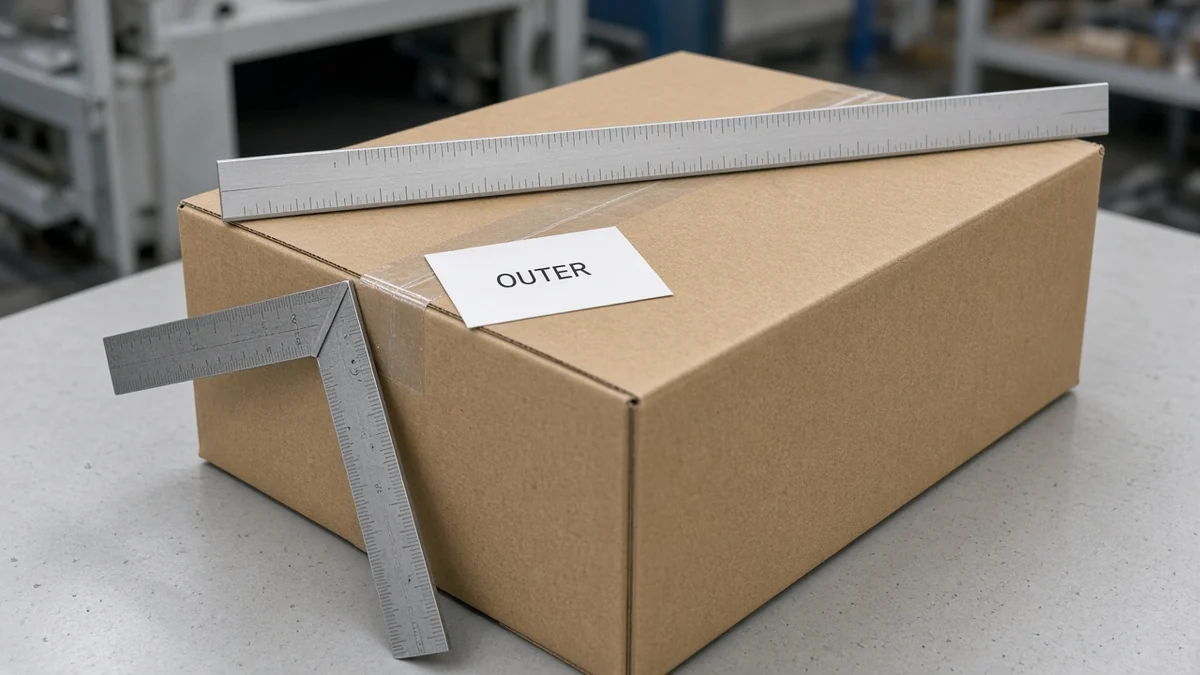
Worked example in centimeters (labelled as an example)
A carton measures 58.5 cm × 39.0 cm × 32.5 cm. Convert to meters: 0.585 × 0.390 × 0.325. Multiply: 0.585 × 0.390 = 0.22815; 0.22815 × 0.325 = 0.07415 CBM, to five decimals. An equivalent shortcut is to multiply in centimeters and divide by 1,000,000: 58.5 × 39.0 × 32.5 = 74,149 cm³, which is 0.0741 CBM.
Worked example in millimeters (labelled as an example)
A carton measures 585 mm × 390 mm × 325 mm. Multiply in millimeters: 74,148,750 mm³. Divide by 1,000,000,000 to get 0.0741 CBM. The answer matches the centimeter method because both describe the same carton.
Worked example in inches (labelled as an example)
A carton measures 23 in × 15.5 in × 12.75 in. Multiply: 4,545.4 cubic inches. One cubic meter is about 61,024 cubic inches, so the carton is 4,545.4 ÷ 61,024 = 0.0745 CBM. You can also convert each inch figure to meters by multiplying by 0.0254 before multiplying. Conversion factors are published by NIST.
Cubic feet
Some US carriers and warehouses use cubic feet. One cubic meter is about 35.315 cubic feet. To convert CBM to cubic feet, multiply by 35.315. To go from cubic inches to cubic feet, divide by 1,728. Keep the original measured unit in your records so anyone can redo the math. Background on SI units and US customary conversions is available from the NIST Office of Weights and Measures.
Measuring technique that holds up
Measure the length along the longest side, the width across the shorter side and the height from the bottom face to the top of the closed flaps. Hold the rule along the edge, not across a curved face. If tape or straps add height, include them. If a carton has handle holes or printed panels, they do not change the outer size.
Take each measurement on two or three cartons from different parts of the production run. Small variations are normal. A large difference usually means two carton suppliers, a change in board grade or a packing change that added inner trays or dividers. Each of those deserves a new line on the packing list.
For cartons that bulge because they are overfilled, record the bulged size and flag it to the packing team. A bulging carton also tends to lose stacking strength, which is a quality issue as well as a volume issue.
Who should measure
Ideally the factory packing team measures, and the buyer’s inspector checks a sample of cartons at pre-shipment inspection. When both measure the same cartons with the same method, CBM disputes are rare. When nobody measures and the size is copied from an old quotation, they are common.
How do you get shipment CBM from carton CBM?
Multiply each carton type’s CBM by its packed carton count, then add the results across all carton types. The packed count is the number of cartons actually filled and sealed, which may differ from the order quantity divided by the pack quantity if there is a partial carton or a short shipment.
For a single SKU in identical cartons, the math is one line: carton CBM × number of cartons. For several SKUs, list each SKU, its carton size, its carton CBM and its carton count, then total the CBM column. A table makes the calculation visible and easy to check.
| Line | What to record | Common error | How to check |
|---|---|---|---|
| Carton outer size | Length, width, height and unit, measured on a sealed carton | Using product size or carton blank size | Re-measure one sealed carton per carton type |
| Carton CBM | L × W × H in meters, kept to four or five decimals | Rounding to two decimals per carton | Recalculate from the recorded sizes |
| Cartons per SKU | Packed and sealed carton count | Copying the PO count | Count against the packing list and pallet labels |
| SKU CBM | Carton CBM × cartons | Multiplying rounded carton CBM | Use the unrounded carton CBM |
| Shipment CBM | Sum of SKU CBM, rounded once | Adding rounded subtotals | Recompute total from SKU lines |
| Palletized CBM, if used | Pallet footprint × loaded height, pallet included | Ignoring the pallet height or overhang | Measure the loaded pallet |
Mixed-SKU shipments
Mixed shipments need one line per carton type, not per SKU, when several SKUs share a carton size. They also need the count of each carton type. The guide on mixed-SKU container loading and carton tallies covers how to keep those counts straight during loading.
Partial cartons
A last carton that is only half full still occupies its full outer volume, unless it is packed in a smaller carton. Count it as a full carton of its actual size. Write a separate line if it is a different size.
Palletized cargo
If cartons are shipped on pallets, the volume that matters for many quotes is the loaded pallet: footprint length × width × total height including the pallet. That figure is larger than the sum of carton CBM because of the pallet and any gaps. Record both if your forwarder asks for both, and say which one each quote used.
CBM per unit for quote comparison
To compare quotes from different suppliers, or the freight cost of different pack options, divide carton CBM by the pieces per carton. A carton of 0.0741 CBM holding 12 towel bars gives about 0.0062 CBM per bar. If another supplier packs 10 bars in a 0.0700 CBM carton, that is 0.0070 CBM per bar. The first option ships more bars per cubic meter.
This per-unit figure is useful at RFQ stage, before any shipment exists. Ask suppliers to state carton outer size and pieces per carton in every quote. Then you can calculate CBM per unit yourself instead of relying on a summary figure.
Common supplier CBM mistakes
Several errors appear again and again on supplier documents. The carton size is taken from the carton drawing instead of a packed carton. The CBM is calculated from inner product size. A carton count is copied from the order instead of the packed list. Carton CBM is rounded to two decimals before multiplying. Units are mixed, such as centimeters for length and millimeters for height.
Each error is easy to catch with one recalculation. Ask for the carton sizes and counts behind every CBM total, recompute one line, and the problem usually appears within minutes.
How should CBM be rounded?
Keep carton CBM to four or five decimals, multiply by the count, add the lines and round the total once to the precision your forwarder or packing list uses, often two or three decimals. Rounding each carton to two decimals before multiplying can shift the total noticeably on large shipments.
Here is why. A carton of 0.07415 CBM rounded to 0.07 loses 0.00415 CBM. Across 500 cartons, that is about 2.1 CBM missing from the total, enough to change a container plan or a consolidated quote. Rounding up to 0.08 adds about 2.9 CBM. Neither is a measurement; both are arithmetic noise.
State the rounding rule
Write the rule on the packing list template or in the shipping instructions: “Carton CBM to four decimals; total CBM rounded to two decimals.” Then every person who calculates it gets the same answer. Without a stated rule, a factory clerk, a forwarder and a buyer may all produce slightly different totals and spend days reconciling them.
Measurement tolerance
Corrugated cartons vary slightly from carton to carton. Measuring every carton is not practical. Measure several sealed cartons of each type, use a representative size, and re-measure if packing changes. If cartons bulge noticeably, record the bulged size, because that is what takes up space.
How do you reconcile CBM with the packing list?
Check that the packing list’s carton sizes, carton counts and total CBM agree with each other and with what was actually packed. A CBM that cannot be reproduced from the packing list’s own numbers is a red flag for the whole document.
Start by recomputing one carton’s CBM from the listed sizes. If it does not match the listed carton CBM, ask which is right. Then multiply by the listed count and compare with the SKU total. Then add the SKU totals and compare with the grand total. Any mismatch is either a typo or a sign that sizes or counts changed after the list was drafted.

Weights live on the same document
The packing list also carries net and gross weights. Those are measured or calculated differently from CBM, and they are covered in the guide on packing list net weight and gross weight. Check them in the same pass, because a carton count error shows up in both volume and weight.
Carton size as a design decision
If the CBM looks high for the product value, the carton may be oversized or the pack quantity poorly chosen. That is a packaging design question rather than a calculation question. The guide on bathroom hardware carton size optimization covers it.
Revision control
When carton sizes, pack quantities or counts change, the packing list must be revised and its CBM recalculated. Keep the previous version with a revision note. Forwarders and customs brokers often receive several drafts; a clear revision trail prevents the wrong one being used.
Reconciliation checklist
- Each carton type has measured outer length, width and height with units.
- Carton CBM is recalculated from those sizes and matches the list.
- Carton counts match packed and sealed cartons, not the purchase order.
- SKU CBM uses unrounded carton CBM × count.
- The total is rounded once, using the stated rule.
- Partial cartons are counted with their actual size.
- Palletized volume, if quoted, includes the pallet and loaded height.
- The unit used for measurement is stated on the document.
- Weights on the same list are checked in the same pass.
- The revision number and date are on the list.
Inner boxes, display boxes and master cartons
Many hardware programs use a retail box inside a master carton. Only the master carton counts for shipment CBM, because the retail boxes sit inside it. If some products ship in their retail box with no master carton, each retail box becomes a shipping unit and needs its own line with its own outer size.
Display-ready cartons and shelf trays are another case. They may have cut-outs or tear strips, but their outer size before opening is what matters for freight. Measure them closed.
A practical note from the factory side
For Koitor programs, our recommended practice is to measure the carton size for the first packing list from packed sample cartons once the packing method is confirmed, rather than copying a quotation estimate, and to agree that rule with the buyer at order confirmation.
For wire baskets and shower caddies, small changes such as adding a corner protector or a pulp insert can change the outer size enough to matter on a large order. When packing changes, the carton should be re-measured and the list revised.
That habit is simple, but it removes most of the disagreements that otherwise appear when a forwarder measures cartons at the warehouse and finds a different volume from the one on the document.
Booking with a forwarder
When you request a booking or quote, send carton sizes, carton counts, gross weights and whether the cargo is palletized. A forwarder can then calculate CBM and chargeable units under their own rules. Sending only a total CBM makes it harder for them to check stacking, pallet build or container fit.
Where is CBM used, and what does it not prove?
CBM is used to request ocean freight quotes, plan container loading and estimate landed cost. It does not prove how many cartons will fit in a container, what the freight will cost or what the chargeable weight is for air. Each of those depends on other factors and other rules.
For less-than-container-load shipments, forwarders often quote on volume or weight, whichever gives the higher charge under their tariff. The exact rule and ratio vary by forwarder and route, so ask your forwarder how they apply it rather than assuming one ratio for all quotes.
For full containers, internal dimensions set an upper limit, but cartons rarely fill a container completely. Carton shape, stacking limits, pallets, weight limits and loading method all reduce the usable volume. A CBM total is a planning input, not a guarantee that the goods will fit. Ask the forwarder or loading team to plan with the actual carton sizes.
Air freight is different
Air freight uses chargeable weight, which compares actual weight with a volumetric weight calculated from dimensions and a divisor set by the carrier. CBM is part of that calculation but not the same thing. The guide on air freight chargeable weight explains it.
Landed cost
Freight cost per unit is one part of landed cost. Duties, fees, inland transport and damage allowances matter too. The landed cost guide for small-batch hardware imports and the true landed cost model for wire storage show how CBM fits into the wider picture.
Container weight declarations
For ocean containers, the shipper must declare a verified gross mass before loading, under SOLAS rules. That is a weight figure, not a volume figure. The guide to SOLAS verified gross mass methods covers it.
What a supplier CBM should look like
A supplier’s CBM line should show carton sizes, counts and the total, with units. If you receive only a total, ask for the breakdown. A buyer cannot check a single number, and a forwarder cannot plan with one either.
Frequently asked questions about CBM
How do I calculate CBM from inches?
Multiply length × width × height in inches, then divide by about 61,024 to get CBM. Or convert each dimension to meters by multiplying by 0.0254 first.
How do I calculate CBM in cm?
Multiply length × width × height in centimeters and divide by 1,000,000.
How do I calculate CBM for a sea shipment?
Calculate each carton type’s CBM from its outer size, multiply by its packed count, add the lines and round the total once. If the cargo is palletized, also measure the loaded pallets.
Should I use product size or carton size?
Carton outer size. The product inside does not set the space the carton occupies.
Is CBM the same as cubic feet?
They measure the same thing in different units. One CBM is about 35.315 cubic feet.
Why does my forwarder’s CBM differ from my supplier’s?
Usually because of different carton sizes, counts, pallet inclusion or rounding. Compare line by line, starting with the carton sizes.
How do I calculate CBM for a pallet?
Measure the loaded pallet’s footprint length and width, including any carton overhang, and the total height from the floor to the top of the load. Multiply in meters.
Can CBM be calculated before production?
Yes, from the carton drawing and the planned pack quantity, as an estimate. Replace it with measured sizes once packed cartons exist, and revise the packing list.
Does a bigger carton always cost more to ship?
Not always in a simple way. It uses more volume, but freight charges depend on the forwarder’s tariff, the route and whether weight or volume governs. Ask the forwarder to price both options with real carton sizes.
Should samples shipped by courier use CBM?
Couriers usually charge by actual or dimensional weight under their own rules, not CBM. Give them the carton sizes and weight and let them apply their method.
What precision should the packing list show?
Use the precision your forwarder and customs broker expect, often two or three decimals for the total. State the rule on the list so everyone rounds the same way.
Does Koitor provide CBM on its packing lists?
Koitor’s packing lists for a program carry carton sizes, counts and CBM agreed with the buyer. The format and rounding rule can be set at order confirmation.
Work With Koitor Hardware
Check a carton and packing-list setup
Send the carton drawing or measured outer sizes, the cartons per SKU and the packing list you plan to issue. We can review whether the CBM is reproducible and consistent with the documents. We do not quote freight rates or promise how much fits in a container.
OEM / PRIVATE LABEL
Turn this sourcing guide into a product brief
Share your target product, size, finish, order quantity and packaging requirements. Your team receives a practical manufacturability review before quotation.



 English
 Español
 Português
 Français
 Deutsch
 العربية