
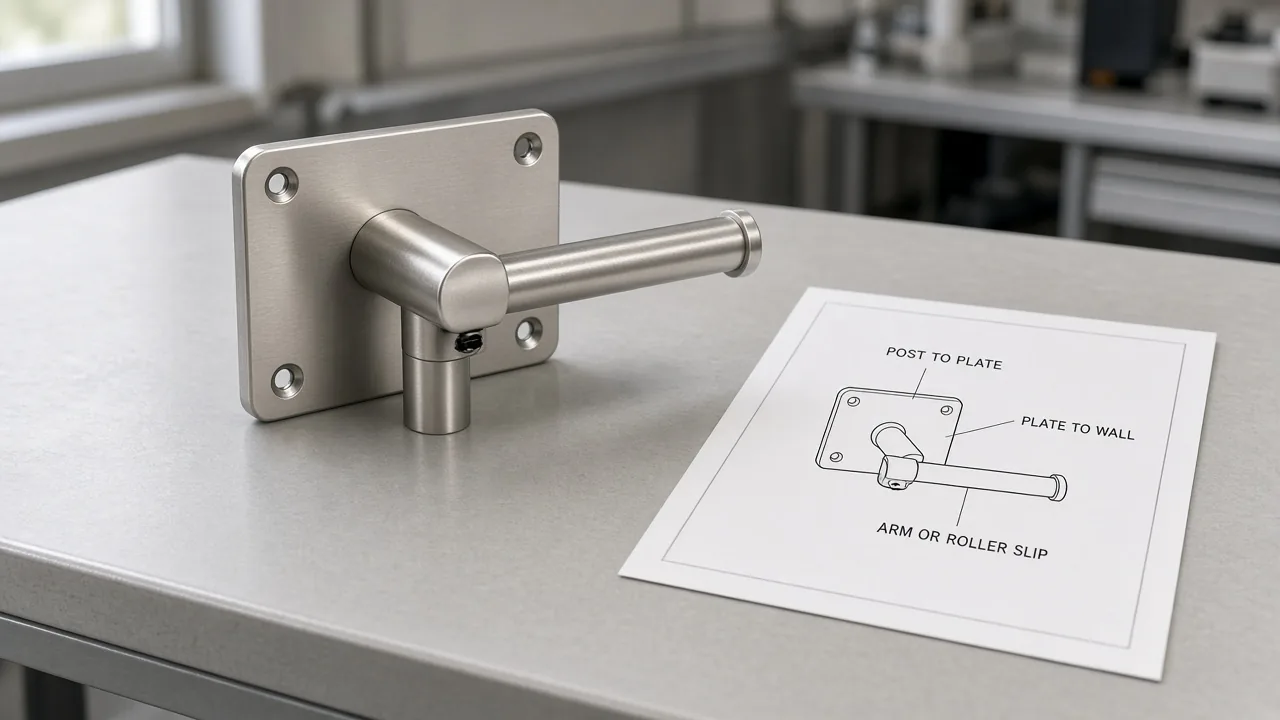
Before a service sheet, listing, or after-sales line tells a user how to fix a loose toilet paper holder, name the loosening mode. The mode is a set-screw or post-to-plate joint that has backed off, a plate-to-wall fixing that has moved, or an arm or roller that is slipping. Do not start with a tighten sentence, and do not start with a first-install sequence.
First-install kit steps belong on the live toilet-paper-holder installation file, which already reserved in-service loosening as its own thesis. Taking the fixture off the wall belongs on the live how-to-remove-a-toilet-paper-holder file. Drive size, roller-bar dimensions, and published height are still other files.
This guide is for importers, distributors, private-label teams, and after-sales programs approving service-sheet wording for a wall-mounted toilet paper holder. Koitor Hardware is a family-owned China OEM manufacturer of custom metal bathroom and home storage hardware, including toilet-paper-holder programs reviewed on artwork and service leaflets.
Send the holder drawing, the post-to-plate or plate-to-wall design, and any service sentence the after-sales program must carry. We can review the wording and the named mode. We will not issue a torque, a hex size, a drywall repair, or a damage-free or permanent-fix claim.
What does a loose-holder service file actually freeze?
It freezes the in-service loosening mode and the promises a service sheet may print after that mode is named. It does not freeze a first-install kit, a wall-fixture release method, a hex-key size, a spring-roller dimension, or a mounting height.
Searchers who ask how to fix a loose toilet paper holder often want the holder to stop spinning, wobbling, or pulling off the posts. That demand is real. For an importer, the usable decision is which loosening mode the service sheet must name, and which neighboring file must stay out of that sentence.
A holder that keeps loosening is not automatically a holder that should come off the wall. Removal is a different decision, already published as its own file. This file is the stay-on-the-wall, in-service decision. If the next useful step is actually to take the fixture off, send the reader to that removal file in prose; do not reprint the release method here.
A custom tissue holder manufacturer can review whether a service sentence matches the holder actually designed. Matching a finish or a post form to a bathroom collection is not the same as inventing a default tighten recipe, a default torque, or a default wall repair. If you are writing after-sales wording, bring the drawing and the named interface with the draft sentence.
A published “just tighten it” line is only as complete as the named mode. If the plate is moving in the wall, a set-screw sentence will be applied to the wrong interface. If the roller is slipping, a plate-to-wall sentence will be applied to a part that was never loose on the wall.
This file can precede an after-sales leaflet or a replacement-parts note. It should not be turned into a first-install manual, a removal tutorial, or a drywall-repair guide.
Which loosening mode must be named before any tighten sentence?
Name the architecture first, then the loosening interface. A single-post plate, a two-post holder, and a pivoting arm are different architectures. They do not share one looseness story, even when the finish matches.
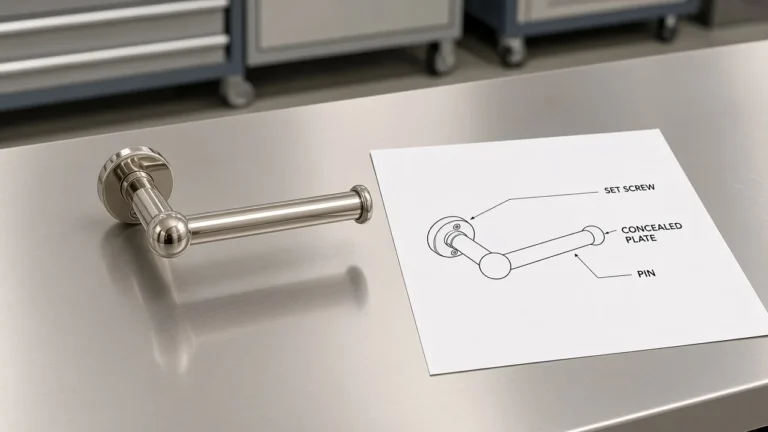
Post-to-plate loosening is a joint between the post or body and a still-fixed wall plate. A set screw, a concealed cap, or a seat that the post is supposed to engage may be part of that joint. If the sheet does not name that interface, a generic tighten line will be read as if the wall anchors were the problem, or as if a hidden fastener did not exist.
Plate-to-wall loosening is different. Here the plate itself is moving, spinning, or pulling away from the wall. That symptom points at the wall interface or the substrate, not at a post set screw. The service sheet may name this mode. It should not invent a toggle-bolt repair, a tile patch, or a drywall method as a Koitor standard. Substrate work is a project note, not a factory repair.
Arm or roller slip is a third mode. The wall fixture may be firm while the arm leaves the post, or while a spring roller walks or drops. That is not a loose wall plate, and it is not automatically a set-screw job on the post. If the symptom is the roll bar, send dimensions and replacement-bar questions to the spring-roller file rather than rewriting them here.
Do not treat “wobbly” as a diagnosis. Wobble can come from any of the three modes. The sheet should ask which interface is moving before it prints a tighten verb. A toilet paper holder keeps loosening, in search language, for more than one reason. The service file has to say which reason it is talking about.
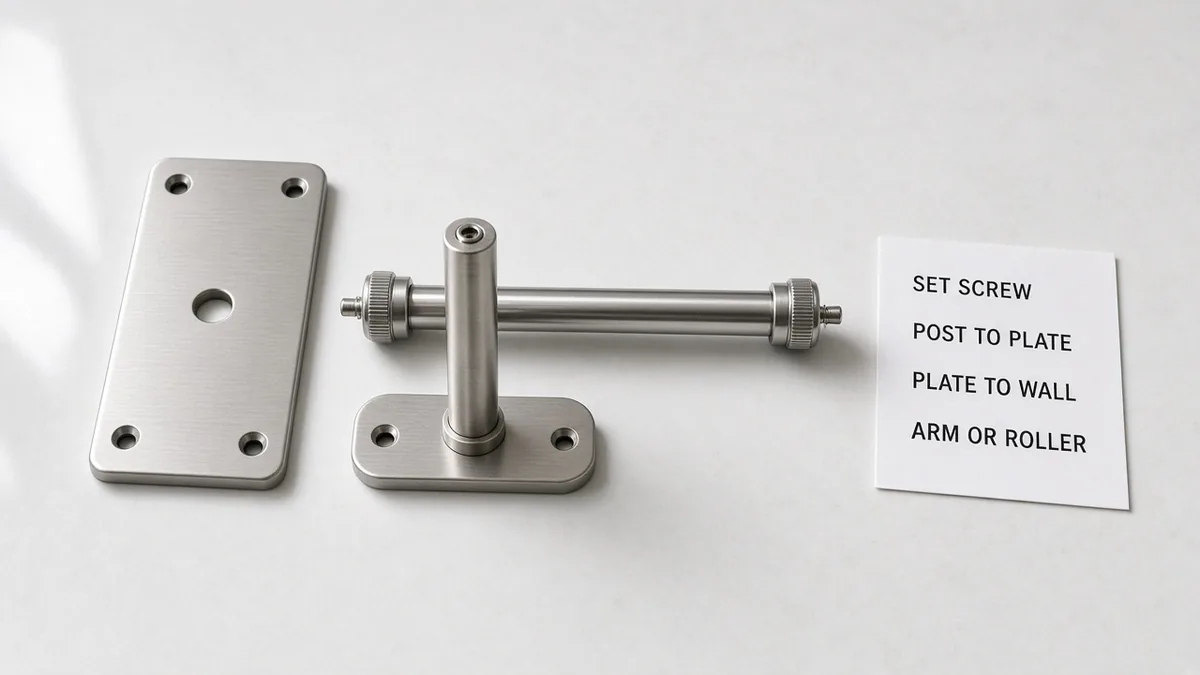
Concealed caps matter because they hide the access path to a set screw or a post seat. If the architecture uses a cap, the service sheet should say that the cap is part of the access path, or that this design has no cap. Do not leave buyers to pry a finish cap that was never meant to come off, and do not leave them searching for a hidden screw the leaflet never mentioned.
A one-armed or pivoting holder that slips off a spindle is still an arm-slip mode, even if a forum title calls it a loose holder. Name the spindle or pivot interface. Do not copy a two-post roller sentence onto a single arm, and do not copy a towel-bar set-screw sentence onto this fixture.
If a program uses more than one architecture, keep a separate service line for each one, or make the mode difference unmistakable on a shared leaflet. A mixed “tighten the screw” panel under a photograph of a plate-to-wall failure is how the wrong advice is printed on the wrong SKU.
What may the service sheet print, and what must it not invent?
The sheet may name the architecture, name the loosening mode, and point to the matching neighbor file when the symptom is not a stay-on-the-wall tighten job. It may say that a set-screw design has a service access path, and that a tool is packed or is not packed, without inventing the drive size.
The sheet must not invent a hex size, a tightening torque, or a “turn until snug” factory standard. Drive size belongs on the live set-screw hex-key file if the buyer needs that decision. This loosening-mode file may say that a tool is in the kit or is excluded. It should not print a millimetre across-flats figure as a Koitor standard.
The sheet must not invent a drywall, tile, or toggle-bolt repair. Plate-to-wall failure is a project and substrate note. The after-sales line can say that the wall interface needs a project review. It cannot publish a Koitor anchor, a damage-free promise, or a permanent-fix claim borrowed from a consumer article.
The sheet must not reprint first-install kit steps. How the holder was first hung, which anchors were packed, and how the plate was marked are install-file questions. A service leaflet that becomes an install manual will be used on a holder that is already on the wall, and it will skip the mode question this file exists to freeze.
The sheet must not reprint a release or removal sequence. If the useful next step is to take the fixture off the wall, the live how-to-remove-a-toilet-paper-holder file already freezes that release method. Mention that file in prose. Do not paste its steps, and do not treat a loosened post as automatic permission to write a removal tutorial here.
| Loosening mode | What must be named first | What the service sheet may print | What this row is not |
|---|---|---|---|
| Set-screw or post-to-plate | That the wall plate is still fixed, and that the moving joint is the post or body on the plate, including any cap or seat that belongs to the design | The named interface, whether a service access path exists, and whether a tool is packed or excluded, without an invented hex size or torque | A plate-to-wall repair, a first-install kit, or a copied towel-bar set-screw essay |
| Plate-to-wall | That the plate itself is moving on the wall, not only the post on the plate | A named mode and a project or substrate boundary, with no factory anchor recipe | A toggle-bolt tutorial, a damage-free guarantee, or a “permanent fix” claim |
| Arm or roller slip | That the wall fixture may be firm, and that the moving part is the arm, spindle, or roll bar | The named interface, and a pointer in prose to the roller-dimension file if the bar itself is the spare part | A wall-plate tighten sentence, or a reprint of roller-bar dimensions as this thesis |
| Symptom is actually removal | That the next useful step is to take the fixture off the wall, not to keep it in service | A send-off, in prose, to the live removal file | A reprint of the release method, or a “loose means remove it” shortcut |
| Consumer tighten or repair video | The video, if cited, as a third-party demand example only | Nothing unless the named mode independently matches the SKU | A Koitor torque, hex size, minute-count, or permanent-fix standard |
Over-tightening that chips a finish is a different protocol. The live installation file already treats finish damage as a risk to keep off a casual tighten-until-it-stops line. This service file should not invent a torque to prevent that damage, and it should not reopen the first-install kit as the answer.
When the service wording changes, revise the after-sales line in the same change. A later decision to stop packing a service tool, or to change a concealed cap, can leave an old “just tighten it” sentence stranded on a leaflet. Record that as a service-sheet revision, not as a silent packing tweak.
When is the symptom actually a removal or first-install question?
If the holder must come off the wall to be serviced, replaced, or inspected, the question has left this file. The live how-to-remove-a-toilet-paper-holder article freezes the wall-fixture release method. It may mention a loosened post only as a reason some searchers want the fixture removed. That mention is not a tighten thesis, and this file should not repay the favor by reprinting the release steps.
If the holder has never been a stable first hang, the question may be an install-kit problem rather than an in-service mode. The live toilet-paper-holder installation article freezes first-install architecture and kit, and it already says that in-service loosening should keep its own file. Send first-hang steps back to that file. Do not reprint them here as a “fix.”
A brand-new holder that loosens during the first days on the wall can still be an in-service mode question, but only after the architecture and the interface are named. “It was just installed” does not, by itself, tell you whether the post missed its seat, the plate missed the wall, or the roller was never captured. Name the mode first.
A ripped-out plate is not a tighten job. It is a plate-to-wall failure, and often a substrate failure. The service sheet may say so, then stop. Consumer pages that offer a ten-minute or “permanent” repair are demand evidence. They are not a Koitor method, and they are not a reason to write a drywall tutorial.
If the buyer actually wants a different fixture, such as a recessed holder or a holder with a shelf, that is a specification change, not a looseness mode. A recessed wall-cavity unit has its own file in the live library and should be named only in prose here. A holder with a shelf that feels loose may be a shelf-assembly issue; send that question to the shelf specification file rather than stretching this wall-fixture thesis.
A freestanding holder that rocks is also a different product. Stability for a floor-standing unit belongs on the live freestanding toilet paper holder stability design page, not on a wall-plate loosening sheet.
Which neighboring bathroom-hardware files should stay out of this sentence?
The live toilet-paper-holder installation file owns first-install architecture and kit. Mention it in prose when the symptom is actually a first hang. Do not reprint its packed list, template, or substrate-install notes as a service answer.
The live how-to-remove-a-toilet-paper-holder file owns wall-fixture release. Mention it in prose when the holder should come off. Do not invent an href if the official link record in this batch does not yet list that URL, and do not paste the release steps.
The live set-screw hex-key size file owns drive size for bathroom-accessory kits. This page may say that a tool is packed or excluded. It should not print a hex size as a factory standard, and it should not become a second hex-key essay.
The live spring-loaded toilet-paper-roller replacement-dimensions file owns the roll bar, not the wall post. Use it when the mode is arm or roller slip and the spare part is the bar. Do not reprint those dimensions here.
The live towel-bar mounting-bracket set-screw buyer guide is a neighboring discipline on a different fixture. The same family of set-screw questions can appear, and the sentences still must not be cloned. A towel-bar post is not a toilet-paper holder.
Bathroom-hardware replacement-parts planning owns spare-part codes, not loosening mode. Height belongs on a height file, including the live commercial toilet paper holder height importer guide when the question is a published height, not a loose fixture. This service file should not print a height chart, and that height file should not be asked to diagnose looseness.
A custom bathroom hardware manufacturer can keep these files in the same collection without merging their theses. Finish and family resemblance are not a reason to copy a towel-bar sentence, a hex-key table, or a first-install kit onto a loose-holder leaflet.
What should be checked before a sheet says how to fix a loose toilet paper holder?
Use the checklist below as a service-sheet and after-sales review, not as a renter repair script. Koitor’s practical manufacturing insight here is that a plant can name a set-screw interface and review whether a service tool is packed or excluded, but it should not be asked to invent a torque, a hex size, or a permanent-fix claim for a plate that is moving in the wall.
During drawing and leaflet review, the useful questions are simple. Does the sentence name the architecture? Does it name post-to-plate, plate-to-wall, or arm or roller slip before it uses a tighten verb?
If a cap hides the access path, is that cap named? If the useful next step is removal or first install, does the sentence send the reader to that file instead of inventing steps? That is wording hygiene. It is not a torque test, and it is not a wall-repair method.
If a later brand file or project specification supplies a required tool size or a required service note, the sheet can carry that note as a cited project requirement. Until then, leave the size and torque fields unstated rather than inventing a plant default.
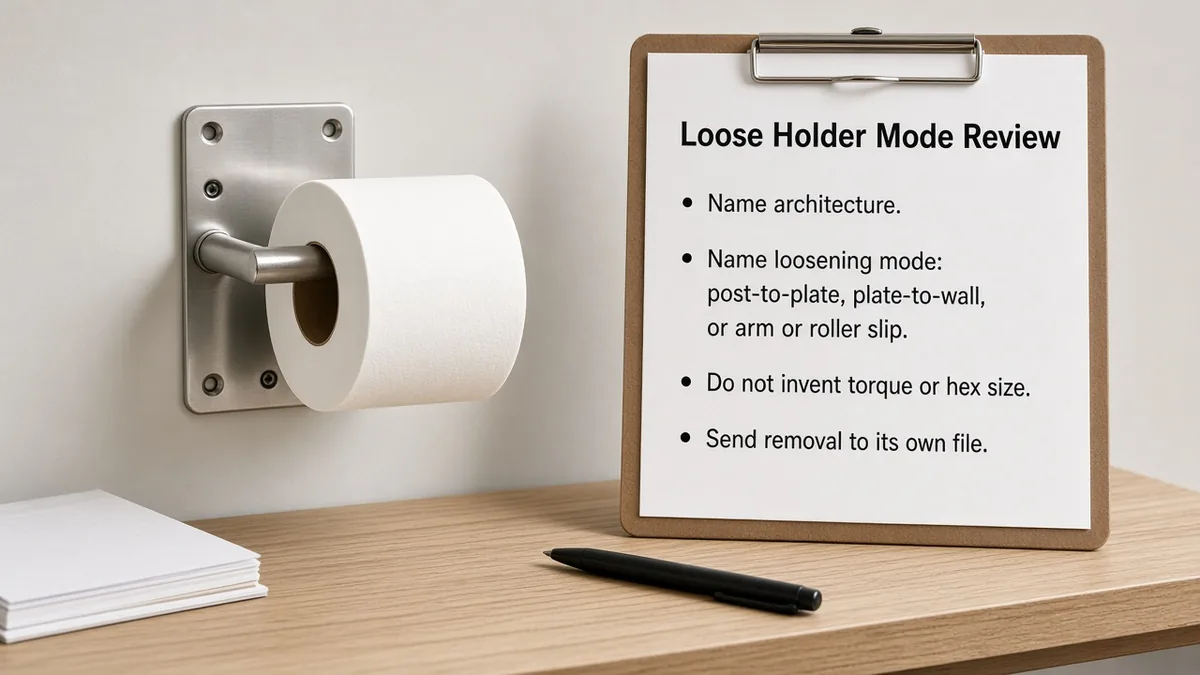
- Name the architecture in plain language: single-post plate, two-post, or pivoting arm, before any tighten sentence is printed.
- Name the loosening mode: set-screw or post-to-plate, plate-to-wall, or arm or roller slip; do not treat “wobbly” as a diagnosis.
- If the design uses a concealed cap or hidden access path, name that path, or state that this design has no cap.
- If a tool is part of post-to-plate service, pack the tool or exclude it in writing; do not invent a hex size or a torque as a Koitor standard.
- If the plate is moving on the wall, write a project or substrate boundary; do not print a toggle-bolt, tile, or drywall repair as a factory method.
- If the arm or roller is slipping, keep roller-bar dimensions on the roller file; do not turn this sheet into a replacement-bar chart.
- If the holder should come off the wall, send the reader in prose to the live removal file; do not reprint the release method.
- If the problem is a first hang, send the reader in prose to the live installation file; do not reprint the first-install kit.
- Do not print a height chart, a minute-count, a damage-free promise, or a permanent-fix claim.
- Do not clone a towel-bar set-screw page, and revise the after-sales line whenever the architecture, the cap, or the packed tool changes.
A bilingual service leaflet should keep the same named modes in both languages. If the plate-to-wall boundary is missing from one language, that market no longer has a boundary. Approve both translations against the same architecture before a tighten verb is added.
A leaflet review can stay concrete: put the drawing beside the service sheet, point at the post-to-plate joint, the plate-to-wall joint, and the arm or roller, and mark whether the sentence names the moving interface. That review is not a torque test and not a wall-anchor study. It only asks whether the leaflet can be believed.
If a later order adds a pivoting-arm SKU beside a two-post SKU in the same finish, treat that as a new service line, not as a sticker change on the same leaflet. The loosening modes may not be the same. A post-to-plate sentence left on an arm-slip carton will be believed, and it will be wrong.
The same discipline applies when a concealed-cap holder later becomes an exposed-screw design in the same collection. The arm can look familiar. The access path is a new path. Reprint the mode fields before the leaflet reuses an old “just tighten it” line.
Frequently asked questions
Can the leaflet say the holder is easy to tighten?
Only once the architecture and the loosening mode are on the leaflet, and only within that mode. “Easy to tighten” does not replace a missing access cap, a missing tool, or a plate that is moving in the wall. This article does not supply a minute-count or a torque.
What if the toilet paper holder keeps loosening after it is retightened?
Name the mode again before printing another tighten sentence. A post that will not stay seated, a plate that is moving on the wall, and a roller that keeps slipping are different problems. If the plate-to-wall interface has failed, stop and write a project or substrate note rather than inventing a permanent-fix claim.
Should this sheet also tell buyers how to remove the holder?
No. Removal is a different file. If the holder should come off the wall, mention the live how-to-remove-a-toilet-paper-holder article in prose. Do not reprint the release method here, and do not treat looseness as automatic permission to write a removal tutorial.
Can we print the hex size or a tightening torque?
Not as a Koitor standard invented on this page. The sheet may say that a tool is packed or excluded, and it may send drive size to the live hex-key file. If a later brand file or project specification names a size, carry that size as a cited project requirement. Do not invent the figure.
Is a wobbly holder the same problem as a holder with a shelf or a freestanding stand?
No. This file is for a wall-mounted holder and an in-service loosening mode. A shelf-assembly question belongs on the shelf specification file. A freestanding unit that rocks belongs on the freestanding stability file. Do not merge those products into one tighten sentence.
Can a consumer “permanent fix” article be used as the service method?
No. Those pages are demand evidence that buyers want the holder to stop loosening. They are not a Koitor procedure, not a damage-free guarantee, and not a drywall or toggle-bolt standard. Quote them only as labeled third-party examples, if you mention them at all.
Work With Koitor Hardware
Need a loose-holder service line reviewed?
Send Koitor the holder drawing, the post-to-plate or plate-to-wall design, and any service sentence the after-sales program must carry. Our team can review the wording and the named mode, without issuing a torque, a hex size, a drywall repair, or a damage-free or permanent-fix claim. MOQ can start from about 100 pcs depending on the product; samples usually take 5-7 working days after details are confirmed; bulk production usually takes 4-6 weeks depending on the project.
OEM / PRIVATE LABEL
Turn this sourcing guide into a product brief
Share your target product, size, finish, order quantity and packaging requirements. Your team receives a practical manufacturability review before quotation.
 English
 Español
 Português
 Français
 Deutsch
 العربية