
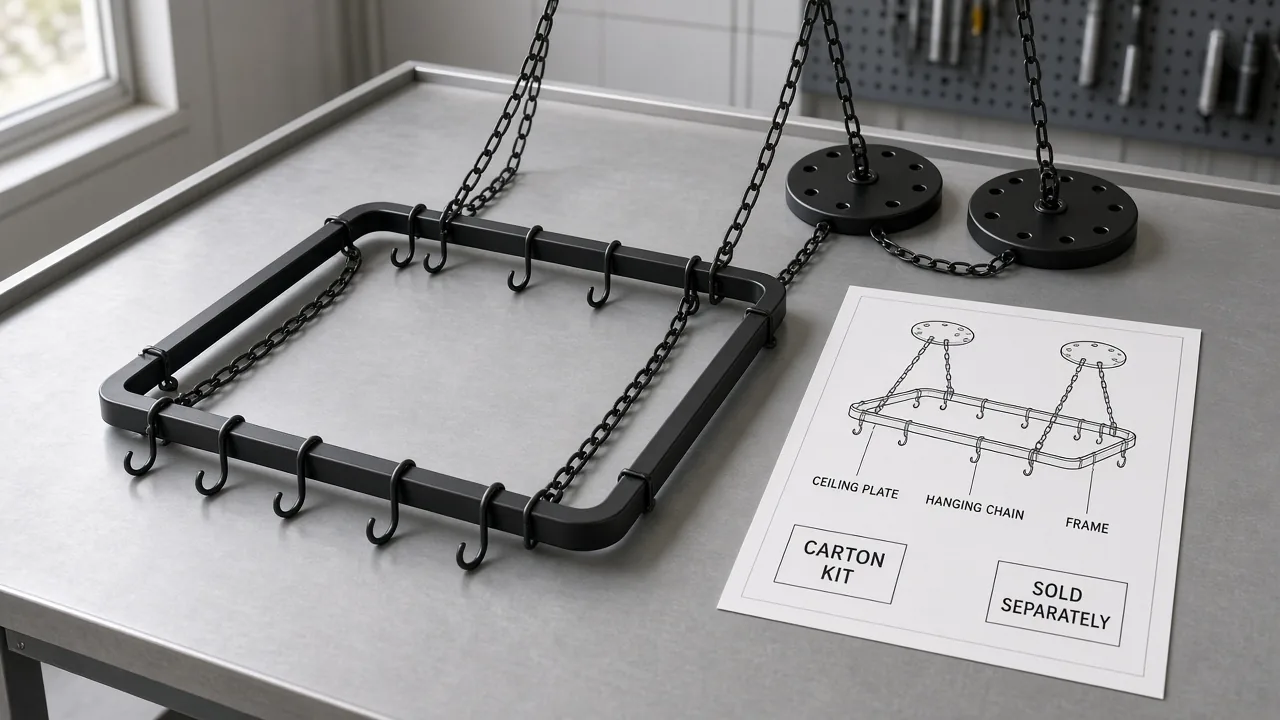
Before a sheet tells a buyer how to hang a pot rack from the ceiling, freeze the hang architecture, the carton kit, and the substrate notes that kit can support. Name whether the design is a ceiling hang, what is in the carton, and what is sold separately. Do not start with a hanging-height chart, and do not start with a load or joist figure.
Rack configuration, usable envelope, and hook layout belong on the live commercial pot-rack RFQ file. Wall-versus-ceiling, on that file, is a format field, not a ceiling-hang kit. A published height question is a different target and stays off this page.
The reader is an importer, distributor, or private-label team already screening pot racks as an adjacent kitchen-storage line, and now deciding whether an install sheet may tell a buyer how to hang the rack.
Koitor Hardware is a family-owned China OEM manufacturer of custom metal bathroom and home storage hardware. A commercial pot-rack RFQ page already sits in that published library. That fact is not a claim that Koitor currently manufactures a named pot-rack SKU, and it is not a load rating or a hanging-height standard.
Share the intended ceiling-mount architecture, what the carton will include, the ceiling or project notes, and the market. We can review that wording and the kit scope. We will not issue a load rating, a joist rule, or a hanging height.
What does a ceiling-hang pot rack file actually freeze?
It freezes the ceiling-hang architecture, the parts packed in the carton, the parts sold separately, and the substrate notes that may be printed without becoming a structural table. It does not freeze hook counts, a usable envelope, a wall-mount kit, or a height chart.
Searchers who look up how to hang a pot rack from the ceiling often want joist advice, a chain length, or reassurance that the ceiling can take the load. That demand is real. For an importer, the usable decision is whether an install sheet may tell a buyer how to hang the rack, and which kit and substrate notes are being promised.
A ceiling-hang kit and a wall-mount kit are different kits. If the sheet does not say which mount is in the carton, a “ready to hang” line will be applied to the wrong substrate. This file is not a wall-mount essay, and it is not a product listing.
A complete rack program still needs a configuration file. Hook layout, frame size, and the usable envelope stay on the commercial RFQ page. This hang file may name the frame that is actually packed. It should not reprint the RFQ checklist, and it should not treat a hang sentence as a substitute for those fields.
An OEM home storage hardware manufacturer can review whether a carton list and a hang sentence stay together. Matching a frame finish or a hook style to a collection is not the same as inventing a default load, a default joist spacing, or a default hanging height. If you are screening this adjacent line, bring the intended kit list and the ceiling notes with the drawing.
A published “easy to hang” claim is only as complete as the named kit. If the photograph shows ceiling plates and lags, and the carton includes only the frame and the hooks, the sheet has already failed. The same is true of chains, rods, canopies, and any structural hardware the sentence assumes.
Buyers can use this hang file before they issue an RFQ. They should not use it as a catalog, a joist-carpentry lesson, or a height chart. Configuration still belongs on the RFQ page, and height stays off this page.
Which hang architecture and carton kit must be named first?
Name the mount architecture first: this file is for a ceiling hang. If the same family also offers a wall-mount rack, that is a different kit and a different sheet. Do not start with a hang sequence, and do not start with a height figure that has not been tied to a cited project rule.
Then name what is in the carton. A ceiling hang often involves some combination of a hanging frame, hooks, chains or rods, ceiling plates or canopies, and a bag of fasteners. “Some combination” is not a kit list. Write the actual parts, and write the actual counts, without inventing a fastener size as a factory standard.
Name what is sold separately. Structural hardware, lags, blockers, or ceiling anchors may be part of a site decision rather than part of the carton. If the hang sentence assumes those parts, and the carton does not include them, the sheet must say they are sold separately or supplied by the project. Leaving the line blank is how buyers assume the lags are in the box.
Chains and rods are not interchangeable just because both can hang a frame. If the design uses chains, say chains. If it uses rigid rods, say rods. If both are offered, they are two kit options, not one photograph. A mixed image that shows rods on the carton and chains in the lifestyle shot is how the wrong bag is packed.
Ceiling plates should be named as included, excluded, or sold as a separate canopy kit. A plate with visible screw holes in a photograph will be read as packed hardware. If the plate is only a styling prop, the photograph should change, or the list should include the plate.
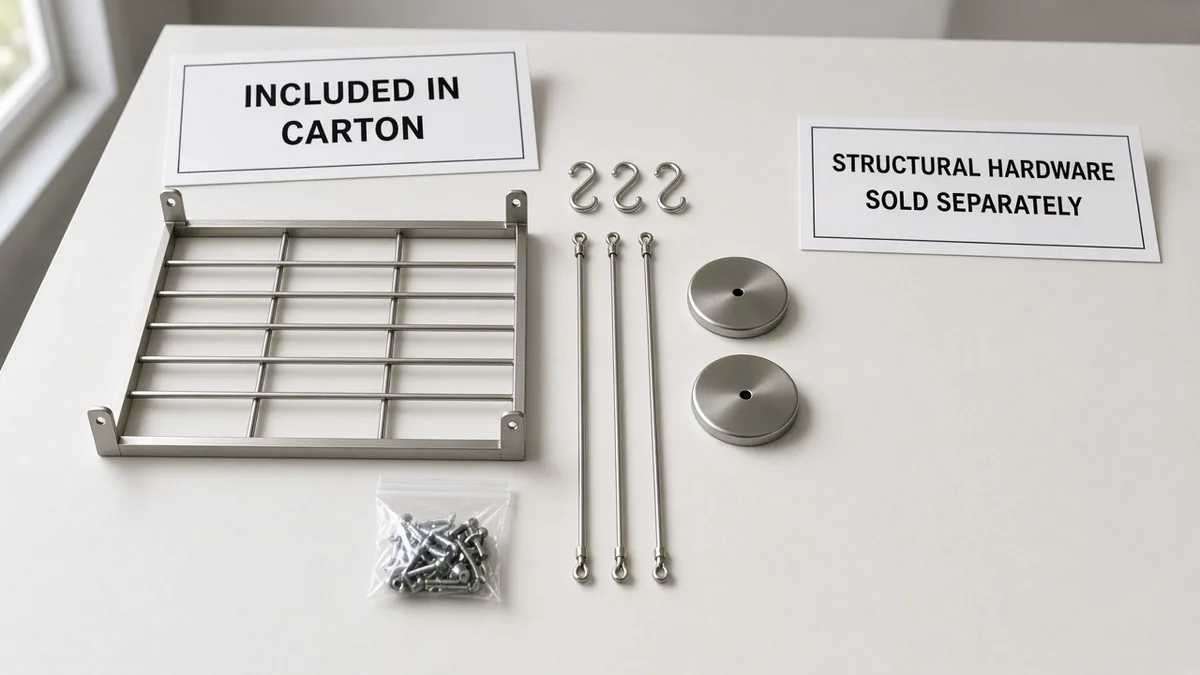
Hooks packed with the frame should be counted and described in the kit, not treated as a later accessory after the hang sentence is printed. Hook layout as a merchandising field still belongs on the RFQ file. The hang file only needs to say which hooks are in this carton.
If a program uses more than one ceiling-hang method, such as a direct-plate hang and a chain hang, keep a separate kit and a separate sheet for each method, or make the difference unmistakable on a shared sheet. A blended “ready to hang” line that is true for only one method will be believed for both.
Instructions packed in the carton should match the named ceiling-hang kit. A generic “how to hang a pot rack” leaflet that mixes wall-mount steps, ceiling-hang steps, and a homemade build is not a complete kit document. Pack the leaflet that belongs to the carton.
How should substrate notes be written without inventing a load or joist rule?
Substrate notes may say that the hang depends on the ceiling construction, and that the project or a named professional must confirm the support condition. That is a boundary. It is not a joist table, and it is not a safe-working-load figure.
Do not print a joist spacing, a joist size, or a “always hit the joist” rule as a Koitor standard. Consumer hanging guides often give that kind of advice for a house they have not seen. Those pages are demand evidence. They are not factory data, and they are not a building-code conclusion this article can issue.
Do not print a load, a pot-weight total, or a “holds a full set of cookware” claim as a plant rating. If a later brand file or a named project engineer supplies a required figure, the sheet can carry that figure as a cited project requirement. Until then, leave the load field unstated rather than inventing a plant default.
Plywood ceilings, concrete ceilings, and joist bays that do not fall where the rack should sit are common questions in third-party forums. Mention them only as examples of why a substrate note is needed, not as a repair method. This file does not supply a blocking detail, a toggle method, or a spread-the-load recipe.
If the carton shows a ceiling plate, the substrate note should not imply that the plate is a complete structural solution. A plate is a part. The support condition is a project question. Keep those two sentences apart so a buyer does not read a canopy photograph as an approved ceiling.
Wall-mount notes stay off this ceiling-hang file. If a collection also offers a wall rack, send that kit to its own sheet. A sentence that begins “hang the rack from the ceiling or the wall” has already mixed two architectures and two substrate families.
| Field the sheet is trying to freeze | What must be named | When this field is complete | What this field is not |
|---|---|---|---|
| Ceiling-hang architecture | That the kit is a ceiling hang, and which hang method the carton is built for, such as chain, rod, or direct plate, if more than one method exists | When a reader can tell the mount type before opening the box | A wall-mount kit, or a format tick on the RFQ file that only says “ceiling” without a kit |
| Carton kit | Frame, hooks, chains or rods, ceiling plates, fasteners, and instructions actually packed, with counts | When the hang sentence assumes only parts that are in the bag or are clearly excluded | A lifestyle photograph that shows lags, blockers, or extra canopies the carton does not include |
| Sold-separately hardware | Structural hardware, lags, or project-supplied anchors that the hang sentence assumes but the carton does not pack | When the exclusion is written in plain language, not left blank | A hidden assumption that “the usual lags” are included |
| Substrate notes | That the hang depends on the ceiling condition, and that the project or a named professional must confirm support | When the note is a boundary, not a structural recipe | A joist-spacing table, a load rating, or a building-code conclusion |
| Consumer joist or hanging guide | The guide, if cited, as a third-party example only | When the citation is labeled and does not supply a factory number | A Koitor load, span, or hanging-height standard |
Lifestyle photographs should not show pots, ladders, or ceiling joists in a way that implies a published load or a published height. If a stylist hangs a full set of cookware under a low ceiling, buyers will read a capacity and a clearance this file has not frozen. Keep the photograph illustrative, or change it.
If the packed contents change, the hang sentence has to change in the same revision. Moving ceiling plates out of the carton, or taking lags out of the bag, can leave an older ready-to-hang claim sitting on the box. Treat that as a kit revision, not as a quiet packing adjustment.
Why are consumer joist guides not a factory standard?
Forum threads and maker guides are useful as demand evidence. They show that buyers ask how to hang a pot rack from the ceiling when the joists are not centered under the preferred location, and that they ask what hardware comes in the box. That is not permission to print one of those answers as a Koitor method.
A joist-centering tip is written for one house, one ceiling, and one rack. If that tip is copied onto a private-label sheet, the sheet inherits a structural claim the carton and the factory cannot support. Label the guide as a third-party example if you need to mention it. Do not present it as factory data.
The same caution applies to do-it-yourself builds, plywood-ceiling Q&A pages, and “hang it high” discussion threads. They can remind you that substrate questions are real. They cannot supply a Koitor joist spacing, a Koitor blocking detail, or a Koitor hanging height.
Do not invent a height chart to close the discussion. Hanging height is a different question, and it was already excluded as a thin, shopping-mixed target. This file may say that height belongs elsewhere. It should not print a clearance, a cook-line height, or a “hang it high” figure as a plant rule.
If a buyer asks for “the usual way” because a guide looked simple, return to the named architecture and the packed list. The useful answer is which kit is in the carton and which substrate note the sheet may print, not a retelling of someone else’s joist advice. If the project has adopted a named engineer’s instruction, cite that instruction as a project rule, and then check whether the packed kit still matches.
Do not use a consumer guide as a back door into the RFQ configuration file. A hanging article may spend most of its time on hook counts or frame size. Those fields still belong on the commercial pot-rack RFQ page, not in a hang-kit sentence.
Which neighboring pot-rack file should stay out of this sentence?
The live commercial pot rack importer RFQ and sample guide already freezes configuration, usable envelope, hook layout, and wall-versus-ceiling as a format field. This hang file may point to that page for those decisions. It should not reprint the RFQ checklist, and it should not treat a ceiling-hang kit as a substitute for sample checks on envelope and hooks.
If a listing must mention both a hang kit and a configuration path, keep the sentences separate. The hang sentence names the ceiling architecture, the carton list, and the substrate boundary. The configuration sentence should send the reader to the RFQ file rather than borrowing that file’s fields.
Do not reopen pot-rack height as a hidden target. There is no height chart on this page, and this article does not invent a hanging-height standard. If a project later supplies a required clearance, carry it as a cited project requirement on the file that owns height, not as a hang-kit default.
Wall-mount pot racks, homemade wood racks, and decorative hanging rails that are not this kit stay out of the hang sentence. They may appear in the same consumer search. They are not a reason to mix architectures, and they are not a reason to claim a current Koitor catalog SKU.
Load, span, and “full set of cookware” claims, if a project later asks for them, need their own named source. This article does not invent those figures. Leave the fields unstated, or carry a cited project requirement, rather than printing a plant default.
Other first-install kit files in home storage are useful only as a reminder that a hang file should freeze a kit and an interface. They are different products. Do not copy their sentences onto a pot rack, and do not use this page to reopen a closet-rod or robe-hook discussion.
What should be checked before a sheet tells a buyer how to hang a pot rack from the ceiling?
Use the checklist below as an artwork, carton, and install-sheet review, not as a ceiling-carpentry script. Koitor’s practical manufacturing insight here is that a plant can pack ceiling plates, chains, and a frame to match a drawing, but it should not be asked to print a load, a joist spacing, or a hanging height as a factory standard.
During sample and packing review, the useful questions are simple. Does the bag match the photograph? Does the sheet name a ceiling hang, not a wall hang? Is every chain, rod, plate, hook, and fastener either packed or excluded in writing? Does any substrate sentence stay a boundary, or has it slipped into a structural recipe? That is kit hygiene. It is not a load test, and it is not a height check.
If a later brand file or a named project engineer supplies a required figure, the sheet can carry that figure as a cited project requirement. Until then, leave the load and height fields unstated rather than inventing a plant default.

- Name the architecture in plain language: this carton is a ceiling hang, and name the hang method if more than one method is offered.
- Name every part the hang sentence assumes, including the frame, hooks, chains or rods, ceiling plates, fasteners, and instructions, with counts.
- Write sold-separately or project-supplied structural hardware in plain language; do not leave buyers to assume that lags or anchors are in the box.
- Keep wall-mount kits on a different sheet; do not print a blended ceiling-or-wall hang sentence on one carton.
- Keep configuration, usable envelope, and hook layout on the commercial RFQ file; this hang file may name the hooks in the carton, but it should not reprint that RFQ.
- Write substrate notes as a boundary that the project or a named professional must confirm, not as a joist-spacing table or a blocking recipe.
- Do not print a load, a pot-weight total, or a hanging height as a Koitor standard.
- Do not print a consumer joist guide, a DIY build, or a “hang it high” thread as a factory method.
- Do not invent a millimetre chart, a torque, a span, or a factory hang test.
- Revise the ready-to-hang line whenever the packed list, the hang method, or the sold-separately field changes.
If the carton is bilingual, both languages should carry the same kit fields. A sold-separately note that exists in only one language will disappear in the other market. Check both translations against one packed list before the hang sentence is approved.
A goods-in check can be equally plain: open the carton, set the frame, hooks, hangers, and plates on the table, and tick each named line, including the sold-separately line. That walkthrough does not become a load test or a joist study. It only asks whether the carton can be believed.
If a later order adds a wall-mount SKU beside a ceiling-hang SKU in the same finish, treat that as a new kit, not as a sticker change on the same bag. The plates, the fasteners, and the substrate notes may all change. A ceiling-hang sentence left on a wall-mount carton will be believed, and it will be wrong.
The same discipline applies when a chain-hang kit later becomes a rigid-rod kit in the same frame finish. The frame can look familiar. The packed list is a new list. Reprint the hang-method and kit fields before the carton reuses an old ready-to-hang line.
Frequently asked questions
Can the carton say the rack is easy to hang?
Only after the ceiling-hang architecture, the carton list, the sold-separately field, and the substrate notes are named, and only if the sentence does not go beyond that kit. An easy-to-hang line is not a substitute for missing plates or for structural hardware the box does not include. This article does not supply a minute-count.
Should this sheet also print a hanging height?
No. Hanging height is a different question and is not this page’s target. This hang file may say that height belongs on another file if one is later approved. It should not print a clearance or a “hang it high” figure as a plant rule.
What if the joists are not where the rack should sit?
That is a project and substrate question, not a factory table. The sheet may note that the hang depends on the ceiling condition and that the project or a named professional must confirm support. Do not copy a consumer joist-centering guide as a Koitor method, and do not invent a blocking or spacing rule.
Does the carton have to include the lags or ceiling anchors?
Only if the hang sentence assumes those parts and you intend to pack them. If they are not packed, say they are sold separately or supplied by the project. A blank line will be read as if the usual lags were in the bag.
Can a consumer hanging guide be printed on the install sheet?
You may mention a hanging guide only if you label it as a third-party example and only after you confirm the packed kit still matches. A joist tip or a homemade build is evidence of demand, not a Koitor load, span, or height standard.
Does Koitor currently offer a named pot-rack catalog SKU?
This article does not assert a current named production SKU. A commercial pot-rack RFQ page already sits in the published OEM library. If you are screening this line, send the intended ceiling-hang architecture, kit list, and ceiling notes for review of wording and kit scope, not for a load rating or a hanging height.
Work With Koitor Hardware
Need a ceiling-hang pot-rack kit reviewed?
Share the intended ceiling-mount architecture, what the carton will include, the ceiling or project notes, and the market. Koitor can review that wording and the kit scope. We will not issue a load rating, a joist rule, or a hanging height. MOQ can start from about 100 pcs depending on the product; samples usually take 5-7 working days after details are confirmed; bulk production usually takes 4-6 weeks depending on the project.
OEM / PRIVATE LABEL
Turn this sourcing guide into a product brief
Share your target product, size, finish, order quantity and packaging requirements. Your team receives a practical manufacturability review before quotation.

 English
 Español
 Português
 Français
 Deutsch
 العربية