
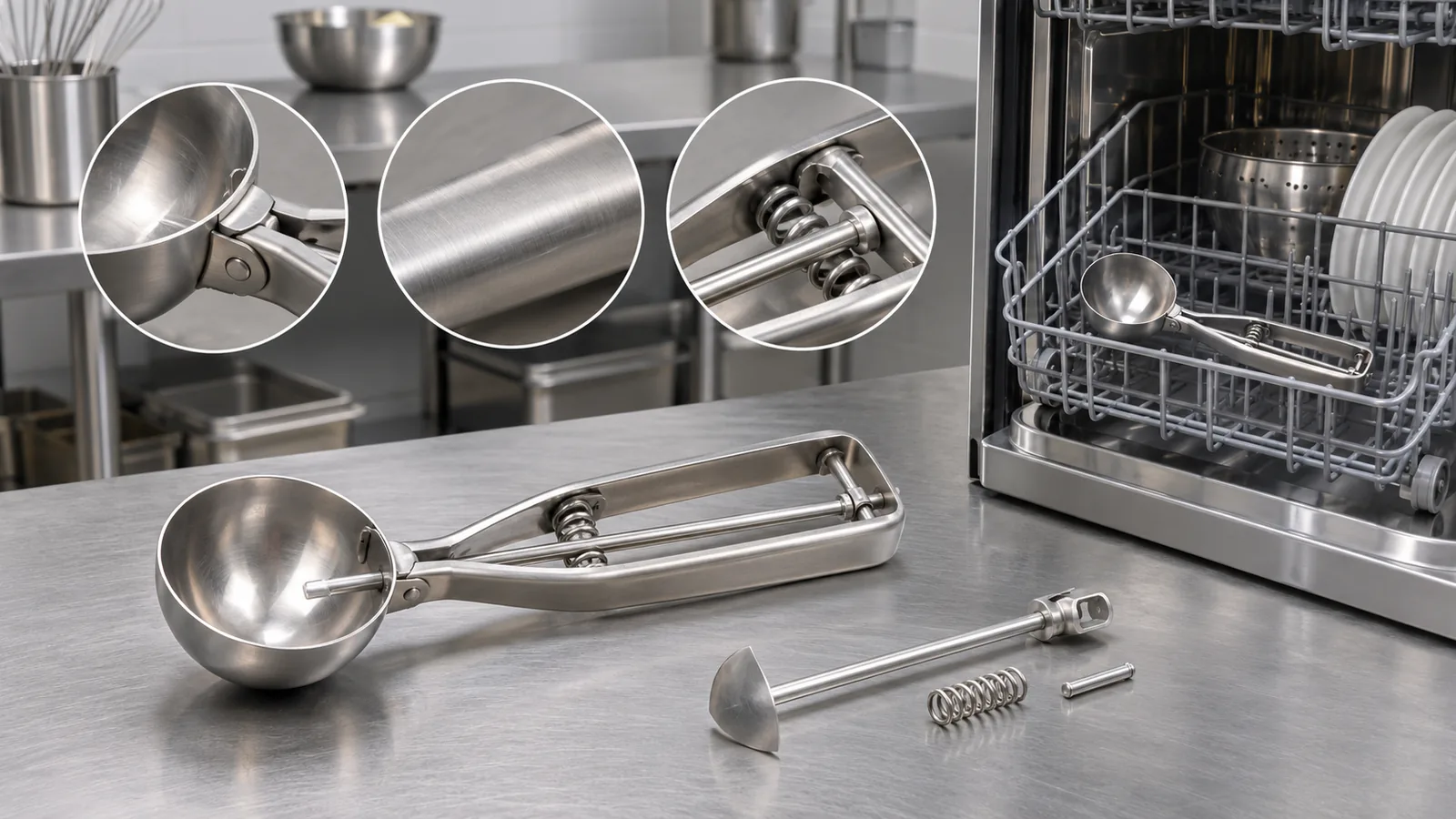
An ice cream scoop dishwasher safe claim must be checked against the exact model and its current care instructions; a metal appearance or a particular release mechanism does not establish dishwasher suitability. Importers should choose the release architecture and the channel’s cleaning workflow as two separate requirements, then confirm that one named model satisfies both. If a model is explicitly handwash-only but the retail or foodservice brief requires dishwasher cleaning, the mismatch is a sourcing decision to resolve before artwork, not a detail to explain away after launch.
The useful distinction is simple: release describes how the portion leaves the scoop, while care describes how the complete product may be cleaned. Those attributes can coexist in different combinations. A manufacturer may offer a heat-conductive handle without a spring, a lever-operated release, or other configurations; only that manufacturer’s documentation establishes the exact construction and care of its model. This guide converts those model-specific facts into a buyer brief without treating one example as a universal engineering rule.
Here, ice cream scoop dishwasher safe refers to the exact buyer decision and product scope described in this guide.
What should an ice cream scoop dishwasher safe review establish?
The phrase is often used as if it were a material property. It is better treated as a claim about a complete named product under the instructions and limitations supplied by its maker. An importer needs to know which model is under discussion, what parts are included, what release method is described, and which cleaning method the product page or instruction sheet permits. A claim detached from model identity can migrate accidentally from one item in a product family to another.
This matters when a category has a simple fixed bowl model, a model with a handle system, and a lever-release item. Their visible similarities do not prove identical internal construction, joints, coatings, assembly, or care limits. One manufacturer’s named Original model, for example, describes an aluminum-alloy scoop with a heat-conducting fluid in the handle, a no-springs construction, and handwash-only instructions. A different named OXO lever scoop is described by its maker as having a pop-up lever and dishwasher-safe care. These are two source-specific product offers, not evidence that all heat-conductive scoops must be handwashed or every lever scoop is dishwasher safe.
The sourcing goal is therefore not to declare a winning mechanism from a product page. It is to compare the exact offer against the intended channel, usage pattern, care process, packaging, and documentation requirements. When evidence is missing, keep the item on hold or request clarification. Do not fill a gap with an assumption based on metal, a photograph, an online review, or another model’s instructions.
Why release design and care instructions belong in separate fields
Release design answers an operational question: how does the user portion or release the contents? A fixed bowl, a handle described as heat-conducting, and a lever-operated mechanism are distinct product architectures that may affect how the tool is handled. Care instructions answer a different question: which cleaning method does the maker permit for that complete configuration? A buyer can describe both fields in one brief, but should not use one as a substitute for the other.
For example, “lever scoop” does not state whether the maker permits machine washing. Likewise, “dishwasher safe” does not tell the buyer whether the product uses a lever, a heat-conducting handle, or another release method. It does not establish portion accuracy, ease of use, corrosion resistance, hygiene qualification, expected life, or consistency across an entire assortment. Each claim needs its own support and exact product identity.
Keep the buyer’s product record explicit:
| Decision field | What to record | What it does not prove |
|---|---|---|
| Maker and model | Exact brand, item code, revision, and source date | That a similar-looking item follows the same instructions |
| Release method | Maker-described fixed, heat-conducting, lever, or other architecture | A particular portion size or comparative user effort |
| Care requirement | Exact permitted method, exclusions, and controlling instruction | That every material or model in the line shares it |
| Intended channel | Retail, catering, institutional kitchen, or another defined route | That a cleaning process is available at every end user |
| Included parts | Scoop, accessory, packaging, and instruction sheet | That a separate component is covered by the same care statement |
Separating these fields reduces quote ambiguity and helps the buyer identify a conflict early. It also prevents the marketing title, a reseller description, and a factory quotation from silently describing different configurations.
Which release architectures can a buyer compare?
An importer should compare the supplier’s actual model descriptions rather than start from a generic taxonomy and assume that every product fits it. A simple scoop can rely on the user’s movement to release its contents. Some named models describe a heat-conducting handle or internal system. A lever model describes a mechanical release action. These categories help frame questions, but a brand’s exact current documentation controls the facts.
The Zeroll model 1010 product page is useful because it gives a concrete example of several details appearing together: aluminum alloy, a handle described as heat-conducting, no springs, and handwash-only care. The source also says the handle contains a fluid. “One piece” therefore should not be rephrased as “solid throughout” or used to infer the unseen arrangement. The buyer should report only what the maker actually states and leave internal chemistry, calculations, seals, and construction details to the responsible manufacturer.
The OXO Classic Swipe and OXO Steel lever models demonstrate a different maker-described release approach and dishwasher-safe care for those identified products. The existence of those products does not show that every lever architecture is dishwasher compatible, or that a lever causes the care rating. Nor does it show that another supplier can copy the arrangement, materials, ergonomics, or product claim. Treat product pages as model-specific evidence and avoid presenting them as independent comparative trials.
When a supplier uses a different name, ask for a drawing or an explanation tied to the exact SKU. A title such as “self-releasing” or “heat-assisted” may be marketing language rather than a complete component description. Request the controls and terms the supplier is prepared to place in a specification or instruction sheet. Buyers do not need to reverse-engineer a competitor’s sealed mechanism to select a range; they need enough accurate information to decide whether the named offer fits the brief.
How to define a channel cleaning requirement
“Dishwasher safe” can hide important distinctions. The buyer’s own requirement may be machine wash after each service, handwashing only, or a permitted option with instructions. A foodservice distributor may need a workflow that differs from a home-retail channel. An importer should write the actual need and ask the responsible manufacturer whether the exact product is designed, documented, and supported for it. Do not reduce the question to “metal or not metal.”
Record the proposed cleaning method, who will use it, how the product will be sold, and how care information reaches that user. If the supplier specifies a restricted method, preserve the limitation in the technical file and customer-facing instruction. If the market requirement cannot accept the limitation, choose another documented model or revise the channel brief with the responsible commercial owner. Do not remove warnings to improve a listing or copy a competitor’s permissive instructions.
The word “dishwasher” itself is not a single set of operating conditions. Programs, detergents, rack placement, cycles, temperature profiles, and drying processes vary. The article does not prescribe a universal test recipe, and the buyer should not invent one. If the supplier offers a dishwasher claim, ask which method and scope support it, what exact models and components were included, and whether the current instruction set matches the claim. This is claim control, not a substitute for qualified product testing or market-specific regulatory review.
For a product requiring handwashing, the instruction should be concise and consistent across product pages, packaging, inserts, and customer-service materials. The importer should review every consumer touchpoint before approval. A specification that says “handwash” while a retailer’s listing says “dishwasher safe” is a document-control problem even before any product is sold. Identify which source is authoritative, who is responsible for correcting downstream copy, and how the approved wording will be versioned.
How internal construction affects the evidence request
The outside of a scoop does not reveal every joint, coating, internal mechanism, or material transition. A buyer should ask for the maker’s assembly description, included components, care limitation, and model-level evidence relevant to the proposed claim. The goal is not to demand proprietary drawings that the supplier is not authorized to share. It is to establish which documents the supplier can provide and how they link to the sellable configuration.
For a mechanism with a moving lever, the buyer might ask whether the whole assembly is covered by the care statement and whether any instruction excludes a part. Do not infer hidden springs, gears, pivots, or lubrication requirements from appearance alone. For a model described as heat-conducting, do not invent the contents of the handle or make claims about the way it transfers heat. For a plain metal model, do not presume that the body, handle, and attached components all have the same material or finish.
The sample review should identify the model, revision, finish, and instruction version. Examine the product as received and compare it with the quoted bill of materials and current controlled description. A sample can help identify obvious configuration mismatches, but a single visual sample does not independently prove a care claim, long-term performance, food-contact status, or manufacturing consistency. Those questions need supplier-controlled records and, where required, qualified evaluation.
If the specification changes after approval—such as a handle, coating, joint, release component, supplier, or instruction revision—the importer should ask whether the previous evidence still applies. The correct answer may depend on what changed and which claim is under review. Avoid categorical assumptions that every minor change invalidates every result or that any unchanged exterior preserves prior evidence. The change owner and responsible supplier should scope the effect.
Build a comparable supplier request
A short request can save later rounds if it separates release, care, product identity, and evidence. Ask every supplier to answer against the same target channel and the same model revision. Leave unknowns visible. If two quotations include different accessories or instructions, price differences cannot be interpreted cleanly until scope is aligned.
The request should include:
- Exact maker or supplier model, SKU, revision, and current product reference.
- Supplier-described release method without adding assumptions about internal components.
- Care instructions for the complete sellable model, including permitted and excluded methods.
- Intended distribution channel and required user cleaning workflow.
- Included parts, packaging, printed inserts, digital instructions, and artwork responsibility.
- Documents supporting any requested care or performance statement, with scope and date.
- Sample identification and the method for matching the approved sample to the production item.
- Change notification and reapproval rules for parts, suppliers, finish, or instructions.
- Open issues, owner, due date, and decision needed before purchase-order release.
Where one supplier cannot support the cleaning requirement, compare a different named model rather than silently changing the requirement. If the price is attractive but the evidence or instruction is incomplete, label the offer “not yet comparable” instead of assuming it is equivalent. A commercial decision can weigh cost, assortment role, supplier responsiveness, service workflow, and documentation, but the record should keep confirmed facts separate from buyer preference.
Sample, instruction, and artwork approval sequence
The sample and the claim must travel together through the approval process. First identify the product to which the model name refers. Next obtain the current instruction and care statement from the responsible manufacturer. Then check whether the proposed listing or packaging uses those exact limits. Finally, preserve the approved reference, source date, and artwork revision in the buyer’s file.
Do not treat a retailer page as a substitute for the maker’s instruction when the wording conflicts. The retailer may summarize, omit exclusions, or attach care details to the wrong variant. Resolve discrepancies before copying text into a private-label package. If the supplier cannot clarify which document controls, hold the care claim until the owner does.
The evidence file can include the supplier specification, instruction sheet, model reference, photographs of the sample and identifying marks, artwork proof, correspondence clarifying unresolved questions, and any scoped test report supplied by the responsible party. Keep the report’s item identity, method, result, and limitation together. A report for a related model is not automatically evidence for another model. A claim that the supplier says “passed” is not enough to establish the protocol or scope if those details matter to the buyer.
An importer should also define who can approve a change after artwork signoff. A supplier may revise a handle, pivot, surface treatment, or purchased component for availability or cost reasons. The buyer needs a notification path and a rule for determining whether the model designation and claim remain accurate. This is particularly important when the retail package says “dishwasher safe” in a prominent callout while the supplier’s master instruction includes a model-specific exception.
Common sourcing errors to prevent
One error is choosing a release method from a photograph, then assuming the cleaning routine. A photo reveals only visible surfaces and does not establish the manufacturer’s complete assembly or permitted care. The correction is to ask for release and care as separate written fields.
A second error is moving a care statement from one model to another. A shared brand, material, shape, or product-family page does not guarantee the same construction or instructions. Match every statement to the exact SKU and revision. If the source names a variant, preserve the name instead of summarizing it as an entire category rule.
A third error is treating “no springs” as “no moving parts,” “maintenance-free,” or “cannot fail.” The maker’s language should be reported precisely and no broader reliability claim should be inferred. Likewise, a lever label does not justify claims about effort, ergonomics, portion consistency, or service life unless the responsible party provides evidence.
A fourth error is assuming that a sample itself proves a dishwasher claim. One sample is useful for product identity and fit review, but it does not establish test scope, manufacturing repeatability, instructions, or legal suitability. Ask for the evidence appropriate to the actual claim and market, then use qualified reviewers where required.
A fifth error is removing care limitations from private-label copy because a channel prefers a more permissive statement. If the product and instructions conflict with the commercial brief, change the model or the brief. Do not make an unsupported promise and do not ask the factory to validate wording that it has not approved.
A final error is presenting a competitor product as a proven benchmark or capability claim. Named examples help show that product offers differ; they do not prove that one arrangement is universally safer, more durable, easier to operate, or compatible with every use. Keep comparison language conditional and attributed.
What an importer can verify—and what it cannot infer
An importer can verify that the supplier identifies the quoted model, provides care instructions, aligns the product information with the sample and artwork, and clarifies included parts. The importer can ask for a documented basis for the proposed statement and can arrange independent review where market obligations or buyer policy require it. The importer can also decide whether a care method fits the intended channel.
The importer cannot infer hidden construction, material grade, process, food-contact status, or cycle life from a photograph or generic label. Nor does this guide establish a test method or regulatory conclusion. If the product will be used in a regulated food-contact environment, the responsible supplier and qualified compliance specialists must confirm applicable requirements for the target market and actual materials. The exact record and review needed depend on jurisdiction, product, and claim.
For metal bathroom or home-storage hardware, Koitor’s approved positioning is a family-owned factory and custom metal hardware manufacturer. That confirmed scope does not establish manufacture of ice cream scoops, sealed heat-conducting handles, mechanical release assemblies, or food-contact products. A buyer with a related metal component requirement can submit a drawing or sample for a bounded scope review, but should not treat the article as a finished-scoop offer. See the project-specific claim evidence discussion on dishwasher-safe metal storage accessories and the Koitor OEM home-storage scope.

A buyer-ready decision checklist
Before approving an assortment item, confirm that the specification answers each question below. A blank or “not stated” response is an open item, not an invitation to assume. Use the same checklist for competing offers so that each supplier has a fair, comparable request.
| Checkpoint | Evidence to retain | Decision if unresolved |
|---|---|---|
| Model identity | Maker, model, SKU, revision, dated source | Hold variant-specific claim |
| Release method | Exact maker wording and product configuration | Request clarification; do not infer mechanism |
| Care method | Current full-product instructions and exclusions | Keep care field open |
| Channel fit | Required cleaning workflow and end-user context | Choose another model or revise brief |
| Included parts | Quotation scope, bill of materials, package contents | Reconcile quote before price comparison |
| Claim support | Evidence source, product scope, method, date, limitation | Do not publish unsupported wording |
| Artwork | Proof aligned to approved instruction and model | Correct copy before production |
| Change control | Supplier notice and buyer reapproval owner | Set a written change rule |

Frequently asked questions
Does a metal ice cream scoop automatically count as dishwasher safe?
No. A metal exterior does not define the care instructions for the complete named product. The maker may specify a particular method or limitation based on the model. Use the exact current instruction rather than inferring care from material appearance.
Is a heat-conducting handle the same as a lever release?
No. These descriptions refer to different maker-described product features. Compare the exact products and do not assume that either feature determines the cleaning method. A handle description also does not disclose every internal construction detail.
Does “no springs” mean there is nothing inside the handle?
Not necessarily. The cited Zeroll model is described both as having no springs and as having a fluid-containing handle. Report the source’s wording without turning it into a claim that the handle is empty, solid, or built by another supplier in the same way.
Can a buyer use a dishwasher-safe statement from another product in the same range?
Only if the responsible maker confirms that it applies to the exact SKU and revision under review. Similar appearance or a common family name is not enough to transfer the statement. Keep the evidence attached to the named item.
What should be compared when two suppliers quote different scoop styles?
Align the model, release method, included components, care instructions, packaging, and evidence scope first. Then compare price, channel suitability, and service requirements. If the offers do not meet the same brief, they are not like-for-like yet.
What is Koitor’s role in this adjacent-category guide?
Koitor’s confirmed manufacturing scope is bathroom and home-storage metal hardware. Scoop release systems and food-contact qualification are not confirmed capabilities. Koitor may review a metal-component drawing or sample within its established scope, but no finished scoop supply is promised here.
Sources
- Zeroll Original Model 1010 — maker-specific material, handle, release, and handwash-only description.
- OXO Classic Swipe Ice Cream Scoop — maker page for a named lever-release model.
- OXO Steel Lever Ice Cream Scoop — model-specific product and care description.
- Koitor dishwasher-safe metal accessory claim evidence — Koitor-specific claim-scope guidance; it does not qualify a scoop.
Work With Koitor Hardware
Discuss a confirmed metal hardware scope
Share the drawing or physical sample, target application, metal-component requirements, and intended order range. Koitor will first confirm whether the product fits its established bathroom and home-storage manufacturing capabilities.
OEM / PRIVATE LABEL
Turn this sourcing guide into a product brief
Share your target product, size, finish, order quantity and packaging requirements. Your team receives a practical manufacturability review before quotation.


 English
 Español
 Português
 Français
 Deutsch
 العربية