
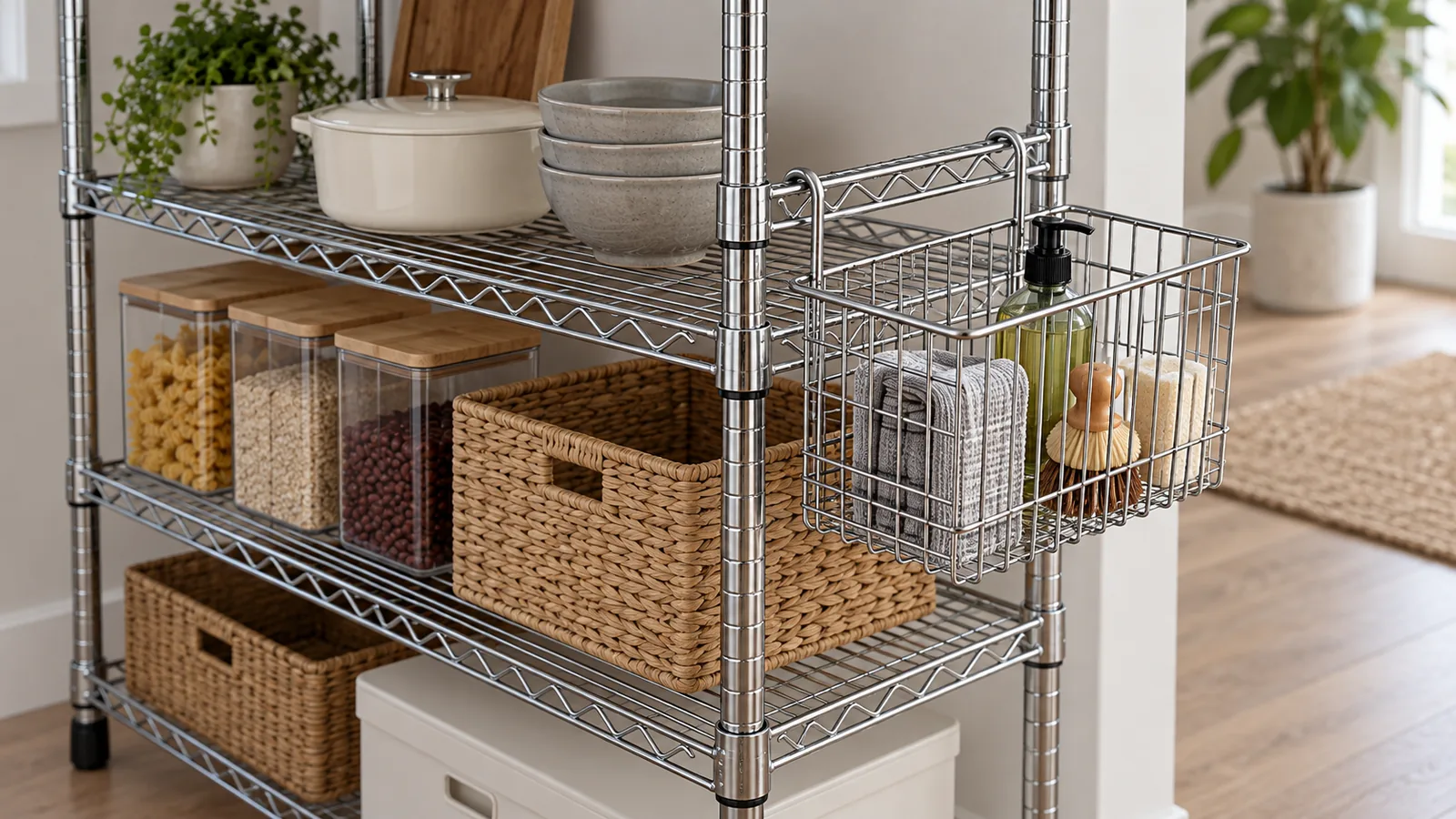
For importers building a modular wire-rack assortment, a wire rack removable side basket attachment must do two things at once: fit the selected rack geometry and allow the basket to be intentionally removed without an unintended release during its stated use. A catalog photo rarely shows enough detail to approve that interface. Buyers should specify the rack wire, hook shape and count, basket envelope, loaded clearance, finish contact and removal direction, then inspect the exact assembled sample.
Do not treat “hooks on the back” as a complete specification. A basket may hang from a shelf edge, a side wire, a rail or a compatible grid, and those interfaces are not interchangeable by appearance alone. Metro’s named product, for example, describes a basket held by two hooks and identifies Super Erecta wire shelving and SmartWall grid compatibility. Uline describes a hanging basket that hooks to shelving without extra hardware and gives system-specific compatibility notes. These listings illustrate accessory designs; neither establishes cross-brand fit for a different rack.
What does the attachment need to accomplish?
Start by stating the intended function. Is the basket a fixed storage accessory that should stay in place during ordinary access, or should a user lift it off for cleaning, replenishment or assortment changes? If removal is intended, define the deliberate movement: lift vertically, tilt away from the rack, or release a secondary retainer first. The part should not depend on an undocumented motion that causes users to bend the basket or scrape the rack.
Map the assembly as three controlled interfaces: basket-to-hook, hook-to-rack, and basket-to-surrounding space. The hook must remain part of the basket assembly under the intended handling. Its throat and contact surfaces need to suit the specific rack wire or rail. The basket body must clear posts, nearby shelves, adjacent accessories and the path of the user’s hand. A sample can fit the hook-to-wire interface and still be unusable if the basket collides with a post or cannot be lifted off after the rack is loaded. A wire rack removable side basket attachment is therefore a rack-and-accessory interface decision, not just a basket-size decision.
Keep the accessory’s job separate from structural claims. A removable hook can locate and support a side basket as designed, but its visual presence alone does not establish a safe load, resistance to impact or suitability for moving a loaded rack. Ask the component supplier what its documentation covers, and do not infer a rating from a displayed sample or a similar model.
Metro’s storage-basket listing specifies two hooks for its basket and names the Super Erecta and SmartWall systems. Its hook count and compatibility statement describe that product. A different basket can use another hook arrangement, and another rack can have different wire spacing or frame orientation. Treat the named example as a reminder to record hook count and approved rack family—not as a universal design rule.
Which rack and hook dimensions belong in the RFQ?
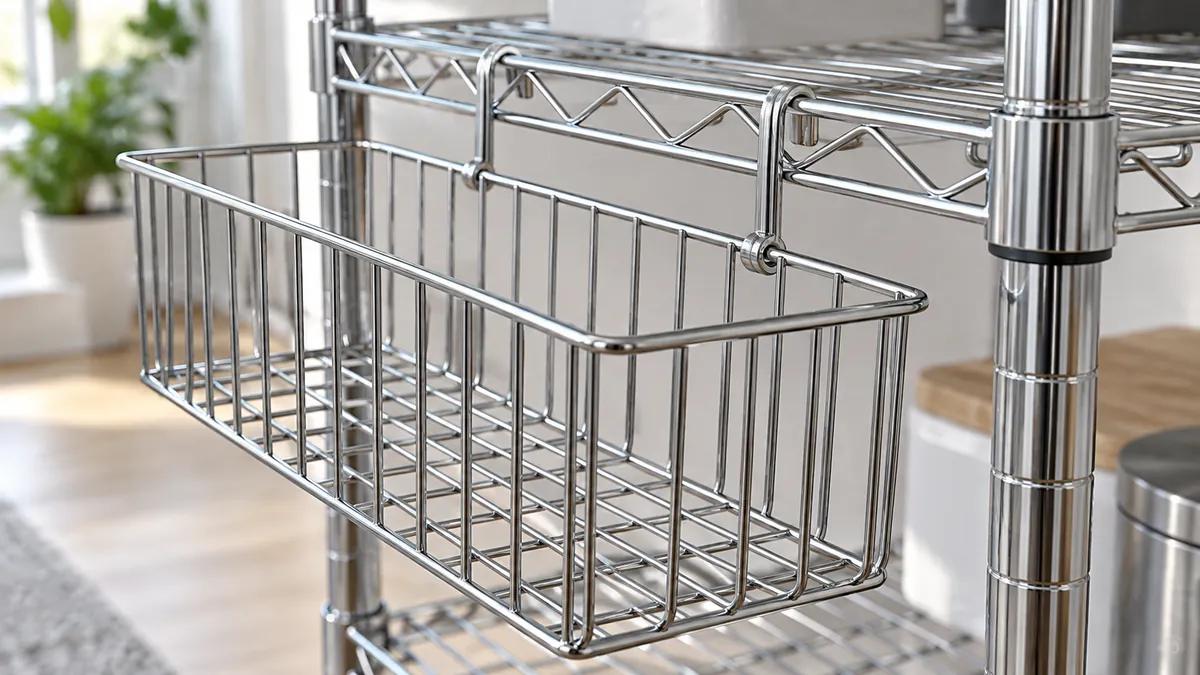
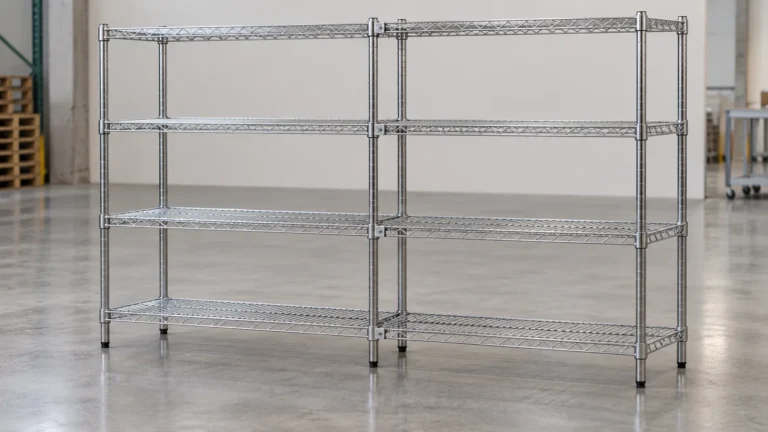
Identify the exact rack model or provide a controlled drawing. Record the diameter and orientation of the wire the hook engages, the spacing and location of those wires, shelf-edge construction, nearby post position, finish and drawing revision. A “wire shelving unit” description is not enough if the assortment contains several shelf depths, wire layouts or frame styles.
For the basket, specify overall width, depth and height, wire or sheet construction, opening direction, intended mounting side and expected storage items. For each hook, show the number, wire diameter, inside throat, return length, bend profile, spacing between hooks and contact points. Include a dimensioned view that indicates whether the two hooks engage one continuous rail, separate shelf wires or side-frame wires. The drawing should make it possible to distinguish the intended rack wire from decorative or non-load-bearing elements.
| RFQ field | Buyer supplies | Supplier confirms |
|---|---|---|
| Rack identity | Model, drawing, revision and finish | Intended rack family and compatible wire/rail locations |
| Hook interface | Wire diameter, orientation, spacing and contact surface | Hook count, throat geometry and intended engagement |
| Basket envelope | Outside dimensions, opening and mounting side | Clearance from posts, shelves and adjacent accessories |
| Removal | Deliberate lift-off or release direction | Removal sequence and any retainer or limitation |
| Use conditions | Stationary or moving rack; expected access and items | Documentation applicable to the exact assembly |
| Concluir | Required appearance and contact areas | Protection or inspection method at hook contact points |
| Approval | Sample configuration, photos and acceptance criteria | Part numbers, revision and change-control triggers |
Ask the supplier to define measurement datums. Hook spacing measured center-to-center is different from inside-to-inside spacing; rack-wire pitch may be measured from wire centerlines or clear gaps. The hook throat should be dimensioned at the working contact area, not estimated from a catalog photograph. Mark tolerances only where they affect fit or operation, and agree how dimensions will be measured on samples and production parts.
If the buyer expects multiple rack models, do not approve one hook as “fits all” based on one size. Create a compatibility matrix for each rack family and basket variant. Mark untested combinations as pending rather than extending the approval. A shared accessory can simplify an assortment, but a compatibility claim needs a defined set of models, revisions and sample evidence. Use the matrix to define exactly which wire rack removable side basket attachment combinations are approved and which remain untested.
How should loaded clearance and retrieval be evaluated?
Check the basket envelope after it is attached, not only the unloaded hook. Measure the distance to the nearest post, upper and lower shelf, wall, adjacent rack or side accessory. Consider the basket’s full outside dimensions and any rim or hook projection beyond its wire body. Confirm that the intended items can be placed in and retrieved from the opening without being blocked by a shelf lip or neighboring structure.
Define a representative arrangement of contents with the product team. It should reflect the product’s intended assortment, not an invented universal weight. Review whether items could shift toward the open side during ordinary access. If the rack will be pushed, rolled or relocated, consult the rack and accessory supplier’s instructions before assuming the basket can remain installed or loaded during movement. A fit check does not replace a specified dynamic, impact or stability test.
Test the designed removal path on the assembled rack. Confirm the user can reach the basket without first removing unrelated shelves or accessories unless that is part of the documented sequence. Lift or release it as instructed, then reinstall it. Observe whether the hooks clear the rack wires, whether the basket stays level during engagement, and whether the basket can be removed without twisting the side frame. If an optional retainer is intended to prevent accidental lifting, verify its operation separately and record the step needed to release it.
The sample check should distinguish intentional removal from accidental disengagement. Apply only the handling conditions established for the product; do not improvise a pull force or load criterion. Note whether the hooks remain engaged during normal access and whether a deliberate lift-off remains possible. If the risk assessment calls for a retention or cycle test, define the method, sample condition, equipment and acceptance limit with the supplier. A smooth hand demonstration can identify a fit issue, but it is not proof of long-term performance.
Uline’s H-4841BL hanging utility basket listing says the basket hooks to shelving without additional hardware and specifies compatibility conditions for its own listing, including a note about plastic shelf liners. That kind of exclusion matters: a liner or shelf cover can change access to a wire interface. Buyers should record similar obstacles for their chosen rack rather than assuming the accessory works unchanged with liners, guards or other add-ons.
What should the sample inspection record show?
Use a production-intent rack and basket. Confirm part numbers, material/finish, hook count, revision and assembly instructions match the approval package. Check that each hook seats at the intended rack wire, that the basket hangs in the approved orientation and that the contact points do not show unacceptable scratching, coating damage or deformation. If the hook is adjusted by hand during installation, record that adjustment and establish whether it is part of the normal method.
Take an overall front and side photograph, plus close-ups of both hook contacts and the area near the nearest post. Include a view of the basket opening and its removal path. Record the rack shelf level, installed accessories, liner condition, sample date and any observation. This makes later supplier or quality reviews more useful than a single image of a loose basket on a table.
Reinstall the basket after removal if repeated removal is part of normal use and the supplier permits it. Look for changes in the hook opening, alignment, surface finish or hanging position. State how many cycles were observed and under what conditions; do not turn a small sample check into a lifetime claim. If a basket becomes visibly loose or requires a different removal action, stop approval and ask the supplier to review the hook geometry or instructions.
Separate each acceptance decision: dimensional fit, secure engagement under defined handling, intentional removability, loaded clearance, appearance and instruction clarity. These are different outcomes. A basket can pass visual inspection but fail removal access; it can hang correctly while empty but have unresolved load documentation. Record an open item as open instead of giving the complete set a blanket “pass.”
How should changes and replacement parts be controlled?
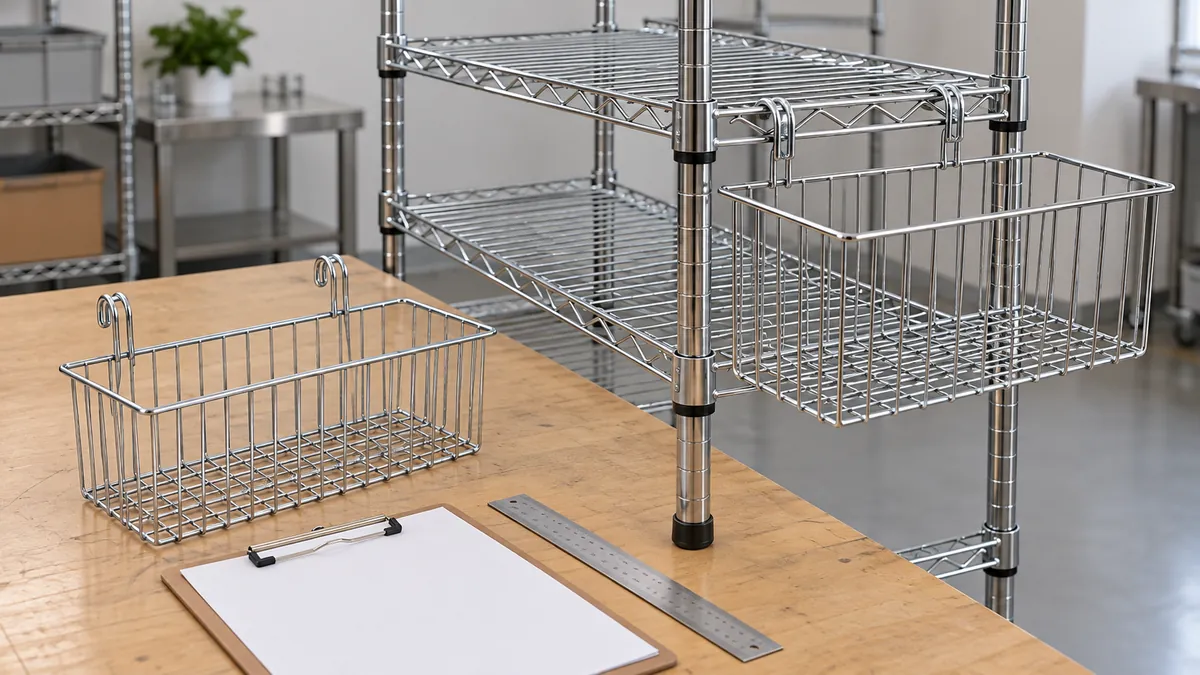
Treat the hook and rack contact as a controlled interface in the BOM. Identify the basket SKU, hook version, rack model, finish and instruction revision. If hooks are welded to the basket, a bend-angle or spacing change may alter fit; if they are separate components, a fastener or assembly change may alter retention. The supplier should identify which geometry or process changes trigger a fit review, supported by its actual construction method rather than an assumed Koitor capability.
Changes that may warrant reapproval include rack-wire diameter or pitch, frame orientation, basket width or depth, hook profile, hook spacing, material thickness, finish build-up, protective sleeves, liner use, or replacement source. Also review packaging and labeling if hooks can snag or deform neighboring basket wires in transit. Agree whether the change needs drawing comparison, first-piece fit, or a full assembled sample. The correct level depends on the risk and the size of the interface change.
For replacement purchasing, the part description should preserve the approved rack family and revision. A generic “side basket” code can lead to a basket with similar dimensions but different hook geometry. Keep superseded versions identifiable and communicate whether they remain interchangeable. If a new supplier proposes an alternative, compare contact dimensions and verify the rack and basket together before transferring the approval.
Perguntas frequentes
Are two hooks required for every removable side basket?
No universal hook count should be assumed. Some named products use two hooks, while other designs may use a different arrangement. Specify and verify the exact configuration for the chosen basket and rack.
Does “tool-free” mean the basket cannot come off accidentally?
No. Tool-free usually describes installation or removal convenience in that product’s instructions. It does not by itself establish retention under movement or impact. Ask for the supplier’s use conditions and test evidence for the exact assembly.
Can a side basket fit through a plastic shelf liner?
Not necessarily. A liner can cover the wire that a hook needs to engage. Check the rack and basket instructions, include the liner in the sample, and treat any exclusion as system-specific.
Does a hanging basket listing prove it fits our rack?
Only where the listing or supplier documentation names the rack system or dimensions that match the buyer’s assembly. Confirm the exact model and revision with a physical sample before making a cross-brand compatibility claim.
Discuss a wire-rack accessory interface
Share the rack-wire drawing, basket dimensions, hook detail, finish, removal direction and sample requirements. Koitor can discuss confirmed metal-storage manufacturing and sourcing inputs; compatibility and retention must be validated for the exact rack and accessory combination.
OEM / MARCA PRÓPRIA
Transforme este guia de fornecimento num resumo do produto
Indique o produto pretendido, as dimensões, o acabamento, a quantidade a encomendar e os requisitos de embalagem. A sua equipa receberá uma análise prática da viabilidade de fabrico antes da apresentação do orçamento.
 English
  Español
  Português
  Français
  Deutsch
  العربية