
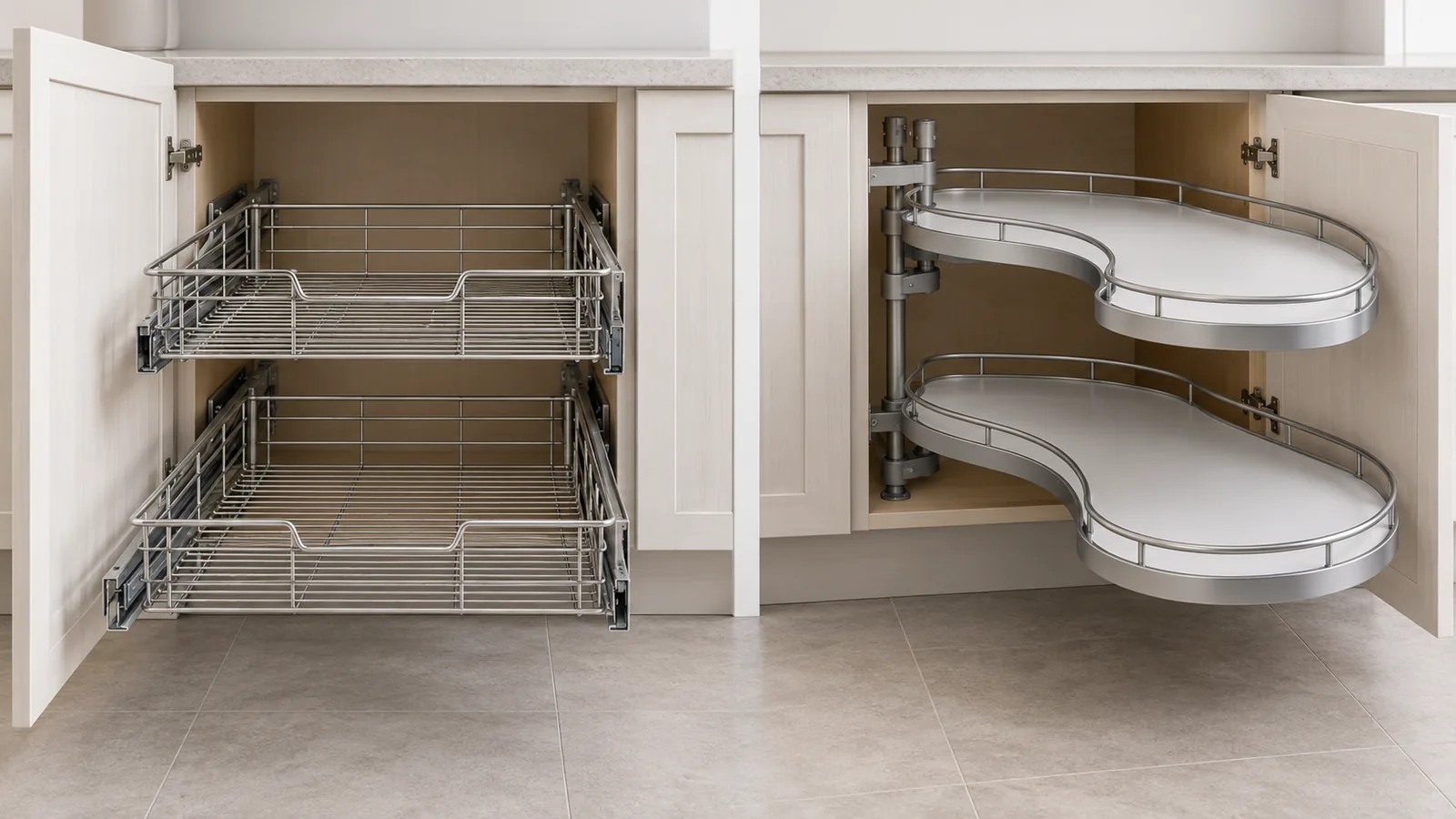
For cabinet and storage buyers, blind corner swing out vs pull out is a fit-and-access decision, not a universal ranking of which mechanism is better. A pull-out system moves a basket or carrier along a slide path; a swing-out system rotates shelves or baskets through an articulated path. Buyers should compare the cabinet opening, door and hinge movement, internal obstructions, occupied motion envelope, accessible retrieval zone and supplier-approved installation data before choosing a system.
The distinction matters because a cabinet’s nominal interior volume is not the same as space a user can reach. A mechanism may expose more stored items while occupying clearance outside the cabinet, limiting adjacent doors, or requiring more complicated support. The correct choice depends on the cabinet drawing, stored goods, use sequence and the exact proprietary mechanism—not only a product photo.
What do pull-out and swing-out mechanisms do differently?
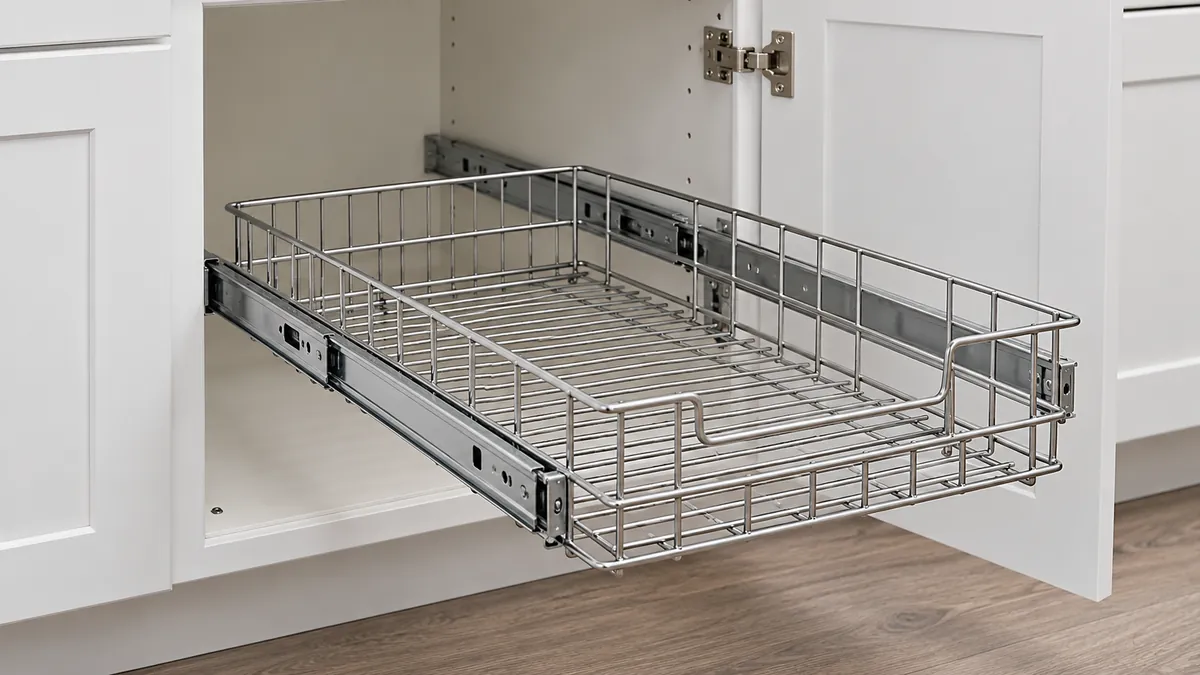
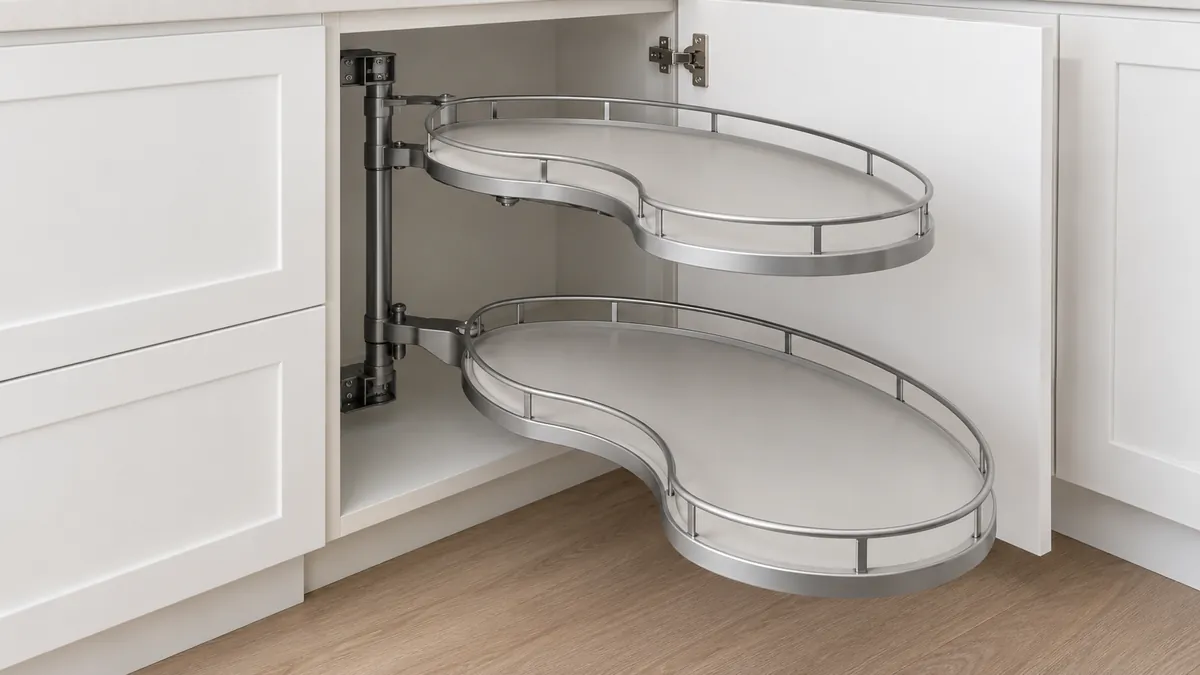
A pull-out mechanism translates a tray or basket outward along one or more linear slides. A swing-out mechanism uses a pivot, hinge, articulated arm or similar path to rotate a shelf or basket through an opening. Some commercial products combine multiple motions, but the buyer should describe the actual path rather than using “pull-out” as a catch-all term.
The mechanism path affects which contents move first and where they end up. A straight slide may bring a basket toward the user while keeping its orientation generally consistent. A pivoting system may carry a shelf laterally and forward, exposing contents in a different sequence. A combined system can include nested or sequential movements. These descriptions are broad categories; actual designs vary by supplier and product series.
One cabinetry product-development discussion raises a practical question about supporting a custom unit after it slides out and swings open. It is one user’s project discussion, not evidence of a general failure rate. It highlights an important sourcing point: the moving assembly must be supported in the positions where it is intended to operate, and the buyer should not infer support behavior from a static catalog view.
The two pictured approaches below are distinct concepts, not Koitor products or direct equivalents to named brands. The current Kesseböhmer LeMans II product page describes a proprietary articulated blind-corner system. Any stated fit, adjustment, load, or motion claim belongs to that supplier’s exact product and instructions; it should not be transferred to another mechanism.
Which cabinet dimensions and obstructions decide whether a system fits?
Start with the cabinet opening and the full internal geometry. Record clear opening width and height, internal width and depth, vertical clearances, panel thickness, corner location, fixed shelves, plumbing or wiring, nearby appliances and adjacent cabinet fronts. A measurement at the cabinet face alone may not show a narrowed interior or an obstruction along the mechanism path.
Door details are just as important. Note hinge side, opening direction, hinge swing, door thickness, handle projection, overlay or inset arrangement, and any adjacent door or drawer that can occupy the same space. A mechanism may fit inside a box when closed but collide with an open door, handle, nearby drawer or user movement when extended. The buyer should check both the stored position and the complete open path.
Create a motion-envelope drawing or annotated cabinet plan showing the path from closed to fully accessed position. Include the door at its intended open angle, shelves at relevant positions, and the nearby obstruction boundary. If the mechanism uses separate stages—such as a front carrier moving first and inner baskets moving later—show each stage. Ask the supplier to identify required clearances and installation restrictions for the chosen model.
There is no single clearance number that fits every blind-corner mechanism. Supplier guidance for a proprietary series may include minimum openings, cabinet depth, shelf positions or limits on travel. The buyer should use current instructions for the exact SKU and verify the actual cabinet drawing. A generic promise that a unit “fits a standard corner” does not resolve an unusual door, filler, partition or adjacent appliance.
How does usable access differ from nominal cabinet volume?
Usable access describes which items a user can reach and remove in the intended sequence. Nominal volume describes geometric space. A blind-corner cabinet can have substantial volume that remains difficult to use if a shelf blocks the opening, an item is hidden behind another tray, or the mechanism does not expose the deepest area.
Compare systems using representative items and a retrieval task. What items are stored? Which are accessed daily? Does the buyer want to reach one container without moving others? Are larger objects loaded vertically or slid into place? Does the system need to accommodate tall bottles, cookware, cleaning products or packaged goods? These questions help determine whether the priority is maximum shelf area, direct access, minimal movement, easier cleaning or a simple packout. For blind corner swing out vs pull out selection, evaluate this usable access before comparing a supplier’s capacity or storage-area claims.
| Considerações do comprador | Pull-out path to review | Swing-out path to review |
|---|---|---|
| Opening geometry | Slide length, carrier width and full extension path | Pivot location, arm path and shelf sweep through opening |
| Door interaction | Whether the carrier clears door and handle | Whether the rotating shelf clears door, adjacent front and user |
| Stored items | Which basket moves and whether contents remain reachable | Whether rotating shelves expose items in a useful sequence |
| Support | Slide mounting surfaces and support in extended position | Pivot/arm support and restrictions through travel |
| Retrieval | Hand access and removal path from the extended basket | Shelf edge, item spacing and access to rear or inner zones |
| Service | Removal of baskets or slide components | Access to pivots, joints, stops and adjustment points |
This comparison is a decision framework, not a product rating. A sophisticated articulated system may improve retrieval for a particular cabinet but introduce more moving interfaces. A simpler pull-out may suit a different layout. Compare the tested configuration and the buyer’s actual use case rather than a generalized “more storage” claim.
What should a buyer review on a mechanism sample?
Review an assembled sample in a cabinet mockup that matches the intended opening and neighboring conditions as closely as practical. A mechanism installed in an oversized display box may appear smooth while concealing interference in a narrower production cabinet. If a full cabinet is unavailable, use a controlled fixture and document the differences from the final installation.
The fixture should reproduce the surfaces that carry the mechanism, not just the visible opening. Panel material, thickness, reinforcement, fastener location and cabinet squareness can influence how a slide or articulated arm is mounted. If the supplier recommends a template or drilling pattern, keep the template version with the approved drawing. A sample that was shimmed, repositioned or adjusted during installation should be documented so the final production setup does not rely on undocumented corrections.
Also consider the user’s position relative to the cabinet. A pull-out carrier may extend into a narrow walkway; a swing-out tray may occupy lateral space in front of an adjacent cabinet. The buyer can map this as a simple outline on the floor or drawing, then check whether the planned retrieval position remains usable. This does not require the article to declare one mechanism safer or more convenient in every kitchen; it makes the layout consequence visible before tooling, packaging and retail instructions are finalized.
Begin with component identity: mechanism model, revision, mounting hardware, basket or shelf dimensions, door handing and installation instructions. Confirm that the drawings correspond to the supplied sample. Verify slide positions or pivot locations, fastener access, door clearance and alignment. Check whether the basket or tray can be removed for cleaning or service and whether the instructions explain that step.
Operate the mechanism slowly through its full intended path. Observe when each component moves, where it stops, whether another tray follows or remains in place, and how the door interacts with the carrier. Look for binding, unintended contact, tilting, racking, loose interfaces, inconsistent stops or a support condition that changes with extension. These are sample observations, not a substitute for a defined test or certified performance claim.
Place representative items in the baskets using the buyer’s intended arrangement. Check whether the user can reach each item, see labels where needed, remove the item without awkward lifting, and return it without knocking other contents. Review the heaviest or largest expected item only under supplier-defined conditions; do not create or infer a load rating from an informal sample exercise.
Record the cabinet mockup dimensions, component identifiers, sample results and any untested assumptions. If the mechanism is adjusted during review, document the final position and repeat the relevant movement checks. A dated approval record helps maintain consistency between the engineering sample, purchase order, installation sheet and later production.
What should the RFQ include when comparing mechanisms?
An RFQ should let suppliers evaluate the same cabinet and stored-item problem. Provide a dimensioned cabinet drawing, door and hinge details, surrounding obstructions, target storage items, preferred access sequence, installation market, order quantity, sample timing, packaging requirements and any buyer constraints. State whether the supplier may propose a purchased mechanism or must quote a specified model.
| RFQ input | Buyer provides | Supplier returns |
|---|---|---|
| Cabinet envelope | Opening and interior dimensions with panel details | Minimum fit requirements for exact mechanism |
| Door and neighbors | Handing, hinge, handle, adjacent fronts and clearances | Motion path and interference points to verify |
| Stored items | Representative sizes, weights and retrieval priorities | Suggested basket/shelf arrangement and exclusions |
| Mechanism | Pull-out, swing-out or combined preference | Exact product series, instructions and component IDs |
| Installation | Target cabinet construction and fixing surfaces | Mounting pattern, hardware and installation sequence |
| Sample review | Mockup, user tasks and acceptable observations | Prototype and revision plan for approval |
| Commercial package | Quantity, private label, carton and manuals | Quote assumptions and packout details |
Ask for a motion-envelope drawing, not only a closed-position product render. Ask the supplier to separate its stated product specifications from installation assumptions and to identify any geometry that is outside the listed fit range. If a named brand’s system is being considered, use that brand’s current documentation and do not imply that another supplier’s basket is interchangeable without evidence.
What sourcing mistakes create avoidable fit problems?
The biggest avoidable mistake is choosing a mechanism from a product photo before measuring the cabinet and mapping the motion path. Other common gaps include comparing only shelf area, omitting the door hinge and handle, overlooking adjacent fronts, and failing to tell the supplier which items must be reached first.
Do not combine components from different proprietary systems based solely on similar shelf shape or nominal cabinet width. Tray shape, pivot geometry, slide length, mounting points, stops and adjustment features can be specific to a system. A replacement basket that looks similar may not attach securely or follow the same path.
Do not publish broad fit or capacity claims unless the exact combination and conditions are supported. A supplier’s load rating applies to its named product under the stated mounting conditions. It does not automatically apply to a different cabinet, mounting surface, basket, mixed mechanism or altered installation. Keep an approval matrix that identifies the cabinet envelope, mechanism revision and accepted shelf arrangement.
Change control should trigger review when cabinet dimensions, door handing, hinge, adjacent appliance, basket size, mechanism supplier, pivot or slide mounting, or storage contents change. Some changes may be minor; others can alter motion clearance or support. The supplier and buyer should decide which checks need repeating instead of assuming every change is safe or disqualifying.
Perguntas frequentes
Is a swing-out system always better for a blind corner?
No. Blind corner swing out vs pull out depends on cabinet geometry, stored items, retrieval priorities, door movement, clearance and the exact system. A swing-out path may improve access in one layout and create interference or added complexity in another.
Does a pull-out basket use more of the cabinet volume?
Not necessarily. Nominal shelf or basket area does not show what the user can reach. Compare the accessible storage zones and retrieval sequence using the actual cabinet and representative contents.
Can the same cabinet accept any pull-out or swing-out kit?
No. Each system has product-specific fit conditions, hardware and installation instructions. Confirm the exact mechanism model and cabinet dimensions with the supplier.
What is the most useful sample test?
A representative assembled fit review that follows the full motion path, door interaction and intended item retrieval. Use supplier instructions and agreed acceptance criteria; an informal review does not establish a universal load or durability rating.
Discuss a blind-corner storage sourcing requirement
Share the cabinet and door drawings, intended stored goods, access sequence and any candidate mechanism documentation. Koitor can discuss metal basket and sourcing inputs within confirmed capabilities; proprietary mechanism fit must be confirmed for the exact system.
OEM / MARCA PRÓPRIA
Transforme este guia de fornecimento num resumo do produto
Indique o produto pretendido, as dimensões, o acabamento, a quantidade a encomendar e os requisitos de embalagem. A sua equipa receberá uma análise prática da viabilidade de fabrico antes da apresentação do orçamento.
 English
  Español
  Português
  Français
  Deutsch
  العربية