
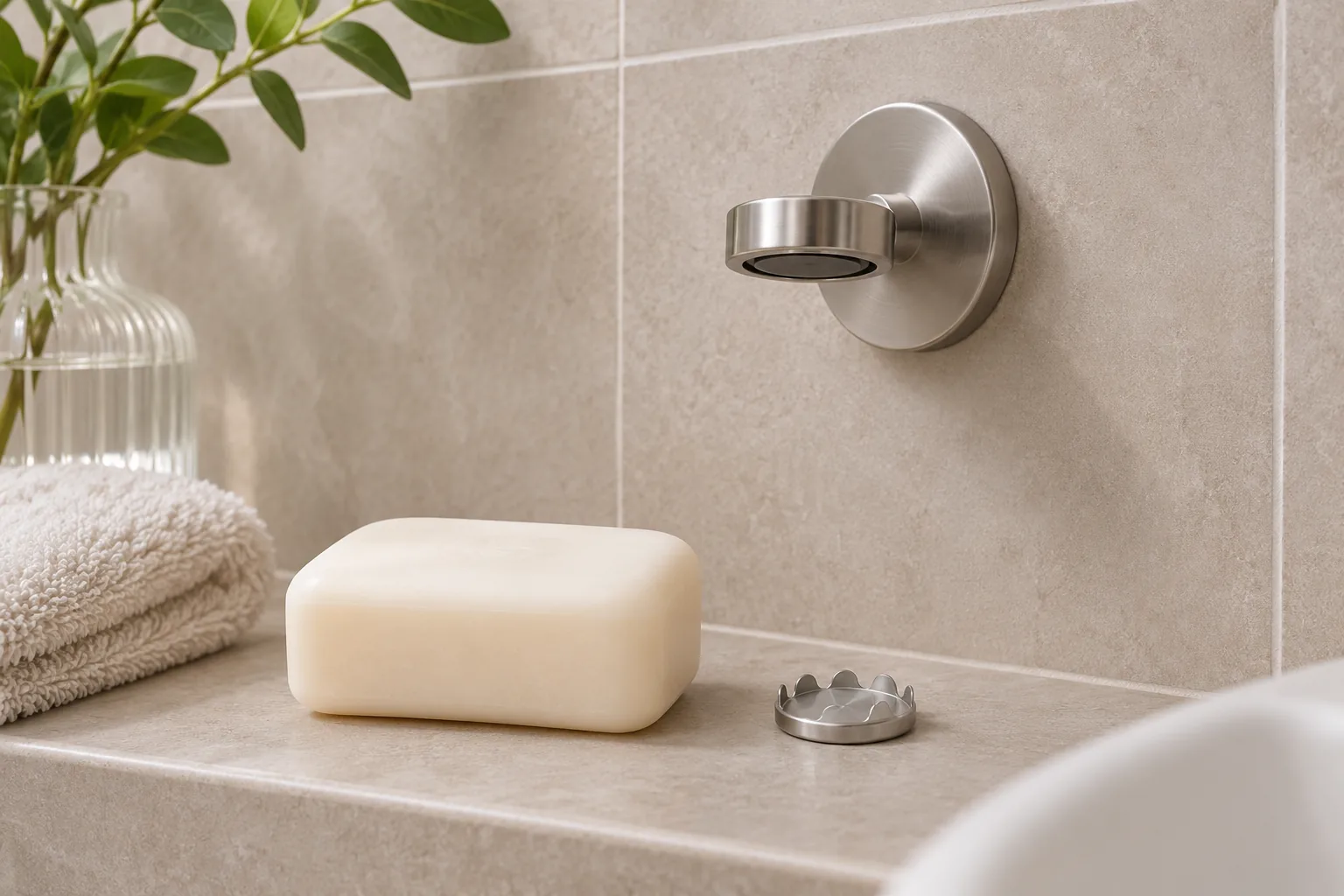
Magnetic soap holder soap disc compatibility depends on two separate interfaces: the insert must remain anchored in the soap bar, and the insert must engage with the holder as intended. A magnet that attracts the disc does not prove that the disc stays embedded when the user removes the bar. Buyers should approve the actual soap reference, insert revision and holder model together, then record what happens during the maker-described use and removal action.
This distinction is useful to importers building bathroom assortments because a listing may describe a “magnetic soap holder” as though it were one simple connection. In practice, the finished experience includes the soap, an insert or disc placed in it, the magnetic support, and possibly a separate wall attachment. Those parts may come from different suppliers. The importer should identify who owns each component and which combinations have been checked, rather than assuming that discs with similar appearances are interchangeable.
For a new assortment, magnetic soap holder soap disc compatibility should be documented for the named soap, insert and holder revisions rather than inferred from one matching pair.
Maker information demonstrates that the operating details vary. Savont’s guide describes an insert placed into soap and attracted to a holder, and notes that soap consistency and holder selection matter to that model’s use. Its product information names model-specific components and replacement parts. DULTON describes a toothed insert pressed into soap and connected to a magnetic support, with product-specific handling and mounting cautions. These sources support separating interfaces and following current product instructions. They do not provide universal dimensions, attraction forces, cycle limits, soap lifetimes or compatibility across brands.

What does compatibility mean for a magnetic soap holder?
Compatibility is a documented pairing of identified parts under stated conditions. It is not merely that the metal disc is attracted to the holder in a demonstration. The buyer should know which soap is used, which insert is placed in it, which holder catches the insert, and how the combined assembly is intended to be removed and returned. If the holder is mounted to a wall, that is another interface with its own fit and installation evidence.
The insert-to-soap interface asks whether the insert remains in the bar during the expected removal action, following the insert supplier’s instructions. The insert-to-holder interface asks whether the intended face or feature meets the holder at the designed location and releases as the product maker describes. The holder-to-wall interface concerns how the holder itself is installed. A success at one connection cannot be used as proof for another.
A buyer’s observation should be bounded. For example: this soap bar model, prepared according to this insert maker’s instructions, was used with this holder revision; the bar was removed using the stated method; and the insert either remained or separated. That record is more useful than a generic “magnetic compatible” label. It also helps diagnose which interface needs attention if a problem appears.
Do not establish a minimum magnetic force or promise that a stronger magnet solves every separation issue. The sources reviewed do not specify a common force test or a universal acceptance value. If a program needs measured performance, the buyer and responsible suppliers should agree on the test setup, soap condition, orientation, removal method and acceptance rule. A short demonstration is not a lifetime test or a guarantee for every bar.
How should buyers assess the insert-to-soap interface?
Start with the insert maker’s actual directions. Identify the approved insert model, its orientation, how it is placed into the soap and any preparation instructions. Do not copy a proprietary tooth or barb design into a new product without authorization. The DULTON page describes a toothed insert pressed into soap; that is a feature of its product, not a universal design instruction for other suppliers.
The soap itself is part of the combination. Savont’s guide notes that the soap’s consistency matters for its approach, and its product information recommends particular soap characteristics. Those statements apply to that maker’s products. They should not be rewritten as universal chemistry advice or as a claim that every soap with a given appearance works. The importer should document the exact soap references intended for the range and ask the insert supplier whether its instructions apply.
A representative sample should include the actual production or buyer-approved soap, rather than an unspecified demonstration bar. Record the maker, product name, size or variant if supplied, and any condition information the supplier says matters. Soap can change as it is used; the buyer should not extrapolate from a new sample to every later state unless the product supplier provides relevant support. This article provides no soap lifespan, moisture threshold or holding duration.
Observe the insertion and removal method specified by the maker. Note whether the insert remains in the soap after the intended removal, whether it appears to shift, and whether the contact condition differs from the supplier’s instruction. Do not pry the insert out or add glue based on an assumption. Such changes would alter the tested configuration and could create new questions about the material, consumer instructions or compatibility. If the maker gives no clear guidance for a proposed soap type, ask before making a product claim.
How should buyers assess the magnetic interface separately?
Confirm the exact holder and insert revisions and their intended orientation. The face that meets the holder may have a specified surface or direction. Record how the part is presented and whether the holder captures it at the position described by the manufacturer. Do not infer a force rating from the fact that the insert attaches during a brief showroom demonstration.
Review the separation action as the supplier describes it. A user may lift or pull the soap bar in a particular direction; the actual path can affect which connection releases first. The intended outcome for the product may be that the soap separates from the support while the insert remains in the bar, but that should be evaluated under the maker’s instructions for the actual combination. Do not invent a universal angle, speed or hand force.
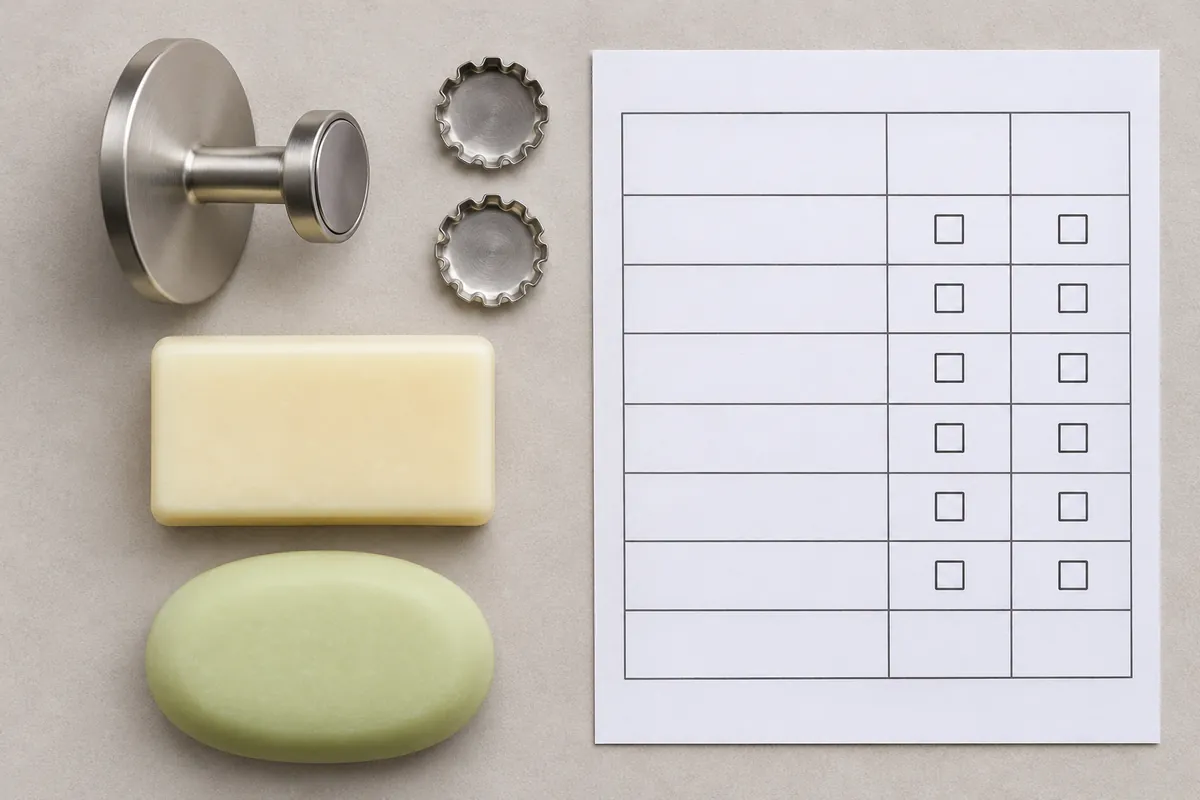
A simple observation log can identify the separation point:
| Item | What to record |
|---|---|
| Soap | Exact maker, product and variant |
| Insert | Model, revision, source and orientation |
| Holder | Model, revision and intended position |
| Preparation | Steps followed from current supplier instructions |
| Removal | Described user action and setup |
| Outcome | Insert remained in soap, separated, shifted or pending |
| Repeat configuration | Whether the same parts and conditions were used |
| Decision | Approved pairing, excluded pairing or open question |
If the insert stays in the soap but the soap does not engage with the holder as expected, the issue differs from an insert that pulls out of the bar. Record the observed interface rather than labeling the whole system “weak.” The research sources provide no validated diagnostic force levels, so visual behavior should not be converted into an engineering root cause without supplier review.
Do not alter the magnet, add an adhesive layer, reshape the insert or substitute a similar disc without review. A change can affect contact, release or wall mounting. If the supplier proposes another insert, obtain its identity and instructions, then assess that exact pair. Visual similarity is not evidence of equivalent materials, dimensions, magnet interaction or retention.
What makes a useful assortment and compatibility matrix?
A distributor may want to offer several holder finishes, replacement inserts or soap pairings. The assortment record should list each combination that has been reviewed and separate it from combinations that are merely proposed. A common holder shell does not prove that every insert revision or soap reference is supported. Likewise, a maker’s replaceable-component listing is not a promise that a third-party replacement fits.
Use one row per approved pairing. Include the source documents and effective date. For any untested or undocumented pair, mark it pending rather than extending an existing approval. A product page can then state the actual supported combination and avoid broad wording that customer service cannot substantiate.
| Holder model | Insert model | Soap reference | Wall attachment | Evidence status |
|---|---|---|---|---|
| Named model and revision | Named insert and source | Exact soap product | Current maker method | Sampled and approved for stated conditions |
| Named model and revision | Alternate insert | Exact soap product | Same or changed mount | Pending supplier review |
| Replacement holder | Existing insert | Existing soap reference | Changed wall setup | New combination; do not assume |
| Unnamed or generic part | Unknown | Unspecified | Unknown | Not assessed |
Separate replacement availability from compatibility. If a maker names a replacement part, preserve the part number and the product family it applies to. Do not promise that it will remain available, fit another brand or be orderable in every market. For private label, obtain a written parts list and change-notification arrangement if future service support is important to the buyer. A product that uses a removable insert does not automatically include or offer replacement inserts.
How is this different from a soap dish or suction-mounted holder?
A magnetic suspended arrangement is not the same as a tray that supports a bar or a suction-mounted holder whose connection to a wall is the primary concern. The product decision and failure location differ. A tray buyer may evaluate drainage openings, support spacing or whether a used bar remains inside the dish. A suction-holder buyer may focus on the mounting surface and attachment instructions. A magnetic arrangement adds the insert-to-soap and insert-to-holder relationship.
Koitor’s no-drill bathroom accessories manufacturer page addresses mounting approaches such as suction or adhesive as a separate decision. The wire soap dish drainage and bar retention guide addresses openings, drainage and how a soap bar is retained by a wire support. Those pages remain the owners for their respective product decisions. This article links them for comparison without reusing their mounting, drainage or generic bar-sizing sections.
This boundary matters for keyword and product organization as well as engineering. A shared phrase such as “soap holder” does not mean the same buyer question is being answered. Keep the magnetic article’s scope on the suspended insert and release sequence. If an importer sells both magnetic and suction products, maintain separate documentation and product claims for each architecture.
What should be reviewed before sample approval?
Before the sample is signed off, gather current instructions from the holder and insert suppliers, identify the intended soaps, and determine which supplier owns the magnet assembly and wall attachment. Confirm whether the product is sold as a holder alone or with inserts and soap. The package contents and images should make that distinction clear. If any components are sourced separately, document their exact item identifiers and the buyer who approved the combination.
Review the actual sample in the specified configuration. Follow the supplier’s insertion and removal method. Record where the connection releases and whether the insert stays with the bar as intended by the product maker. Keep the observation tied to the soap and part revisions. If conditions such as soap state, orientation or surface preparation are not defined, make that uncertainty visible instead of filling it with a made-up test threshold.
A sample review does not prove universal compatibility, lifetime, corrosion resistance, hygiene or antimicrobial effect. It does not demonstrate that the holder can be mounted on every wall surface. If the holder has a separate mounting system, follow its own maker instructions and evaluate that interface independently. A magnetic connection between soap insert and holder cannot establish the performance of a wall pad or suction cup.
Give each supplier a focused review question. The insert supplier should confirm the current insertion method and which soap references its guidance covers. The holder supplier should identify the corresponding holder and insert models and describe the intended attachment and release. The soap supplier can confirm the identity and any relevant handling information for the selected bar. The importer then coordinates the combined assortment and owns the wording on the product offer. One supplier’s approval of its own part should not be represented as approval of every other component in the system.
When one supplier sells the entire set, ask whether the compatibility statement applies to every item in the carton or only to the supplied reference parts. If the packaging permits replacement soap or inserts from another source, establish whether the maker has tested or documented those alternatives. If it has not, communicate the bounded compatibility information and avoid implying that any replacement part is suitable. A buyer may choose to offer other combinations later, but each should be documented separately.
The sample record should preserve the source version used. Product pages and instructions can change, and a generic family page may not list all model exceptions. Save the document title, URL, date reviewed and exact part identifier. If the source describes a replacement component, preserve the model relationship stated by the maker rather than copying only the part name. This allows a later category manager to tell whether a claim came from a current instruction, an older page or a physical sample observation.
If a sample behaves differently from the product instructions, pause the compatibility decision and ask the relevant supplier to clarify. Record the observed condition without deciding the root cause prematurely. A disc that comes away from a bar might relate to insertion method, soap condition, insert model or another factor; the available evidence does not establish which explanation applies to an arbitrary product. Do not solve the uncertainty by adding adhesive, pressing more forcefully or changing the magnet without supplier approval.
For retail packaging and instructions, keep the approved configuration visible. If the insert must be placed into the soap by the user or by a production partner, clarify who performs that step and what the approved method is. If the product is sold with an already prepared bar, record the exact supplier process and avoid describing it as permanent or maintenance-free without evidence. If replacement inserts are sold separately, align their labels with the holder models actually documented by the maker.
Use a change-control trigger for any change to the insert, holder, magnet, soap reference, preparation instruction, mounting part or product listing. The buyer and relevant supplier should decide whether the change requires a new sample or updated documentation. Changes do not automatically mean a product is unsuitable; they mean that the earlier approval may not describe the revised configuration.
Claims and questions buyers should avoid
Do not claim that a magnetic holder works with every soap bar or every insert. Do not promise a specific force, number of cycles, bar lifespan or reliable retention through every stage of soap use unless the responsible supplier has substantiated that exact statement. Do not state that a stronger magnet guarantees the insert will stay anchored. The two interfaces have separate failure possibilities and need separate evidence.
Avoid hygiene, drying, antimicrobial or mold-prevention claims based solely on a bar being suspended. The sources reviewed describe product operation and recommendations, but they do not establish a general health benefit or test outcome for every combination. Follow current maker care guidance and obtain appropriate evidence for any environmental or performance claim the buyer intends to make.
The buyer should also distinguish a metal component description from a material declaration. A product listing may describe a holder or insert as metal without identifying the exact alloy, finish or construction for every part. Do not infer that the magnet, support and insert share a material or finish. If corrosion or appearance is important for the intended bathroom environment, request the supplier’s declarations for the exact components and determine what evidence is appropriate. This guide does not assign a grade, coating or corrosion duration to any cited product.
Likewise, mounting statements should remain tied to the exact wall attachment system. The fact that a holder is magnetic says nothing about whether it is fixed by suction, adhesive, screw or another method. Follow the holder maker’s instructions for the supplied mount and the intended surface. The existing Koitor suction-holder and wire-dish guides address different mounting or retention decisions; their guidance should not be silently merged into a magnetic product specification.
For catalogue teams, translate the evidence into a bounded compatibility statement. Name the tested holder and insert, identify the soap reference if the maker’s guidance is product-specific, and state whether tools or replacement pieces are included. If the scope is not known, use a pending status internally instead of writing an expansive external claim and planning to clarify it later. Customer service should receive the same approved model list so that verbal answers do not extend the listing beyond the available evidence.
Does a stronger magnet fix insert pullout? Not necessarily. If the insert-to-soap connection releases first, magnetic strength alone may not solve the issue. Identify the observed separation point and ask the responsible suppliers.
Are visually similar metal discs interchangeable? Do not assume they are. Confirm model, dimensions and supplier guidance for the exact holder and insert.
Does attachment during a demonstration prove compatibility? It shows that an attraction occurred in that setup. It does not establish the soap anchoring behavior or support a universal claim.
Can the buyer recommend a different soap? The buyer can select an assortment, but should obtain the insert supplier’s guidance and assess the exact soap reference before stating compatibility.
Is a replacement insert automatically available? No. Confirm the part identity, product family and current supply terms with the maker.
Does a magnetic soap holder replace wall-mount review? No. Holder-to-wall attachment is separate and should be handled under the relevant mounting product’s instructions and evidence.
A dependable sourcing decision names the soap, insert and holder, follows the current maker instructions, and records which interface was observed. Approve exact combinations, keep replacement availability distinct from removability, and recheck the configuration when a supplier or part changes. This gives buyers a clear compatibility record without inventing universal forces, product capabilities or performance outcomes. Reassess magnetic soap holder soap disc compatibility whenever the soap reference, insert model or holder revision changes.
Trabalhe com a Koitor Hardware
Discuss a Bathroom Hardware Component
Share the actual metal-part drawing and purchased insert or holder references for scope review. Current Koitor production of magnetic soap holders, magnets or proprietary inserts is unconfirmed.
OEM / MARCA PRÓPRIA
Transforme este guia de fornecimento num resumo do produto
Indique o produto pretendido, as dimensões, o acabamento, a quantidade a encomendar e os requisitos de embalagem. A sua equipa receberá uma análise prática da viabilidade de fabrico antes da apresentação do orçamento.


 English
 Español
 Português
 Français
 Deutsch
 العربية