
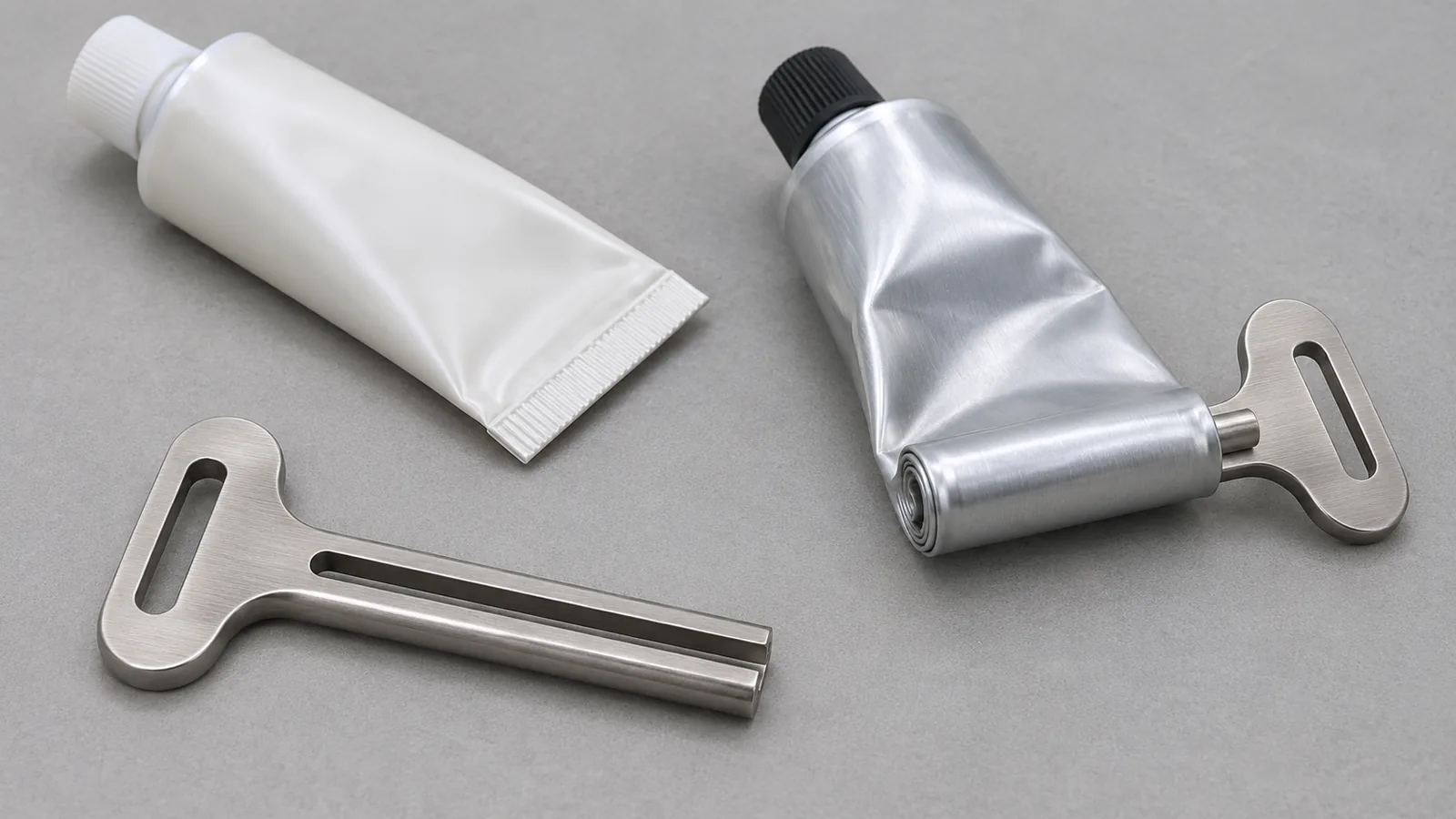
Metal tube squeezer compatibility depends on the actual tube end, the key or winding tool, and the way the maker intends them to be used. A tube that can be placed in a slot is not automatically compatible through winding, and a metal body or broad “multi-purpose” label does not prove that every tube construction or contents condition will work. Importers should identify the exact reference tubes, match their folded or sealed ends to the intended tool, follow current supplier instructions, and record what happens during an agreed sample review.
The important distinction is between initial engagement and continued operation. A tube end may enter a slot, yet the key may slip or fail to support the folded material in the expected way as the contents are used. A different tube may have a harder end, a different fold, or a construction the tool maker excludes. These are model and use-specific questions. The buyer should not respond by forcing the tube, adding leverage or assuming that an initial fit observation establishes a performance claim.
Maker documents provide useful but bounded examples. DULTON’s H21-0366 page describes a stainless winding or standing product, illustrates its slot-insertion operation and explicitly excludes hard tubes or hardened contents for that model. Its directions and cautions are specific to its product. Georganics describes a winding key and gives use directions; one customer review reports a grip problem and a seller response about operation. That single exchange is an anecdotal use signal, not a test result, defect rate or proof of a systemic issue. Neither source supports universal dimensions or a claim about Koitor’s manufacturing capability.

What should an importer mean by metal tube squeezer compatibility?
For procurement, compatibility should mean that a named tube model and condition have been assessed with a named winding tool revision under the instructions and use conditions that apply to that combination. It should not mean merely that the tube fits into a slot, that the tool can be turned once, or that a retailer uses broad category language such as “fits most tubes.” The buyer’s approval should state which tubes were considered and what was observed.
There are several distinct questions to keep separate:
- Does the folded or sealed end enter the tool’s slot as the maker directs?
- Does the tube remain supported as winding proceeds?
- Does the key engage without slipping, pinching or visibly damaging the tube end under the agreed review?
- Does the actual contents condition fall within the tool maker’s stated limits?
- Can the user remove the tube and tool as directed?
- What compatibility wording can the importer substantiate from that review?
A positive answer to one question does not settle the others. A tube may fit the slot while its end construction is unsuitable for ongoing winding. The contents may be hardened even though the tube’s outside dimensions look familiar. A product that stands upright may not be designed for the same tube-end engagement as a winding key. The buyer should document those distinctions rather than collapsing them into one checkbox labelled “fits.”
The approval should be bounded to the exact reference set. Record the tube maker and model, packaging or lot reference where relevant, type of end fold as identified by the supplier, tool model and revision, operating direction, and any maker exclusions. If a dimension is recorded, state which feature it describes and where it came from. A measurement from a photograph or another product listing is not a controlled specification.
Do not infer that “metal” defines the tool’s precise alloy, temper, finish, corrosion behavior or manufacturing process. A product title or visual appearance can describe the general form without documenting those details. When those facts matter to the buyer’s listing or market, obtain the current supplier declaration for the exact product.
Why is the tube end more important than the outside tube width?
The interface between the winding tool and the tube is at the end that enters or wraps around the key. Overall tube width may be useful for early assortment screening, but it does not describe the fold, seam, laminate, stiffness, or end reinforcement that the tool contacts. Two tubes with similar outside widths can have differently formed ends. Conversely, two tubes with different bodies may share a similar-looking tail while still behaving differently during winding.
Buyers should request a sample of each named reference tube, especially when an assortment spans different brands or product families. Photograph the tube end before insertion and note its visible construction without pretending that visual inspection identifies hidden materials. If the tube maker provides a technical specification or compatibility note, retain the document and version. A physical sample shows the supplied item; it does not reveal every property of its layers or seal.
A simple comparison record can include these fields:
| Reference field | Buyer record |
|---|---|
| Tube identity | Maker, product name, size and revision or package reference |
| End description | Supplier terminology and visible fold or sealed profile |
| Tool identity | Key maker, model, part code and revision |
| Intended insertion | Orientation and method from the current tool instructions |
| Initial engagement | Whether the end entered as directed without forcing |
| Winding observation | Direction, support and any observed slip or damage under agreed conditions |
| Contents condition | New, partly used or another supplier-defined condition |
| Outcome | Approved for named combination, excluded or pending |
| Evidence | Instruction, drawing, sample photo and review date |
The table deliberately avoids a universal slot width, tube thickness, turning force or acceptance tolerance. The research sources do not establish common values across products. If the buyer requires numeric limits, the tube supplier and tool supplier should identify the applicable controlled documents or agree how the limits will be determined for the specific design.
Tube construction also belongs in change control. If a supplier changes its end-forming method, packaging or material structure, the outside dimensions may remain similar while the tool interaction changes. The importer should ask what material or construction changes trigger notification and whether a new sample is required. This is not a claim that any change necessarily causes poor operation; it is a reason to confirm that the earlier approval still represents the supplied product.
How should buyers separate slot entry from winding?
Treat insertion and winding as two review stages. First, follow the maker’s stated method for placing the tube end into the slot. Observe whether it engages as described and whether the tube needs an unapproved bend, pinch or force to enter. If the tool maker’s product page or instructions specify an exclusion, follow it rather than trying to overcome it. DULTON’s listed exclusions for hard tubes or hardened contents apply to that named product and should not be generalized as a rule for every winding tool.
Second, evaluate winding only under supplier-approved conditions. Record the intended direction, how the tube is supported, and whether the tool remains engaged during the agreed observation. Note visible slippage, unexpected movement, creasing or damage. Do not state that the tool empties the tube completely, reduces waste by a percentage, or provides a specified leverage advantage unless suitable evidence for the exact product supports that language. Neither initial insertion nor a short demonstration proves long-term operation.
Avoid forcing a tube that resists. Do not use pliers, an extension handle or another improvised lever to increase torque. That can change the use condition and create a risk not addressed by the maker’s instructions. If a sample does not proceed as described, stop and ask the supplier whether the tube is within the intended scope. Record the issue and decision rather than modifying either product to make the sample appear compatible.
The review method should be agreed before testing. Identify who supplies the samples, whether each sample is new or partly used, how the tube is positioned, which user action is being observed, and what counts as an acceptable observation for that buyer program. The sources cited in this guide do not give a common cycle count, force limit or torque value. Do not invent one. Any quantitative test should be defined with the responsible supplier and tied to a documented claim.
What do maker instructions and customer feedback actually establish?
A product page can establish the manufacturer’s declared model features and limitations when the current page is inspected. DULTON’s H21-0366 page describes its winding and standing use, shows insertion into the tool, and gives explicit exclusions. Those declarations tell a buyer what the maker says about that product. They are not independent laboratory evidence, a universal tube specification or proof that a different key has the same restrictions.
Georganics’ published directions provide an example of how use method can matter. A customer review reports a grip problem; the seller responds with guidance about use. The exchange shows that operating instructions and user expectations can be relevant to the buyer’s review. It does not establish how often the issue occurs, whether a design defect exists, how the reviewer’s tube was constructed, or whether another product will behave similarly. Treat it as one qualitative question lead only.
The distinction between supplier statement, buyer observation and inference should be explicit in the file:
| Evidence type | What it can support | What it cannot establish on its own |
|---|---|---|
| Current maker instructions | Intended operation and stated limitations for that model | Compatibility with every third-party tube |
| Supplier drawing | Dimensions and features within the drawing’s scope | Performance under conditions not specified |
| Buyer sample observation | What happened with the exact samples and method reviewed | Defect rate or long-term performance |
| Individual review | One reported experience and possible question to investigate | Prevalence, root cause or population-wide conclusion |
| Product photograph | Visible form and arrangement | Alloy, hidden construction or a controlled dimension |
This evidence labeling is especially important when preparing product copy. Do not turn one manufacturer’s exclusion into a universal warning, and do not turn one positive sample into a broad multipurpose claim. Instead, name the reference tubes that have actually been assessed and state the boundaries of any compatibility language.
How should buyers choose representative reference tubes?
A reference set should represent the exact products the importer plans to name, not a convenient collection of tubes chosen only because they are nearby. If a listing will mention several brands or product families, obtain each actual reference or reliable controlled drawings from their manufacturers. Keep the sample identities legible in internal records even when the public article or product listing avoids brand endorsement.
Consider variations that the supplier identifies as relevant: tube size, tail construction, material family, closure condition or contents state. Do not assume that different sizes are the only meaningful variation. The pack’s research supports recording construction and actual end form; it does not provide a universal classification of all tubes. Ask the tube supplier what changes are significant and the tool maker what limits apply.
A practical matrix can make gaps visible:
| Tool revision | Tube reference | End construction evidence | Contents condition | Result | Customer-facing scope |
|---|---|---|---|---|---|
| Exact named key | Reference A | Maker document and sample | State used in review | Approved, pending or excluded | Name only this reference if appropriate |
| Same key | Reference B | Sample only; construction unconfirmed | State used in review | Pending clarification | Do not imply broad support yet |
| Proposed alternate tool | Reference A | Same tube sample | Same or changed condition | New pairing, not inherited | Re-review before adding a claim |
| Unknown tube | Not identified | None | Unknown | Not assessed | No compatibility claim |
A “representative” sample is not automatically representative of a whole brand. If the importer approves one product within a brand, do not expand that approval to all tubes from that source without evidence that the relevant construction and use conditions are shared. The statement should track the true evidence boundary.
For assortment planning, choose references based on the customer-facing scope rather than on convenience. If a distributor intends to market a key beside a limited set of refill tubes, ask for those exact references first. If the listing will name a tube family, clarify whether the family has one controlled end construction or several. If the tube supplier cannot provide that information, preserve the uncertainty and use a smaller named list. A specific and accurate model matrix is more useful than a broad compatibility promise that no supplier has reviewed.
The buyer can also separate technical fit from commercial inclusion. A tool may be sold alone while the tube shown in photography is only a reference. A bundle may include a tool and a specific tube. Product descriptions and carton contents should state which situation applies. A photo of a tube beside a key should not imply that the tube is included or that its maker endorses the key. This is a packaging and assortment responsibility, separate from the physical fit review.
When the product includes multiple keys or finishes, identify whether they share the same slot and operating design or whether each variant needs its own record. A finish color change may leave the interface unchanged, but the buyer should confirm that the product revision and supplier documentation support that conclusion. Do not infer material grade, coating or manufacturing route from a color name. If the intended claim is identical across variants, keep the evidence that justifies applying it to each SKU.
What should a private-label approval record contain?
A private-label approval record should connect the product identity to the evidence used for the compatibility claim. Keep the drawing or product reference for the tool, the exact tube identifiers, current instructions, review date, observed results and responsible approver. Include both accepted and unassessed combinations so that purchasing changes do not silently broaden the scope.
The record should answer:
- Which tube references were supplied and by whom?
- Which tube-end construction information came from a maker document versus observation?
- Which tool model and revision were tested or sampled?
- Which instructions and exclusions applied?
- Was the tube new, partly used or in another stated condition?
- What exact insertion and winding method was followed?
- What was observed about engagement, support, slip or visible damage?
- Which combinations are approved, excluded or still pending?
- What wording is authorized for the product page or packaging?
- Which change to the tube, tool or instruction requires review?
Do not use a signed sample sheet to imply that the buyer performed a standardized test unless a defined protocol was actually followed. It can record an ordinary sample review accurately. If formal testing is needed, state the method, responsibility and purpose separately.
Claims should be no broader than the underlying evidence. “Reviewed with reference tube A under the maker’s instructions” is more defensible than “fits all toothpaste tubes.” Metal tube squeezer compatibility is a bounded product statement that must remain tied to the exact tube and tool references assessed. A retailer’s generic use of “universal” does not grant permission to repeat that claim for a different product. Ask the tool supplier what model and tube family its statement covers, and keep proof with the approval record.

What changes should trigger another compatibility review?
A new tube supplier, altered end fold, changed laminate or stiffness, different tool slot, revised key mechanism, new operating instruction, or change in the contents condition named by the maker may require the buyer to reassess. Whether a new sample is needed depends on the change and supplier evidence. Record the decision either way. A change notification process helps the importer know when the approved configuration no longer matches the offered one.
Packaging and artwork changes may also affect which models the product page or carton names, even if the physical parts remain constant. If the claim expands to additional tube brands, sizes or formats, treat that as a change to the claim scope and ask for supporting evidence. Do not use a prior sample approval to justify new compatibility wording that was not considered.
If a tool supplier substitutes material or a manufacturing route, request the impact assessment relevant to the interface and use. The article does not assume that a particular material change automatically alters performance. It also does not assume that the supplier has performed a test. Record what was assessed and which information remains open.
Questions importers should resolve before assortment release
Does a tube entering the slot prove compatibility? No. It proves only an initial fit observation for that sample. Review the winding action and the maker’s instructions separately.
Does stainless steel mean the tool fits every tube? No. Material naming says nothing universal about slot geometry, tube-end construction or intended use. Confirm the exact references.
Can a hard tube be forced into the key? Follow the specific maker’s instructions and exclusions. DULTON lists hard tubes or hardened contents as exclusions for its product. Do not extrapolate a different method or force a tube into the tool.
Can one sample support a multipurpose claim? Not without evidence that the other named tube constructions are within the approved scope. A successful sample is tied to its exact reference and conditions.
Does standing upright prove winding suitability? No. A product may be described as both a standing support and a winding key, but each operation should be considered as the maker documents it. A stable standing position does not establish fit with every tube.
Should an individual review change the specification? It can prompt a question, but one review does not establish prevalence or root cause. Ask the supplier for clarification and assess the intended reference tubes.
A buyer can make a clearer sourcing decision by separating initial slot fit, actual winding, maker limitations and claim scope. Identify the tube references, follow the right instructions, stop when the product is outside stated limits, and keep the approval tied to the reviewed revisions. Reconfirm metal tube squeezer compatibility when the tube, key or use instructions change. Do not invent a force threshold, cycle count, universal fit statement or waste-reduction claim.
Koitor’s approved knowledge includes metal hardware sourcing and general manufacturing considerations, but current tube-squeezer production and specific mechanism capability are unconfirmed. For a metal component concept, send the lawful drawing, exact reference tubes and intended claim through the contact page. Koitor should first confirm whether the requested scope fits its current capabilities; this guide does not imply a current Koitor tube-squeezer product.
Trabalhe com a Koitor Hardware
Discuss a Metal Bathroom Accessory Concept
Share a lawful drawing, actual tube references and intended compatibility wording for scope review. Koitor’s current tube-squeezer production and mechanism capability are unconfirmed.
OEM / MARCA PRÓPRIA
Transforme este guia de fornecimento num resumo do produto
Indique o produto pretendido, as dimensões, o acabamento, a quantidade a encomendar e os requisitos de embalagem. A sua equipa receberá uma análise prática da viabilidade de fabrico antes da apresentação do orçamento.


 English
 Español
 Português
 Français
 Deutsch
 العربية