
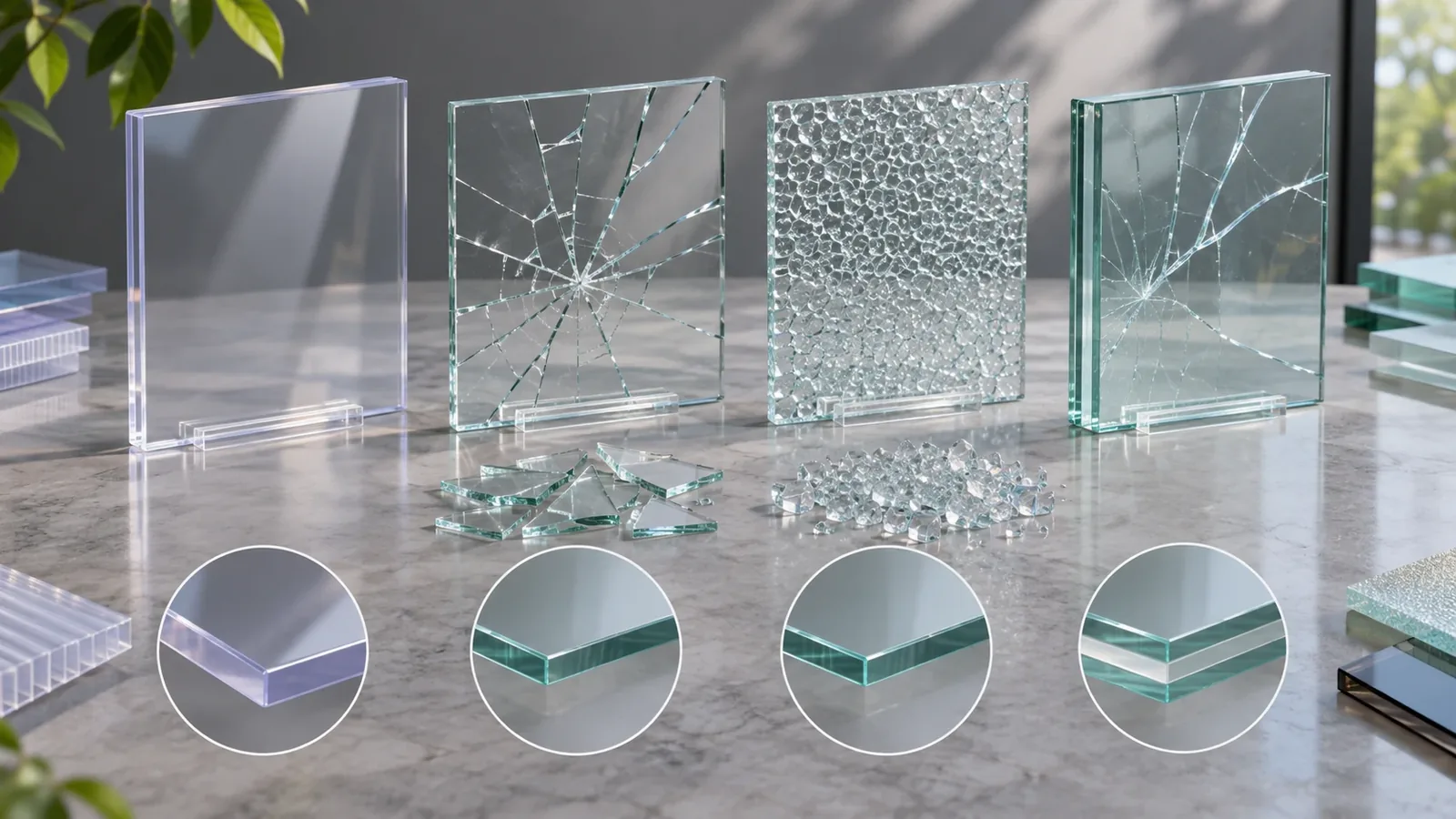
Polycarbonate vs glass is a comparison between specified panel products, not two single materials with one fixed set of properties. Polycarbonate is a family of thermoplastics, while glass panels can be annealed, tempered, laminated or otherwise processed. A buyer should identify the exact panel construction, thickness, surface treatment, optics, edges, holes and mounting method before comparing a part for a metal storage or display assembly. Polycarbonate may provide a lower-mass option for comparable geometry and different impact behavior, while scratch appearance, cleaning, exposure and fabrication need separate evidence; neither material name proves the performance or safety of the finished assembly.
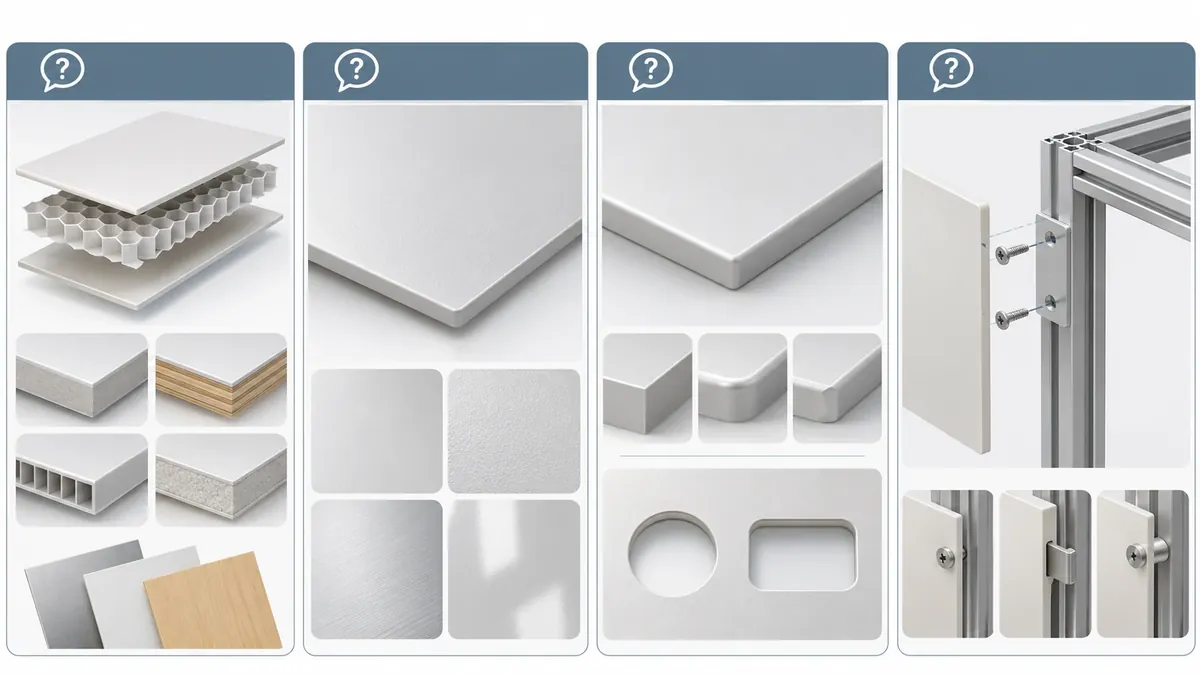
What is the difference between polycarbonate and glass panels?
Polycarbonate is a thermoplastic sheet material, and glass is a broad family of inorganic panels with different processing and construction options. Piedmont Plastics’ comparison is a general sheet-buyer orientation, while Palram’s Palsun product information identifies specific polycarbonate product options. Neither page should be read as a performance promise for an unspecified panel or finished assembly. The phrase “polycarbonate vs glass” therefore needs a product-level comparison. A clear standard polycarbonate sheet is not interchangeable with every coated, structured or UV-treated polycarbonate product. Likewise, annealed glass, heat-treated glass and laminated glass are distinct constructions, with different specifications and intended uses.
For a buyer, the first question is not which material is universally better. The question is what the panel must do in a defined product, environment and assembly. A shelf in a dry indoor cabinet, a transparent guard, a display panel and a panel close to a heat source can involve different requirements. Even where the same nominal material is proposed, the thickness, dimensions, support span, edge finish, holes, surface treatment and mounting components can change the practical comparison.
| Comparison point | Polycarbonate sheet | Glass panel | Pergunta do comprador |
|---|---|---|---|
| Product identity | Thermoplastic family with multiple grades and surface variants | Glass with distinct constructions and processing routes | What exact manufacturer product and construction are quoted? |
| Mass | May be lower than a comparable glass panel geometry | Depends on glass type, thickness and dimensions | Compare actual dimensions and thickness rather than a broad material claim |
| Impact behavior | Product- and condition-specific; a general material name is not an assembly test | Depends on construction, thickness, edge quality, support and impact conditions | What test or use condition is relevant to this product? |
| Surface | Some products have optional treatments; not every sheet has them | Surface and coating options vary by panel product | Is abrasion resistance or a particular cleaning method specified and evidenced? |
| Optics | Depends on sheet grade, thickness, surface and aging exposure | Depends on composition, thickness, processing and surface condition | What transmission, appearance or distortion is acceptable? |
| Edges and holes | Fabrication method and geometry affect fit and local stress | Edgework and hole processing depend on glass type and fabrication sequence | Are edges, holes and clearances shown on the controlled drawing? |
| Montagem | Requires compatible supports, fasteners, pads or retainers | Requires appropriate edge support, clearances and contact surfaces | Who confirms the panel-to-frame interface? |
This table is an orientation tool, not a strength chart or material approval. It does not set a universal thickness, load, impact rating, service life, temperature limit, safety-glazing classification or cost. Those require the specific panel product, geometry, application, responsible specialist and project evidence.
Does the word “glass” mean tempered glass?
No. Glass may be supplied in different constructions and processing states. A buyer should state the required glass type and any applicable product standard or safety classification instead of assuming that an unqualified “glass panel” is tempered or suitable for a particular application.
How should buyers compare the actual panel product?
Start with a controlled product description that lets suppliers quote the same item. Material name alone is insufficient. For polycarbonate, request the manufacturer and product family, grade, thickness, color or tint, surface treatment, UV or other specified option, dimensions and fabrication details. For glass, identify the construction, thickness, finish, edge treatment, holes or cutouts, color, coating if any and any relevant classification or test requirement.
The word “polycarbonate” can describe products with different surface performance and manufacturing options. A manufacturer may offer a specific abrasion-resistant or UV-treated variant, but that does not mean every polycarbonate sheet carries the same treatment or behavior. The proposal, label, technical document and supplied item should identify the actual variant. If the exact variant matters, write it into the approved specification and order record.
Glass has similar identity questions. “Tempered,” “laminated” and “annealed” describe different constructions or processing conditions. Edge finishing and hole placement also matter because glass fabrication often needs to be coordinated before certain thermal processing steps. A supplier’s product title is not a substitute for a drawing that identifies the panel dimensions, edge profile, holes and approved construction.
A robust request for quotation should separate required attributes from preferences. Required attributes affect fit, safety approval or use; preferences describe appearance or sourcing convenience. If the buyer cannot yet define a numeric acceptance criterion, state the decision that must be resolved and request the supplier’s available product data. Do not ask an unqualified supplier to promise a glass-equivalent result from an unspecified plastic sheet. Such language lacks a defined method and can encourage incomparable quotations.
How can purchasing teams compare two supplier quotations?
Put each proposal into a common comparison sheet and mark any missing field as unconfirmed rather than filling it with an assumption. One supplier may quote standard polycarbonate sheet while another includes a specific surface-treated variant. A second supplier may quote a glass construction whose edges or holes are not included in the same price scope. If those differences stay hidden, a low quotation may simply describe a different product.
A useful comparison sheet includes the named manufacturer and product, panel construction, thickness, dimensions, tolerance, color, surface treatment, edge profile, hole or cutout work, protective film, supplied hardware, packaging, sample timing and the records available for identification. Add a column for each supplier’s deviation or unanswered question. Ask the supplier to confirm the exact proposal in writing before the buyer compares price or schedule.
If a quote uses an adjective such as “premium,” “strong” or “scratch proof,” request the product designation and evidence that gives the adjective a defined meaning. If no test or acceptance criterion has been selected, record that as an open technical decision. The buyer can then ask its engineer or specialist to define the relevant requirement rather than treating marketing language as an engineering specification.
When products differ, do not average their specifications into a compromise. Decide which attributes are mandatory and which may vary. For example, the project may permit more than one color while requiring one exact thickness, edge detail and mounting interface. A documented substitution should list the change, effect on the assembly, evidence reviewed and person who approved it. This creates an auditable purchasing decision without pretending that two unlike panels are equivalent.
A careful polycarbonate vs glass review also includes the interface, not only the panel material. For a metal bathroom shelf or home-storage product, the panel interface may matter as much as the panel. A clamp must accommodate the specified thickness and any gasket. A shelf hole or notch may affect the fabrication process. A metal support’s span and contact points affect the assembly. The buyer should provide the frame drawing, panel drawing and attachment details together, then confirm which party is responsible for reviewing each part.
How do surface, edges and mounting affect the comparison?
The panel’s face and edges meet the user’s eye and the assembly’s supports, so surface and interface details should be defined independently from the base material.
Packaging deserves the same attention as fabrication. Clear panels can arrive with rub marks, trapped debris, edge damage or a shifted interleaf if the pack-out does not match the route and handling pattern. A supplier should identify how panels are separated, how corners and edges are protected, whether protective film remains in place, how a bundle is restrained and how the package identifies the approved revision. The buyer should review a representative pack-out or written packaging specification when the panel is visually important or the shipment passes through several handoffs.
Transport records and packaging records answer different questions. A delivery receipt may record carton count or visible condition, while the pack-out specification describes how protection was intended to be applied. If damage is found, photograph the package and panel condition before altering it, record the shipment and panel identifiers, and contact the party named in the receiving procedure. Avoid concluding that the material itself is defective when the evidence may point to fabrication, handling or packaging; the investigation should compare the observed condition with the approved requirements. A standard polycarbonate sheet may have different scratch behavior from a specially treated product. A glass panel can have different edge and post-breakage characteristics depending on its construction and processing. A polished-looking sample does not by itself prove a defined abrasion or impact requirement.
For the panel face, identify whether the product will be clear, tinted, textured, coated or otherwise treated. Confirm which side carries a treatment and whether the surface needs to face a particular direction. Ask how the supplier identifies the treatment on its production records and how the buyer can distinguish the approved product from an untreated alternative. If cleaning agents or a chemical environment matter, obtain compatibility evidence for the exact panel variant and cleaner rather than relying on a broad statement about the material family.
For the edge, specify the profile, finish and any visible quality expectations. Edge chips, sharpness, exposed layers or rough machining can affect appearance, fit and handling. What is acceptable depends on the product, user contact, support design and quality agreement. Do not infer that a clean edge proves impact performance, or that one edge treatment is right for all assemblies.
For mounting, state the support and retention arrangement. Identify clamp width, gasket or pad material, fastener location, required clearance, panel protrusion and whether the panel must be removable. A metal clamp that grips a sample may still be wrong for the production panel if the thickness, coating or edge tolerance changes. Conversely, a fit that is too tight can create contact or assembly problems that require specialist evaluation. The appropriate clearance should come from the responsible panel and assembly designers.
Consider the full drawing chain:
- Panel dimensions, thickness and tolerance.
- Edge finish, corners and hole or cutout positions.
- Face treatment, orientation and protected side.
- Metal support location and contact surface.
- Gasket, pad, fastener or retainer identity where specified.
- Assembly sequence and any required protective film removal.
- Packaging that prevents face abrasion, edge damage and movement in transit.
These points link procurement, fabrication, assembly and packaging. A change in panel thickness can affect clamp fit; a new coating can change the contact interface; a hole change can alter fabrication and assembly. The buyer should route such changes through the revision owner rather than informally swapping a material name in a purchase order.
| Assembly feature | Why it belongs in the specification | Evidence to request or approve |
|---|---|---|
| Panel product and thickness | Establishes the actual item supplied and fit envelope | Supplier product identification and controlled drawing |
| Edge profile and finish | Affects appearance, handling and fit at supports | Approved sample, edge detail and inspection criteria |
| Holes and cutouts | Must align with frame and fabrication capability | Dimensioned drawing with datums and revision |
| Surface treatment | Different product variants may look similar | Exact product designation and identification record |
| Clamp, pad or gasket | Influences fit and contact with the panel | Assembly drawing, component specification and sample review |
| Packaging separation | Helps protect faces and edges during handling | Pack-out sample, interleaf or edge-protection specification |
For related product-specific questions, compare the site’s guides to acrylic vs polycarbonate e polycarbonate vs PETG. Glass buyers can review how tempered and laminated glass differ after breakage, why glass shelf holes and edge processing need coordination and what to confirm about glass shelf clamp thickness and gasket fit. Each guide has a narrower owner question; none replaces a project-specific approved panel specification.
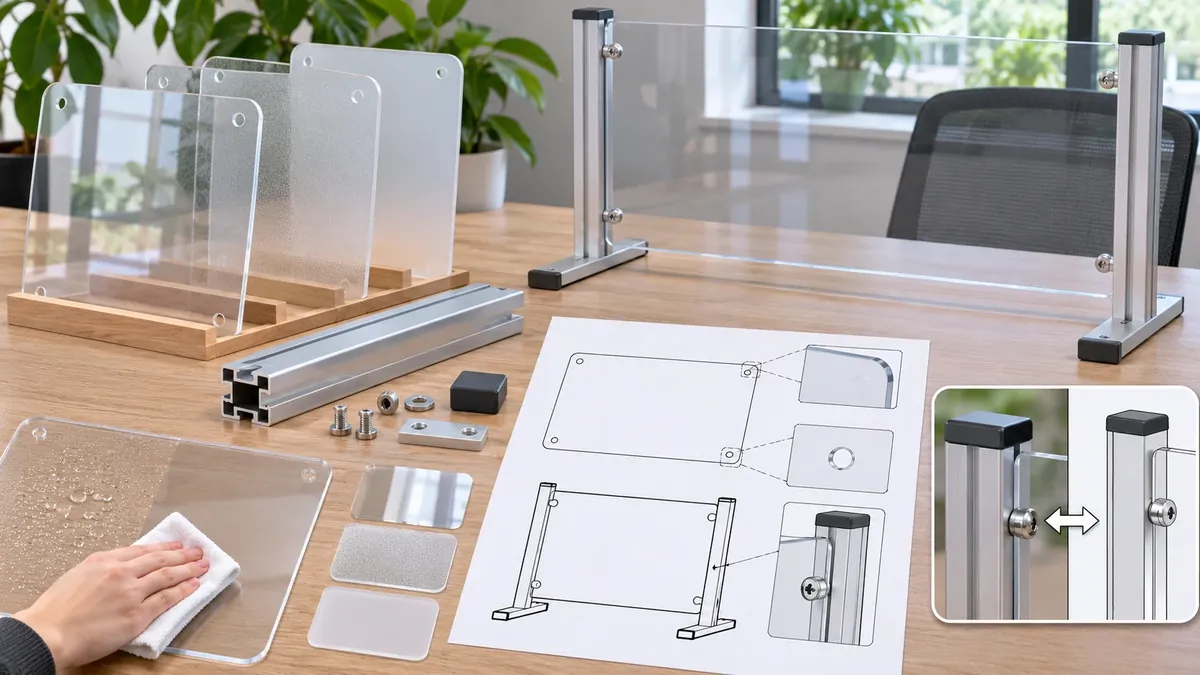
What evidence should buyers request before approval?
Request evidence that matches the attribute under review. A product data sheet may identify a panel family, but it may not establish that the delivered panel matches a specific treatment, thickness or fabrication drawing. A supplier sample can show appearance and fit, but a sample alone does not establish production lot consistency or safety suitability. A lab test can answer a defined test question, but only if the method, conditioning, specimen, result and acceptance criterion apply to the actual requirement.
Before approving a purchase, record:
- The panel’s manufacturer and full product designation.
- The construction, nominal dimensions, tolerances and surface variants.
- The controlled panel and frame drawings, with aligned revisions.
- The required appearance criteria for face, edge, tint and visible defects.
- The assembly method, contact material, clearance and retention responsibility.
- Any cleaning, impact, load, UV exposure or safety requirement and its accountable technical approver.
- The sample or test evidence used to support each approval.
- Packaging and identification methods that preserve the approved product through shipping and receipt.
Do not infer a numerical performance value from a general comparison article. A panel’s behavior depends on product selection, geometry, support, boundary conditions, environment and test setup. If a buyer has a load-bearing or safety-critical use, the responsible engineer or glazing specialist must define the design and evidence requirements. Koitor’s role is limited to confirmed metal hardware and assembly scope; it does not establish glass or polycarbonate structural design or specialist approval.
What mistakes should importers avoid?
Avoid comparing a material family on a single marketing adjective. “Impact resistant,” “scratch resistant,” “lightweight” and “safety glass” are not complete purchase specifications. They should connect to a product, test, construction, size, condition and acceptance criterion. A general sheet supplier’s comparison can help form questions, but it should not become a promise about an unspecified product or assembly.
Other avoidable mistakes include:
- Treating every polycarbonate grade as equally clear, scratch resistant or UV capable.
- Treating all glass as annealed, tempered, laminated or safety rated without a product designation.
- Comparing a coated polycarbonate sheet to untreated glass or one glass construction to an unspecified polymer panel.
- Approving the face appearance while ignoring edge quality, holes or support contact.
- Allowing a fabricator to change thickness or cutout position without reviewing the frame and clamp.
- Assuming a clamp’s sample fit proves production tolerance compatibility.
- Specifying a cleaning chemical without evidence that the chosen product and surface are compatible.
- Using a small sample to claim a finished assembly has a particular load or impact performance.
- Failing to protect clear panel faces and edges during pack-out and transit.
- Asking the metal factory to certify a panel product or safety application outside its confirmed capability.
When a proposal is unclear, return to the drawings and identify what the supplier is actually quoting. If two proposals differ in surface treatment or glass construction, list that difference rather than scoring them as equivalent. If one party proposes an alternative, require a documented deviation and review its effect on fit, appearance, use, packaging and any specialist approval. The buyer should approve a changed product only after the correct technical owner has evaluated it.
A buyer should also keep the comparison proportional to the project. If a panel is decorative and non-load-bearing, the purchasing decision may center on appearance, cleanability, supply consistency and fit. If people rely on the panel to support an item or protect an area, the responsible design authority must define the needed performance and evidence before material selection. The material comparison helps frame the conversation but cannot replace that requirement.
Buyer checklist for polycarbonate and glass panels
Use this checklist when requesting or approving a panel used with metal bathroom, storage or display hardware:
- Name the manufacturer, exact panel product and construction.
- Specify material family, thickness, color or tint, dimensions and tolerances.
- State the face treatment, orientation and any UV or abrasion-related requirement.
- Define edge finish, corner details, holes, notches and cutout positions.
- Provide a matching metal-frame drawing with support and attachment details.
- Identify clamps, gaskets, pads, fasteners or retainers and who supplies them.
- Confirm sample appearance and fit using controlled revisions.
- Separate visual approval from load, impact, cleaning or safety qualification.
- Ask for evidence only for the defined requirement and method.
- Record the supplier, technical approver, acceptance evidence and revision.
- Confirm protective packaging for faces, edges and assembled components.
- Reopen approval when the panel product, surface, thickness or interface changes.
Perguntas frequentes
Is polycarbonate always better than glass for a storage product?
No. The right choice depends on the specified panel, use conditions, appearance, fabrication, interface and evidence required. A material-family comparison cannot select a universal winner.
Is every polycarbonate sheet scratch resistant?
No. Specific surface-treated products may be offered, but the treatment and product need to be identified. Do not assume every sheet has the same abrasion behavior or cleaning compatibility.
Does glass automatically mean tempered glass?
No. Buyers must identify the required glass construction and any applicable approval. The word “glass” alone does not establish processing or safety classification.
Can I compare a polycarbonate panel and glass panel at the same nominal thickness?
The nominal thickness helps define the specimens but does not make them equivalent. Compare product identity, geometry, supports, surface, edges and the performance condition that matters to the project.
Do polycarbonate and glass need different mounting details?
They may. The interface should account for the specified panel thickness, edge and surface, as well as the support, gasket, clamp and assembly sequence. The responsible designer should approve the complete interface.
Does a successful sample prove the finished assembly is safe?
No. A sample can demonstrate appearance or fit under reviewed conditions. It does not by itself establish an assembly’s load, impact or safety performance.
Trabalhe com a Koitor Hardware
Koitor Hardware is a family-owned custom metal bathroom and home-storage hardware factory. If a panel is being combined with a metal frame or support, share the controlled drawing or sample, the confirmed panel specification and the unresolved metal interface question. Koitor can review the confirmed metal hardware scope; panel selection and specialist glazing approval remain with the responsible panel supplier and technical authority.
Review a Metal Panel Interface
Share the frame drawing or sample, confirmed panel identity and the unresolved fit or packaging question. Koitor can review whether the metal hardware project fits its current OEM scope.
OEM / MARCA PRÓPRIA
Transforme este guia de fornecimento num resumo do produto
Indique o produto pretendido, as dimensões, o acabamento, a quantidade a encomendar e os requisitos de embalagem. A sua equipa receberá uma análise prática da viabilidade de fabrico antes da apresentação do orçamento.



 English
 Español
 Português
 Français
 Deutsch
 العربية