
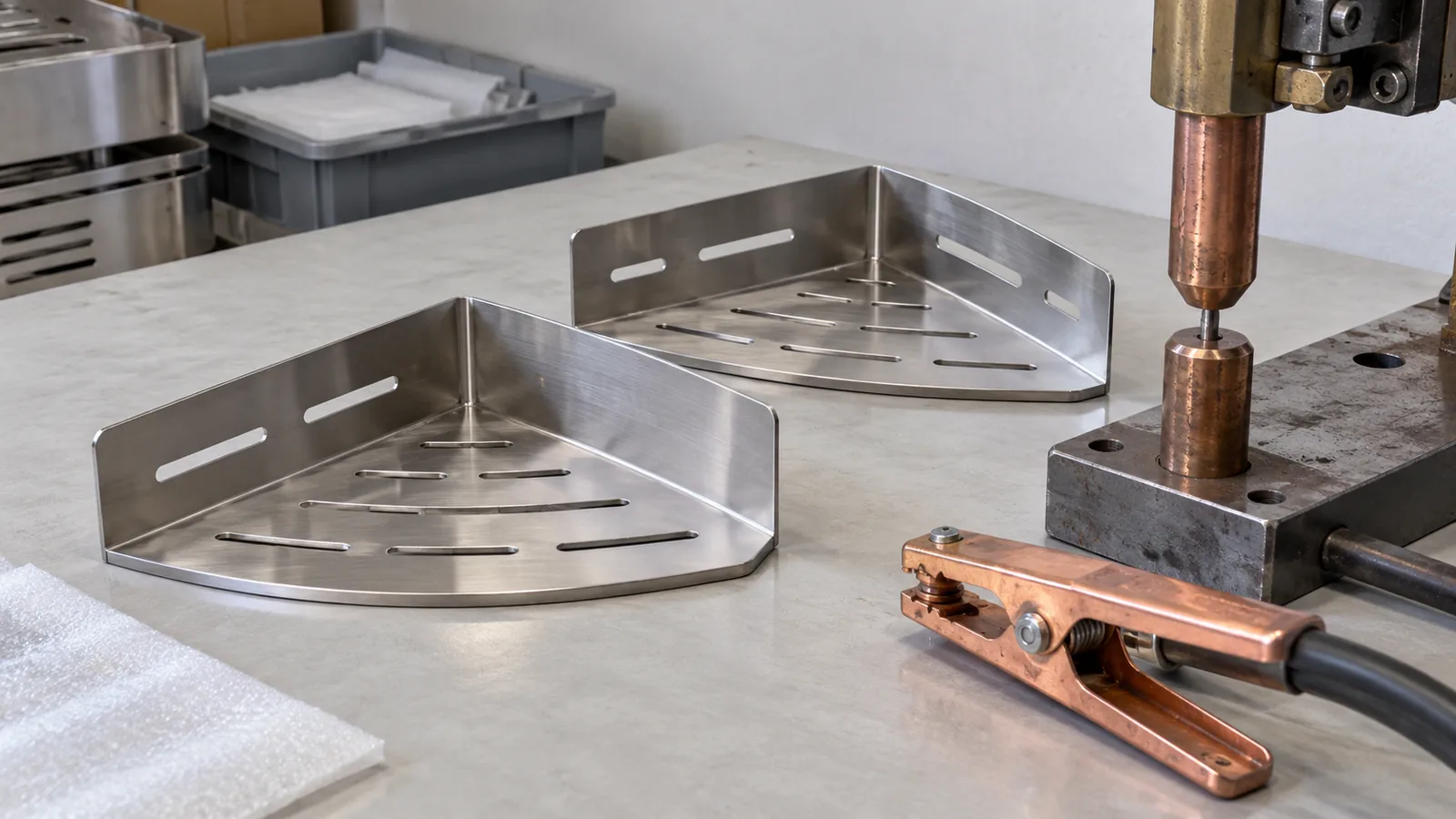
For a closed rack mounting assembly, single sided resistance spot welding return electrode access is a geometry-and-process review—not simply a request to “weld from one side.” A resistance weld still needs a complete, controlled electrical circuit. The supplier must identify where the welding electrode contacts the visible or accessible side, how current returns, and whether the proposed return arrangement can reach the joint without damaging the part, obstructing assembly, or leaving an unacceptable mark. Buyers should approve the actual drawing, fixture concept, representative sample and evidence together. The specific route depends on the component geometry and qualified supplier process; this article does not prescribe welding settings or claim that Koitor uses a particular single-sided welding gun.
The key distinction is between electrode access and current-return access. A product may allow a gun to approach the front surface while leaving no practical place for a counter-contact, cable connection or second electrode. That is why buyers should ask for a simple current-path explanation before approving a sample. NIMAK describes single-sided resistance spot-welding arrangements in which a rear-sheet ground cable or a separate flat ground electrode provides the return path, as well as a duplex arrangement that makes two spots from two electrodes on one side. These are examples of equipment configurations, not universal solutions for bathroom hardware. See the manufacturer’s overview of single-sided resistance spot-welding guns.
This sourcing guide focuses on closed rack mounting assemblies, where a bracket, folded return, wall plate or nearby frame can restrict access. The practical buyer question is: what return path is proposed, what product geometry does it require, and what sample evidence proves that the intended joint and finished appearance are repeatable?
Why does return-electrode access matter on a closed rack assembly?
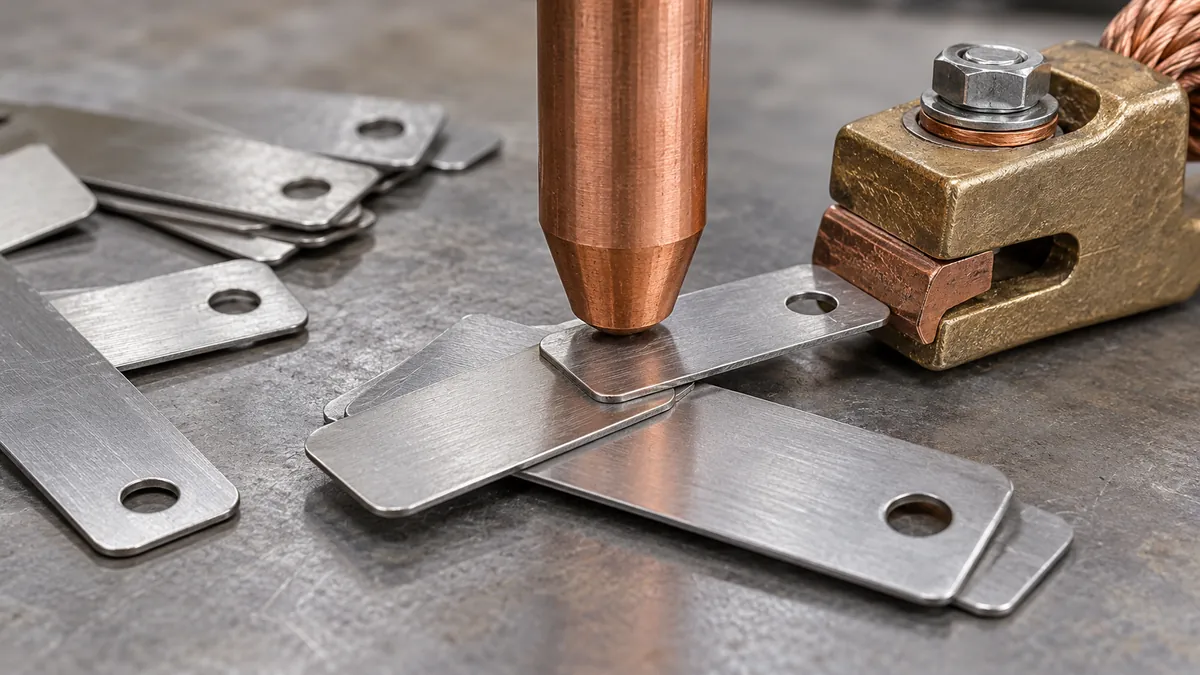
Resistance spot welding relies on electrical current and electrode force at the joint. If the product construction blocks access to one side, the supplier may propose a specialized single-sided arrangement. But “single-sided” does not mean the buyer can ignore the return path. Current still has to travel through the intended circuit. The exact equipment and contact arrangement must be confirmed by the supplier for the part, material, joint and production condition.
A rack assembly can create access constraints in several ways. A closed perimeter may prevent a conventional opposing electrode from reaching the back of a seam. A mounting flange can sit close to the weld location. A folded wall may hide the reverse face after forming. The same bracket may also need a flat mounting surface, a clean visible face, and clearance for a screw, insert or mating component. These product requirements can conflict with the space required by an electrode, clamp or cable.
The buyer should therefore treat access as a design-for-manufacturing input. It affects whether a supplier can position and hold the parts, whether the return contact can be attached at the required point, and whether the proposed fixture has room to repeat the operation. For single sided resistance spot welding return electrode access, the drawing review should make the proposed return point and the constrained geometry visible together. It can also affect cosmetic review: an unintended current path, contact location or local heat effect may leave a mark on a surface that the buyer intended to remain visible. The presence or absence of a mark does not by itself establish joint quality; acceptance criteria should be agreed separately.
Avoid framing the problem only as “Can the supplier weld this corner?” A more useful question is: “Please identify the proposed electrode and current-return locations on this drawing, and show how the representative sample will be fixtured and inspected.” That wording invites a process-specific answer instead of an unsupported yes/no assurance.
Which product and drawing inputs should buyers provide?
Before asking a supplier to select an approach, provide enough information to make the geometry review meaningful. A product photograph is helpful context but cannot replace the controlled drawing. The request should identify the part number, revision, joint location, material and thickness as specified by the buyer, plus the surfaces that are visible after assembly.
At minimum, clarify:
- Which two components form the joint, and which face is considered the user-facing or appearance-critical side?
- Is the joint on a closed section, a bracket, a folded flange or an open assembly that may change shape before welding?
- What other features are near the weld, including mounting holes, slots, fasteners, return lips or adjacent panels?
- Can the opposite face be reached before assembly, after assembly, or not at all?
- What is the required finished condition: as-welded, ground, polished, plated, powder-coated or otherwise finished?
- Which dimensional, functional and appearance requirements must be checked on the sample?
- What assembly interfaces must remain clear after welding and finishing?
Do not infer that the material grade, coating or thickness is known from a rendered image or an old sample. Identify the current specification and revision. If the supplier recommends a change to the joint, material, contact point or process route, treat it as a proposal that requires buyer review—not as an automatic equivalence.
The drawing should distinguish product requirements from supplier process choices. A buyer can specify the seam location, finished appearance, assembly fit and required evidence without prescribing a machine design or welding schedule. If a project requires a particular process route, that requirement should be explicit and technically reviewed. Otherwise, ask the supplier to propose a feasible route and document its limits.
How should buyers compare possible return arrangements?
There is no universal return arrangement for every restricted-access joint. NIMAK’s public examples illustrate that a single-side welding gun may use a separate rear-sheet ground connection or a flat return electrode; another configuration uses two electrodes on one side to create two spots. The buyer should not assume that an arrangement described for another industry, part geometry or gun will fit a storage rack. Ask the supplier to map the proposed contacts to the drawing and explain what each option requires.
| Review question | Rear-sheet cable return | Separate flat return electrode | Two-electrode single-side arrangement |
|---|---|---|---|
| What must the drawing review show? | Where the return cable or contact attaches to the rear sheet and how the part is reached | The contact face, support surface and available space for the flat electrode | Both electrode locations and the intended two spot locations |
| What geometry may constrain it? | Access to a suitable rear contact area and a route for the cable | A stable, reachable surface and clearance for the return contact | Room for both electrodes, compatible joint layout and a feasible gun approach |
| What should the sample demonstrate? | The proposed attachment/contact location and representative part handling | Repeatable positioning without interference with other features | Correct positioning of both spots and the finished assembly condition |
| What should not be assumed? | That any nearby metal is an acceptable return point | That the contact will leave no visible effect or suit every material | That two spots automatically meet a strength or durability requirement |
| What buyer decision follows? | Approve or revise the contact location and access condition | Confirm the contact area, fixture clearance and appearance criteria | Confirm whether the two-point arrangement is appropriate for the design |
The table is a discussion framework, not an engineering selection rule. The source documents equipment examples, but the fit of any arrangement to a particular rack is supplier- and design-specific. Request a marked-up drawing or a simple annotated fixture view. If the return contact is attached to a separate workpiece or fixture, ask how the intended current path is maintained and how the setup is controlled during production. Do not prescribe an unsupported numeric setting based on a supplier brochure.
A useful supplier response should state what assumptions remain open. For example, the supplier may need the final material condition, a revised flange, access from a different assembly stage, or a sample that includes the actual adjacent parts. If the route cannot be confirmed from the drawing alone, record the needed sample or design review rather than treating uncertainty as approval.
What sample evidence should be required before approval?
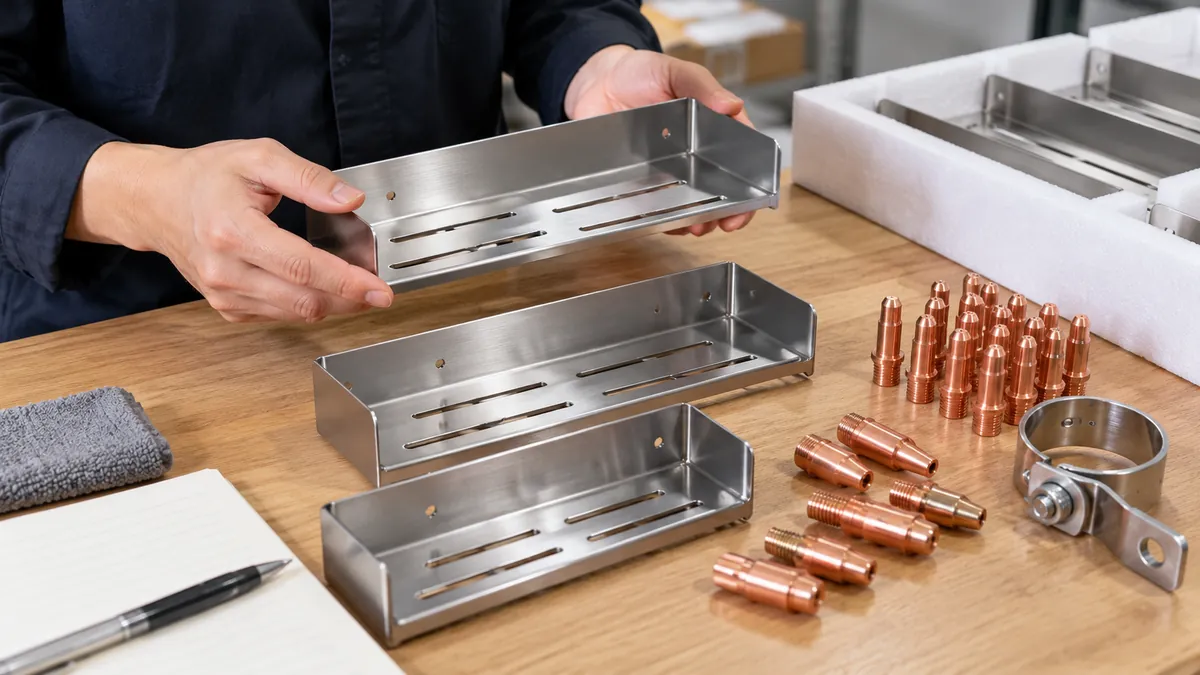
A sample review should represent the intended product geometry and the supplier’s proposed process route. A flat coupon can help explain contact placement, but it may not reproduce the access constraints of a closed rack assembly. Where access is the key risk, ask for a sample or fixture demonstration that includes the relevant bracket, fold, adjacent frame or mounting feature.
The sample record should connect the evidence to controlled inputs:
- Part number, drawing revision and sample identification.
- Material and thickness information per the project specification.
- A marked joint location and the proposed electrode/contact locations.
- A clear statement of how current is returned for the proposed arrangement.
- The assembly stage at which the contacts are applied and the parts are restrained.
- Photographs or records showing the same identified sample from relevant sides.
- The agreed checks for assembly fit, joint location and visible surface condition.
- Any project-specific performance test, including method and acceptance authority, if the design requires one.
- The process, material or fixture changes that require renewed review.
Keep appearance review separate from functional evidence. A clean-looking surface does not prove that the joint meets an engineering requirement; a visually imperfect surface does not, by itself, tell the buyer what functional consequence exists. If the requirement concerns appearance, define the viewing surface and review condition. If it concerns assembly or retention, define a suitable dimensional or performance check with the responsible engineering team.
Likewise, a photograph of a fixture cannot establish repeatability by itself. The buyer should understand which features are controlled, how the part is located, what prevents a reversed or offset position, and what records are available for the approved sample. The evidence should be proportionate to the risk; do not demand a laboratory report when the project has not defined a test, and do not imply that a supplier owns accredited testing facilities unless that is confirmed.
If the supplier proposes a modified return contact after the initial sample, ask whether the change affects the contact point, joint location, visible face, fixture restraint or assembly sequence. Revisit the relevant acceptance criteria and capture the revised setup in the approval record. A small change may be straightforward, but the buyer should not assume it is irrelevant without a reasoned review.
How should the RFQ prevent assumptions and late changes?
A concise RFQ note can make the access question actionable:
- Attach the controlled drawing and identify the restricted-access joint.
- Ask the supplier to mark the proposed electrode and return-contact positions.
- State which faces must remain visible or free of contact marks.
- Identify nearby mounting and assembly features that must remain unobstructed.
- Ask whether the proposal depends on a rear contact, separate electrode, two-point arrangement or another route.
- Request representative sample evidence before production approval.
- Define who approves process deviations, fixture changes and sample substitutions.
- Separate drawing acceptance from any performance testing requirement.
The buyer does not need to dictate an unverified process detail to obtain a useful quotation. Instead, specify the product condition and evidence needed, then ask the supplier to disclose the route and its assumptions. If competing suppliers propose different arrangements, compare them on the same drawing revision, sample geometry, finished condition and acceptance criteria. This avoids comparing a fully assembled sample from one source with an open coupon from another.
For repeat orders, retain the approved sample reference and process description with the drawing revision. Notify the buyer before changing the supplier, fixture, joint geometry, material or contact arrangement when that change could alter the approved result. A supplier’s internal process records may be proprietary; the buyer can still request a clear change notification and project-relevant evidence without demanding an unnecessary machine recipe.
What are the limits of public process information?
Manufacturer pages can help buyers identify possible equipment configurations and frame questions. They cannot determine the best route for a particular bathroom shelf, mounting bracket or storage frame. NIMAK’s page describes its own single-sided gun variants and application examples. It does not establish that a particular configuration is suitable for every material, thickness, joint, finish or product geometry, and it does not provide acceptance criteria for Koitor hardware.
Do not transfer a machine capability, process setting, performance statement or sample outcome from another application to a new design without qualified review. Do not interpret “single-sided” as proof that the reverse side needs no preparation or contact. Do not claim that a return electrode location guarantees no distortion, no marks, corrosion resistance or a specific load capacity. Those claims require evidence for the actual part and defined evaluation method.
Koitor’s stated manufacturing background includes metal forming, punching, welding, finishing, assembly and drawing/sample development. That supports a practical discussion of product geometry and supplier review. It does not mean Koitor owns a particular single-sided welding gun, has qualified this exact assembly, or can promise a specific result. Confirm capabilities and project feasibility during the actual quotation and sample process.
For a broader OEM discussion, buyers can review Koitor’s home-storage hardware manufacturing overview e contact the team with the drawing, sample and required approval evidence.
Perguntas frequentes
Does single-sided spot welding mean only one electrical contact is needed?
No. “Single-sided” describes the access or gun arrangement, not the absence of a complete electrical circuit. The proposed current-return method still needs to be identified and reviewed for the part.
Can a rear cable or return electrode be placed anywhere on the assembly?
Do not assume so. The supplier should identify the proposed location and explain how it relates to the joint, geometry, fixture and finished surfaces. The buyer should approve the location when it affects product requirements.
Is a two-electrode arrangement automatically better than a separate return contact?
No. The cited manufacturer describes different equipment variants, but that does not establish a universal ranking. Compare each proposal against the same product drawing, access constraints, sample condition and acceptance criteria.
Is a flat coupon enough to approve a closed rack joint?
Not when the key question is restricted access or assembly interference. A coupon may support process discussion, but a representative sample should include the geometry that creates the access limitation.
Which welding settings should be written into the purchase order?
Only settings that have been technically established and are appropriate to the project. This guide does not provide a welding schedule. Buyers can require the supplier to document the approved route and sample evidence while leaving qualified process parameters to the responsible technical team.
What if the supplier changes the contact arrangement after sample approval?
Ask for change notification and review the affected requirements. Depending on the change, the buyer may need a new drawing review, representative sample, assembly check or other evidence before accepting production.
What should the buyer send for a feasibility review?
Send the current drawing revision, material and finish specification, a clear view of the restricted joint, adjacent features, assembly sequence and the acceptance evidence needed. Koitor can discuss the manufacturing questions that fit its confirmed capabilities; any specific route or result requires project review.
A practical approval decision
For closed rack mounting assemblies, approve the return-electrode approach only when the supplier has connected it to the actual product geometry, fixture access, sample condition and finished-part requirements. Record the proposed circuit path, contact locations, drawing revision, sample ID and change triggers. Ask for a representative demonstration when a flat coupon cannot capture the access constraint. Keep performance claims and numeric settings tied to qualified, project-specific evidence. The single sided resistance spot welding return electrode access decision should name the approved contact arrangement and the geometry it covers.
This process gives importers, product developers and supplier-quality teams a concrete basis for comparing proposals without over-specifying a machine or accepting an undefined “single-sided” claim. Share the drawing or physical sample and the question-specific approval requirements through Koitor’s contact page.
Review a restricted-access rack joint
Send the current drawing or physical sample, identify the constrained joint, and tell us what approval evidence your buyer team requires. A project review can confirm which manufacturing questions fit the documented product scope.
OEM / MARCA PRÓPRIA
Transforme este guia de fornecimento num resumo do produto
Indique o produto pretendido, as dimensões, o acabamento, a quantidade a encomendar e os requisitos de embalagem. A sua equipa receberá uma análise prática da viabilidade de fabrico antes da apresentação do orçamento.
 English
  Español
  Português
  Français
  Deutsch
  العربية