

A shower door hinge replacement should be matched to the exact enclosure model, hinge position and maker-controlled glass or wall interface. Similar finish, shape or visible dimensions do not prove that two hinges are interchangeable. A buyer should identify the original door and hinge marking, obtain the correct manufacturer’s parts information and template, and ask a qualified enclosure or glazing professional to confirm any replacement against the installed system. For distributors, the goal is a traceable part record that states what is verified and what remains uncertain—not a generic fit promise or a DIY glass-door procedure.
Why does shower door hinge replacement require model-specific evidence?
A shower hinge transfers the door’s movement and support through interfaces defined by the enclosure maker. Depending on the system, it may connect glass to a wall, glass to another panel, a pivot point to a fixed support, or a door to a frame. A buyer may encounter wall-mount hinges, glass-to-glass hinges, pivots, clamps, angle hinges and other configurations. The names and design details vary by supplier. A hinge that looks similar from the front may have a different body depth, swing, closing behavior, gasket arrangement, glass interface or template.
The interface can include more than the hinge body. It may involve a particular glass cutout, edge clearance, panel arrangement, wall condition, fixed panel, gasket, fastener and mounting plate. Some models are designed for a specific glass thickness or door geometry. Those values and limits belong to the named product’s technical documentation; they cannot be borrowed from a different hinge or used to approve an aftermarket substitution.
Manufacturer documents make the model link clear. Kohler’s support guidance for discontinued Helios and Freestyle shower doors asks the user to identify an E-number on the hinge before contacting the company about parts. CRL’s hinge documentation directs buyers to use the template supplied with the specific hinge because cutout dimensions can differ between brands. These are product-specific examples, not universal fit criteria. The practical sourcing lesson is to identify the original model and use the correct maker’s parts reference before comparing an alternative.
A hinge part number can also change across model revisions or finishes. A product family name may cover several configurations. A retailer’s category can contain numerous hinges with different wall, glass-to-glass, pivot or angle uses. A broad phrase like “frameless shower hinge” does not establish the correct hinge for a particular door.
For a replacement-parts program, distinguish four statuses: original manufacturer’s part for the exact model; manufacturer-approved supersession; specialist-supplier cross-reference with documented model coverage; and an unverified candidate that only appears similar. List the status and source. A photo, finish match or approximate measurement can help start identification, but should not become an assured-fit claim.
This article addresses purchasing, documentation and compatibility review. It does not explain how to remove a loaded glass door, support a heavy panel, change a glass cutout or install a hinge. Those tasks remain with the enclosure manufacturer and qualified professionals following the current product instructions.
What information should buyers collect?
Start with the enclosure model, series, revision and purchase or service record. Look for a product label, invoice, carton code, installation manual or maker’s parts diagram. If the enclosure is older, the manufacturer may use a separate identifier on the hinge or panel. Record what is legible and request maker support when the model cannot be confirmed.
Identify the hinge’s position and role. Is it on the wall side, between two glass panels, at a pivot, at an angle, or part of a framed system? Record whether the door is left- or right-handed only when the manufacturer defines that term for the model. Capture the fixed-panel arrangement, opening direction and closing behavior from the product documentation. Do not infer hinge handing from a single photograph.
Photograph the entire enclosure and the hinge in context. Include the hinge body, the edge of the door, the adjacent wall or panel, and any visible marking. A close view of the hinge can help with supplier matching, but it rarely shows the entire glass cutout or the back side of a mounted plate. Keep photographs labeled by enclosure model and location. Do not ask a customer to disassemble the hinge or remove the door to obtain a picture.
| Identification field | Evidence to collect | Why it matters |
|---|---|---|
| Enclosure identity | Brand, model, series, revision and purchase record | Connects the hinge to the correct door system |
| Hinge identifier | Maker code, E-number, label, part number or drawing callout | Supports an exact service-part lookup |
| Hinge position | Wall-to-glass, glass-to-glass, pivot, angle or model-specific role | Separates distinct architectures |
| Door configuration | Fixed panels, door direction and named handing | Clarifies the mating arrangement |
| Manufacturer template | Current template or drawing for the exact hinge model | Defines model-specific preparation information |
| Existing interface | Documentation held by the maker or qualified glazing professional | Avoids unsafe inference from appearance |
| Kit contents | Hinge body, gaskets, covers, fasteners and matched pieces | Prevents incomplete replacement orders |
| Finish | Manufacturer finish code or approved reference sample | Separates appearance from interface compatibility |
| Evidence status | Confirmed, maker-referenced, professional-reviewed or unknown | Keeps confidence limits visible |
| Source date | Document revision and date checked | Helps identify obsolete support material |
If an old hinge is available as a sample, label its original position and model before it is separated from other parts. A worn or damaged hinge may have distorted features. It should be treated as an identification reference, not as a definitive engineering drawing. Ask the manufacturer whether the exact part number is still available or has been superseded.
Measurements should come from the current model documentation or a qualified professional’s record. Do not direct buyers to measure a concealed cutout by removing glass or taking apart a loaded door. A dimension on a competitor’s product page cannot be transferred to a different brand. If critical dimensions are missing, mark them unknown and request a supplier or professional review.
Record the door condition and service concern separately from the assumed cause. A door that sags, rubs or fails to close could involve hinge wear, alignment, installation, panel movement, fasteners or another part of the system. A distributor can capture the reported symptom and model, but should not diagnose structural safety from a photo or promise a hinge replacement will solve it.
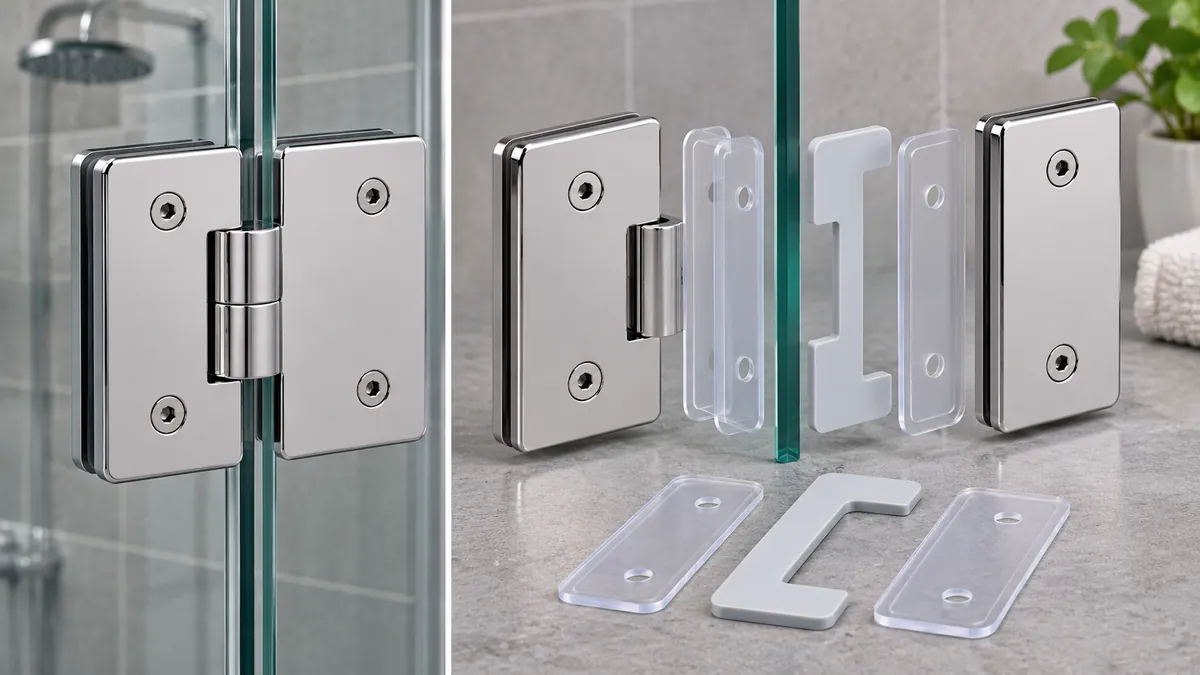
How should the buyer compare hinge architecture and interface?
Use the original manufacturer’s classification. A wall-to-glass hinge and a glass-to-glass hinge have different mating interfaces. A pivot may use a defined pivot point or support arrangement. A fixed-angle hinge may be designed for a particular corner. A glass clamp or framed hinge can have a different attachment scheme. These categories help organize the search but do not make parts within one category interchangeable.
The hinge’s movement and closing behavior matter. Some products may be designed to swing in one direction, both directions, or return toward a closed position under model-specific conditions. The buyer should consult the product documentation and avoid assuming that the new hinge behaves like the old one based on outward appearance. A change in swing or closing action can alter how the door interacts with adjacent panels, seals or stops.
The glass or wall interface is a critical safety-related feature. The exact glass preparation, thickness, edge clearance and mounting details must be confirmed by the responsible enclosure maker or a qualified glazing professional using the correct template and product instructions. A generic online diagram, approximate photo measurement or another brand’s cutout template is not approval to alter or reuse glass.
| Comparison point | Evidence to obtain | Buyer boundary |
|---|---|---|
| Hinge architecture | Maker’s product name and diagram | Do not substitute by category label alone |
| Position | Exact panel-to-wall or panel-to-panel role | A wall hinge is not automatically a glass-to-glass hinge |
| Swing/closing | Current model instructions | Do not infer behavior from a similar product |
| Glass interface | Exact maker template and professional confirmation | Never transfer a template across models |
| Gaskets and covers | Parts diagram and kit list | Similar covers may hide different internal geometry |
| Fasteners | Maker’s part list and specified mounting context | Do not substitute hardware by appearance |
| Capacity or size limits | Current model-specific technical sheet | Do not extrapolate from another hinge |
| Finish | Maker’s code or approved sample | Finish is not proof of mechanical compatibility |
A proposal should be compared against a full part number, template revision and the model list it covers. If a supplier says a hinge is compatible with multiple models, ask for the underlying cross-reference and any exclusions. Record whether the evidence comes from the original manufacturer, a tested aftermarket cross-reference or a visual similarity assessment. Do not publish a broad compatibility claim when the source covers only one model.
If the original hinge is no longer available, ask the enclosure maker about a superseding part. If the maker cannot confirm one, a specialist may review the product information and refer the matter to a qualified glazing professional. Keep the outcome as a candidate until the responsible parties confirm the interface. Do not use “universal” as a substitute for identifying unknown glass preparation.
What should the supplier RFQ and sample review establish?
An RFQ should include the enclosure maker and model, revision, hinge location, original part number or marking, current manual or template, finish, quantity, photos and the intended order scope. State which information is confirmed by the original maker and which is an observation. Ask the supplier to identify its own part code and drawing revision and to name the exact models covered.
Ask whether the quoted item is the hinge body alone or a complete replacement kit. The kit might include gaskets, cover plates, mounting components or matched hinges, depending on the manufacturer. Request the BOM and identify separate items. Do not assume that an attractive product photo shows everything included.
A sample review needs an explicit boundary. It may confirm that the supplier’s sample corresponds to a drawing or that the finish is visually comparable. It cannot by itself establish safe installed compatibility, glass preparation, load performance or compliance. Any physical evaluation against a glass door should be performed by the enclosure maker or a qualified professional under current model-specific instructions.
Keep the review record precise. Identify the sample, supplier, hinge code, drawing revision, enclosure model, reference template, reviewer and exact checks completed. If the professional only confirmed the maker’s part number, do not describe the result as an installed fit test. If a sample was not tested on the actual enclosure, state that limitation.
| RFQ field | Buyer request |
|---|---|
| Enclosure | Confirm maker, model, series and revision covered |
| Original hinge | Identify the part number or marking and its location |
| Architecture | Specify the model’s wall, glass-to-glass, pivot or other configuration |
| Template | Cite the exact current hinge template and revision |
| Interface authority | State who reviewed existing glass and mounting details |
| Part scope | List hinge, gasket, cover, fastener and matched-pair contents |
| Finish | Identify maker code or approved sample reference |
| Evidence | Provide cross-reference, exclusions and remaining unknowns |
| Sample | State what a sample review will and will not establish |
| Commercials | Quote sample, MOQ, lead time, labeling and packaging |
| Change control | Explain how drawing, source or kit changes are reported |
A quote should not be approved as a fit confirmation unless it addresses the identified model and interface. If a supplier has only a generic catalog match, keep it in the unverified state. Resolve conflicting part numbers between the manual, quote and sample before ordering service stock.
How should a distributor manage hinge replacement SKUs?
Maintain a separate service-part record for each confirmed model relationship. Include enclosure model and revision, hinge position, manufacturer code, supplier code, template reference, finish, kit contents, approval status, date checked, source of confirmation and any exclusions. Link the record to the internal service SKU and purchase history so repeat orders can be checked against the same evidence.
Do not combine hinges that differ in architecture, handedness, finish, gaskets, fasteners or model coverage under one generic SKU. A parent listing can present the product family, but each orderable variant should make its model limitations visible. If an aftermarket part is cross-referenced to a short list of models, preserve that list and its source. Do not extend it to visually similar doors without evidence.
Use distinct status labels such as “original part,” “manufacturer-approved supersession,” “supplier-matched for listed models,” “sample under review” and “unverified candidate.” Customer service can then explain the basis for a recommendation. A status field is especially useful when an old model is discontinued or when the original hinge marking is the only way the maker identifies its service part.
Packaging and labels should keep matched components together. If the hinge is supplied as a pair or with a specific gasket set, the SKU and carton label should say so. Protect the finish and avoid loose hardware rubbing against visible surfaces. Follow the supplier’s packing guidance and do not add unverified claims about the package’s ability to protect glass or prevent transit damage.
Track returns and service inquiries by exact hinge, model, evidence state and reported symptom. Useful categories include “model not identified,” “wrong architecture,” “finish mismatch,” “kit item missing,” “supplier cross-reference unclear” and “professional review required.” A single complaint may justify checking the listing or supplier record, but it does not establish a systemic hinge defect or a general compatibility problem.
When the maker revises a hinge, template, gasket, fastener or part number, review the SKU record before repeat purchase. Ask whether the old compatibility approval still applies. Reapproval may be required if the mating interface or kit changes. Keep old part mappings visible for service history, but clearly mark their availability and status.
What mistakes should B2B buyers avoid?
Do not choose by finish or silhouette. Polished chrome, brushed metal or a similar cover shape says little about the hinge’s glass and mounting interface.
Do not treat a hinge category as a compatibility standard. “Wall-to-glass” narrows the search but does not identify the cutout, model, glass preparation or motion requirements.
Do not reuse a template from a different brand or model. The manufacturer’s warning about template specificity exists precisely because cutout dimensions can vary. Use the exact product document and professional review.
Do not ask a customer to remove or support a heavy glass door to obtain measurements. Route safety-critical work to the named maker or qualified professional.
Do not substitute fasteners, gaskets or mounting pieces based on appearance. The maker’s specified kit and instructions control the service application.
Do not assume that a complete-looking product image means the quote includes all related parts. Obtain a written kit list.
Do not tell buyers that a sample proves safe installed fit, service life or load capacity unless the responsible maker provides the relevant evidence for the exact model and intended conditions.
Do not describe an aftermarket hinge as original. Keep original parts, approved supersessions and supplier-matched alternatives distinct in the catalog.
Do not diagnose a hinge problem from a photograph. Capture the symptom and refer model-specific or safety questions to qualified service professionals.
Do not let a repeat order rely on memory. Keep the current model reference, part number, template, approval record and supplier revision together.

Buyer checklist for shower door hinge replacement
- Identify the enclosure maker, model, series and revision.
- Find the hinge marking, model-specific part number or maker support reference.
- Determine the hinge position and architecture from the current parts diagram.
- Obtain the correct manufacturer’s template and note its revision.
- Keep existing glass-interface review with the maker or qualified glazing professional.
- Record door configuration, handing and swing only as the maker defines them.
- Confirm whether the quote includes gaskets, covers, fasteners and matched parts.
- Separate finish approval from mechanical compatibility.
- Ask whether the part is original, approved supersession or supplier-matched.
- Record the exact model list, exclusions and evidence source.
- Define what a sample review establishes and what remains unverified.
- Do not instruct customers to lift, dismantle, drill or modify glass.
- Keep a revision-controlled replacement SKU record for reorders.
- Refer installation and safety decisions to the enclosure maker or qualified professional.
A shower door hinge replacement should not move from candidate to approved stock until the model and maker-controlled interface are resolved. If the original model cannot be identified, keep the inquiry open and seek manufacturer or professional assistance rather than promising that an approximate match will fit.
Frequently asked questions
Can a shower door hinge be replaced by matching its outer dimensions?
No. The glass or wall interface, model, hinge position, motion, gaskets and mounting details can differ. Use the exact maker’s parts information and professional confirmation.
Are wall-to-glass and glass-to-glass hinges interchangeable?
Not by category name alone. They connect different interfaces. Confirm the architecture and model using the manufacturer’s documentation.
Can I use a cutout template from a similar hinge?
No. Use the template supplied for the exact hinge and model. A similar product may require different glass preparation.
Can a distributor verify compatibility from photos?
Photos can help identify a hinge, but they may not reveal the model, hidden interface or glass preparation. The maker or qualified glazing professional should confirm safety-critical details.
What if the original hinge has been discontinued?
Ask the enclosure maker for a supersession or service path. If a specialist proposes an alternative, document its exact model coverage and professional review before listing it as compatible.
Does a sample prove the hinge is safe for every door?
No. A sample only supports the checks actually performed. It does not establish suitability for unreviewed models or installations.
Does Koitor manufacture replacement shower door hinges?
The approved Koitor profile confirms metal bathroom and home-storage hardware, not a shower-door hinge product line, glazing service or installation capability. This guide does not claim Koitor supplies or installs those hinges.
Technical references
- Kohler support: Parts for Helios and Freestyle shower doors — model-specific hinge marking used for legacy part identification.
- CRL shower hardware product information — product-specific hinge and template documentation; verify the exact product instructions.
- FHC shower hinge document library — supplier templates for distinct hinge models and configurations.
- Koitor Hardware OEM information — verified metal-hardware sourcing context.
Discuss Your Bathroom Hardware Sourcing Requirements
Share a metal hardware drawing, sample, finish reference and assembly context for a capability review. The enclosure maker or qualified glazing professional should confirm hinge model, glass interface and installation suitability.
OEM / PRIVATE LABEL
Turn this sourcing guide into a product brief
Share your target product, size, finish, order quantity and packaging requirements. Your team receives a practical manufacturability review before quotation.


 English
 Español
 Português
 Français
 Deutsch
 العربية