

Shipping marks are identifiers and related marking information placed on transport packages so buyers and logistics partners can identify, handle, and reconcile those packages with shipment records. The exact fields depend on the buyer’s instruction, transport arrangement, package level, and applicable destination requirements. A shipping mark is not automatically the carrier’s tracking label, a retail barcode, a country-of-origin label, or every legally required mark. For an importer, the practical task is to agree which information belongs on each package, which document records it, and who approves the final marking instruction before pack-out.
What are shipping marks used for?
Shipping marks help distinguish packages within a shipment and connect the physical cases to information used during packing, transport, receipt, and document review. They can include a buyer reference, order reference, package sequence, consignee reference, handling notation, or other information required for that specific movement. Which fields are appropriate is determined by the transaction and logistics plan; there is no universal carton template that applies to every shipment.
A mark becomes useful when the buyer and logistics parties can interpret it consistently. If a carton shows a case sequence, the packing list or another agreed record should make it possible to reconcile that sequence with the shipment. If a reference identifies an order, all relevant parties should know which reference it means. A printed field with no agreed source can create more ambiguity than it resolves.
The U.S. International Trade Administration’s guidance on common export documents explains that a packing list can include package marks, dimensions and package counts, and that document information should be consistent for shipment review. FedEx’s customs-document guidance likewise stresses consistency among shipping documentation. Those sources support the documentary relationship, but they do not prescribe a single shipping-mark design for every buyer, country, carrier or product.
| Information type | Main purpose | Where it may appear | What it should not be confused with |
|---|---|---|---|
| Buyer/order reference | Identify the commercial order or project | Carton mark and buyer records | A carrier tracking number unless explicitly defined that way |
| Package sequence | Distinguish cartons within a shipment | Each outer package and packing list | The product’s SKU or unit serial number |
| Handling instruction | Communicate agreed handling information | Package artwork or handling label | A guarantee that the carrier will follow it |
| Carrier label/tracking ID | Route and track a parcel or freight service | Carrier-generated shipping label or system | A buyer’s shipping mark or carton sequence |
| Product barcode/GTIN | Identify a trade item under its data system | Product or logistics label as specified | An informal carton reference |
| Regulatory or origin marking | Meet a specific destination or product requirement | Product, packaging or document as required | A generic transport identifier |
The table is a role distinction, not legal advice or a list of universally mandatory information. A single package may carry more than one information system, but each needs an owner and a clear purpose. Buyers should ask their freight forwarder, carrier, importer, compliance advisor, or customer which destination-specific requirements apply rather than infer them from a generic example.
How do package marks relate to a packing list?
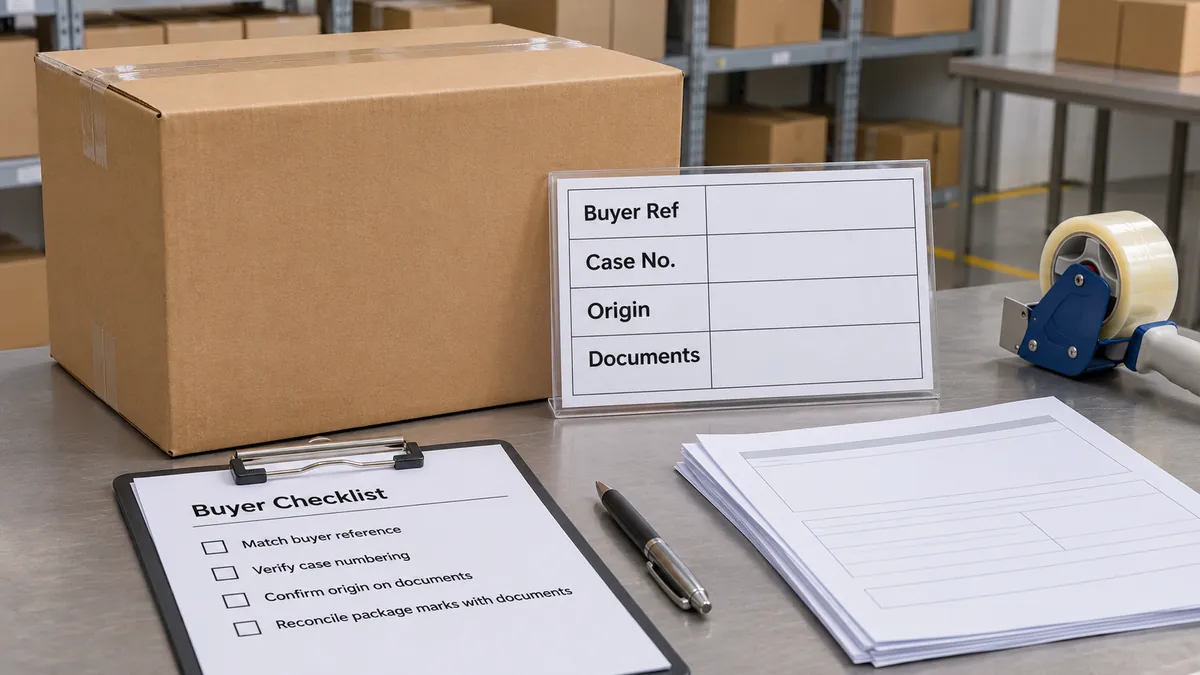
The physical carton and the packing list should be reconcilable through the agreed references and package details. Depending on the shipment, the packing list may identify the number and type of packages, package marks, dimensions, and weights. A buyer receiving multiple cartons needs a practical way to compare the package identifiers against that document and determine which records apply to the cases at hand.
A hypothetical shipment of bathroom accessories illustrates the relationship without using any real customer data. Suppose an order contains six outer cartons. The buyer may instruct the supplier to mark each case with a buyer reference and a sequence such as CASE 1 OF 6 through CASE 6 OF 6. The packing list should use the same reference and sequence basis so the receiving team can reconcile the records. If product styles are mixed across cartons, the packing details need to describe that allocation according to the agreed document format. The example is illustrative only; it does not establish a mandatory phrase, numbering style, carton layout, or customs-compliant template.
A mismatch can arise when the carton uses one order code while the packing list uses an internal production code, or when a case sequence is restarted for a partial shipment. The buyer should decide which reference is authoritative and how split shipments, replacement cartons, or mixed packs will be represented. It is safer to record the rule before labels are printed than to rely on warehouse staff to infer how two codes relate.
A useful reconciliation check compares:
- The order or shipment reference used on the physical carton.
- The number of cartons and the sequence or package identifiers.
- The package descriptions and quantities on the packing list.
- The relevant dimensions and weights where those are part of the agreed records.
- Any split, mixed, replacement, or separately packed items.
- The approved mark artwork or instruction version.
These checks are about identifying and reconciling records. They do not prove that package contents conform to quality requirements, that customs documents are complete, or that every transport rule has been met. Those are separate verification tasks with their own owners and evidence.
Are shipping marks the same as labels, barcodes, or origin marks?
No. The phrase “shipping marks” can be used broadly in trade discussions, but buyers should distinguish the purpose of each printed or attached item. A carrier label supports routing within a carrier’s process. A tracking identifier is generated and managed under the carrier’s system. A retail barcode can identify a trade item; a logistics identifier may identify a logistic unit. A country-of-origin statement or other regulated marking may be subject to separate product and destination rules.
The buyer should not substitute one field for another simply because both are printed on the same carton. A product GTIN and a logistics-unit identifier have different roles. Koitor’s existing article on SSCC pallet labels versus carton GTINs covers that identifier comparison. Likewise, barcode artwork and version control are discussed in the separate guide to private-label barcode artwork. This article focuses on transport package identity and its document relationship rather than reproducing those topics.
A “handle with care” or orientation symbol is not necessarily an identity field. A printed origin statement is not just a logistics convenience. Whether a mark, symbol, label or origin statement is required depends on the buyer’s market, product, channel and shipment. The shipment mark should not be used as a shortcut for compliance review. Ask the party responsible for destination rules which requirements apply and retain the source of that instruction.
The word “label” also hides physical placement differences. A field printed directly on a carton, an applied carrier label, an inner retail label and a pallet label may be controlled by different parties. State which package level is being discussed: individual product, inner pack, outer carton, pallet, or another handling unit. An instruction that only says “put the mark on the box” can be ambiguous when a shipment contains several packaging levels.
What should a buyer specify before carton marks are applied?
A buyer’s marking instruction should make the content, package level, reference source, placement expectation, version, and approval responsibility clear enough for the supplier and packing team to follow. It should distinguish mandatory buyer fields from carrier-provided fields and from product or regulatory artwork. The instruction should also explain what to do if the order is split, cartons are mixed, or a case is replaced.
A concise instruction may define:
- Package level: Which items receive a mark—outer cartons, pallets, or other agreed units.
- Reference fields: Which buyer/order/project identifiers must appear and where their source data comes from.
- Package sequence: Whether numbering runs across the whole order, a shipment, a container, or a partial dispatch.
- Document relationship: Which document or system repeats each identifier and how the case count is represented.
- Content exclusions: Which confidential, unnecessary, or unapproved fields should not be printed.
- Artwork control: Which file or written instruction version controls and who approves a proof if one is required.
- Exceptions: How mixed cartons, replacements, short shipments, or revised quantities are handled.
- Responsibilities: Who provides the information, who prints or applies it, and who confirms completion.
This is a buyer coordination framework, not a mandatory shipping-mark checklist. Some shipments may use a very simple reference; others may require more complex identifiers or customer-specific instructions. The buyer should avoid copying a competitor’s carton sample without confirming that it applies to the destination, carrier, product and transaction.

Who should provide, approve, and verify shipping marks?
The order should identify responsibilities before packaging begins. The buyer or importer commonly supplies commercial references and any customer-specific instructions. The supplier or packing party may apply the approved information according to the agreed scope. The freight forwarder or carrier may provide separate routing labels or transport documents. The importer, broker, or compliance professional may need to confirm destination-specific requirements. The exact division varies by transaction, so do not assume the factory owns every label or document.
Approval should be tied to a recognizable version. If the buyer sends an artwork file, mark the filename or revision and state whether the proof requires approval before printing. If the mark consists of text instructions rather than designed artwork, record the approved content and package-level rule. A file copied into a message thread without a revision note can be difficult to distinguish from an earlier version.
A simple handoff record can include the date, order identifier, instruction version, package level, approval owner, and any open questions. The record should also say whether a carrier label is generated later and whether its identifier will appear on the carton mark or only on a shipping document. Avoid placing personal, confidential or unnecessary buyer details on packaging unless the buyer has approved that use and it is appropriate for the shipment.
The supplier’s confirmation can describe what was applied and what remains outside its scope. A confirmation that cartons were marked does not prove document accuracy or regulatory compliance. Likewise, a buyer’s approval of artwork does not prove the actual shipment contents, package count, or carrier routing. Each control should be matched to evidence that actually covers it.
If a mark changes after pack-out begins, pause the affected marking decision and reconcile old and new instructions. Determine which cartons have already been printed, whether they can be corrected under the approved process, and which shipment records need updating. Keep the status and approved revision visible to the buyer and packing team. This is a document-control principle, not a claim that any particular facility has a specific label-management system.
How buyers should control package identification
What shipping-mark mistakes create receiving confusion?
- Using an internal code without explaining it. A production or warehouse reference may not be recognizable to the importer unless the parties have mapped it to the buyer’s order.
- Repeating a tracking number as if it were a package sequence. Carrier identifiers and buyer carton identifiers serve different roles and may change independently.
- Restarting carton numbers without a rule. A partial shipment can create duplicate identifiers if the sequence basis is not defined.
- Printing a mark that conflicts with the packing list. The physical package and document should use compatible references and package counts.
- Treating every printed field as a shipping mark. Barcode, retail, origin, compliance and carrier information may have separate owners and purposes.
- Leaving package level unclear. “Label the boxes” may refer to product boxes, inner packs, export cartons or pallets.
- Using an obsolete artwork file. Old buyer references or a superseded layout can be applied if file versions are not controlled.
- Assuming a symbol proves handling performance. A symbol communicates an instruction; it does not guarantee how a carrier will handle the cargo.
- Putting unapproved confidential data on a carton. Print only the information authorized for that shipment and package.
- Assuming marks replace customs or transport documents. A mark helps identify a package; it does not substitute for required records.
These are possible coordination gaps, not evidence of their frequency in Koitor orders or the export industry. When an inconsistency is discovered, record the affected package range, identify the controlling instruction, and coordinate the correction with the responsible logistics and document owners. Do not silently alter carton information after records have been finalized.
What should importers check during pre-shipment review?
Before dispatch, compare the agreed marking instruction with the package evidence and shipment documents that the buyer is authorized to review. Confirm the reference and sequence basis, the number of packages represented, and whether any split or exception is correctly recorded. Where a proof or packing photo is part of the agreed process, ensure it corresponds to the current order and instruction version. A photo can show visible package information, but it does not by itself validate hidden contents or every document field.
For a multi-carton order, the buyer can sample-check a reasonable set of cartons or use the inspection arrangement agreed for the transaction. The method should account for the shipment’s risk and contract requirements; this article does not set an inspection sample size or acceptance limit. If all packages must be individually reconciled, specify that requirement in the shipment process. If only the overall reference and case sequence are needed, state that narrower goal.
Review exceptions carefully. A replacement carton may carry a different identifier from the original; a split order may have a separate shipment reference; mixed styles may require itemized package details. Ask the supplier or forwarder to report deviations and document the agreed resolution. If the carton mark, packing list and invoice use inconsistent descriptions, the responsible documentation owner should reconcile them before the shipment is released.
The U.S. Trade Administration notes that the importer or freight forwarder is a useful starting point for determining which export documents are needed. That guidance is specific to export-document coordination and does not make this article a customs compliance checklist. For shipments to any market, the buyer should confirm current requirements with the appropriate freight and compliance professionals.
What checklist can buyers use for package identification?
Use this checklist to clarify the handoff. Mark items “specified,” “not applicable,” or “pending” rather than assuming a general template covers the shipment.
- [ ] Order, shipment or buyer reference is defined and sourced from an approved record.
- [ ] Package level is identified: product unit, inner pack, outer carton, pallet, or other unit.
- [ ] Package numbering basis is stated and split shipments or mixed cartons are addressed.
- [ ] The packing list or other agreed record can reconcile the physical marks to package details.
- [ ] Carrier tracking information is distinguished from buyer/package references.
- [ ] Barcode, retail, origin and regulatory information have separate owners and instructions.
- [ ] Mark content and artwork version are approved by the responsible buyer.
- [ ] Confidential or unnecessary data is excluded unless specifically authorized.
- [ ] Supplier, buyer, forwarder and carrier responsibilities are clear.
- [ ] Any proof, photo or pre-shipment check is tied to the current instruction version.
- [ ] Required destination or customer rules have been confirmed by the responsible party.
- [ ] Exceptions and corrections are recorded before shipment documentation is finalized.
How can a hardware buyer coordinate packaging instructions?
Koitor Hardware is a family-owned custom metal hardware factory focused on bathroom and home-storage hardware. Buyers can provide the current packaging instruction, order reference, carton artwork, and the required shipment-document relationship for project discussion. The confirmed order scope determines what packaging information is coordinated by the supplier and what is supplied by the buyer, forwarder, carrier, or another party.
This discussion does not imply that Koitor provides customs brokerage, legal compliance review, carrier services, certification, or ownership of every carton printing task. Confirm the specific order responsibilities in writing. For a relevant product project, buyers can review the custom bathroom hardware manufacturing scope and use the separate Koitor resources on carton print proof and color or production milestone communication for their narrower topics.
The project handoff should identify who supplies reference data, who prepares the mark, who approves it, and which documents repeat the identifiers. That makes it easier to discuss packaging requirements before final packing and reduces dependence on informal assumptions. Any destination-specific rule should be verified with the party responsible for that requirement.
Frequently asked questions
Are carton identification required on every export carton?
Requirements vary by buyer, transport arrangement, destination, product and applicable rules. Some shipments may use a buyer or consignee reference; others may have different identification needs. Ask the importer, freight forwarder, carrier, or responsible compliance advisor what applies instead of treating a generic list as mandatory.
Are carton identification the same as a carrier tracking label?
No. A carrier label and tracking number belong to the carrier’s routing and tracking process. A buyer’s package mark or carton sequence may identify cases for order and document reconciliation. The parties should define both when both are used.
Does the packing list need to repeat every carton mark?
The buyer and documentation owner should agree how package identifiers and package details are represented. Government export guidance describes packing lists as commonly including package marks and dimensions, but the actual document format and requirements depend on the shipment. Confirm the applicable process for the transaction.
Can a barcode replace the shipping mark?
Not automatically. A barcode may identify a trade item or logistics unit under a specific system, while a shipping mark may carry other package references or handling information. Confirm identifier ownership, package level and document relationship. Do not treat different identifiers as interchangeable without the relevant data-system approval.
Who provides the shipping-mark information?
The buyer often supplies order-specific references and instructions, while a supplier may apply approved marks within the confirmed packing scope. A carrier may generate its own label, and an importer or broker may confirm destination documentation. The contract and shipment plan should identify each responsibility.
What if the carton and packing list show different references?
Identify which instruction and document revision controls, determine which packages are affected, and coordinate a recorded correction with the responsible parties. Do not silently change the carton or document without reconciling the rest of the shipment records.
Work With Koitor Hardware
If a hardware order needs carton identification coordinated with packing records, share the approved reference fields, package level, artwork version, shipment-document expectation and responsible contact. Koitor Hardware can discuss the confirmed packaging scope for the order. Carrier routing and destination compliance remain with the appropriate logistics and compliance parties.
Coordinate package identification for a hardware shipment.
OEM / PRIVATE LABEL
Turn this sourcing guide into a product brief
Share your target product, size, finish, order quantity and packaging requirements. Your team receives a practical manufacturability review before quotation.


 English
 Español
 Português
 Français
 Deutsch
 العربية