
A shower caddy rust proof claim is a construction claim, not a catalog adjective. Before a hanging hook-over shower caddy rust proof listing is used, or a rust-free line is considered, the buyer should lock the substrate and grade, the weld and cut-end treatment, and the coating or plating system that will actually ship, including hooks and fasteners.
A bright sample under showroom light does not, by itself, support that wording. Salt-spray hours, when a project uses them, describe an agreed laboratory environment; they do not convert into years of shower use. The practical sequence is to freeze the bill of materials and the first-to-rust sites, then decide whether the shower caddy rust proof listing can stand, or must say rust resistant with limits, or should stay silent until the evidence file is complete.
What must be frozen before a rust-proof shower caddy listing?
The listing can only be as strong as the construction that will be repeated in bulk. Freeze three groups together: the metal in every wet-zone part, the way joints and cut ends are treated after welding or cutting, and the coating or plating stack that has to cover those sites.
Start with the hanging hook-over architecture that this page addresses: a hook that sits on a shower arm, wire or tube uprights, welded baskets or trays, lower hooks, and any rivets, screws, or plastic pads that ship in the same SKU. Tension-pole joints, suction cups, adhesive pads, and over-door hooks are different mounting systems. If a program also sells those versions, give each construction its own claim file rather than copying artwork across the family.
On the metal side, name the grade and the form, not only a marketing word such as stainless. A mill certificate or equivalent purchase specification should follow the basket wire, the hook wire or tube, and any fastened parts that stay in the spray. If the hook is a different grade from the basket, that difference belongs in the file, because retail wording is read as a claim about the product, not only the tray.
On the joint side, record the welding method you will allow for production, the post-weld cleaning or passivation step if the part is stainless, and the standard for burrs, burn marks, and exposed cut ends. Resistance welds on wire crossings leave nuggets and heat-tint rings. Those sites hold moisture and, on stainless, can also hold free iron if shop tools were not controlled.
Guidance for cleaning, descaling, and passivation of stainless parts is set out in ASTM A380 practice documents, and chemical passivation treatments plus lot tests are described in ASTM A967/A967M. Those documents do not automatically prove a rust-proof retail claim. They are tools you can point to when the project agrees that weld discoloration and iron contamination must be removed and then checked.
On the finish side, freeze the system, not a color chip alone. For powder, that usually means pretreatment, specified powder, cure evidence, and coverage at edges and weld crevices.
For decorative chrome on steel, it means the undercoat stack as well as the visible chromium, because a bright face can hide a thin or missed layer at a cut end. Koitor’s note on a copper undercoat in nickel-chrome plating is useful when a chrome caddy is in the assortment, but it does not, by itself, authorize a rust-proof line of copy.
Write the freeze in the language the factory and the artwork team will both use: approved substrate, approved joint treatment, approved coating or plating specification, approved cosmetic and functional faces, and a short list of parts that are inside the claim. If a part is outside the claim, say so in the brief before the carton is printed.
Which shower-caddy zones should the claim file treat as first-to-rust sites?
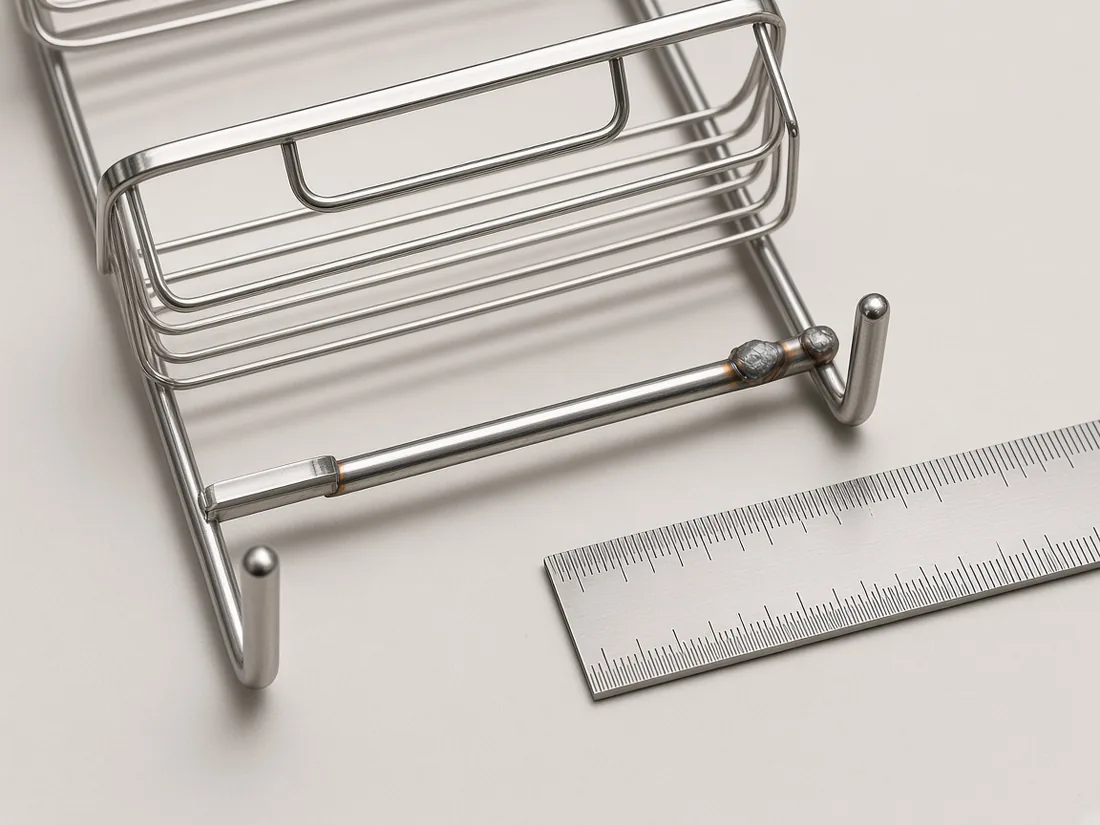
Most wet-zone failures on a hanging wire caddy do not start in the middle of a long, well-coated wire. They start where the surface is interrupted: weld nuggets, cut ends, hook bends, tray corners, and fastener holes.
A resistance-weld nugget is a crevice and a heat-affected spot at the same time. Soap film and spray collect around the button of metal. If powder or plating is thin on the shoulder of that nugget, the first red or brown stain often appears there while the mid-span still looks clean. The claim file should therefore tell inspectors to photograph and evaluate nuggets, not only open faces.
Cut ends are the next regular site. Basket wires are sheared or sawn, then sometimes burred or capped. A hollow tube hook may be plugged, or it may be left open. An untreated cut end is a raw edge with a different coating thickness from the drawn surface. If the listing will use rust-proof language, the brief should say how that end is closed, coated, or otherwise treated, and how an inspector will look at it.
The hook bend and the contact line on the shower arm see abrasion as well as spray. A hook that is a different metal from the basket can rust first and still generate a product-level complaint.
Lower towel hooks and soap-tray lips see drips that do not drain as quickly as an open grid. Drainage design is a separate buyer question, covered in Koitor’s shower caddy drainage design guidance, but trapped water matters here only as a corrosion-risk input: if a tray holds standing water, that pocket belongs on the observation list.
Iron contamination is a distinct stainless failure mode. The British Stainless Steel Association explains that rust staining on stainless often comes from free iron transferred by tools, blasting media, or carbon-steel contact, and it points to iron tests described in ASTM A380 and A967, including the sensitive ferroxyl method.
That is not a reason to invent a factory test result. It is a reason to ask, in the claim file, how mixed-metal tooling is controlled and how a lot can be checked if rust appears on an otherwise correct grade.
Fasteners and small bought-in parts belong on the same map. A stainless basket with a zinc-plated screw, an uncoated rivet, or a painted hook can void a product-level rust-proof line even if the wire itself is acceptable. Record those parts by specification, not by a photo of the basket alone.
What evidence belongs in the file, and what does a salt-spray report not prove?
The evidence pack should explain the construction, the test method, the specimen, and the evaluation rule. It should not jump from a laboratory hour count to a retail promise of years without rust.
ASTM B117 is a practice for operating a salt-spray (fog) apparatus. Its published scope is clear: it covers the apparatus, procedure, and conditions required to create and maintain that environment. It does not prescribe the type of specimen, the exposure period, or the interpretation of results for a specific product.
The same official text states that prediction of performance in natural environments has seldom been correlated with salt-spray results used as stand-alone data, and that correlation or extrapolation should be considered only when corroborating long-term atmospheric exposures have been conducted.
ISO 9227:2022 is the current ISO document for corrosion tests in artificial atmospheres by salt spray, including neutral salt spray and the acetic-acid and copper-accelerated variants. Like B117, it is a method standard. Duration, specimen orientation, and pass/fail language still have to come from the product agreement or a referenced product specification, not from the method document alone.
That is why a report that only says “B117, 48 hours, no red rust” is incomplete for a rust-proof listing. The file should state whether the specimen was a finished hanging caddy, a cut basket, or a coated panel; whether welds, cut ends, and hook bends were in the evaluated area; how the part was held; and what counted as a failure. A mid-span-only reading can miss the sites that shoppers actually see after a few weeks in a shower.
For teams that need help reading those reports, Koitor already maintains a page on salt spray test report interpretation for bathroom hardware. This article does not repeat that reading method. It only requires that a shower-caddy claim file use a report whose specimen and evaluation match the product that will be listed.
Objective advertising claims also sit under a general substantiation expectation. The FTC Policy Statement Regarding Advertising Substantiation states that advertisers should have a reasonable basis for objective claims before disseminating them. That policy is not a shower-caddy test method, and it does not tell you how many hours to run. It is a reminder that rust-proof and rust-free are performance claims, not decorations, and that the construction freeze and the test file should exist before artwork is released.
A one-page evidence index is usually enough at the RFQ stage: approved BOM, weld and cut-end treatment, coating or plating specification, photograph set of first-to-rust sites on the golden sample, the agreed corrosion-test method and edition, specimen definition, evaluation rule, and the exact words allowed on the carton and retailer page. If any of those cells is empty, the safer listing uses narrower wording, or no rust-proof line at all.
| Claim-file item | What to freeze | What it does not prove by itself |
|---|---|---|
| Substrate and grade | Grade and form for basket, hook, tray, and fasteners, with the purchase specification or mill document the project will accept | A stainless name on a drawing does not prove welds are clean of free iron, and it does not prove a rust-proof retail line |
| Weld and cut-end treatment | Welding method, dressing, cleaning or passivation step if used, and the visual standard for nuggets, tint, burrs, and open ends | A tidy sample weld does not prove bulk coverage at every crossing if the process is not locked |
| Coating or plating system | Pretreatment, coat or stack, cure or plating route, and coverage expectation at edges, nuggets, and hook bends | A color chip or a mid-span thickness reading does not prove edge coverage |
| Corrosion-test report | Method and edition (for example ASTM B117 or ISO 9227:2022), agreed duration, finished-caddy specimen, and evaluation of named sites | Hours in the cabinet do not equal years in a shower, and a panel test does not speak for a hook or cut end that was not exposed |
| Artwork wording | The exact phrase allowed, any environment limits, and any parts excluded from the claim | A laboratory pass does not automatically authorize “rust free,” never-rust claims, or lifetime language |
How should coating thickness measurement be separated from lot sampling?
Thickness measurement and lot sampling answer different questions. One asks how a film is measured at agreed points. The other asks how many pieces from a lot are examined, and against what acceptance quality limit, under a plan the two sides have adopted.
For powder applied in the uncured state, ASTM D7378-16 (reapproved 2024) is the practice for measuring the thickness of applied coating powders in order to predict cured thickness. It describes portable methods, including notched comb gauges, magnetic or eddy-current gauges, and non-contact ultrasonic instruments, and it notes that some procedures need a reduction factor because powder shrinks during cure. That document is a measurement practice, not a pass/fail table for shower caddies, and not a sampling plan.
After the film is cured, nondestructive dry-film thickness on metal is commonly handled under ASTM D7091-22, which describes magnetic and eddy-current gauges, plus calibration, verification, and adjustment steps. Again, the practice tells you how to measure. The minimum and maximum thickness, and the exact locations on a hanging caddy, come from the project specification. Those locations should include edges and weld shoulders, not only flat mid-spans, if the claim depends on coverage at first-to-rust sites.
Lot sampling belongs in a separate clause. ISO 2859-1:2026 is the current ISO sampling system indexed by acceptance quality limit for lot-by-lot inspection by attributes. The 1999 edition has been withdrawn and replaced, so the purchase agreement should name the edition the project will use.
Inspection level, AQL values, and switching rules are commercial choices. They should not be bundled into the same sentence as a caliper datum or a thickness-gauge location, because a buyer can otherwise think that “measure here, AQL 1.5” is a single technical recommendation. It is not.
A clean specification therefore has at least two headings. Under measurement, list tools, datums, film-thickness method, and the named sites (nugget shoulder, cut end, hook bend, mid-span). Under sampling, list the ISO 2859-1 edition, inspection level, AQL, and whether the plan is for visual rust stains, thickness nonconformities, or both, as separate characteristics if that is how the parties will inspect. Keep weld-quality visuals in the visual standard, not hidden inside the AQL number.
None of those clauses creates a rust-proof claim by arithmetic. They only make the evidence file inspectable. If the project has not yet agreed duration or evaluation for a salt-spray run, leave that cell marked as not agreed rather than inventing a number to look complete.
Artwork should wait until the freeze and the evidence index exist. The risky phrases are the absolute ones: rust proof and rust free used without construction limits, never-rust wording, guaranteed rust-proof slogans, and any lifetime rust warranty. Those lines are hard to support on a wet-zone wire product with joints and cut ends, and Koitor does not use them as product promises on this site.
Safer listing language is conditional. It can name the construction (“304 stainless wire basket and hook, with agreed weld cleaning”) and, where the file only supports it, rust resistant in a stated environment, such as indoor residential showers, excluding coastal outdoor use or abrasive cleaner damage. If the hook or the fasteners are outside the tested construction, the copy should not imply that every part is equivalent.
A jewelry-industry FTC guide, 16 CFR 23.11, draws a useful official contrast between rust proof and rust resistant, but its scope is the Guides for the Jewelry, Precious Metals, and Pewter Industries. It is not a regulation written for shower caddies, and this article does not treat it as one.
The contrast is still worth reading. That guide reserves rust proof and similar terms for products whose parts will be immune from rust and other corrosion during the life expectancy of the product, and it treats rust resistant as a milder claim tied to normal use over a major portion of life. Even as an analogy, that is a high bar for a hanging wet-zone caddy.
Hold the retailer portal, the carton, the hangtag, and the comparison-chart icons until they use the same agreed phrase. A carton that says rust proof while the portal says rust resistant is still a claim problem. Change control should treat wording as a controlled field, the same way a grade change would be controlled.
If the construction is still in sampling, print no rust-proof line. A pre-production sample can look excellent and still change when a weld schedule, a hook source, or a plating rack is adjusted. The listing can be updated after the freeze, not before.

What should go on a rust-proof listing checklist for a shower caddy?
Use a checklist that would be wrong if you pasted it onto a dish rack, a towel bar, or a suction caddy. The items below are tied to a hanging hook-over shower caddy and to a rust-proof or rust-free listing decision.
- Confirm the SKU is a hanging hook-over caddy, and do not reuse this claim file for suction, adhesive, tension-pole, or over-door versions.
- Name the metal grade and form for the basket, the hook, the soap tray, and every screw, rivet, or hook that remains in the spray.
- State the weld method and the post-weld treatment, including how nuggets, heat tint, and spatter will be judged on the golden sample photographs.
- State how cut wire ends and any open tube ends are finished or coated, and include those ends in visual review.
- Lock the coating or plating system, including pretreatment and coverage at nugget shoulders, hook bends, and tray lips, with thickness measured under the agreed method at those sites.
- Define the corrosion-test specimen as a finished caddy, or explain in writing why a panel or a cut subassembly is being used instead, and which product sites that substitute cannot represent.
- Record the corrosion-test method and edition, the agreed duration, and the evaluation rule, without converting hours into years of shower service.
- Write the exact listing phrase, any environment limits, and any excluded parts, and apply that same phrase to the carton, hangtag, and retailer portal.
- Keep thickness-gauge locations and tools in a measurement clause, and keep ISO 2859-1 sampling (edition, level, AQL) in a separate sampling clause.
If any of those lines cannot be completed, do not fill the gap with a generic rust-proof icon. Complete the freeze, or narrow the wording.
How can a family-owned OEM review a rust-proof construction brief?
Koitor Hardware is a family-owned custom metal hardware factory in China that manufactures bathroom and home storage hardware, including shower caddies, for overseas importers, distributors, and private-label programs. On a rust-proof brief, the useful factory discussion is the construction and the evidence index, not a promise that any Koitor caddy is rust-proof.
A practical review looks at the drawing or the physical sample, the bill of materials, the weld and cut-end treatment, and the finish route, then marks which first-to-rust sites can be photographed on a pre-production sample.
Teams still comparing factory options can also use Koitor’s custom shower caddy manufacturing page for scope and development context. If a salt-spray or thickness method is proposed, the review should check that the method, edition, specimen, and evaluation are written as project agreements, not as implied factory standards.
Small-batch OEM production can help when a buyer wants to test one construction before a larger run, or when hook grade, weld dressing, or a coating change needs a new sample. MOQ can start from about 100 pcs depending on the product. Samples usually take 5–7 working days after details are confirmed. Bulk production usually takes 4–6 weeks depending on product, order quantity, finish, and packaging. Those timings are planning ranges, not guarantees, and they do not replace the claim file.
Send the intended listing sentence with the drawing. If the sentence is stronger than the construction, the honest outcome is a revised sentence, not a stronger adjective on the same open cut ends.
Frequently asked questions
Can a stainless shower caddy be listed as rust proof just because the drawing says 304?
No. Grade is only one cell in the file. Weld tint, iron contamination, cut ends, hooks, and fasteners can still stain in a shower. Freeze those items and decide wording after the evidence index is complete, not from the grade name alone.
If a sample passes an agreed salt-spray run, can the carton say rust free?
Not automatically. ASTM B117 and ISO 9227 define test environments; they do not convert hours into rust-free service life. Even a clean report supports only the specimen, duration, and evaluation that were written down. Absolute rust-free or never-rust language still needs a separate, supportable basis, which many wet-zone caddy constructions do not have.
Should tension-pole or suction caddies use the same rust-proof file as a hanging hook-over caddy?
No. The wet-zone joints are different. A tension pole adds spring seats and joints; a suction version adds cups and clips. Copying hanging-caddy artwork onto those SKUs mixes constructions. Open a separate freeze for each mounting system.
Where should inspectors look first on a hanging caddy?
Look at weld nuggets, cut ends, hook bends, tray lips, and fasteners before mid-span wires. Those are the usual first stains, and they are the sites a shopper photographs in a return.
Can coating thickness and AQL be written as one incoming-inspection sentence?
They should not be. Thickness methods such as ASTM D7378 or ASTM D7091, and the datums on the caddy, belong in a measurement clause. ISO 2859-1 sampling belongs in a sampling clause, with the edition and AQL agreed by the parties. Mixing them hides which number is a film reading and which number is a lot plan.
Work With Koitor Hardware
Need a shower caddy rust proof listing brief reviewed?
Send Koitor the drawing or sample, the intended rust-proof or rust-resistant wording, and the weld, cut-end, and coating details you want to freeze. The team can review construction and manufacturability before artwork is released. This review does not mean a Koitor caddy is rust-proof.
OEM / PRIVATE LABEL
Turn this sourcing guide into a product brief
Share your target product, size, finish, order quantity and packaging requirements. Your team receives a practical manufacturability review before quotation.


 English
 Español
 Português
 Français
 Deutsch
 العربية