
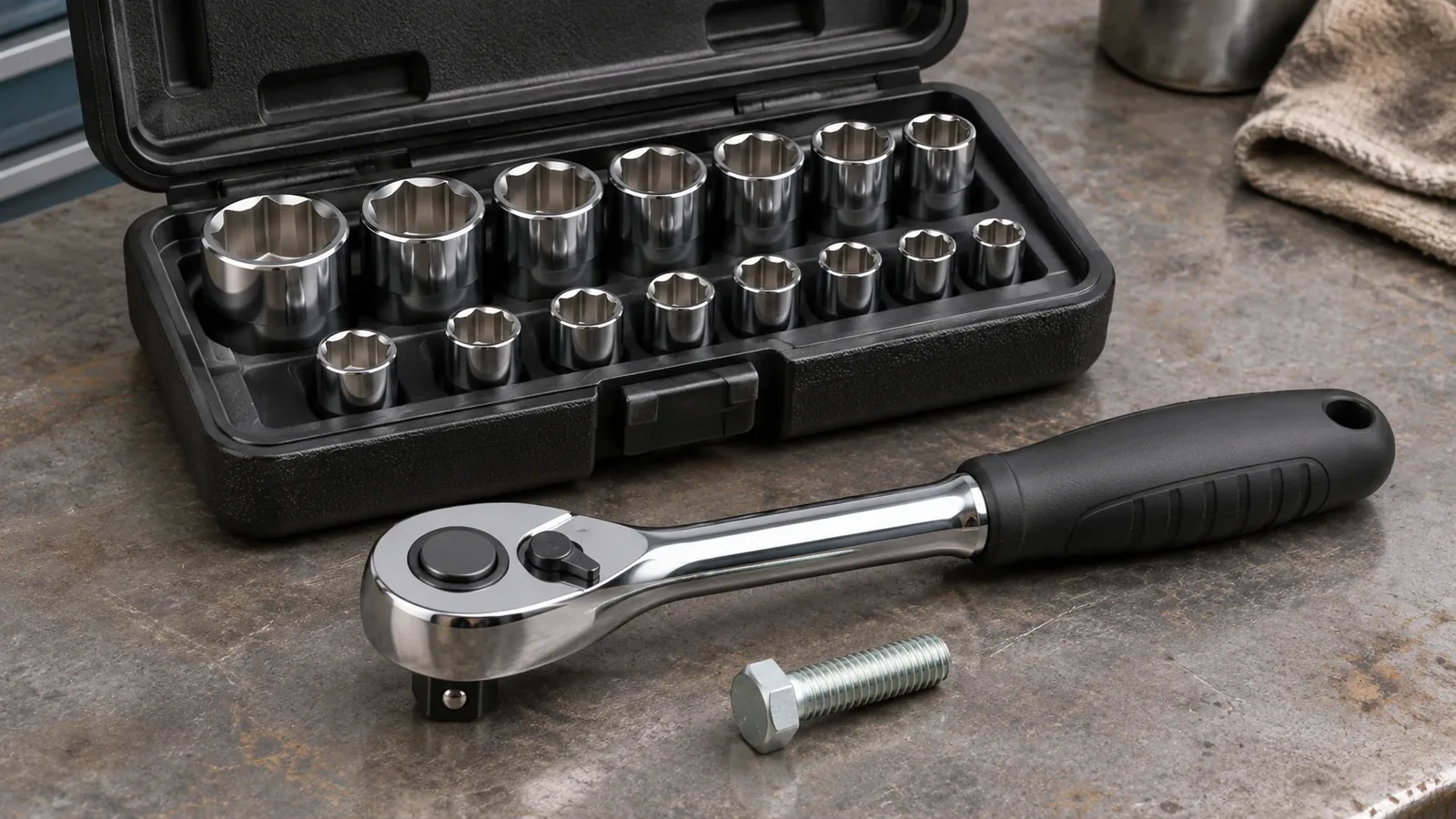
Socket vs wrench is not quite a choice between two mutually exclusive tools. A socket is generally a removable fastener-engaging component; it is commonly paired with a handle such as a ratchet or breaker bar to form a socket-wrench setup. “Wrench” can refer to a complete tool family, including open-end, box-end, combination and adjustable designs, as well as a socket wrench. The buyer should therefore identify whether the requirement concerns the socket, the handle, the complete assembly or the access envelope around the fastener.
For hardware procurement or assembly review, the drive connection, fastener interface and surrounding clearance all matter. A socket size describes the fastener-engaging end; the square drive connection describes the interface to a compatible handle; and the handle length or head form influences access. Those attributes do not establish torque control or a product-specific assembly result. Select and document tools against the actual fastener and authorized task rather than relying on a broad category name.
This article clarifies common terms and provides a buyer comparison framework. It does not prescribe operator technique, fastener torque, powered-tool use or safety practice. Follow the tool maker’s instructions, product design requirements and the responsible process owner’s approved work instruction.
What is a socket?
A socket is a removable component with an opening shaped to engage a compatible fastener head or nut. It typically connects to a drive tool through a square-drive interface, although exact designs and product families vary. A socket by itself is not the complete wrench. It needs a compatible handle or driver to apply turning input.
Sockets come in different engagement profiles and sizes. A buyer may encounter six-point or twelve-point openings, shallow or deep forms, and other specialty constructions. These categories describe geometry and reach, not a universal ranking. The buyer should use the exact fastener specification and tool documentation to select a suitable interface. Do not assume a socket that appears close in size or shape will fit correctly.
The socket’s drive end also needs to match the handle’s drive connection. For example, socket and ratchet systems are sold in drive-size families. The socket must be compatible with the handle and any extension or adapter in the setup. A socket’s nominal opening size and its drive connection size are two different measurements; an article or catalog can mention both, so read the labels carefully.
What is a wrench?
A wrench is a complete hand tool or broader tool family for turning fasteners. An open-end wrench contacts accessible flats with open jaws. A box-end wrench surrounds the fastener head through a closed opening. A combination wrench pairs open and closed ends in one tool. An adjustable wrench changes jaw opening within a range. A socket wrench uses removable sockets attached to a compatible handle such as a ratchet.
The word “wrench” is therefore broader than “socket.” A socket wrench is one type of wrench system; a standalone socket is one component used in that system. In some regional English, “spanner” is another common term for wrench, while specific catalogs and standards may distinguish designs. When the tool must be procured exactly, use a product designation, drawing or specification rather than relying on a regional synonym.
A box-end or open-end wrench has jaws or an opening integrated into the handle. A socket separates the fastener-engaging part from the handle. That modular structure can allow a buyer to use different compatible sockets with the same drive handle, but it also creates another compatibility check. Confirm that the socket, ratchet, extension and fastener are intended to work together.
| Term | What it identifies | Buyer check |
|---|---|---|
| Socket | Removable fastener-engaging component | Opening profile and size |
| Ratchet | Handle mechanism that permits repeated strokes | Compatible drive and task instructions |
| Socket wrench | Complete system using a socket and handle | Socket, drive, handle and extension compatibility |
| Open-end wrench | Complete tool with open jaws | Correct fastener flats and available access |
| Box-end wrench | Complete tool with enclosed opening | Opening size and approach space |
| Adjustable wrench | Complete tool with movable jaw | Actual fit and authorized tool selection |
Socket vs wrench: compare the parts of the system
The phrase socket vs wrench can confuse a component with a complete tool. To compare options, break the requirement into three interfaces:
- Fastener engagement: what exact head or nut profile and size must the tool fit?
- Tool connection: does the system use a socket drive and compatible handle, or a fixed wrench opening?
- Access: how much room exists around the fastener for the tool head and handle movement?
A socket system can help when the buyer needs interchangeable fastener-engaging sizes or an approach that fits a particular location. A fixed wrench may suit an accessible fastener when its opening can be placed over the flats. These are conditional examples, not performance recommendations. The product geometry and work instruction determine the acceptable option.
A socket can be used with a ratchet, a fixed handle, an extension or another compatible drive tool. Ratcheting is a handle mechanism; it is not what defines the socket’s fastener size. A ratchet may enable repeated turning strokes without lifting the tool from the fastener, but that description does not prove a torque limit or calibrated result. A conventional wrench may also be used in different ways according to its maker’s instructions and the approved task.
Access matters independently. A socket needs room to pass over the fastener and fit around it; the attached handle needs clearance to move. A box-end wrench also needs approach room, while an open-end design may approach from the side. A tight location can limit the use of either option. Review the actual assembly orientation, nearby flanges and product surfaces before naming a tool.

How to choose terminology for a hardware specification
Start with the fastener drawing or approved sample. State the head or nut type and its specified dimensions. A generic “wrench” requirement may be too broad if the buyer expects a socket system; “socket” may be incomplete if it does not identify the compatible drive handle. Specify the tool at the level needed for procurement and process control.
A concise purchase or assembly record may identify the exact tool family, socket opening size, drive connection, extension if relevant, access clearance, and the approved task. If an exact model is required, include the maker and model. If equivalents are acceptable, define which dimensions or interfaces must match and who approves a substitution.
Do not copy a nominal size without confirming the unit and reference. Fasteners and tools may be described using different unit systems or conventions, and catalog fields may show the socket opening and drive connection side by side. Ask the supplier to clarify which dimension is being quoted. If a drawing is ambiguous, obtain an authoritative revision or sample approval before placing a tooling requirement.
For a hypothetical metal rack assembly with a recessed fastener, the buyer might compare a socket and extension with a box-end wrench. The right answer depends on approach direction, head clearance, fastener flats, required rotation and surface protection. This example does not claim which tool Koitor uses or recommend a method for a real product. The responsible process owner should select and approve the actual tool.
Common comparison errors
Treating socket and wrench as synonyms. A socket is usually a component; wrench often names the complete tool. A socket wrench combines a socket with a handle.
Confusing socket opening size with drive size. The opening mates with the fastener; the drive connection mates with the handle. They are different interfaces and should be recorded separately.
Assuming a ratchet is a socket. A ratchet is a handle mechanism. It can accept sockets when the connection is compatible.
Assuming more engagement points prove suitability. Point count is one design attribute. It does not establish that a socket is right for a particular fastener or task. Check the exact interface and maker information.
Ignoring clearance. A socket can fit the fastener but the attached handle may not have enough space to move. Review both head access and handle arc.
Using “adjustable wrench” as a dimensional specification. The broad name does not tell a buyer which opening range or configuration is needed. Identify the fastener and relevant product data.
Treating fit as torque control. A tool that engages a fastener does not prove a specified torque was applied or that a joint has been qualified. Keep those requirements separate.
Assuming tool choice demonstrates product quality. A list of tools does not establish assembly repeatability or the finished hardware’s performance. Request evidence relevant to the buyer’s actual requirement.
Record tool access and substitution decisions
A buyer can make tool review easier by attaching an assembly view that shows the fastener in context. Identify the direction from which the tool approaches, nearby obstructions, whether a handle can rotate and whether finished surfaces could contact the tool. A flat parts list may not show these spatial constraints.
If a supplier proposes an alternative tool, compare the interfaces and relevant dimensions. Does the socket engage the same fastener profile and size? Is its drive compatible with the handle? Is there clearance for the head and handle? Does the alternative change any approved process control? Do not accept “equivalent wrench” without knowing what equivalence means for the task.
The record should name the approving role and point to the current drawing or work instruction. A substitute approved for one SKU, fastener or assembly revision may not apply to another. When the product changes, confirm whether access or fastener geometry changed. This is a scope check rather than a blanket instruction to requalify every tool after every minor revision.
Fastener condition and material may also matter to assembly. A tool that engages a fastener can still encounter galling, coating damage, cross-threading or access issues for reasons beyond tool naming. See the existing stainless steel fastener galling discussion for metal storage racks; it covers a separate fastener interaction rather than serving as a tool approval.
Treat the socket opening and the drive connection as separate requirements
Catalog listings often place several measurements on the same line. One value may describe the socket’s fastener opening; another may describe the square-drive interface that connects the socket to a handle. A buyer should label each dimension in the purchase specification so a supplier does not interpret an opening size as a drive size. If a product series uses both metric and inch references, confirm the exact system and model number from the maker’s current catalog.
The opening also needs to match the fastener shape. Hex nuts, external hex heads, internal hex sockets and other forms do not all use the same engagement geometry. The word “socket” alone does not define six-point versus twelve-point form, depth, wall thickness or access features. Specify the relevant profile and identify the fastener from the drawing or an approved sample. Avoid relying on a cropped photograph, especially when the image does not show scale or the fastener’s complete profile.
A handle may accept a particular drive connection while the assembled tool still fails to reach the fastener. Extensions, universal joints and adapters add interfaces and length, which can affect access and alignment. Whether those components are allowed is a task-specific decision. Record any approved extension or adapter and check the complete assembly in the actual access envelope. The presence of a compatible connector does not establish that the resulting approach is appropriate for the operation.
Compare fixed and interchangeable tools in the assembly context
A fixed opening wrench carries its engagement shape as part of the handle. A socket system separates the engagement component from the handle, which can support interchange among compatible sockets. This modularity can be useful for a tool inventory, but it also means the buyer must control which socket is paired with which drive and fastener. A loose component without an identified set may create selection ambiguity.
If the product includes several fastener sizes, a buyer can map each fastener to the compatible opening and note whether a shared handle is permitted. Where procurement needs require dedicated tools, identify the complete tool rather than only listing a group of loose sockets. Where interchangeable components are acceptable, record how each is identified and stored. This is an organization and traceability choice; it does not promise faster work or fewer errors by itself.
Tool reach should be assessed from the assembly drawing or physical product. The distance from the approach point to the fastener, surrounding walls, folded edges and nearby finished parts can affect whether a socket head, wrench jaw or handle can be positioned. A tool might fit over the fastener but leave insufficient space for the handle’s movement. Another might approach from the side but not fully engage the fastener. Specify which condition matters and ask for a sample review if the drawing cannot show it clearly.
Where visible finishes are involved, define any prohibited contact surface and permitted handling approach through the approved work instruction. Do not assume a socket or wrench will not scratch a coating just because it is a commonly used tool. Tool condition, contact and part presentation are application-specific. The buyer’s acceptance criteria and process owner should address those points rather than a generic online recommendation.
Understand what tool categories do not establish
A tool label does not prove that it was used during production, that it was maintained, or that the assembly met a requirement. A ratchet’s mechanism does not make it a torque wrench. A socket with the correct nominal opening does not confirm that a fastener was installed to the required condition. Tool identification can support a process record, but evidence of process execution and product acceptance comes from the relevant control and inspection records.
The buyer should also avoid comparing tools using a single unsupported performance adjective. Terms such as stronger, more precise, faster or safer require a defined product, task and evidence. A manufacturer’s catalog may explain intended design features, but those features do not automatically transfer to every application. If a selection has a consequence for a joint, finish, safety practice or warranty, consult the tool maker’s instructions and qualified process owner.
A product audit may ask which tool types are present, but that question should be linked to the process risk. If the requirement is merely that a fastener can be accessed, drawing review may be enough. If the process requires controlled fastening, identify the separate instrument and verification criteria. If cosmetic finish is critical, define the contact and inspection criteria. Do not use “socket versus wrench” as a proxy for all these distinct decisions.
Keep substitutions and records traceable
A socket or wrench substitute should be reviewed against the relevant interface and task, not accepted solely because the supplier describes it as equivalent. Compare fastener profile and size, socket opening, drive connection, reach, approach direction and any explicitly required tool control. The authorized reviewer decides which dimensions matter and whether the replacement is acceptable. Preserve the original requirement and the substitution decision with the assembly revision.
If an approved fastener changes, reconsider the tool mapping. A change from one head style or size to another may affect engagement and clearance. If the physical fastener stays the same but its supplier or part number changes, confirm whether the specification is unchanged rather than assuming equivalence from appearance. Keep a link to the current drawing or bill of materials so future buyers can see which version the tool list covers.
A useful review sheet identifies the product revision, fastener line, drive profile and size, complete tool type, model or allowed range, access note, applicable instruction, approver and date. Add the reason for any exception and the evidence used. This record can be concise; the purpose is to show which component is specified, which tool is intended and which requirement governs. It should not claim calibration, torque or safety status unless those separate facts have actually been verified.
Frequently asked questions
Is a socket a wrench?
A socket is generally a removable component. A socket wrench is the complete tool system formed by a socket and a compatible handle.
Is a ratchet a type of socket?
No. A ratchet is a handle mechanism that can drive a compatible socket. The socket is the removable fastener-engaging component.
What is the difference between a socket size and drive size?
Socket size normally identifies the fastener-engaging opening; drive size identifies the connection to the handle. Check the exact product labels because the dimensions serve different interfaces.
Is a socket wrench better than an open-end wrench?
There is no universal answer. The fastener, approach direction, surrounding clearance and approved task determine which design is suitable.
Does a ratcheting wrench control torque?
The ratcheting mechanism alone does not establish torque control or calibration. If a joint requires controlled torque, specify and verify that separately.
Is “spanner” different from “wrench”?
Usage varies by region and catalog. Confirm the exact tool design and specification rather than relying on a regional term.
Specify the component, complete tool and access
The useful comparison in socket vs wrench is not simply which word is correct. Identify the fastener interface, the removable socket or complete wrench design, the handle connection and the available approach space. A socket can be part of a wrench system; a wrench can also have fixed jaws or a box opening. Ratcheting describes a mechanism, not the fastener size or proof of controlled torque.
For a custom metal hardware assembly, share the controlled drawing or sample, actual fastener specification and access question with the responsible technical team. Koitor’s OEM scope is described on the home-storage hardware manufacturer page; buyers can contact Koitor with a project-specific question.
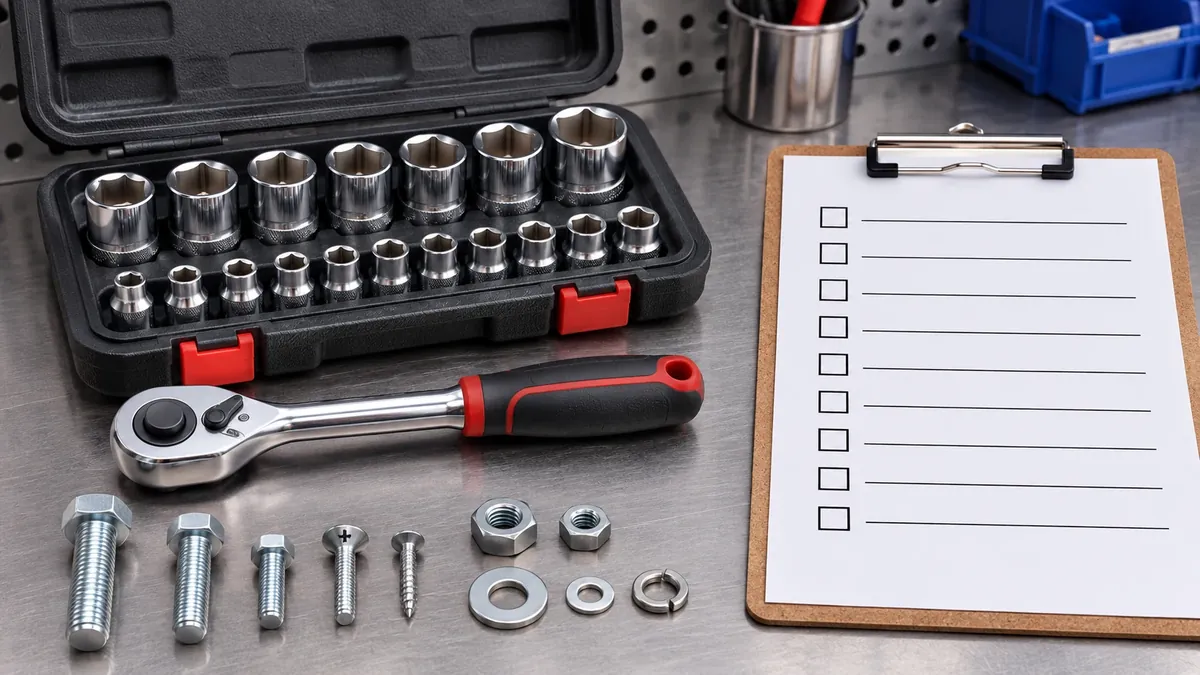
Review a Hardware Assembly Requirement
Share the controlled drawing or sample, fastener identity and access constraint so the relevant OEM project question can be scoped.
OEM / PRIVATE LABEL
Turn this sourcing guide into a product brief
Share your target product, size, finish, order quantity and packaging requirements. Your team receives a practical manufacturability review before quotation.


 English
 Español
 Português
 Français
 Deutsch
 العربية