
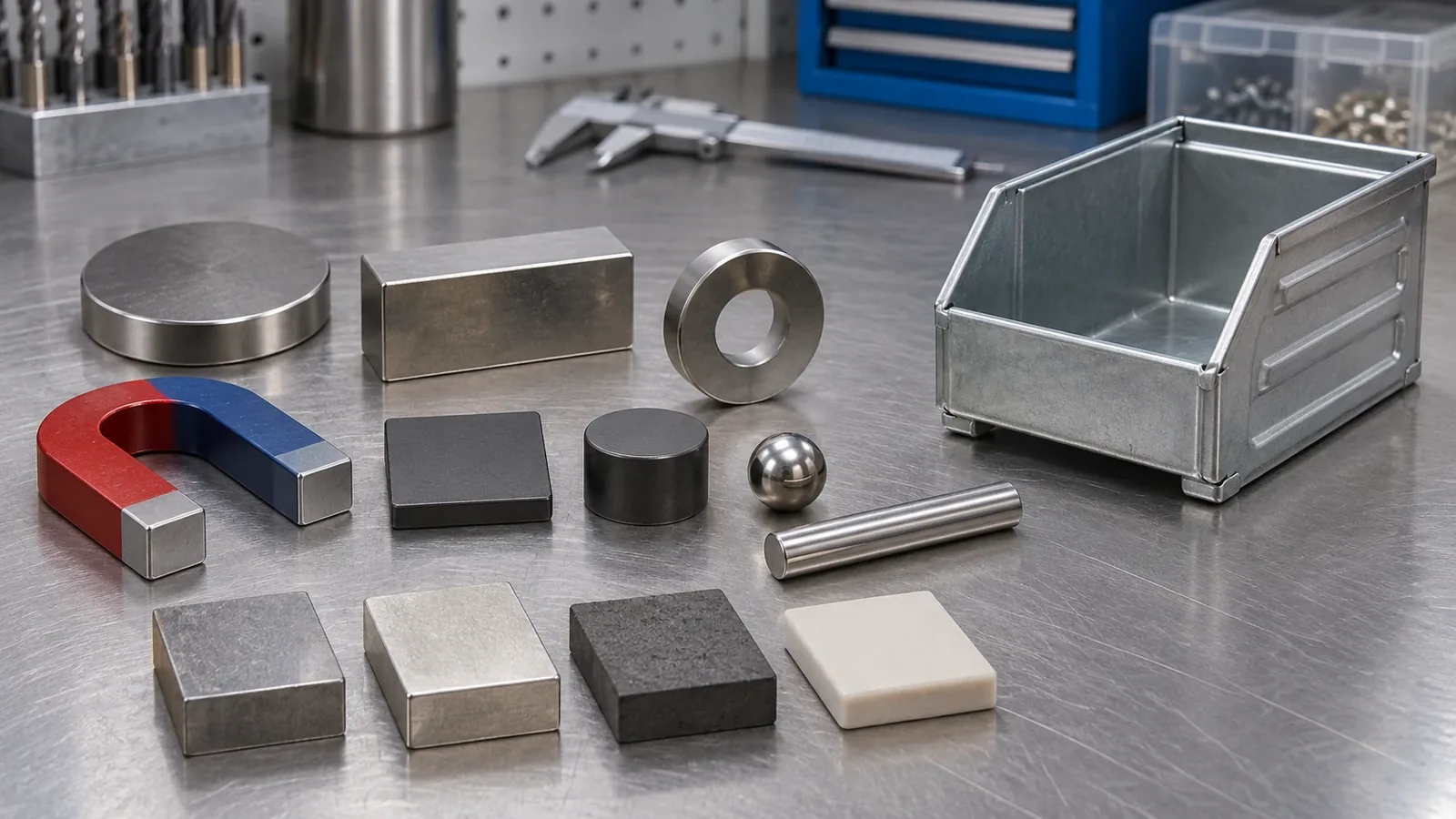
Types of magnets are easier to compare when the buyer separates three questions: where the magnetic field comes from, what material or magnetic compound is used, and how the magnet is built into a product. A permanent magnet provides a persistent field without an energized coil; an electromagnet depends on electrical current through a winding. NdFeB, ferrite, alnico and samarium cobalt identify material families, while flexible or bonded magnet describes construction forms. These labels do not create one universal strongest-to-weakest ranking or identify the force of a finished assembly.
For bathroom and home-storage hardware, the useful buying question is usually more specific: what magnet or magnetic assembly is used, which surfaces and gaps are present, what retention or release behavior does the product require, and what evidence supports that requirement? The answer may depend on magnet dimensions, grade, orientation, backing steel, contact geometry, coating, assembly and the mating part. A material name alone cannot establish a catch’s holding behavior in the finished product.
This guide provides a taxonomy and a buyer specification map. It does not claim that Koitor manufactures magnets, recommend a material for every environment, or give a universal pull-force or temperature rating. Confirm the actual component and assembly with its supplier and design owner.
Classify magnets by field source
A permanent magnet retains a magnetic field as a component without requiring continuous electrical current through a coil. Permanent magnets are available in multiple material families and product forms. The category identifies a field-source concept; it does not specify dimensions, grade, magnetization direction, surface protection, force or suitability.
An electromagnet creates a magnetic field through electrical current in a coil. Its behavior depends on the electrical and magnetic circuit, geometry, current, duty and application. It is not interchangeable with a permanent magnet simply because both can attract ferromagnetic materials. A product requiring a powered field also needs a defined electrical system and operating controls; this article does not specify or approve such a system.
The field-source distinction matters early in product development. A passive catch may be reviewed as a component with a permanent magnet; an energized actuator or magnetic system requires the relevant power and control architecture. Buyers should not infer that a product uses an electromagnet from a strong attraction demonstration, nor assume every permanent magnet is identical because it needs no power.
Compare permanent-magnet material families carefully
Eclipse Magnetics lists common material families including neodymium-iron-boron (NdFeB), samarium cobalt (SmCo), alnico and ferrite. These categories help identify possible materials, but product capability depends on exact grade, form, dimensions, magnetization, assembly and application. A catalog taxonomy is not a selection approval.
NdFeB is a rare-earth permanent-magnet family. Ferrite is a ceramic magnet family. Alnico and SmCo are other permanent-magnet materials with different compositions and material characteristics. Those descriptions distinguish families but do not provide a performance ranking for an actual catch or holder. Compare exact product data and operating conditions from the supplier.
A buyer should be careful with broad labels like “strong magnet” or “rare-earth magnet.” They do not state the grade, size, direction of magnetization, backing arrangement or assembled behavior. Nor does a magnet material alone establish corrosion protection, temperature capability, impact tolerance or service life. Ask for evidence tied to the named component and actual requirements.
| Classification axis | Examples | What it identifies | What it does not establish |
|---|---|---|---|
| Field source | Permanent magnet, electromagnet | Whether a persistent field is supplied by a magnet or energized coil | Holding force of a finished product |
| Material family | NdFeB, ferrite, alnico, SmCo | Broad magnetic material category | Exact grade or environmental suitability |
| Construction form | Rigid, flexible, bonded, assembled | How the magnetic element is formed or integrated | A universal force or durability ranking |
| Product assembly | Magnet, housing, backing steel, mating part | The complete component arrangement | Performance without an applicable test |
Construction form is a separate question
Magnet materials can be made or assembled in different shapes and forms. A rigid sintered magnet, flexible magnetic sheet or bonded magnet may differ in construction. A supplier may also combine a magnetic element with a steel backing, housing, adhesive, plastic carrier or protective cover. Those components affect how the finished assembly is presented and mounted, but the exact result must be supported by product-specific evidence.
Flexible magnet refers to a form that can conform or be supplied in sheet or strip formats, depending on the product. Bonded magnets are produced by combining magnetic material with a binder in a specified manufacturing route. These are construction descriptions, not a grade ranking or proof of performance. Product makers can state which specific material and construction apply.
An assembly may use a magnet together with pole pieces, a steel cup or a back plate to shape or support the magnetic circuit. If the buyer is purchasing a complete catch, the assembly drawing and supplier specification matter more than a generic material family. A loose magnet’s information may not describe the final component once it is enclosed, bonded or positioned near another material.
Specify the complete magnetic component
For a buyer, a practical record should identify:
- Component supplier and part number.
- Permanent magnet or electromagnet field source.
- Material family and exact grade if documented.
- Shape, dimensions and magnetization direction where specified.
- Backing, housing, adhesive or other assembly parts.
- Coating or protective treatment if present.
- Mating material and contact geometry.
- Gap, alignment and mounting arrangement relevant to the product.
- Required retention or release behavior and how it will be evaluated.
- Drawing, sample and revision used for approval.
Not every project requires every field. The designer and buyer should choose the attributes that affect the product decision. A supplier may be unable to disclose a proprietary grade, but should still identify the approved component and provide appropriate product evidence for the buyer’s stated requirement.
A magnet name alone does not establish pull force. The finished behavior depends on the magnet and the magnetic circuit, mating part, air gap, contact surface, alignment and test configuration. A pull-force value is meaningful only with the stated test setup and conditions. Do not compare numbers from different suppliers if one test uses bare magnet-to-steel contact and another uses a housing, coating or gap.

Understand the finished product interface
A magnetic catch or holder is a system: magnet, housing or mount, mating surface, contact condition and surrounding product geometry all contribute. The product designer should specify where the magnet sits and what component it attracts or holds. A buyer reviewing only the magnet subcomponent may miss an air gap, cover thickness, panel position, coating or misalignment in the finished assembly.
An existing magnetic storage rack page addresses buyer sample review and retention evidence; see the magnetic metal storage rack importer sample-check guide. That product-specific page should remain the owner for a rack’s retention verification. This taxonomy does not recreate a rack load test or set a force requirement.
For a magnetic knife strip, the intended contact and release interaction differs from a cabinet catch or wall-mounted rack. The magnetic knife strip sample-check article addresses that separate product context. Do not transfer its criteria to a different magnetic assembly.
Surface coatings, residues and barriers can change the distance between magnetic surfaces. A buyer should document the actual finished stack-up and approved position. If the assembly uses an adhesive or overmold, verify that the sample and production configuration use the specified materials and dimensions. This is not a guarantee that any coating or adhesive is compatible.
Common specification mistakes
Treating material family as product performance. NdFeB, ferrite, alnico and SmCo identify broad families, not the measured behavior of a finished catch.
Comparing unlike force ratings. Test setup, contact surface, air gap, alignment and component assembly must be comparable before figures are interpreted.
Assuming “rare earth” is a complete grade. Identify the exact approved component and its applicable supplier data.
Ignoring construction. A flexible or bonded format differs from a rigid magnet and may be selected for form or assembly reasons; the name does not alone establish suitability.
Leaving out the mating surface. A magnet and receiver form an assembly. Identify the actual material, position and contact condition.
Assuming the surface finish is irrelevant. Coatings, covers and gaps may affect the stack-up. Review the real production configuration.
Transferring criteria from another product. A catch, knife holder, rack and magnetic fixture serve different functions. The same generic magnet label does not make their acceptance criteria interchangeable.
Claiming Koitor makes the magnet. Do not infer component manufacturing scope. Identify the actual supplier and confirmed project responsibilities.
Review samples and supplier data
A sample review should match the buyer’s intended question. If the decision is whether the product closes or releases as intended, define the sample configuration, mating surface, alignment, gap and observation method. If the buyer needs a measured force, specify the test fixture and conditions with the responsible engineer. A hand demonstration can illustrate a sample behavior but does not provide a standardized rating.
Record the sample ID, magnet or assembly part number, revision, housing and mating component. Note whether the tested unit is a prototype or production-intent sample. Capture any differences from the approved drawing. If one unit behaves differently, do not immediately attribute the cause to material; check assembly position, contact, gap, part variation and measurement setup.
Supplier documents should identify the product and relevant limitations. Confirm that the document’s grade and configuration correspond to the item being purchased. If a supplier substitutes a magnet material, shape, coating or backing, treat it as a product change for review. The buyer’s technical authority determines whether evidence and sample approval are sufficient.
For a custom metal storage product, share the drawing or sample and clarify which party supplies the magnetic component, how it is integrated and which retention or release behavior is required. Koitor’s confirmed OEM role is described on the home-storage hardware manufacturer page; the actual magnet sourcing and test responsibilities must be confirmed for the project.
What are the main types of magnets?
Buyers can classify magnets by field source, material family and construction. Permanent magnets include families such as NdFeB, ferrite, alnico and SmCo; electromagnets use an energized coil. Flexible and bonded are construction descriptions.
Is NdFeB always the strongest choice?
A material-family name is not a complete comparison. Evaluate exact component data and the assembled product requirement rather than relying on a universal ranking.
Is a flexible magnet a separate material?
“Flexible” usually describes a product form or construction. Identify the magnetic material and product construction separately.
Does a magnet material determine holding force?
No. Geometry, orientation, backing, gap, mating material, contact and test setup affect the complete assembly result.
Can I compare two supplier pull-force values?
Only after checking whether the products and test conditions are sufficiently comparable. Record the setup, contact, gap, alignment and component configuration.
Does a magnetic catch use an electromagnet?
Not necessarily. Many catches use permanent magnets; verify the actual part and any electrical connections rather than infer the source from the product name.
Identify the requirement before comparing grades
A buyer should begin with the product behavior that needs to be supported. Does the design need to stay closed, hold a removable item, locate a part, provide a detectable magnetic feature or perform another defined task? The answer should name the real assembly and relevant interface. A generic request for a “strong magnet” is difficult to evaluate because it omits contact condition, gap, position, size, housing and the required retention or release behavior.
If a numerical force requirement exists, identify how it was established and which test applies. Record the fixture, contact material, alignment, gap, direction and measurement method. A product maker may publish a force value for a specific configuration; the buyer should check that the product and test setup correspond to the order. Do not compare one supplier’s bare-magnet figure with another supplier’s assembled-catch figure as though the values describe the same system.
If there is no agreed numerical requirement, do not invent one while researching material types. The buyer can still define a sample question—such as whether a component stays in its intended position under the agreed sample arrangement—and ask the design owner to specify an acceptance method. Record that the result is a sample observation and avoid turning it into a general holding-force claim.
Keep magnet material separate from magnetization and geometry
Material family is only one field. Magnets also have physical shape, dimensions, orientation and magnetization direction. Two components with the same broad material family can still differ in size, shape, grade or assembly. The label alone does not reveal which pole arrangement faces the mating part or how the component is mounted. Where those details affect the design, use a controlled drawing or supplier specification.
A component drawing can show dimensions and placement but may not disclose all proprietary material details. A buyer can still ask the supplier to identify the approved part number and confirm that production material matches the agreed product. If an exact grade is a contractual requirement, the documentation should state it or link to the supplier’s controlled specification. Avoid adding a grade from a generic search result to a design without engineering approval.
When a material change is proposed, compare it within the exact component form and use conditions. Ask what changed, which test evidence supports the proposed replacement, whether dimensions and magnetization remain the same, and whether the complete assembly requires sample review. A substitution should not be approved solely because the supplier calls both items “permanent magnets.”
Consider covers, backing and contact gaps
A finished magnetic assembly may include a protective coating, plastic or metal housing, adhesive layer, cover or backing. Each can change the distance or geometry between the magnet and mating surface. Record the stack-up in the real product. If a visible cover or coating is part of the design, confirm that the approved sample and production version use the same configuration.
The mating part also matters. A magnet is not a universal attraction source for all materials. The product designer and supplier must confirm that the specific receiver is appropriate to the intended interaction. A demonstration using a thick steel plate may not represent a finished component with a different alloy, coating, thickness or gap. Keep the test sample and receiver dimensions attached to any reported result.
Contact is not always face-to-face. A catch may close across a designed clearance, or the magnet may attract a component from a different orientation. Those details should be shown in the assembly drawing. Do not use the magnet’s nominal size as proof that the finished door, holder or rack will function as intended. Review the whole product’s motion and fit using the approved design procedure.
Review environmental and handling limits from the exact supplier
Material categories may have different properties, but a buyer should not infer the complete operating range or corrosion behavior from a family name. The finished component can also include coatings, adhesives, housings and contact materials. Ask the supplier for the limitations that apply to the exact product and intended environment. If a claim is important to compliance or service, request the relevant document and verify its scope.
Handling and storage instructions should also come from the component maker. Avoid assuming that all magnet types are handled identically or that a product’s material family alone determines precautions. The buyer’s instructions should match the actual delivered part and applicable workplace controls. This article does not provide magnet handling or installation directions.
For a bathroom application, distinguish moisture exposure at the product interface from a supplier’s generic material statement. The buyer should confirm the completed assembly, exposed edges, protective layers and cleaning environment with the responsible design and quality teams. Do not claim a magnet is corrosion-proof or suitable for every bathroom from its material name alone.
Maintain a traceable assembly revision
A sample may contain a magnet, cover, housing, adhesive and mating component. Record each visible component and the sample revision so a supplier’s replacement part can be compared accurately. If a housing or coating changes, the magnet material might remain the same while the assembled interface changes. Conversely, an assembly can appear unchanged while its internal magnet grade has been substituted. Obtain written confirmation against the approved part number where that distinction matters.
A receiving record can compare labels, dimensions, supplier documentation and sample appearance. These checks do not necessarily verify hidden magnet composition or assembled force. Assign evidence requirements in advance: supplier declaration, product traceability, dimensional checks, sample test or third-party evaluation as appropriate to the project. Do not describe a visual inspection as a material assay.
When an issue appears, record the part number, lot or shipment reference, assembled state, mating component, gap and test method before proposing a cause. A weak or inconsistent interaction could have several possible contributors, including position, contact, housing or component variation. The responsible engineering team decides what investigation is needed. Keep the original sample and the approved comparison reference when practical.
A purchase order should point to the agreed magnetic component and assembly revision, not just a broad magnet category. If the supplier provides a product code, retain it with the buyer’s component list and approved sample. When a code changes, ask whether the supplier’s internal revision, construction or source changed and request a comparison of relevant fields. Keep the decision linked to the SKU that uses the component. This prevents a material taxonomy from being mistaken for an order-ready part number and makes later receiving questions easier to trace.
Specify source, material and assembly separately
The types of magnets are not one ranked list. Permanent versus electromagnet identifies the field source; NdFeB, ferrite, alnico and SmCo identify broad permanent-material families; flexible, bonded or rigid describes construction. A finished catch or holder adds housing, backing, mating surface, gap and mounting details. Buyers should confirm the exact component, test evidence and product scope.
For a metal storage project, tie any magnetic requirement to the controlled assembly drawing and sample. Do not claim a material name alone proves retention or environmental performance. Koitor’s confirmed OEM scope is described on the home-storage hardware manufacturer page; buyers can contact Koitor with a specific product interface question.

Review a Magnetic Hardware Requirement
Share the controlled drawing or sample, mating surface and the specific retention or release question that needs review.
OEM / PRIVATE LABEL
Turn this sourcing guide into a product brief
Share your target product, size, finish, order quantity and packaging requirements. Your team receives a practical manufacturability review before quotation.


 English
 Español
 Português
 Français
 Deutsch
 العربية