
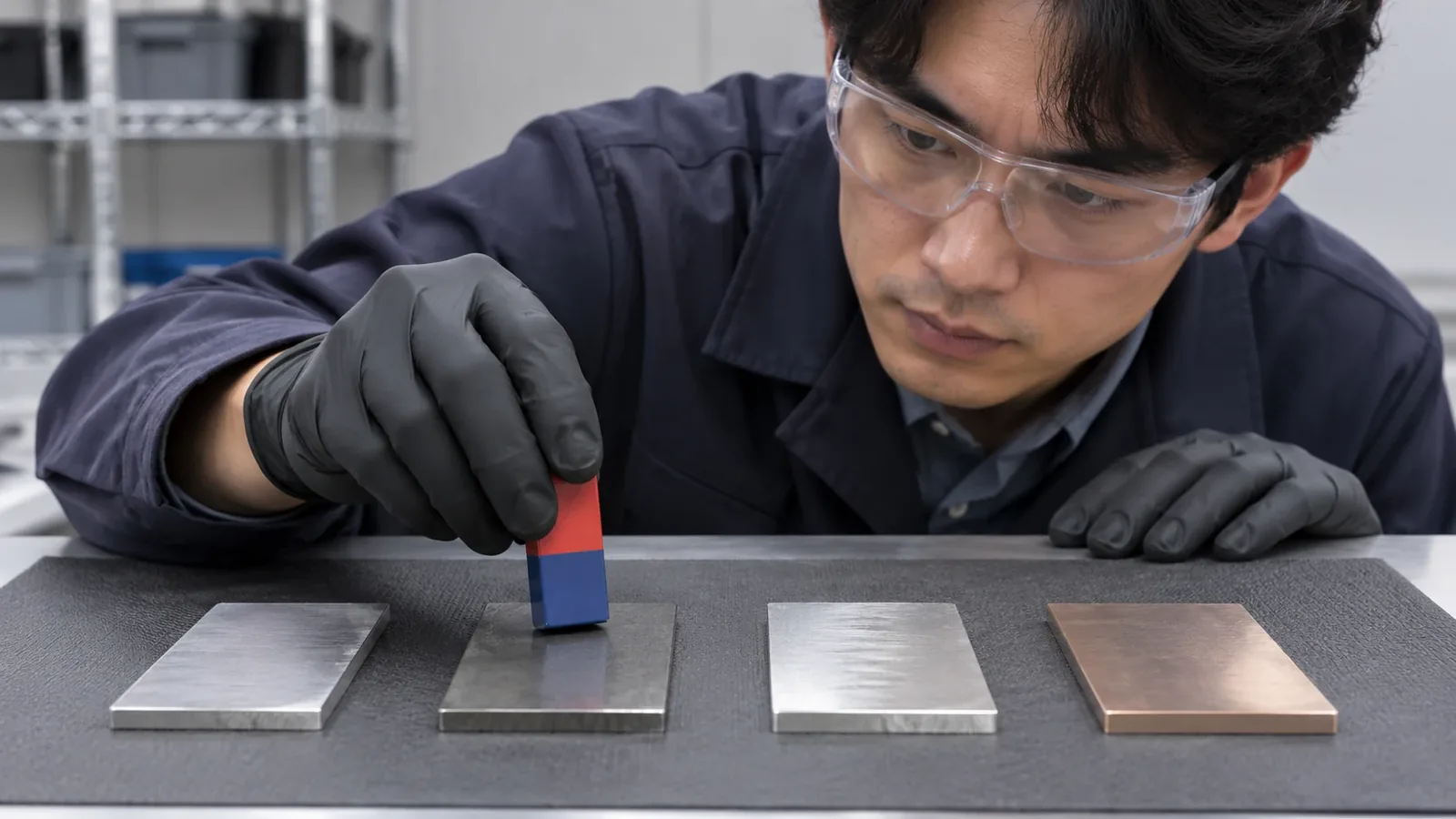
What types of metal are magnetic is a practical screening question, but a magnet test does not identify an exact alloy. Iron, nickel and cobalt are familiar examples of metals that can show strong magnetic attraction in common forms. Many iron-based materials can also respond, while stainless steel behavior varies with its composition, structure and processing history. A noticeable pull is an observation about the sample’s response to a particular magnet and setup—not proof of grade, chemistry, certification or finished-product performance.
For buyers of bathroom and home-storage hardware, this distinction matters when checking a component, mating surface or proposed magnetic feature. A quick attraction check can help sort samples for follow-up, but it cannot replace supplier documentation or material verification. Even a weak or absent response does not by itself identify which alloy or construction is present. Surface layers, geometry, thickness and the magnet used can affect what the buyer observes.
This guide describes common patterns and explains how to record a screening observation without overclaiming. It does not identify any specific Koitor product material, guarantee a magnetic retention force or define a laboratory test method. Use the actual drawing, supplier records and appropriate verification route for the purchase.
What does “magnetic metal” mean?
In everyday purchasing, “magnetic” usually means that a sample is attracted by a magnet under a particular setup. In physics, magnetic behavior includes several categories and is not limited to the simple “sticks or does not stick” demonstration. For a buyer screening metal parts, the useful question is narrower: does this sample show noticeable attraction to this test magnet in this position and condition?
That observation depends on the magnet and sample together. Magnet size and strength, distance, contact, sample thickness, shape, alloy, microstructure and processing can affect the response. A small coupon held directly against a strong magnet may appear different from a finished panel tested at a distance through a coating or housing. Unless the procedure is standardized, record the test as a qualitative check and avoid comparing samples as if it were a calibrated measurement.
The term “magnetic metal” also risks being treated as a material identity. Attraction does not tell the buyer whether a steel is a particular grade, whether it is stainless, or whether a component meets a composition requirement. A material certificate, traceability record or qualified analytical test may be needed depending on the specification. Choose the verification route with the responsible quality or engineering team.
Common metal examples that attract a magnet
Iron is a well-known example of a metal that is strongly attracted to a common permanent magnet in typical forms. Nickel and cobalt are also familiar magnetic metals. Some alloys containing these elements can show magnetic response, but their behavior depends on composition and structure. A family name or the presence of one element does not establish the response of every alloy.
Many steels are based mainly on iron and can show attraction. The response differs by alloy family, phase structure, processing, cold work, heat treatment and component shape. A buyer should not assume that all steel samples respond identically. Nor should a magnetic response be used as the sole proof that a sample is steel rather than another material or assembly.
Some non-metallic materials and composites can include magnetic particles or a magnetic insert. A finished product can attract a magnet because of an internal component even when the visible surface layer is not magnetic. Conversely, a metal surface can appear weakly responsive because of geometry, separation or the test arrangement. Inspect what part of the assembly is being tested and whether the magnet contacts the actual metal.
| Common screening observation | Possible interpretation | What still needs verification |
|---|---|---|
| Noticeable attraction on a plain iron or steel coupon | The sample responds to the test magnet under the setup | Exact alloy, grade, composition and specification compliance |
| Response varies across stainless samples | Stainless families and processing can differ in magnetic behavior | Exact grade and material certificate or agreed test |
| Weak response through a coated surface | Gap, coating, geometry or sample material may affect observation | Whether the underlying part meets its material specification |
| Attraction on a finished assembly | A metal or magnetic element may be present in the assembly | Which component caused attraction and what its material is |
| No noticeable attraction in one quick check | The chosen setup did not produce an obvious response | Alloy identity, hidden elements or response under a defined method |
The matrix is a screening aid, not an identification chart. It intentionally does not map an observed response to a specific grade.
Why stainless steel does not have one magnetic answer
Stainless steel is a broad family rather than one uniform magnetic material. Different stainless families have different structures; processing and cold work can also influence whether a particular component shows attraction. A polished, machined, formed or welded part may not behave like a simple unworked coupon of a related nominal grade.
A buyer may hear a simplified rule such as “stainless is non-magnetic” or “a magnet proves it is not 304.” Such statements are too broad for material identification. Some stainless steel products may show magnetic response, and absence or presence of attraction does not establish the exact grade. A quick magnet check can be one clue for a material review, but it is not a replacement for the agreed grade evidence.
For a storage hardware component, compare the supplier’s declared grade, product form and traceability to the drawing and purchase specification. If the grade is critical, request the documentation and verification method stated in the quality plan. Do not change a material acceptance decision based only on a handheld magnet result unless the controlled procedure explicitly says that the test is the approved criterion.
A magnet test is a screening observation
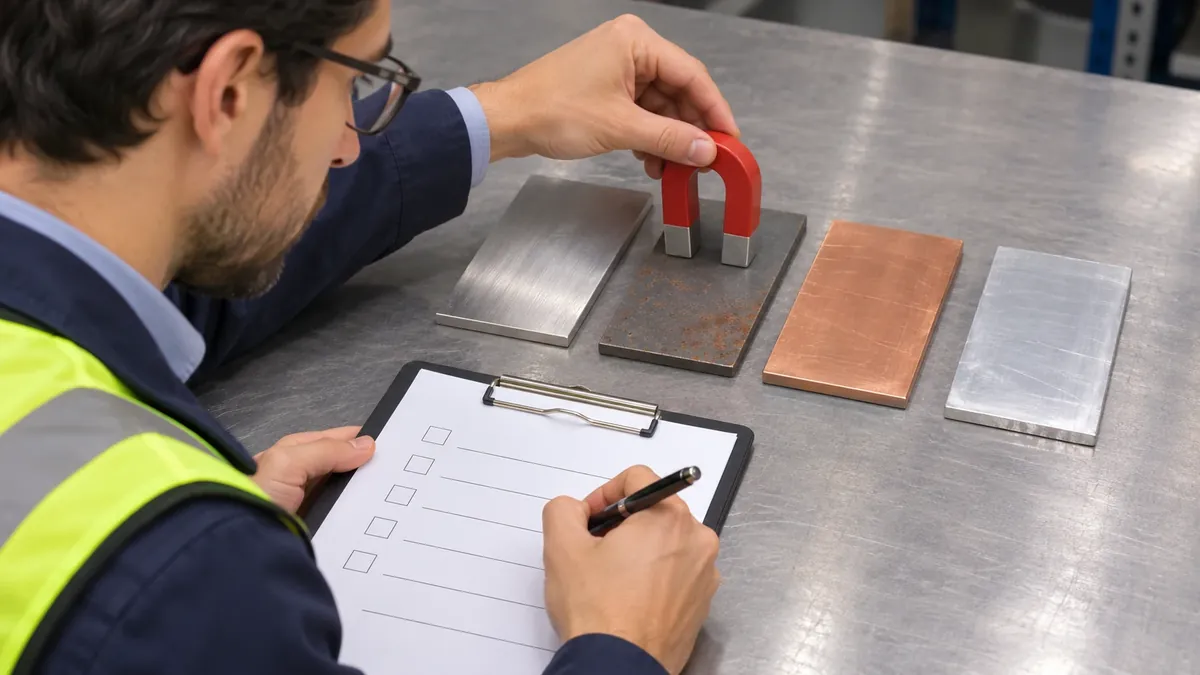
If a buyer performs a quick check, record it narrowly. Note the sample identity, location tested, magnet used if known, whether contact was direct or through a surface layer, and whether attraction was noticeable under the same orientation. This makes the observation repeatable enough for communication, without presenting it as a grade test.
Keep comparison conditions consistent if the purpose is to compare samples. Use the same test magnet, distance, contact location and sample orientation. Do not compare a bare coupon in direct contact with a finished part through a thick coating and conclude that one alloy is more magnetic. The tested setup changed multiple variables.
A screening check may help flag a sample for a follow-up. If it differs from the expected behavior, verify that the sample is the correct part, check whether an internal magnet or steel insert is present, and request the material record. Escalate to a suitable analytical method if the buyer’s specification requires exact chemistry or grade identification. The appropriate test and acceptance method depend on the material and purchasing requirement.

Separate attraction from magnetic retention performance
A material’s response to a magnet and a product’s ability to retain or hold an item are different questions. Retention depends on the complete magnetic circuit, dimensions, poles, backing, surface gap, contact area, alignment, mating material and the applied load direction. A coupon that is attracted to a magnet does not show how a finished catch, rack or holder will behave.
If the product requirement is retention, the designer should define the finished assembly and verification method. Identify the target object, surface, location and gap; state how the sample is mounted and how the response is evaluated. Any measured force should be tied to its test configuration. Do not infer a product’s pull force from the alloy name or the fact that the metal responds to a magnet.
For product-specific sample review, see the magnetic metal storage rack importer sample checks. That page owns rack retention review; this article stays with material response and screening. A magnetic knife strip sample-check guide addresses a different magnetic product and should not be treated as a universal acceptance protocol.
Common errors when identifying magnetic metals
Assuming all iron-based products respond the same. Alloy, structure, processing, shape and test setup affect the observed behavior.
Calling every responsive sample “steel.” A magnet response is not a chemical analysis or grade certificate.
Using a magnet to prove 304 stainless. Presence or absence of attraction alone cannot confirm that grade.
Treating weak attraction as no magnetic behavior. Distance, thickness, coating and magnet choice may alter the observation.
Testing a complete assembly without locating the source. An embedded magnet, insert or steel backing can produce response unrelated to the visible surface material.
Comparing samples with different test setups. Different magnets, gaps and contact conditions make the observations non-equivalent.
Equating magnetic response with holding force. Finished retention requires an assembly-specific assessment.
Using visual finish as chemistry evidence. A polished or coated surface does not reveal exact composition.
How importers should document a material check
A concise record can include the purchase order, SKU, part and drawing revision, sample or lot identifier, supplier-declared material, magnet used, test location, contact or gap condition, qualitative observation and next verification step. If an exact grade is specified, record the document that verifies it and who approved the evidence. If the quick check is only an informal screening step, label it that way.
The buyer should distinguish three states: “attraction observed,” “material declared by supplier,” and “grade verified by the agreed method.” These statements are not interchangeable. A supplier may provide a declaration; a material test may verify a property or composition; a magnet check may only report attraction in the observed setup. Use the statement that matches the evidence.
If a test result conflicts with the order record, preserve the sample and request clarification before accepting or rejecting the lot. Confirm identity and test setup, then route the issue to quality or engineering. Do not edit the material description to fit the test. Record a deviation or corrective review using the buyer’s approved process.
Make the observation repeatable without turning it into a grade test
An importer can make a simple screening note more useful by controlling the parts of the check that are easy to control. Use the same magnet, test face, contact distance and sample orientation when comparing two submitted parts. Identify whether the part is bare, plated, painted, powder coated or covered by a nonmetallic layer. Note whether the magnet was held against the surface or separated by a visible gap. If a sample has several components, test the component of interest separately when that can be done safely and without damaging the sample.
The record should describe the result in observable language: “noticeable attraction at direct contact on the mounting plate,” “weak response through the coating,” or “no obvious response with the stated magnet.” Avoid converting those phrases into “confirmed stainless,” “confirmed 304,” or “nonmagnetic alloy.” Those are material conclusions and require evidence beyond the casual observation. If comparing several samples, keep the same setup and record each result against its sample number rather than relying on memory or a photograph alone.
This is particularly useful during sample review. A buyer may have a product drawing that calls out one grade for a visible component and a separate fastener or insert that is allowed to differ. Testing the assembled article can obscure which component responded. Mark the tested area on a sample photo or drawing, and list other nearby metal parts that could affect the observation. If a response seems inconsistent with the declaration, ask the supplier to confirm the sample identity and material traceability before escalating to a more formal test.
Choose evidence according to the purchasing decision
Not every purchase needs the same level of verification. If a buyer only wants to sort visually similar samples for a follow-up conversation, a consistent magnet observation may be sufficient as an informal screen. If the purchase order names a specific grade, the record should point to the material declaration, lot traceability and verification method agreed in the quality plan. If the performance requirement is corrosion resistance, the magnet test does not answer that question; the specification and relevant evaluation must address the product environment and finish instead.
The decision tree is straightforward. First ask what claim is being checked: basic attraction, alloy identity, corrosion behavior, product retention or compliance with a drawing. Then identify the evidence that can support that exact claim. A magnet can inform the first question. It cannot by itself establish the others. Where the result affects acceptance, agree on the sample, method, responsible party and disposition before production or shipment. That avoids a late disagreement in which one party treats a quick screening result as definitive while another considers it merely preliminary.
Keep the evidence proportional to the risk and the specification. A cosmetic accessory component with no grade requirement may need only supplier identification and normal incoming inspection. A load-bearing or corrosion-critical component may call for a tighter specification and a documented verification plan. The article’s examples do not prescribe a testing laboratory or acceptance threshold; the buyer and supplier should use the contract documents and qualified technical support for those decisions.
Separate a component material question from a finished-product question
Magnetic response can also be confused with a product feature. A buyer evaluating a magnetic holder, catch or organizer needs to assess the complete product as supplied, including magnet type and placement, backing, contact surface, target object, mounting method and expected direction of force. Asking what types of metal are magnetic is not the same as asking whether the finished product will retain a particular item. The first concerns material response; the second concerns an assembly and application.
For a retention review, the buyer should state the intended target and installation condition. A magnet tested on a flat steel coupon may behave differently on a curved, coated, thin or partly separated surface. A product mounted to a wall may also be affected by the attachment system and substrate. If the required outcome is a holding or release behavior, define how the sample will be positioned and evaluated. Do not accept a material name as a substitute for a product-level check.
Conversely, a finished assembly’s attraction to a test magnet does not prove that the visible panel itself is made from a particular alloy. An embedded magnet or concealed steel part can produce the response. The supplier’s drawing and bill of materials should identify the component being specified; the quality plan should identify what is inspected. If those records do not say which piece is being checked, clarify the scope before drawing a conclusion.
Use a practical supplier clarification request
When the observation and paperwork do not align, send a concise, neutral request. Identify the purchase order, SKU, drawing revision and sample or lot. State the tested location and setup, describe the observed attraction without assigning a grade, and ask the supplier to confirm the material designation and traceability for that exact component. Request the applicable supporting document or propose a mutually agreed verification method if the specification requires one. Keep the question tied to the order requirement so that the response can be reviewed and filed.
Avoid leading the supplier toward a preferred answer, such as asking them to “confirm that the magnet proves it is 304.” That phrasing embeds an unsupported conclusion. A better request is: “The mounting plate showed noticeable attraction with the same handheld magnet at direct contact. Please confirm the declared material for this part and provide the lot or material evidence required by drawing revision C.” If product retention is the concern, ask a separate question about the finished assembly and its acceptance condition.
This separation improves corrective action as well. If the supplier confirms the correct part and documentation, the buyer can decide whether additional verification is needed. If sample identity is uncertain, the first action is to reconcile the sample and production records. If the declared grade differs from the purchase requirement, the issue is a specification deviation, regardless of magnet response. Clear categories prevent a screening clue from becoming a substitute for formal acceptance criteria.
For custom metal hardware, the material and finish should connect to the controlled drawing or specification. Koitor’s OEM scope is described on the home-storage hardware manufacturer page; buyers can contact Koitor with the actual component and evidence question. This does not imply a particular grade or magnet test service.
What metals are commonly attracted to a magnet?
Iron, nickel and cobalt are familiar examples, and many iron-based steels can respond. Exact behavior depends on the sample’s composition, structure and condition.
Does a magnet prove that a metal is steel?
No. Attraction is not an exact material identification method. Use the supplier’s approved documentation or a suitable verification route.
Is all stainless steel non-magnetic?
No. Stainless steel behavior varies by family, structure and processing. A magnet check alone cannot identify the grade.
If a metal does not attract a magnet, is it non-metallic?
No. The test setup, separation, thickness and alloy can affect the observation. A lack of noticeable response does not prove the sample is not metal.
Does magnetic metal make a product magnetic enough to hold something?
Not necessarily. Holding performance depends on the complete assembly and application-specific setup, not just the material response.
How can I verify an exact metal grade?
Use the verification method and documentation required by the purchase specification and quality plan. A magnet check is not a substitute for a grade verification method.
Record what the magnet check actually shows
The answer to “what types of metal are magnetic” can help a buyer understand common attraction patterns, but it cannot identify the exact alloy. Iron, nickel, cobalt and many steel forms can respond; stainless behavior varies. A magnet check should be documented as an observation tied to its magnet, sample and contact setup.
For material approval, compare the supplier’s declaration and traceability to the controlled specification, then use the agreed verification method if the grade matters. Keep that material decision distinct from a finished magnet assembly’s retention test. Koitor’s OEM hardware context is on the home-storage hardware manufacturer page; use contact for the project-specific scope question.
Review a Metal Material Requirement
Share the controlled drawing or sample, supplier-declared material and the specific magnet-check or grade-verification question.
OEM / PRIVATE LABEL
Turn this sourcing guide into a product brief
Share your target product, size, finish, order quantity and packaging requirements. Your team receives a practical manufacturability review before quotation.


 English
 Español
 Português
 Français
 Deutsch
 العربية