
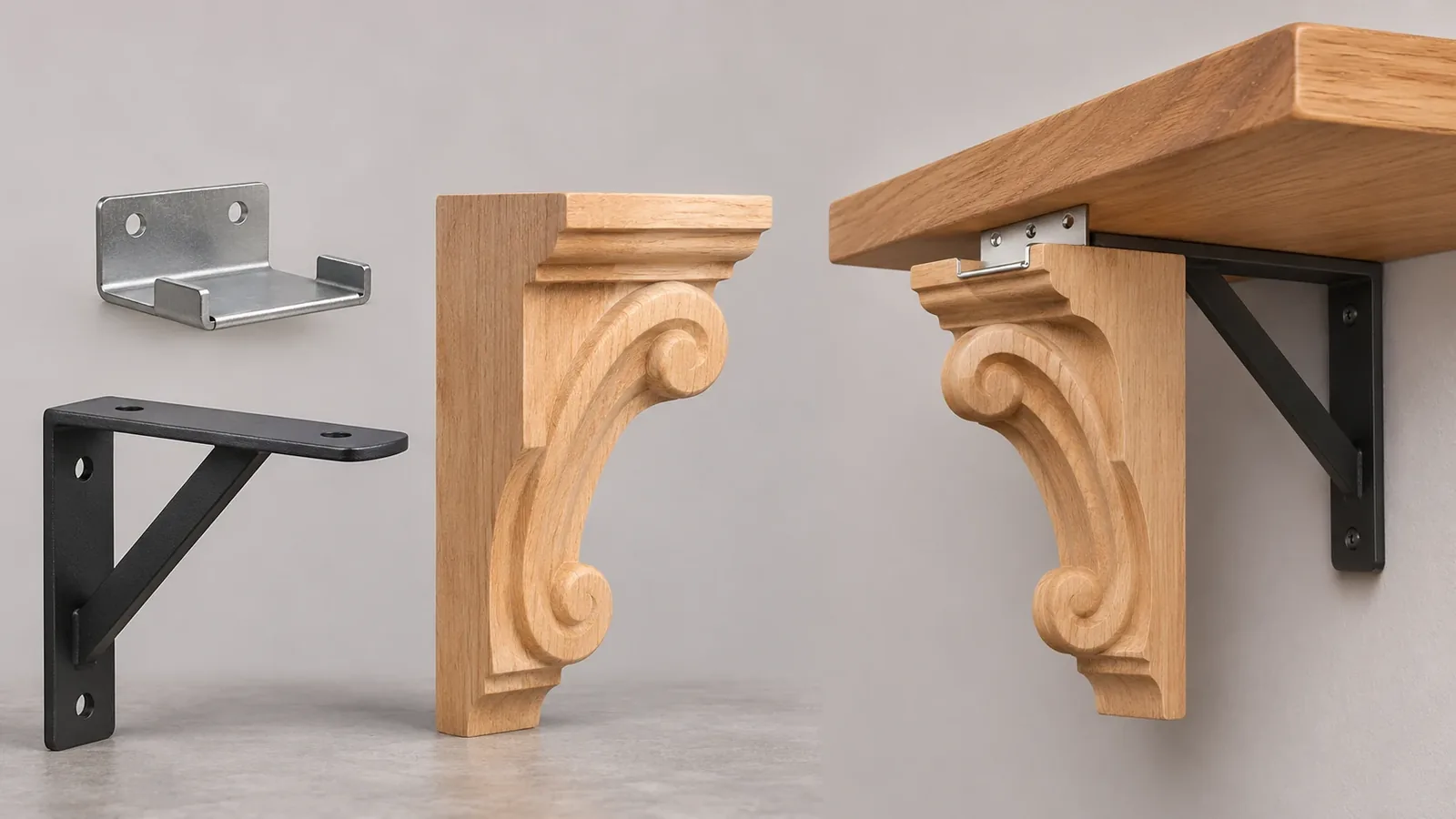
Corbels for shelves should be specified by the job assigned to each component, not by the decorative name alone. In a maker’s product range, one mount may retain a decorative corbel while a separate rib or bracket is described as the carrying component. A buyer must identify what the metal part is supposed to do, what is included in the quotation, and who owns the evidence for the complete assembly before comparing models or prices.
This guide is about an adjacent household shelf assembly and its sourcing responsibilities. It is not a load calculation, structural design, installation guide, retrofit instruction, or recommendation to remove or replace an installed corbel. No capacity or fastener prescription is provided.

What problem do corbels for shelves create in an RFQ?
The buyer has to state whether the requested component holds decorative trim in place or provides a specified supporting function. A quotation that says only “corbel mount” may describe a different component from the one a buyer expects to carry the shelf or assembly.
In a product range, the visible corbel, its mounting system, and a supporting rib can be separate parts. The product family may present these parts together, but their functions and evidence are not automatically identical. If the RFQ does not specify the intended job, suppliers can quote unlike components and leave the buyer to compare appearance, thickness, or price without knowing whether the parts answer the same need.
Federal Brace’s current category description provides a named example. It distinguishes a corbel rib described as intended to provide carrying function from a separately linked Corbel Mount System described as light duty and as a choice when weight-bearing capacity is not needed. This source supports a distinction in that manufacturer’s own product range. It does not establish that all decorative corbels lack support function, that all mounts are non-structural, or that the cited system is suitable for a particular shelf.
The distinction matters before product selection because responsibility for a performance statement may belong to a system designer, component maker, or supplier of the complete assembly. A decorative retention quotation cannot silently satisfy a request for a carrying component. In the other direction, buying a support component does not define the decorative corbel, its fit, or its attachment.
The useful buyer question is: Is this metal component retaining a decorative piece, providing the required support function, or doing both in a defined assembly? Record each role and the responsible evidence owner before asking suppliers to compare alternatives.
What should buyers define before comparing models?
Name the item being retained or supported and assign a function to every component in the proposed assembly. If the product has both a decorative element and a separate supporting element, keep them in separate rows.
Use a role-and-responsibility schedule:
- Item being retained or supported: identify the decorative corbel, shelf, frame, or assembly element by drawing callout or model.
- Component job: state whether the part retains decoration, provides a specified support function, or serves another documented purpose.
- Supplier’s included scope: list the exact pieces supplied, optional items, and buyer-supplied components.
- Claim declaration: record whether a carrying or other performance claim is made for the part or complete assembly.
- Evidence and configuration: identify the model, source document, relevant arrangement, and revision that support the claim.
- Responsible party: name who reviews the completed assembly and any required project-specific evidence.
- Open questions: flag load, mounting, substrate, or integration details for the qualified reviewer rather than filling them with an assumption.
| Item or component | Required job | What the supplier should identify | Evidence owner |
|---|---|---|---|
| Decorative corbel or trim | Visual or decorative role as defined by the project | Exact item and how it attaches to the rest of the assembly | Corbel/assembly supplier |
| Retaining mount | Hold the decorative item in the documented arrangement | Included parts and the named model’s intended role | Mount manufacturer and assembly designer |
| Carrying component | Provide the support function required by the design | Exact component, assembly configuration, and supporting technical evidence | Responsible system designer and component maker |
| Complete shelf assembly | Meet the buyer’s defined application | What items are included and what evidence covers the finished system | Complete product/system owner |
This is not a universal either-or classification. One assembly can contain a decorative retainer and a separate support. A component can have more than one function if the responsible maker documents it. The buyer should not force all products into one category; the table simply makes it explicit what each line item is expected to do.
How does a decorative mount differ from a support component?
A decorative mount may be intended to position or retain a corbel, while a separate support component may be specified for a carrying function. The exact distinction depends on the named product and its maker documentation.
The current Federal Brace Corbel Rib Support category explicitly differentiates a rib component presented for a carrying role from a separately linked light-duty Corbel Mount System. It also directs buyers to contact support when determining whether a mount system fits a project need. The article relies on that role distinction only. It does not repeat the maker’s numerical capacity claim or its broad performance wording as an independent engineering result.
The source is useful because the manufacturer states that not every component in the decorative-corbel family has the same purpose. It does not establish a universal product taxonomy for the market. Other manufacturers may use different names, combine functions differently, or require a different system review. The buyer must read the actual page and product instructions for the model under consideration.
Keep three records separate:
- Product identity: what item or assembly is being quoted?
- Component role: what job does each part perform according to its maker?
- System evidence: what documentation supports the complete project configuration and any performance claim?
A catalog photograph can show the relative appearance of parts, but it cannot substitute for those records. Nor does metal thickness, profile, finish, or quantity of mounts establish that a component is designed for a particular carrying role. If a supplier’s quote uses broad terms such as “support,” ask the supplier to label the part on its drawing and identify the evidence that applies to the complete assembly.
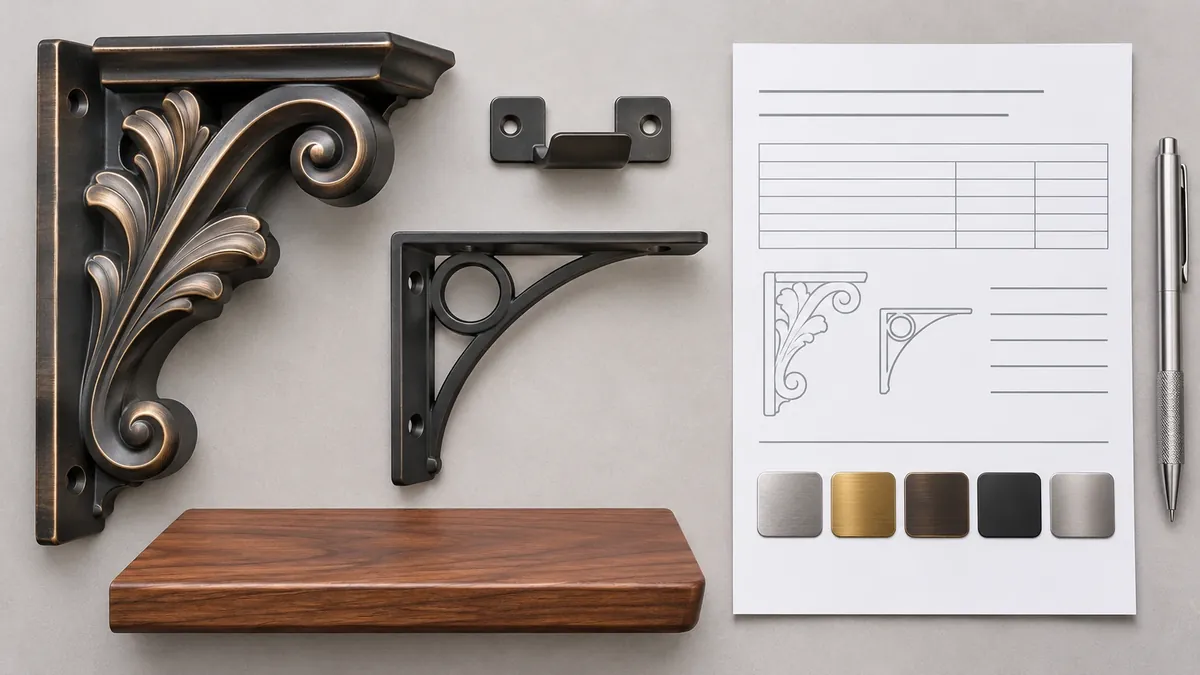
How should quotations distinguish retention from support?
Ask each supplier to price and describe the same defined function. If one offer includes a decorative-retention mount and another includes a support component, mark them as different scopes rather than comparing the totals as if they were substitutes.
| Quote comparison field | What to request | Why it matters |
|---|---|---|
| Component purpose | State whether it retains decoration, supports a specified item, or has another documented role | Prevents a product name from concealing the function |
| Included parts | Enumerate the mount, rib, bracket, decorative piece, fasteners, and accessories as applicable | Reveals partial versus complete supply scope |
| Model and configuration | Record maker, exact part, drawing, revision, and assembly arrangement | Ties the description to a specific product |
| Performance statement | Identify who makes the claim and what configuration it covers | Keeps component claims separate from whole-system claims |
| Project requirements | Refer the load and mounting design to the responsible reviewer | Avoids invented capacity or anchor guidance |
| Change control | State how model, substrate, or assembly changes affect approval | Keeps the approved configuration traceable |
The buyer can accept a partial quote while holding the unconfirmed function outside the approved package. For example, a supplier may quote a decorative piece and its retainer while a separate system supplier reviews the carrying component. The purchase order should identify the boundary and avoid suggesting that the partial quote covers the complete shelf assembly.
If the supplier proposes a different component, request a written explanation of the role and evidence. A replacement may be suitable for the decorative retention function but not for the carrying function, or the reverse. Do not decide equivalence from the word “corbel,” an image, or a price comparison alone.
For a complete comparison, ask each bidder to mark the same role-and-responsibility schedule. A bidder that quotes only the decorative retainer should state that the support component and system review are excluded. A bidder offering a support component should identify the exact model and the evidence it relies on. If the buyer needs both decorative appearance and a carrying function, the quotation should identify each component and the system designer responsible for combining them. This makes it possible to compare a partial supply against a complete scope without implying they are equivalent.
The decision can then be recorded as “confirmed for quoted scope,” “requires designer review,” or “not covered by this supplier.” These are purchasing statuses, not performance ratings. They keep open technical questions visible through quote review, sample approval, and order release. If a project changes the shelf, corbel, mounting system, or installation environment, the buyer should return the updated configuration to the responsible party rather than assuming that the original review remains valid.
What evidence is needed for a carrying claim?
A carrying claim must be supported by evidence for the identified component and the complete configuration it covers. The research sources in this guide do not establish a project-specific capacity, anchoring method, substrate, or installation detail.
If the buyer requires a support function, the product design owner should define the application and technical requirements. The responsible maker should identify the exact model, configuration, and documentation relevant to those requirements. If the source covers a component alone, ask whether it also addresses the finished assembly; do not treat a component statement as a complete system approval without confirmation.
The buyer should record who specified the requirement, who selected the component, and who approved the final combination. If the intended use changes, return the revised configuration to the responsible reviewer. A different shelf, wall, material, mounting arrangement, or accessory can change the system question; a previous record should not be assumed to cover it automatically.
This article does not recommend a fastener, anchor, wall substrate, or installation sequence. Those decisions are outside the source evidence and require the responsible designer and manufacturer. Likewise, a visual sample review does not establish load performance, long-term durability, building-code compliance, or suitability for a particular installation.
For a buyer who only needs decorative retention, the RFQ should say so and identify the exact corbel and finish. For a buyer who needs support, the RFQ should not stop at “mounting bracket”; it should request the current product documentation and a responsible technical review. If both purposes exist, make them separate acceptance criteria and identify how the complete assembly will be approved.
What assumptions should buyers avoid?
Avoid assuming that every item called a corbel is decorative, or that every item called a mount carries the shelf. The manufacturer example demonstrates that a single product family may distinguish between those roles, while the broader market may use different names and configurations.
Do not assume the mount and the carrying component are the same part. Check the supplier’s parts list and drawing. A decorative piece can have a separate retainer and a separate support component.
Do not assume that a metal mount automatically establishes capacity. A part’s material or appearance does not prove a rating or suitability for the complete configuration. Obtain current evidence from the responsible maker and design owner.
Do not assume that the word “corbel” makes a product non-structural. The Federal Brace page distinguishes roles within its own range; it does not establish an all-market rule. Follow the exact model documentation.
Do not assume that more decorative mounts establish a shelf rating. Component count alone is not an engineering evaluation. The actual assembly and application must be reviewed by its responsible designer and supplier.
Do not use an unread catalog as proof. Older catalog links in the research record were inaccessible or not visually inspected. Their search extracts are not used to support geometry, installation, or capacity claims.
Do not copy fastening guidance from another system. The research pack does not establish fastener sizes, anchors, substrate, installation torque, or a safe retrofit procedure. Request current instructions for the selected product and application.
Do not turn one maker’s product wording into a Koitor claim. The cited example is a third-party product family. It does not establish Koitor production of corbels, wood parts, engineered supports, or a certified testing service.
These limits help product teams write accurate listings. State the component’s documented role and scope, name the system owner, and avoid performance claims that are not supported by the actual technical file.
Buyer handoff and next steps
How can Koitor support a related metal-component inquiry?
Koitor Hardware can discuss metal-part drawings, forming, joining, finishing, basic assembly, and packaging within its approved bathroom and home-storage hardware scope. This does not establish current production of corbels, wood components, engineered structural supports, anchors, or complete shelf assemblies.
For a related inquiry, identify the metal part that needs review and say whether it is a decorative retainer, a separate support component, or another defined item. Share the drawing or physical sample, the connected parts, material and finish requirements, quantity, and packaging. Koitor can confirm whether that specific metal scope fits current capability before a quotation is prepared.
If the project includes a carrying claim, assign the technical requirement and evidence owner to the responsible system designer and component maker. Koitor’s ability to discuss a metal component does not replace structural engineering, anchoring design, load testing, or approval of the finished shelf. The quote should clearly state what is and is not included.
Small-batch OEM production may help buyers develop a defined metal part or evaluate an adjacent storage product concept. Project quantity, sample needs, finish, assembly, and packaging affect feasibility and timing. Confirm those details with the factory; do not interpret a general manufacturing capability as a commitment to make the cited third-party corbel system.
Review the OEM home-storage hardware scope for general project context, then provide the exact component and evidence boundaries when contacting Koitor.
Buyer checklist before requesting a quotation
Before sending an RFQ, make the component role and system responsibility visible:
- Identify the item being retained or supported and its drawing callout.
- State whether the metal part retains decorative trim, provides a defined support role, or has another documented job.
- List the exact manufacturer, model, and configuration for each proposed component.
- Enumerate included parts, optional parts, and buyer-supplied components.
- Identify who owns the complete assembly design and any performance claim.
- Attach current, legible documentation for the exact model and application.
- Record the project requirements that the responsible reviewer must evaluate.
- Keep the decorative component and support component in separate quote lines when they are different parts.
- State the material, finish, quantity, sample, and packaging requirements for a metal component inquiry.
- Mark missing load, mounting, or substrate evidence as unresolved rather than assuming it.
- Ask suppliers to list deviations and exclusions in writing.
For sample approval, name the exact sample and configuration and state what the review is meant to confirm. A fit or appearance review does not substitute for the separate technical evidence required for a carrying claim.
Before a buyer adopts the word “support” in a product description, identify what the cited component is documented to do and where that statement stops. Federal Brace distinguishes a named rib support intended for a shelf-support role from a separate decorative or lighter-duty corbel product. That distinction is useful for organizing a review, but it does not provide a transferable capacity for another bracket, shelf, wall or installation. Avoid turning a visual resemblance into a structural conclusion.
A buyer can keep three questions in separate fields: what role the maker assigns to the corbel or rib; which shelf and receiving surface are included in the stated application; and what evidence supports any performance language. If a product page describes appearance but not its intended support scope, treat the claim as unresolved. If a supplier uses a numerical rating, request the applicable test basis, configuration and limitations from that supplier; this article supplies no rating or design calculation.
For private-label copy, avoid combining a decorative product photo with a broad “heavy-duty shelf support” promise unless the responsible manufacturer confirms the exact product and application. Keep the component description, approved assembly drawing, and copy claim linked to the same model. A substitution that changes the corbel, rib or mounting arrangement should trigger a new review rather than inherit the prior description automatically.
For an RFQ, provide the shelf concept, intended use, receiving surface, proposed component, finish, quantity and any product-specific evidence required by the project. The factory or component supplier should state whether the request is within its documented scope. A quote or sample alone does not demonstrate load performance. If the design relies on a structural claim, assign the evaluation to the qualified designer and responsible maker, and keep their verified evidence with the approved configuration.
When comparing corbels for shelves, name the component role and source document before using a carrying or decorative description in buyer-facing copy.
Frequently asked questions
Are all corbels decorative?
No universal conclusion follows from the name. The Federal Brace category reviewed here distinguishes a decorative mount system from a rib product described for a carrying function. Other product families may differ, so check the exact manufacturer and model.
Does a metal mount automatically establish a carrying capacity?
No. Material and appearance do not establish a rating. A carrying claim requires current evidence for the specified component and the configuration it covers, reviewed by the responsible designer and supplier.
Can a decorative component sit beside a separate support?
Yes, an assembly can assign different roles to different parts. The buyer should list the decorative retainer and support component separately and identify who approves the complete assembly.
Do more decorative mounts establish a shelf load rating?
No. The number of mounts alone does not establish a system rating or suitable installation. Obtain the applicable project-specific documentation from the responsible maker and designer.
Work With Koitor Hardware
Define the Metal Component and Its Role
Share the component drawing or sample, the connected parts, required role, finish, quantity, and packaging scope. Koitor can confirm whether a defined metal-part request fits its capabilities; the system designer and component maker remain responsible for the completed assembly and any carrying claim.
OEM / PRIVATE LABEL
Turn this sourcing guide into a product brief
Share your target product, size, finish, order quantity and packaging requirements. Your team receives a practical manufacturability review before quotation.

 English
 Español
 Português
 Français
 Deutsch
 العربية