

“Adjustable” is not a slogan, and it does not settle adjustable shower caddy shelves until the height increments are written. A shelf that can move still has to park a named bottle set on a real step map. Freeze the increments, the pin or hole pattern, and the bottle heights you will claim, and leave any occupied shelf-lock page untouched.
This guide is for importers and private-label teams writing hanging or tension-pole caddies that are merchandised as adjustable. It is not a lock-mechanism page, not a removable-versus-welded architecture page, and not a front-rail bottle-retention page. The decision is whether the shelf steps can actually park a named bottle set.
Koitor is a family-owned custom metal hardware factory. We can review the step map, the retention family at a high level, the named bottles, and the wording you want to print. We do not invent a Koitor pitch, revive an occupied lock article, or print a universal “fits any bottle” line for a map we have not agreed how to observe.
Why a lock page and a removable-shelf page do not close pitch
A shelf-lock article would be about how a shelf stays at a chosen height once it is set. That subject is already occupied elsewhere and is not rewritten here, and it is not linked. This page does not need that mechanism to freeze the thing a buyer first has to know: what heights are even available.
Removable versus welded architecture answers serviceability and joint strength. A removable shelf can still have a useless step map, and a welded shelf is not this adjustable family. Keep architecture on that page. Keep increment spacing here.
tension-pole height-range specification answers whether a tension pole covers a ceiling-to-tub range. That is the pole’s installed length, not the spacing between shelves on the pole or on a hanging frame. A pole can reach the ceiling and still offer shelf steps that cannot park a tall bottle under the next shelf or under the hook.
shower caddy drainage design matters for how a shelf sheds water, not for whether a bottle has a usable parked height. Front-rail retention is also a different leftover decision: whether a bottle stays on the shelf once it is there. This page stops at whether the step map can place the named bottle in the first place.
Brand collection pages and shopping modules that say “adjustable shower caddy” are usually merchandising, not a step file. Do not adopt a transactional volume or a lifestyle photograph as proof that the increments are useful. Write the map.
How should increments be frozen against a named bottle?
Name the bottle set before you name a result. Record bottle height, including the cap or pump in the use position you will claim, which shelf the bottle is meant to occupy, and whether the bottle sits on a liner or on the wire. A styled short bottle cannot support a tall-pump listing photograph.
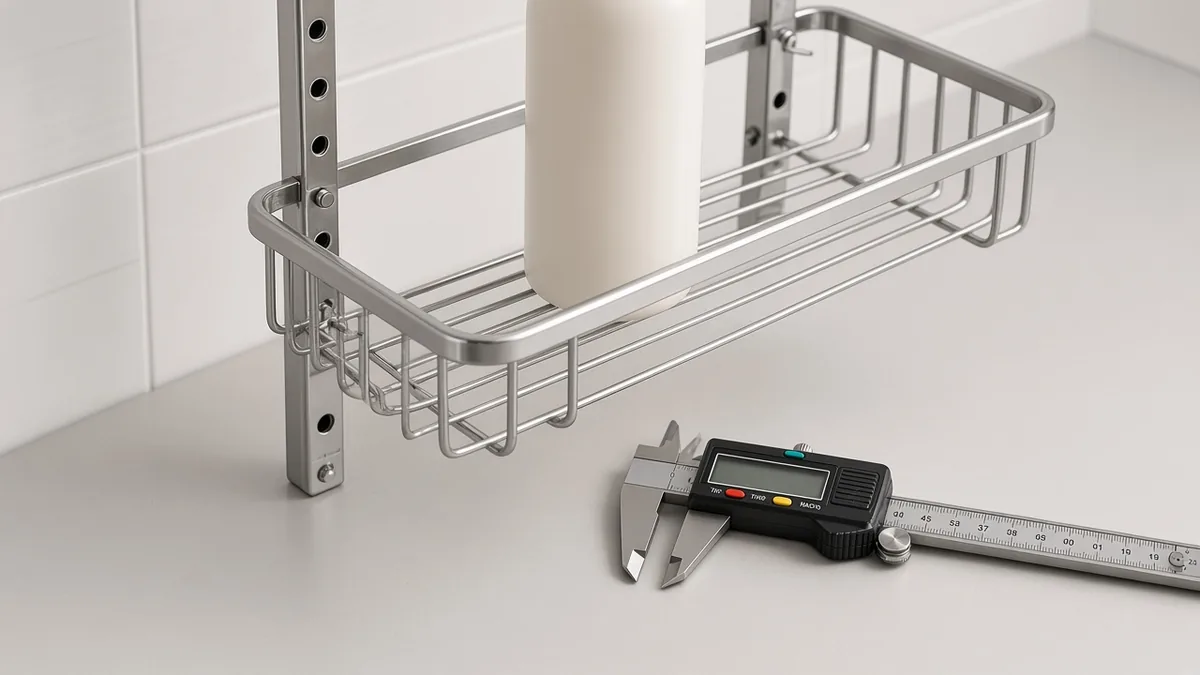
Name the step map. Record the increment family — holes, pins, slots, or another specified pattern — and the available parked heights on the actual sample. “Many holes” is not a map. A buyer needs to know whether a needed height exists, not only that the shelf can be moved.
Do not invent a millimetre pitch or a Koitor hole count. If the project wants a stated pitch, measure it on the sample and write it as a project figure. Until then, stay with the parked heights you can photograph against the named bottles.
Check the remaining opening, not only the step below the shelf. A shelf can sit on a “correct” hole and still leave too little room under the next shelf, the hook, or a rain-head envelope that belongs on another page. The useful increment is the one that parks the named bottle without forcing a second conflict.
If the caddy is sold as both hanging and tension-pole, write which architecture was observed. The same shelf part may offer a different usable opening once it is hung from an arm rather than mounted on a pole, because the structure above the top shelf changes.
Record how many shelves are in the set and which steps they can occupy at the same time. Two shelves that each have many holes can still collide if the map does not leave a legal pair for the named bottles. A one-shelf demonstration is a weak basis for a three-shelf listing.
How can retention families be named without republishing a lock article?
You still have to say, at a high level, what keeps a shelf on a step: a pin, a hook into a hole, a clamp, or another specified family. That is a bill-of-materials note so the sample matches the listing. It is not a revival of an occupied lock-mechanism article, and it does not need a lock slogan or a lock URL.
If the shelf can be set on a hole but will not stay during ordinary loading, that is a retention problem and should be written as such, or the increment claim should wait. Do not pretend a step exists if the shelf cannot occupy it in use. Just do not turn this page into a lock-design reprint.
Spare pins, clips, or buttons belong in the packing list if the map depends on them. A sample set with all pins present cannot support a carton that omits them. Put the part in the kit, or write the observation as a missing-part risk.
What claim wording and exclusions should be agreed?
Do not print that the shelves fit any bottle, offer infinite adjustability, or work at any height. Those lines turn a hole pattern into a universal fit rating. Safer language names the bottle set and the parked steps you observed.
If only one bottle family was run — for example a short square bottle — write an exclusion for taller pumps, or run the taller pump. Merchandising that shows both short and tall bottles needs both openings in the file.
Do not invent a pitch number to make the listing sound technical. A photographed parked bottle on a named step is stronger than a figure that was never measured on the sample.
After-sales photos should show the bottle, the shelf, the next obstacle above, and the step being used. A beauty shot of an empty adjustable frame will not tell you whether a customer’s pump had a legal parked height.
What should the importer freeze before artwork is approved?
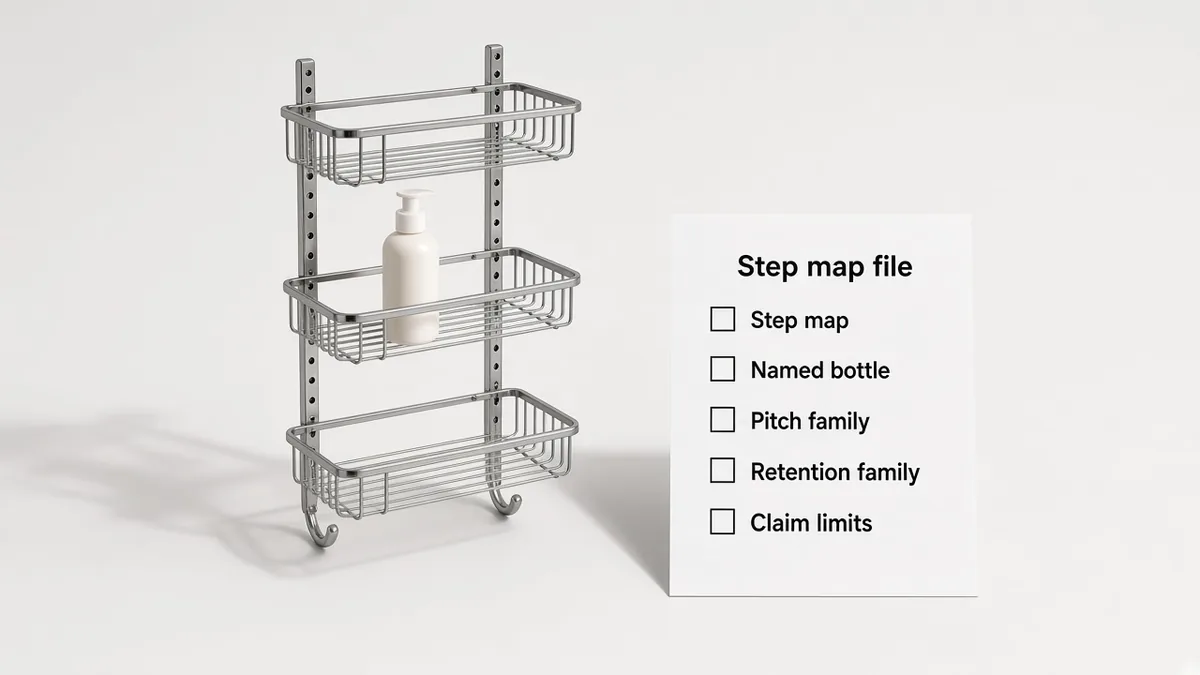
Use a written step-map file. The checklist and the matrix remind you which decisions to freeze. They do not replace the named bottles or the photographed parked heights.
Do not approve an adjustable shower caddy shelves line until the increment map and the named bottle set are in the pack. An empty frame with visible holes is not a parked-bottle check.
If production later changes hole spacing, shelf count, hanging drop, or the recommended bottle map, the file needs a new observation. A copied “fully adjustable” sentence from a pilot lot is not evidence for a tighter map.
A first-article pack should include the step family, the legal shelf pairs, the named bottles with caps or pumps, and the remaining opening at each claimed parked height.
Instruction diagrams should show a legal pair, not a fantasy layout that the holes cannot actually produce. If the diagram shows a tall pump under a tight top gap, either change the diagram or change the map.
If the same frame is sold with a liner, observe the bottle on the liner, because the liner raises the parked height. A bare-wire opening can disappear once the insert is in.
Tension-pole and hanging versions should not share a silent step claim if only one architecture was run. Write the architecture, or run both.
Compact merchandising bottles should not be the only sample if the listing also shows tall pumps. Style the file the way you style the page, or drop the tall-bottle artwork.
When the map, the bottles, and the legal pairs agree, the listing can stay modest and still be useful. Name the increments you observed and avoid an unbounded fits-any-bottle badge.
A finish-only change can often keep the prior step record if the holes, shelves, and hanging drop did not change. Confirm the functional geometry first.
After-sales complaints about “not adjustable enough” should be sorted against the named bottle and the step that was tried. A user may have a taller pump than the merchandised set. That is either an exclusion or a reason to widen the map, not a reason to print a slogan that was never substantiated.
Spare-part policy belongs in the brief if pins can be lost. A step map that depends on a loose pin is only as durable as the kit and the replacement path. Write that path, or choose a family that does not depend on a loose part.
Do not use or invent a shelf-lock article URL in the listing or in the internal links. If a reader needs a lock-mechanism discussion, that is a different, already occupied subject and is out of scope for this increment file.
Send the drawing, the bottle set, and the intended sentence before the artwork is locked. A factory can quote the caddy while the step observation is still being written, but the adjustable headline should wait for a parked bottle on a legal step.
Pump heads that tilt or have a wide collar need their own note in the bottle set. A body may fit the remaining opening while the pump hits the shelf above when someone uses it. If the listing shows a pump in the use position, the parked check should include that motion, or the artwork should show only a closed cap and say so.
Corner bottles and square bottles do not occupy a shelf the same way as a round bottle of the same labelled height. If the merchandising mixes those shapes, include the shape in the named set. A round styling bottle is a weak basis for a wide square bottle that crowds the side rails or the next shelf.
A sliding or continuous slot, if that is the family, still has preferred parked zones where a bottle is stable and the next opening remains usable. Do not describe a slot as infinite adjustability if the useful parked positions are limited by the hook, the next shelf, or the retention part. Write the useful zones you observed.
Retail planograms sometimes force a three-shelf story on a frame that only has a legal pair for two named bottles. If the planogram cannot be built on the actual map, change the planogram or change the frame. Do not ask the factory to paper over a layout the holes cannot produce.
First-article photographs should be taken square to the frame, with the bottle sitting naturally, not tipped to fake an opening. A camera angle from below can make a tight gap look generous. Use the same stand-off for each claimed parked height so a later reviewer can compare them.
If a customer will also store cleaners or larger household bottles, that is a wider set than a shower-gel pump. Either observe those cleaners or keep them off the artwork. A bathroom-cleaner bottle is often taller or wider than the merchandised personal-care set.
Replacement shelves sold as spare parts should follow the same map. A later shelf with a thicker rim or a different pin can shrink the opening even when the holes in the frame are unchanged. Write the spare as part of the family, or tell the buyer that a mixed-generation shelf needs a new check.
When the parked heights, the legal pairs, and the named bottles agree, the listing can stay modest and still be useful. Name the increment family you observed and leave fits-any-bottle language off the page until a wider set exists.
If the frame also carries soap baskets or a lower hook row, include those parts when they steal opening from the lowest shelf. A legal middle-shelf pump can still fail if the lowest step is blocked by a hook or a soap tray the listing never mentioned in the step file.
Keep the adjustable headline tied to the pack you will actually ship. A factory can quote the caddy while the bottle observation is still being written, but the merchandising should not show a parked layout the holes cannot legally produce on the finished unit.
If a later review finds only a cosmetic change to shelf wire or finish color, the prior parked-height record can usually stay, provided the increment family, shelf count, and hanging drop are unchanged. Confirm those functional parts first, then keep or retire the sentence.
| Claim impulse | What to freeze | What the sample should show | What to keep off artwork until then |
|---|---|---|---|
| Fully adjustable shelves | Step family, available parked heights, and legal shelf pairs | The named bottles park on real steps with a usable opening | An unbounded any-bottle or infinite-adjustability slogan |
| Fits tall pumps | The tall pump, including cap or dispenser, on the claimed step | The remaining opening is usable on that step | A short styling bottle used as proof of a tall pump |
| Works on hanging and tension-pole versions | Which architecture was observed, or both | The claimed architecture is the one you ran | A pole photo used as proof of a hanging drop, or the reverse |
| Shelf stays where you set it | A high-level retention family and a loaded check, without a lock-article reprint | The shelf occupies the step in use, with kit parts present | A step claim for a shelf that will not stay, or a revived lock URL |
| Holes are close enough for any height | The actual increment map measured or photographed on the sample | A needed height exists, or an exclusion is written | An invented pitch number or a copied technical-sounding figure |
- Write the product as an adjustable hanging or tension-pole shower caddy, not as a welded fixed-shelf unit and not as a screw-mounted wall rail unless that is the actual SKU.
- Name the bottle set, including caps or pumps and whether a liner is in place.
- Name the increment family and the available parked heights on the sample, without inventing a pitch.
- Check legal shelf pairs, not only one shelf in isolation.
- Look at the remaining opening above the parked bottle, not only the hole below the shelf.
- Name the retention family at a high level and keep occupied lock-mechanism pages out of this file and out of the links.
- Put loose pins or clips in the packing list if the map depends on them.
- If only one architecture or one bottle family was observed, write an exclusion.
- Keep unbounded fits-any-bottle language off the listing.
- Send the drawing, the bottle set, and the intended sentence before the artwork is locked.
How can a family-owned OEM review the step map?
Koitor can review the frame and shelf geometry, the increment pattern, the named bottles, and the wording you want to use. That is a construction and acceptance discussion, not a universal-fit certification. تصنيع حاملات أدوات الاستحمام حسب الطلب is the usual starting point when the caddy family itself still needs development.
If you already have a bottle set and a hole or pin layout, attach them. If you only have an empty-frame photograph, say that. We can help you tighten the map and the sentence, but we will not invent a pitch to fill a blank. For a step-file review, send the shelf-step brief to Koitor with the drawing and the intended claim.
MOQ, sample timing, and bulk lead time stay on the quotation path and depend on the product, the finish, and the order. They are not a substitute for the increment observation.
الأسئلة الشائعة
Can adjustable shower caddy shelves be cleared by a photo of empty holes?
No. Holes show that a pattern exists. They do not show that a named bottle can park under the next obstacle. Take the parked-bottle record on the actual steps.
Do we need a published pitch to sell the caddy?
Not from this article, and not as an invented Koitor figure. You need a named bottle set and a real step map. If a later project wants a stated pitch, measure it on the sample and write it as project evidence.
How is this different from pole height range or a lock-mechanism page?
Pole height range is the installed length of a tension pole. A lock-mechanism page would be about how a shelf stays put, and that subject is occupied and is not used or linked here. This page is the available height increments for parking bottles.
What if we sell hanging and tension-pole versions on the same listing?
Observe both, or write an exclusion. The useful opening above the top shelf can change with the architecture even when the hole strip looks similar.
What if the shelf uses a liner?
Observe the bottle on the liner. The insert raises the parked height and can turn a barely legal opening into a conflict.
Can Koitor write the shelf-increment sentence for us?
Koitor can review a height-adjustment sentence against the increment pitch and the hole or slot map, as a construction and acceptance discussion. The buyer still owns what is printed. If the increment file is not there, the safer path is to narrow or drop the line.
اعمل مع شركة «كويتور» للأدوات
Need a shelf-step brief reviewed?
Send Koitor your adjustable caddy drawing or sample, the named bottle set, and the increment sentence you want to print. Our team can review the step map and claim wording as a construction and acceptance brief before quotation. MOQ can start from about 100 pcs depending on the product; samples usually take 5–7 working days after details are confirmed; bulk production usually takes 4–6 weeks depending on the project.
OEM / العلامة التجارية الخاصة
حوّل دليل التوريد هذا إلى موجز منتج
يرجى إطلاعنا على المنتج المستهدف، والحجم، والتشطيب، وكمية الطلب، ومتطلبات التغليف. وسيتلقى فريقك تقييمًا عمليًّا لإمكانية التصنيع قبل تقديم عرض الأسعار.
 English
 Español
 Português
 Français
 Deutsch
 العربية