

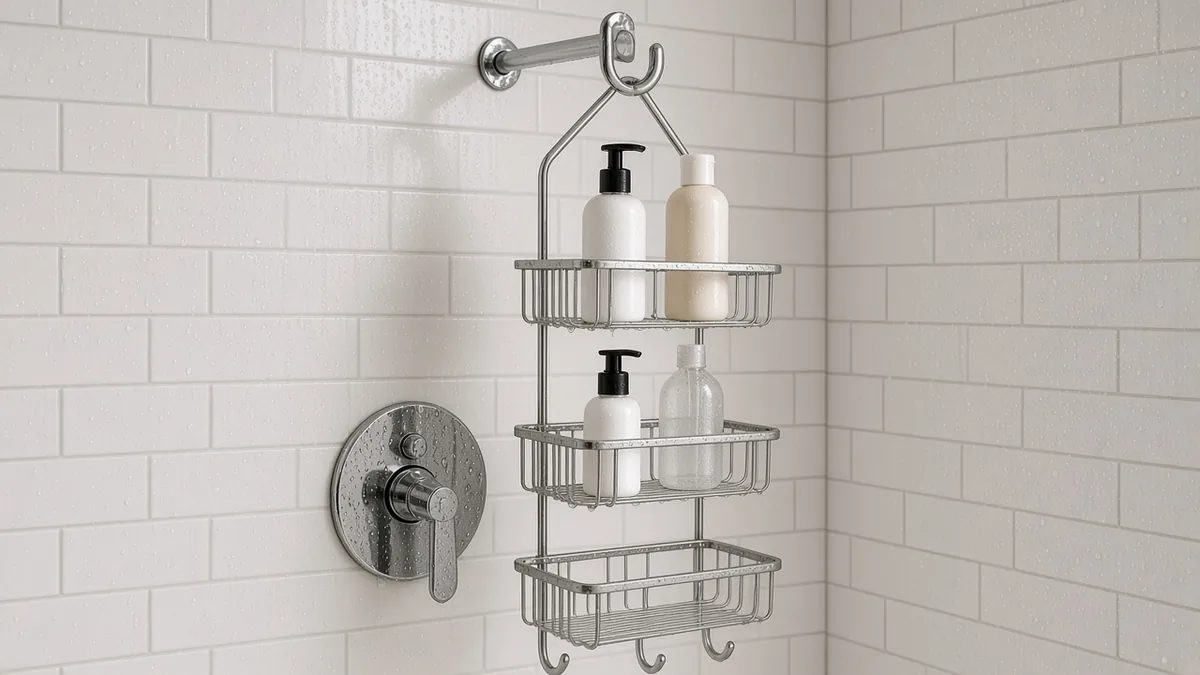
A hook that fits the shower arm does not settle shower caddy hook orientation. The hook can seat correctly and the loaded basket can still sit in front of a named valve or control. Freeze hook clocking and the loaded basket envelope against those controls, and keep a clearance slogan off the artwork until that envelope is written.
This guide is for importers and private-label teams writing hanging hook-over shower-caddy artwork and first-article checks. It is not a hook-profile or arm-diameter fit page, not a vertical rain-head clearance page, and not a tension-pole basket-spin page. The decision is whether the hook is clocked so the loaded basket clears named shower controls.
Koitor is a family-owned custom metal hardware factory. We can review hook geometry, fixed or walking clocking, the basket envelope, and the wording you want to print. We do not invent a clearance millimetre, a fixed-clock hook SKU, or a “will not block the valve” promise for a stall we have not agreed how to observe.
Why hook fit and vertical rain-head clearance do not close clocking
Hook geometry and arm-diameter compatibility answer whether the hook can hang on the arm at all. That file can pass while the basket is rotated toward a mixer, a diverter, or a temperature handle. Fit is not facing. Keep diameter and profile on the hook-fit file.
Vertical clearance to a rain head is a leftover height decision and is not reopened here. A caddy can sit low enough to clear the shower head and still block a wall control to the left or right. Height and clocking are different envelopes.
Tension-pole basket spin is a different architecture. A hanging hook-over caddy does not use that pole, and a 360° basket feature is not this page. If a hook can walk around the arm after loading, that walking is a clocking stability question on this hanging product, not a pole-basket rotation feature.
over-door shower caddy glass-door fit is also a different hanging family: whether an over-door caddy fits a glass shower door. Do not borrow a glass-door fit sentence and print it as a valve-clearance line for an arm-hung caddy. shower caddy drainage design matters for how the basket sheds water, not for whether the basket stands in front of a handle.
Wall-mount shopping pages that show a caddy “in the way” are often a different product: a screw-mounted or corner unit. Do not adopt that merchandising as this hanging-hook volume. Stay on hook clocking and the loaded envelope versus named controls.
Accessory hooks at the bottom of a caddy are a leftover unused topic and are not this decision. A lower hook that holds a loofah can still be fine while the basket body blocks a valve. Keep accessory-hook opening off this page.
How should the control envelope and the hook clocking be named?
Name the controls you are claiming to clear. A single-handle mixer, a three-handle cluster, a diverter, a handheld holder, and a thermostatic set do not share one vague “valve” word. Record which controls are in the project, and where they sit relative to the shower arm in the sample stall or on the drawing.
Name the hook behavior. Some hooks are intended to stay in a fixed facing once hung. Some can walk under load or under a bump. If the listing implies a set-and-forget facing, the hook has to hold that facing under the named load, or the artwork should not imply it.
Name the loaded envelope, not only the empty wire. Bottles, a soap bar, and items hanging from lower hooks can widen the envelope toward a handle. If the merchandising photograph is loaded, that load is the observation load. An empty basket is a weak basis for a clearance sentence.
Record the arm and the wall relationship used on the sample: arm length, how far the caddy hangs from the wall, and whether the stall is a corner or an open wall. A long arm can swing the basket into a control that a short arm would miss, or the reverse. Write the geometry you ran.
If the assortment will be sold into compact stalls and larger showers, either observe the tighter stall or write an exclusion. Silent artwork that implies any bathroom is how a wide-stall sample becomes a blocked mixer in a small enclosure.
If the hook can be rotated by the installer to “aim” the basket, the instruction sheet has to say that, and the first-article pack should show the aimed condition and whether it stays after loading. A factory-aimed sample that a household cannot repeat is a weak basis for a clearance claim.
What loaded check and exclusions should be agreed?
Agree a loaded check before anyone argues that a caddy is “in the way.” Typical project choices are whether a named handle can still be gripped, whether a diverter can still be turned, and whether the basket envelope stays out of an agreed keep-out around those controls after the named load and an agreed wait.
Do not invent a Koitor clearance millimetre. If the project wants a stated keep-out, write that dimension into the brief and show it on the sample. Until then, stay with a named control and a pass or fail that a later inspector can repeat in the same stall or on the same mock-up.
A hook that walks during the wait is a clocking failure even if the initial hang looked good. Photograph the facing when the caddy is first hung, after it is loaded, and after the wait. If the hook drifted into the control, record that as a walking hook, not as a hook that never fitted the arm.
Exclusions should be written when a control family was not observed. A sample that cleared a single-handle mixer does not automatically clear a wide thermostatic cluster. Either run the second family or say you did not.
Do not turn this file into a vertical rain-head claim, a hook-unbending claim, or an arm-diameter claim. If the hook yields, the arm is too large, or the caddy hits the shower head, those belong on their own pages.
What must not be printed as a universal clearance slogan?
Do not print that the caddy will not block any valve, fits every stall, or stays perfectly facing without a method. Those lines turn a hook SKU into a stall layout rating the factory did not issue.
Safer language stays inside the observation: the named controls, the loaded envelope, the hook behavior, and the stall or mock-up you used. If that evidence is not in the file yet, omit the clearance slogan or print an exclusion.
After-sales photos should show the hook, the arm, the loaded basket, and the control in one frame if possible. A close-up of a hook on a bench will not tell you whether the basket blocked a handle on the wall.
What belongs on the hook-geometry or door-fit page instead?
Hook profile, wire diameter, and arm fit belong on the hook-geometry and diameter pages. Glass-door over-door fit belongs on that door-fit guide. Drainage belongs on the drainage page. Tension-pole basket rotation belongs on the spin page. Vertical rain-head clearance stays a leftover decision and is not rewritten here.
If a complaint mixes a loose hook, a bent hook, and a blocked valve, split the file. Check whether the hook still fits the arm, whether it yielded, and whether the remaining facing puts the loaded envelope in the control keep-out.
What should the importer freeze before artwork is approved?
Use a written clocking file. The checklist and the matrix remind you which decisions to freeze. They do not replace the stall or mock-up photographs or the named control list.
Do not approve a shower caddy hook orientation line until the loaded envelope and the named controls are in the pack. An empty-basket studio shot against a blank tile wall is not a control-clearance check.
If production later changes hook shape, hanging length, basket width, or the recommended bottle map, the file needs a new observation. A copied “clears the valve” sentence from a pilot lot is not evidence for a wider basket.
A first-article pack should include the hook facing at hang, after load, and after wait; the named controls; the arm and wall geometry; and whether the hook is specified as fixed or allowed to be aimed.
Installer aiming belongs in the instruction if the hook depends on it. If the user is never told to aim the basket away from the mixer, do not assume they will. Write the default facing you expect, and observe that default.
Compact-stall merchandising should use a compact-stall sample. A wide-stall photograph with plenty of tile around the basket cannot support a small-enclosure clearance line.
When the facing, the load, and the named controls agree, the listing can stay modest and still be useful. It can name the control family you observed and avoid an unbounded will-not-block-the-valve badge.
After-sales videos should be read with the same split. Ask which control was blocked, whether the hook had walked, and what was in the baskets. Then compare that setup to the first-article envelope.
If a later change is only a finish or a hook color, the clocking file can often stay with the prior geometry record, so long as hook shape and basket width did not change. If those functional parts changed, re-run the envelope, then decide whether the sentence can stay.
A modest sentence is stronger than a borrowed millimetre or a copied “fits any shower” headline with no control list behind it. Keep the artwork inside the stall you actually observed.
Handheld holders and slide bars deserve their own line in the control list because they often sit closer to the hanging envelope than the main mixer. A sample that cleared a mixer can still block a handheld cradle. If the merchandising shows a handheld in the same wall, include that cradle or write an exclusion.
A shower arm that also carries a rain head and a handheld tee can change how the hook sits and how far the basket hangs toward the wall. If the project will sell into those tees, observe the tee, or say the sample used a simple arm only. Do not assume one arm family covers the other.
Lower hooks and hanging bottles can swing after the caddy is hung. If those items are part of the merchandising, include their swing in the envelope, not only the rigid wire. A still photograph of a tucked loofah is a weak basis for a handle that later sits behind a swinging bottle.
Corner stalls can hide a blocked control in a flattering camera angle. Take a head-on view of the handle path, not only a three-quarter beauty shot. If a hand cannot reach the mixer without moving the basket, the envelope has failed even if the tile still looks tidy.
Instruction diagrams should match the observed facing. A drawing that shows the basket neatly away from the mixer is a claim if that is not the default hook hang. Either make that facing the observed default, or change the diagram so it does not promise a layout you did not run.
When a complaint arrives, ask whether the user hung the caddy on the arm, on a door, or on a temporary hook. An arm-hung clocking file does not automatically cover an improvised hang. Sort those setups before you treat the complaint as a hook-orientation failure of the SKU.
Production changes to basket width, hook opening, or hanging drop should reopen the envelope even if the wire diameter of the hook still fits the arm. Fit can stay the same while clocking versus a control changes. Re-run the loaded frame, then decide whether the sentence can stay.
A finish-only change, such as chrome to a coated color on the same hook and basket geometry, can often keep the prior clocking record, so long as those functional parts did not change. Confirm the geometry first, then keep or retire the sentence.
If the caddy will be photographed both empty and loaded, use the loaded frame for any clearance sentence. The empty frame can still show hook style and finish. Mixing those jobs is how an empty beauty shot becomes a clearance claim the loaded basket cannot support.
When the named controls, the facing, and the loaded wait agree, the artwork can stay modest and still help a buyer. Name the control family you observed, name the hook behavior, and leave any-stall slogans off the page until a wider observation exists.
Send that pack with the drawing before the listing is locked. A factory can quote the caddy while the stall observation is still being written, but the clearance sentence should wait for the loaded frame and the named controls.

| Claim impulse | What to freeze | What the sample should show | What to keep off artwork until then |
|---|---|---|---|
| Will not block the valve | Named controls, loaded envelope, hook facing, and wait | The named handle can still be used after the loaded wait | An unbounded any-valve or any-stall slogan |
| Hook stays facing | Whether the hook is fixed or can walk, and the loaded check | The facing holds after load and wait, or walking is disclosed | A set-and-forget line on a hook that walks |
| Fits compact stalls | The compact geometry you actually observed, or an exclusion | The tight stall or mock-up was the setup you ran | A wide-stall photo used as proof of a small enclosure |
| Hook fits the arm, so it is clear | A split between arm fit and clocking versus controls | The hook seated, and the envelope was judged separately | A diameter pass treated as a clearance pass |
| Clears the shower head, so it is fine | A split between vertical rain-head clearance and left-right clocking | The head was clear, and the wall controls were judged separately | A height pass treated as a valve-clearance pass |
- Write the product as a hanging hook-over shower caddy, not as a tension-pole or a screw-mounted wall caddy.
- Name the controls you claim to clear, rather than a vague valve word.
- Name whether the hook is intended to stay fixed or may be aimed, and whether it can walk under load.
- Load the baskets as merchandised, including lower hanging items if they widen the envelope.
- Photograph facing at hang, after load, and after the agreed wait, in one frame with the controls if possible.
- Record arm length, wall relationship, and stall or mock-up geometry.
- Keep hook-profile fit, arm diameter, glass-door fit, drainage, and rain-head height on their own files.
- If only one control family or one stall size was observed, write an exclusion for the others.
- Keep unbounded any-valve or any-stall language off the listing, and do not invent a clearance millimetre.
- Send the drawing, the control list, and the intended sentence before the artwork is locked.
How can a family-owned OEM review the clocking brief?
Koitor can review the hook and basket geometry, the intended facing, and the wording you want to use against a named control list. That is a construction and acceptance discussion, not a stall certification. تصنيع حاملات أدوات الاستحمام حسب الطلب is the usual starting point when the caddy family itself still needs development.
If you already have a stall or mock-up outline, attach it. If you only have an empty-basket studio photograph, say that. We can help you tighten the envelope and the sentence, but we will not invent a millimetre to fill a blank. For a clocking-file review, send the hook-clocking brief to Koitor with the drawing and the intended claim.
MOQ, sample timing, and bulk lead time stay on the quotation path and depend on the product, the finish, and the order. They are not a substitute for the loaded orientation observation.
الأسئلة الشائعة
Can shower caddy hook orientation be cleared by an arm-diameter fit photo?
No. A hook that seats on the arm does not tell you whether the loaded basket sits in front of a named control. Take the fit record, then take the clocking record with the controls in the frame.
Do we need a clearance millimetre to sell the caddy?
Not from this article, and not as an invented Koitor figure. You need named controls, a loaded envelope, and an agreed check. If a later project wants a stated keep-out, write it into the brief and show it on the sample.
How is this different from rain-head height or basket spin?
Rain-head clearance is a vertical leftover decision. Basket spin is a tension-pole rotation question. This page is left-right hook clocking of a hanging caddy versus wall controls.
What if the hook can be rotated during install?
Then the instruction must say so, and the sample should show whether that facing holds after loading. If the user is not told to aim the basket, observe the default facing instead of assuming a perfect aim.
Can a wide-stall photograph support a compact-stall line?
No. Observe the compact geometry, or write an exclusion. A generous tile wall in a studio is not evidence for a tight enclosure.
Can Koitor write the hook-orientation sentence for us?
Koitor can review a clearance sentence against the control envelope and the clocking photographs, as a construction and acceptance discussion. The buyer still owns the listing. If the valve-clearance check was not run, the safer path is to narrow or drop the line.
اعمل مع شركة «كويتور» للأدوات
Need a hook-clocking brief reviewed?
Send Koitor your hanging caddy drawing or sample, the named control list, and the clocking sentence you want to print. Our team can review hook facing, basket envelope, and claim wording as a construction and acceptance brief before quotation. MOQ can start from about 100 pcs depending on the product; samples usually take 5–7 working days after details are confirmed; bulk production usually takes 4–6 weeks depending on the project.
OEM / العلامة التجارية الخاصة
حوّل دليل التوريد هذا إلى موجز منتج
يرجى إطلاعنا على المنتج المستهدف، والحجم، والتشطيب، وكمية الطلب، ومتطلبات التغليف. وسيتلقى فريقك تقييمًا عمليًّا لإمكانية التصنيع قبل تقديم عرض الأسعار.

 English
 Español
 Português
 Français
 Deutsch
 العربية