
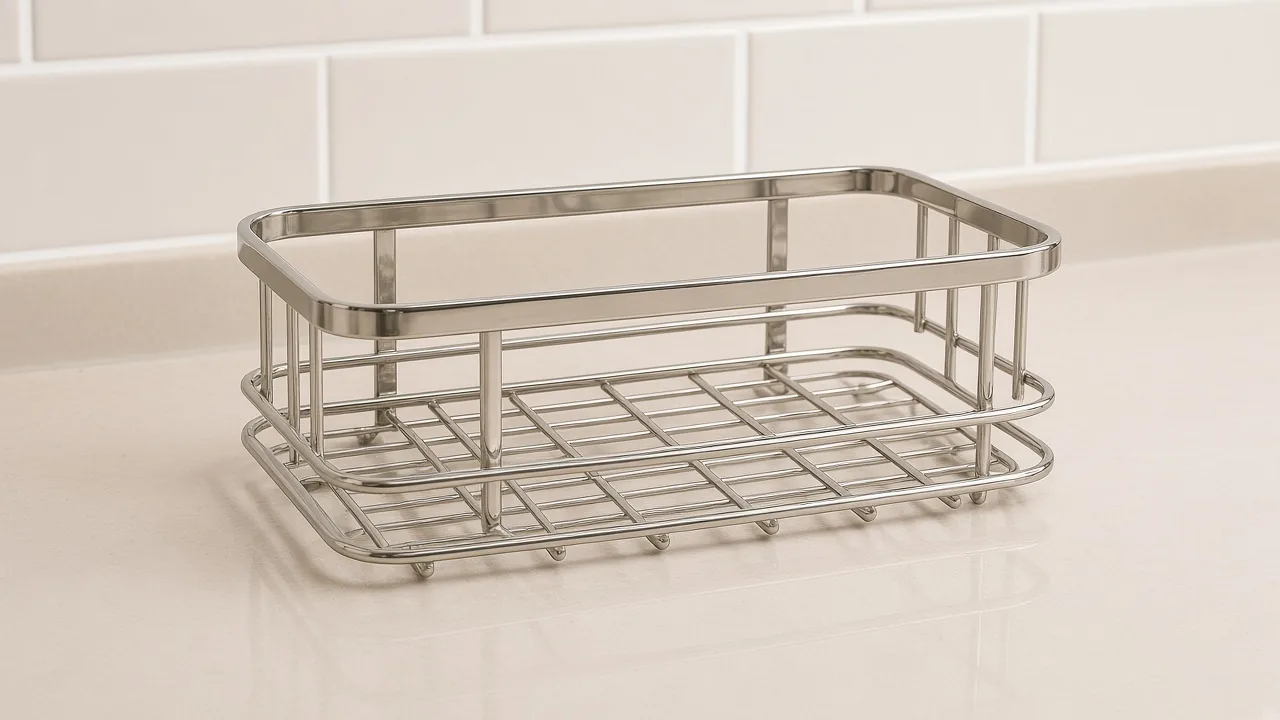
A mesh opening and a packaging abrasion note do not settle wire basket sharp edges. Where a hand enters a kitchen or bath basket, the rim, the cut ends, and any caps or returns have to be judged as user-touch surfaces. Freeze a tactile acceptance file for those sites, and keep an invented roughness number or an unbounded “smooth and safe” slogan off the artwork until that file exists.
This guide is for importers and private-label teams writing handled or open-rim kitchen and bath wire baskets. It is not a wire-shelving end-cap retention page, not an export-carton abrasion page, not a dish-rack cut-end rust page, and not a handle pull-off page. The decision is whether the rim and cut ends are acceptable where hands actually enter.
Koitor is a family-owned custom metal hardware factory. We can review rim geometry, cut-end treatment, caps or returns, coating at the ends, and the wording you want to print. We do not invent a roughness number, a “no sharp edges” guarantee, or a tactile limit for a site we have not agreed how to judge.
Why caps, cartons, and handle strength do not close a rim file
Wire-shelving cut-end caps are a shelving decision: whether a cap stays on a shelf wire. A kitchen or bath basket may use caps, welded returns, or ground ends, but the question here is the feel and the condition of the user-touch path, not whether a shelving cap survived shipping.
Export packaging abrasion is a carton decision. A basket can arrive without carton rub and still have a burr at a rim corner that a hand will find in a sink or a shower. Incoming rust scale on wire is also a different file. A clean, bright wire can still have a sharp cut end.
Dish-rack cut ends may share a welding vocabulary, but they are a different product and often a different hand path. Handle pull-off is a joint-strength question: whether a handle stays attached under load. A handle can hold and still present a sharp weld or a raw end where fingers wrap. Keep strength and tactile finish in separate records.
wire-basket lid fit and retention checks answers whether a lid fits and stays on. That is useful, and it is not a rim-burr file. A lid can fit perfectly over a rim that still catches a hand when the lid is off, which is how many kitchen baskets are actually used.
coating cut-edge corrosion on aluminum parts is a corrosion discussion at coating cut edges, often on aluminum parts. This page may mention coating coverage at basket ends, but only as part of the tactile and acceptance path. It is not a filiform or salt-spray reprint, and it is not an industrial parts-basket or store-fixture page.
Shopping language such as smooth, snag-free, or baby-safe does not close the file. Those words are listing impulses. They become claims only after the touch path, the end treatment, and the agreed method are on the page. Until then, they should stay off the artwork.
How should the user-touch path and the end treatment be named?
Name where a hand enters. For an open basket, that is usually the top rim, the corners, and any cut ends along the rim or at the feet. For a handled basket, include the grip, the weld or wrap at the handle join, and any end that a finger can reach while lifting. A laboratory-looking underside that nobody touches is not the first site.
Name the end treatment as it will be shipped: a welded return, a ground and coated end, a cap, a plastic tip, or another specified part. “Deburred” is not a treatment unless the project also says what that looks like on the sample and how it will be judged. Do not invent a roughness value or a grit number.
Name the coating or plating at the ends. A face that is well coated can still leave a raw wire end, a thin coverage at a ground spot, or a cap that does not fully cover a cut. If the project will claim that ends are coated or capped, the sample has to show that condition, not only a pretty side wall.
Name the user, at least as a use condition. A deep pantry basket that is carried by a handle has a different touch path than a shallow sink basket whose rim is used as a lift edge. If the listing shows a hand on the rim, that is a rim file, not only a handle file.
If the assortment includes more than one rim family — for example a rolled rim and a raw cut end with caps — observe each family or write an exclusion. A smooth rolled-rim sample cannot support a capped-cut-end sentence by habit.
Record whether the basket is judged empty or with a liner, a lid, or typical contents. A liner can hide a mid-wall wire and still leave the rim exposed. A lid can hide the rim in a photograph and leave it exposed in daily use. Photograph the condition you are claiming.
What tactile observation can be agreed without inventing a number?
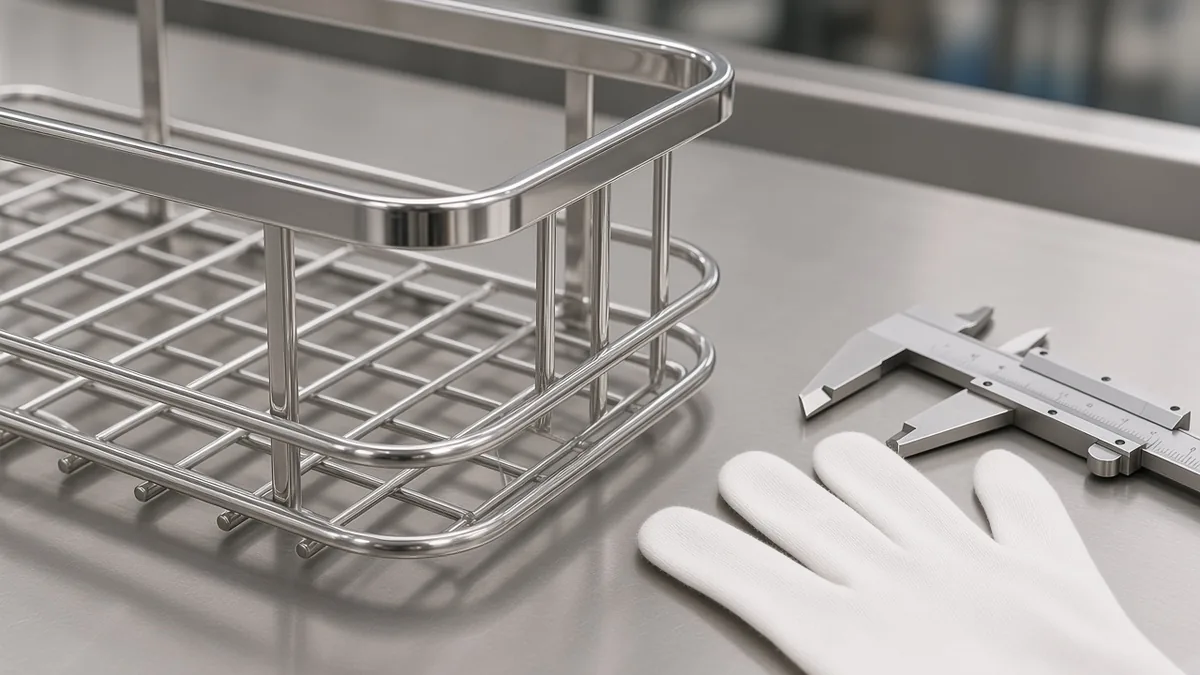
Agree what “acceptable” means on the actual sample before anyone argues about a sharp edge. Typical project choices are a no-catch hand pass along the named path, no uncoated raw end where a finger enters, caps or returns fully seated, and no burr that snags a cloth. Pick the sites and write the method.
A hand pass is a method only if you say who does it, along which path, and what a fail looks like. It is not a substitute for looking at the ends. Some burrs are easier to see than to feel, and some fine wires catch a cloth before they catch a dry finger. The brief can use more than one check, so long as each check is written.
Do not invent a roughness average, a micrometre limit, or a Koitor “sharpness grade.” If a later project adopts a named surface method, record the method and the sites as project evidence. Until then, stay with the tactile and visual file you can repeat on the same rim family.
Separate a process failure from a design choice. A returned end that is specified and well made is a design. A splatter, a leftover burr, a half-seated cap, or a ground patch that was never coated is a process condition. Those two findings should not share one casual “the edge felt rough” note.
First-article photographs should include the corners, the cut ends, the inside of a cap if caps are used, and the handle join if a handle is part of the path. A single pretty three-quarter view of the basket will not let a later inspector see the site that cut someone’s hand, or the site that did not.
If production later changes wire diameter, end treatment, cap part, or coating at the ends, the file needs a new observation. A copied “smooth rim” sentence from a pilot lot is not evidence for a changed end.
What must not be printed as a smoothness or safety slogan?
Do not print that the basket has no sharp edges, or that it is safe for any user, without a method. This page will not support an unbounded safety slogan. Safer language stays inside the observation: the named path, the end treatment, and the agreed hand or visual check.
Do not borrow a roughness number or a baby-safe line from a competitor listing. If the buyer wants a stated method, that method has to be written into the project. The factory can help you describe the rim. It cannot invent a laboratory result.
After-sales scripts should ask which site was involved. A complaint about a handle weld, a foot end, and a top rim are three different records. A generic “sharp basket” form that never names the site will push the next lot in the wrong direction.
What belongs on the shelving, packaging, or handle-strength page instead?
Shelving cap retention, carton abrasion, incoming rust scale, mesh opening, handle pull-off, and dish-rack cut-end rust each have their own jobs. Mention them only to send the reader to the right file. Do not rewrite those answers here, and do not let those passes stand in for a user-touch rim check.
Industrial parts baskets and store fixtures stay out of this page. If a search result shows a warehouse basket or a retail dump fixture, that is not this kitchen or bath hand-entry file.
What should the importer freeze before artwork is approved?
Use a written rim file. The checklist and the matrix remind you which decisions to freeze. They do not replace the photographs of the named path or the end-treatment part in the bill of materials.
Do not approve a wire basket sharp edges line until the touch path and the end treatment are named for the SKU you will ship. A rolled-rim photograph cannot support a raw-end sentence, and an empty-lid photograph cannot hide a rim that users will hold.
Caps and tips are only evidence when they arrive in the carton and stay on in use. If a cap is optional or easily pulled off, the listing should not assume it is present. Put the part on the packing list, or write the observation as an uncapped path.
Installer or merchandising substitution also matters. A sample with seated caps can be displayed without them. If the instruction or the planogram allows that, the rim file should include the uncapped condition or forbid the substitution.
When the path, the treatment, and the check agree, the listing can stay modest and still be useful. It can name the end treatment and the hand-entry check you ran, and it can avoid an unbounded smooth-and-safe badge. That modest sentence is stronger than a borrowed number.
After-sales returns should be sorted by site and by treatment family. A burr on a ground end, a missing cap, and a sharp handle weld are three different records. Mixing them into one “edge” bucket will not improve the next lot.
If a later change is only a coating color on the same end geometry, the tactile file can often stay with the prior geometry record, so long as coverage at the ends did not change. If the end treatment or the cap changed, re-run the path, then decide whether the sentence can stay.
Weld spatter at a handle join or at a rim corner is part of this path when a finger can reach it. A strong weld that holds a handle can still present a sharp nugget. Do not let a weld-strength note, or a pretty overall photograph, stand in for a pass along that join.
Feet and bottom returns are easy to forget because the listing photograph looks down into the basket. Users still set the basket down and pick it up by the rim or by a lower rail. If a cut end lives at a foot, include it in the path, or write why that site is excluded.
A cloth or a paper-towel snag check can be a useful second method when the brief wants something more repeatable than an informal finger pass, so long as the cloth, the motion, and a fail are written down. It is still not a roughness number, and it should not be written as a laboratory result the factory never ran as a standard method.
Retail packing should be checked for end protection only as a support to the tactile file, not as a replacement. A sleeve or a corner board can keep a cap on in transit and still leave the rim unprotected in use. If the project uses transit protection, say whether that protection is part of the sold unit or only part of the incoming pack.
When a complaint arrives with a cut finger photograph, ask for the site, the SKU family, and whether a cap was present. Then compare that site to the first-article path. A new site that was never in the file is a reason to widen the path, not a reason to argue about a slogan that was never substantiated.
A modest listing can still be useful. It can name the end treatment and the hand-entry check you ran, and it can avoid an unbounded no-sharp-edges badge. That sentence is stronger than a borrowed micrometre or a copied safety headline with no path behind it.
If the buyer will also print care instructions, keep those instructions consistent with the rim file. A line that tells the user to lift by the rim is a reason to judge that rim. A line that tells the user to lift only by the handle is a reason to keep the handle join in the path, and not to pretend the rim will never be touched.

| Claim impulse | What to freeze | What the sample should show | What to keep off artwork until then |
|---|---|---|---|
| No sharp edges | Named hand-entry path, end treatment, and agreed check | The path passes the written hand or visual check on that family | An unbounded smooth or snag-free slogan |
| Ends are capped or returned | The cap or return as a specified part, fully seated | The part is present and covers the cut on the sample | A capped-end sentence on an uncapped SKU |
| Coating covers the cuts | Coverage at the actual ends, not only on the side wall | The end is finished as claimed, or the claim is narrowed | A pretty-side photo used as an end-coverage pass |
| Handle is strong, so it is fine to hold | A split between pull-off strength and tactile finish | The handle held, and the grip path was judged separately | A strength pass treated as a rim pass |
| Arrived clean, so the rim is acceptable | A split between carton abrasion and incoming tactile rims | The carton was acceptable, and the rim was judged separately | A packaging pass treated as a hand-entry pass |
- Write the product as a kitchen or bath wire basket with a user-touch rim, not as a shelving standard, a store fixture, or an industrial parts basket.
- Name the hand-entry path: rim, corners, feet, and handle join if a handle is used.
- Name the end treatment as shipped: return, ground and coated end, cap, or another specified part.
- Do not invent a roughness number or a factory sharpness grade.
- Photograph corners, cut ends, and the inside of caps or returns at first article.
- Separate a specified end design from a process burr, a missing cap, or a bare ground patch.
- Keep shelving caps, carton abrasion, mesh opening, rust scale, and handle pull-off on their own files.
- If more than one rim family is sold, observe each family or write an exclusion.
- Keep unbounded no-sharp-edges or baby-safe language off the listing.
- Send the drawing, the end-treatment callout, and the intended sentence before the artwork is locked.
How can a family-owned OEM review the rim brief?
Koitor can review the rim and end geometry, the cap or return callout, the coating at the ends, and the wording you want to use. That is a construction and acceptance discussion, not a laboratory certification. تصنيع سلال تخزين معدنية حسب الطلب is the usual starting point when the basket family itself still needs development.
If you already have a touch-path outline, attach it. If you only have a pretty side photograph, say that. We can help you tighten the sites and the sentence, but we will not invent a roughness number to fill a blank. For a rim-file review, send the rim and cut-end brief to Koitor with the drawing and the intended claim.
MOQ, sample timing, and bulk lead time stay on the quotation path and depend on the product, the finish, and the order. They are not a substitute for the tactile observation.
الأسئلة الشائعة
Can wire basket sharp edges be cleared by a packaging inspection alone?
No. A carton can be clean while a rim corner still catches a hand. Take the packaging record if you need it, then take the touch-path record on the basket itself.
Do we need a roughness number to sell the basket?
Not from this article, and not as an invented Koitor figure. You need a named path, a named end treatment, and an agreed check. If a later project adopts a named method, record it as project evidence.
How is this different from handle pull-off or shelving cap retention?
Handle pull-off is whether the handle stays attached under load. Shelving cap retention is whether a cap stays on a shelf wire. This page is the feel and condition of the hand-entry rim and cut ends on a kitchen or bath basket.
What if the listing photograph always shows a lid on the basket?
Then the photograph is hiding a path users may still touch when the lid is off. Either observe the open-rim condition, or keep a hand-entry sentence off artwork that never shows the rim.
Can a capped sample support an uncapped SKU?
No. Observe the uncapped family, or write an exclusion. Caps that can be omitted in merchandising should be treated as optional unless the packing list and the instruction keep them on.
Can Koitor write the rim-acceptance sentence for us?
Koitor can review a user-touch wording against the rim path and the cut-end sample, as a construction and acceptance discussion. The buyer still owns what is printed. If the tactile observation is not in the pack, the safer path is to narrow or drop the line.
اعمل مع شركة «كويتور» للأدوات
Need a user-touch rim brief reviewed?
Send Koitor your kitchen or bath wire-basket drawing or sample, the end-treatment callout, and the rim sentence you want to print. Our team can review rim geometry and claim wording as a construction and acceptance brief before quotation. MOQ can start from about 100 pcs depending on the product; samples usually take 5–7 working days after details are confirmed; bulk production usually takes 4–6 weeks depending on the project.
OEM / العلامة التجارية الخاصة
حوّل دليل التوريد هذا إلى موجز منتج
يرجى إطلاعنا على المنتج المستهدف، والحجم، والتشطيب، وكمية الطلب، ومتطلبات التغليف. وسيتلقى فريقك تقييمًا عمليًّا لإمكانية التصنيع قبل تقديم عرض الأسعار.


 English
 Español
 Português
 Français
 Deutsch
 العربية