
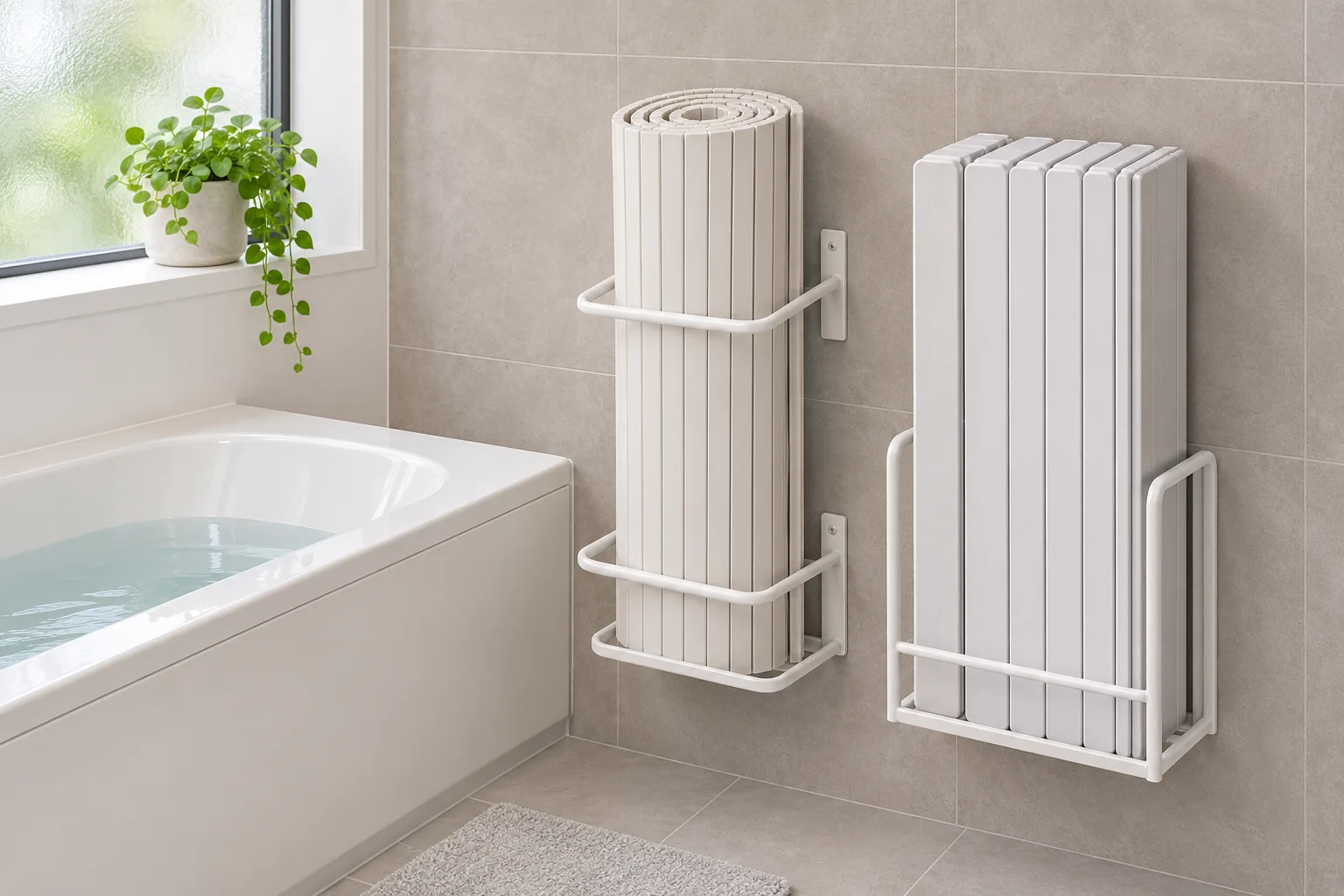
A bathtub cover storage holder should be specified for a real cover format and a defined stored state. Flexible rolled covers, multi-panel folding covers and rigid sections create different width, thickness, weight distribution and contact points. A holder that looks suitable in an empty bathroom may not accommodate the customer’s actual cover once it is wet, folded or placed beside the tub.
For importers, the buyer decision is to define which cover formats the product supports, how they are stored, and what clearance is needed for removal and cleaning. A product page should not imply universal compatibility from one staged photograph. This guide provides a sample-review framework for an adjacent bathroom accessory; it does not confirm that Koitor currently manufactures bathtub-cover holders.
Identify the cover construction and storage state
For this decision, record the bathtub cover storage holder requirements in the controlled specification and sample review so the approved scope remains clear to purchasing, quality and the supplier.
The bathtub cover storage holder specification should also identify the assumptions that remain open and who must confirm them before order release.
Collect samples or detailed dimensional information for the cover families in the assortment. A flexible cover may roll into a compact cylinder, while a segmented cover may fold along hinges into a thicker stack. One-piece soft covers may bend rather than hold a consistent shape. Record the cover’s open dimensions, folded width, folded depth, thickness and approximate mass if those details are available.
Define the state the holder is intended to support. Does the buyer expect the cover to be stored dry after use, briefly drained, folded while wet, or placed in the holder during normal bathroom use? The storage state affects the amount of clearance, surface contact and the possibility of water collecting in a corner. A visual sample review can identify the intended position; it does not prove drainage, corrosion performance or hygienic suitability without further validation.
Observe the cover’s edge and moving components. Hinges, end caps, handles, cut-outs and raised ribs can catch on a narrow wire or protruding fastener. A wide, flat section might rest differently from an edge-supported panel. Place the cover in the holder using the intended motion, then remove it. Check whether the user needs to twist, lift over a rail or reach behind the tub to retrieve it.
| Cover attribute | Buyer record | Holder review |
|---|---|---|
| Construction | Flexible roll, segmented fold or other form | Identify support points and interference |
| Stored envelope | Folded or rolled width, depth and height | Compare against clear holder dimensions |
| Mass and balance | Available product data and center of mass | Observe stability in intended position |
| Edge features | Hinges, handles, caps and raised ribs | Check for snagging or concentrated contact |
| Stored condition | Dry, damp or another defined state | Assess clearance and cleaning access |
| Retrieval path | Lift, slide, rotate or unhook | Verify the user can remove the cover safely |
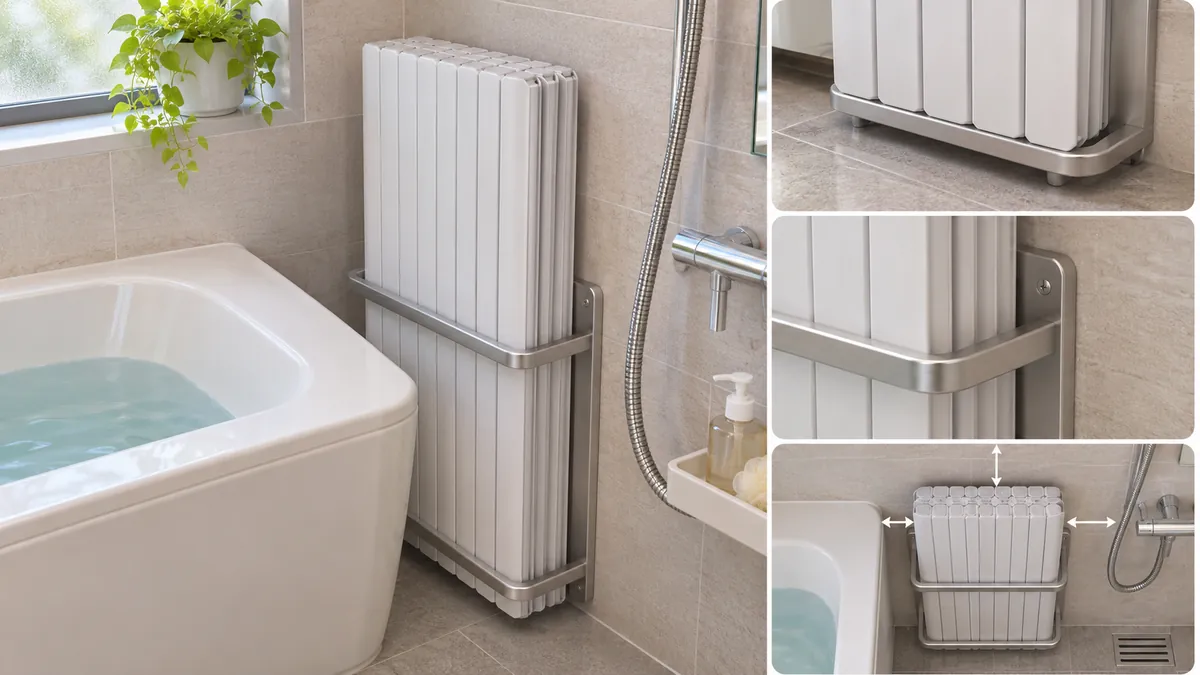
A Yamajitsu bath-cover holder example shows one specific storage form and the product maker’s stated fit. Use it to understand one market configuration, not as a universal dimensional standard. For a different cover family, request current drawings and test actual samples.
Select a holder architecture around the cover envelope
A wall-mounted rail with retaining arms can hold a folded cover against a surface and preserve floor space. It needs enough depth and spacing for the thickest part of the fold. If the retaining arms are too close, the user may struggle to place the cover; too far apart, the cover may tilt or contact the floor. The correct spacing depends on the chosen cover and required presentation.
A basket or cradle can support a rolled cover across a longer contact area. Open sides may improve access, while narrow bars may cause a soft cover to sag or a ribbed cover to sit at an angle. The buyer should inspect whether the cover rests on intended surfaces and whether its edge touches exposed fasteners or a cosmetic face. A product rendering rarely shows how a flexible cover behaves under its own weight.
A compact single-hook arrangement can be easy to understand but may concentrate the cover’s mass at one or two points. Confirm that the cover has a compatible handle or opening and that the contact does not deform a soft edge. Do not infer safe load capacity from the fact that a sample can hang briefly. Load claims and installation suitability require an agreed test and appropriate instructions.
The mounting position is part of the architecture. A holder can be placed on a wall, beside a tub, inside a storage cabinet or near a shower zone. The chosen location determines the necessary clearance around faucets, shower hoses, tub rims, door swings and cleaning tools. Record which fixture arrangement was used during approval, then avoid promising a fit for every bathroom layout.
Check removal, clearance and wet-area maintenance
The buyer should review the entire movement path: approach the holder, place the cover, release it and remove it again. Check where the user’s hands go and whether a tall cover touches a shower control or door. If a cover must be lifted above a rail, measure the overhead clearance. If it slides into a cradle, inspect the exit direction and whether the cover catches on a corner.
Clearance from the tub and floor affects both use and cleaning. A cover stored too low may touch the floor or obstruct a cleaning tool. A holder placed too close to a tub rim may block access to the cover or make it difficult to wipe behind the mounting plate. A wet-area location can expose metal and finish to water, cleaning products and humidity, but a concept image does not establish corrosion resistance. Define environmental expectations and request suitable material and finish evidence.
Inspect drainage only if the design or product claim depends on it. Open gaps may allow water to escape, but geometry, cover orientation and installation level still matter. A small demonstration with a damp sample cannot substantiate long-term drying or hygiene claims. If drainage is relevant, define the product condition, test method and acceptance criteria with the responsible supplier.
Check the finish where the cover contacts the holder. A burr, rough weld or sharp fastener can abrade a cover, while a coating edge can mark a light-colored surface. Review these surfaces under consistent lighting and touch where appropriate. Record the inspected areas and sample revision. Do not generalize one visual check into a statement about every production unit.
Run a paired sample review
A useful approval uses both the holder sample and the buyer’s selected covers. If exact retail samples are unavailable, define temporary proxies and label them as such. Do not allow a proxy’s thickness or stiffness to become an undocumented fit standard.
Use this sequence:
- Verify the drawing revision, mounting method, overall envelope and usable support area.
- Place each selected cover into the holder in its specified stored state.
- Check edge contact, balance, visible deformation and proximity to adjacent fixtures.
- Repeat placement and removal using the expected user motion.
- Inspect the holder’s corners, welds, fasteners and contact surfaces for snag points.
- Review floor and tub clearance as well as access for routine cleaning.
- Photograph the stored state and note which cover model or dimensions were used.
- Record approved combinations, exclusions and changes that require a recheck.
These are fit and usability checks. They are not structural load certification, corrosion testing, drainage validation or proof of suitability for a particular wall substrate. If the buyer needs one of those claims, define that work separately and retain the evidence with the product specification.
Align claims, packaging and reorder control
Product descriptions should identify the intended cover format and key fit conditions. “Fits folding bath covers” may still be too broad if the range includes different panel thicknesses or handle arrangements. Use tested dimensions or identify the named cover models where permitted. For an e-commerce listing, show the cover in a clearly illustrative position and avoid implying a capacity that the sample review did not establish.
Keep the compatibility statement close to the actual evidence. If the sample was reviewed with one folded cover whose panels were a certain thickness, the internal specification should retain that sample identity and measurement. A later cover with a wider hinge, thicker edge cap or different fold direction can occupy more space even when the overall open size appears similar. When a distributor combines products from multiple brands, confirm whether the buyer has permission to name those products in public compatibility claims. If not, state the relevant dimensional envelope and the measurement method instead of implying an endorsement.
Packaging and instructions should help users reproduce the approved stored state. A simple line drawing can show whether the cover should be folded, rolled or placed with a particular side facing the wall. Keep those instructions consistent with the evaluated sample. If the package includes several brackets or alternative supports, identify which configuration matches each cover format. This reduces the chance that a flexible cover is squeezed into a configuration intended for a rigid panel. It also gives customer-service teams a specific fit reference if a buyer reports that a cover sits unevenly or touches an adjacent fixture.
Packaging should protect both the holder’s finish and any detachable parts. Check that mounting brackets do not rub against the visible surface and that screws or anchors cannot move freely inside the carton. If a screw pack is included, state which substrate it is intended for and whether professional installation is required. Do not imply that one fixing set fits every wall.
Retail teams should keep the carton illustration consistent with the holder orientation approved in the sample. If the storage position shown requires the cover to be rolled tightly, verify that this is possible with the listed cover format and does not depend on an unmentioned strap or accessory. If the package shows an item beside a tub, make clear whether the tub or cover is included. These small details help prevent a buyer from reading an illustrative arrangement as a promise that every cover in the category will fit.
For a reorder, maintain the approved drawing, bill of materials, finish reference, inspection notes, packaging layout and compatible-cover list. A change to the cover source, hinge geometry or holder spacing may affect the stored envelope. Reassess the affected interfaces instead of relying on an old product photo.
Koitor’s documented experience relates to bathroom and home-storage metal hardware and drawing- or sample-based customization within confirmed capability. The available company facts do not establish production of bathtub-cover holders. Confirm the exact product, process and accessory scope before attributing this concept to Koitor. Buyers developing a relevant custom metal organizer can review the custom bathroom hardware manufacturer page and contact Koitor through the contact page.
Buyer checklist before approving a holder
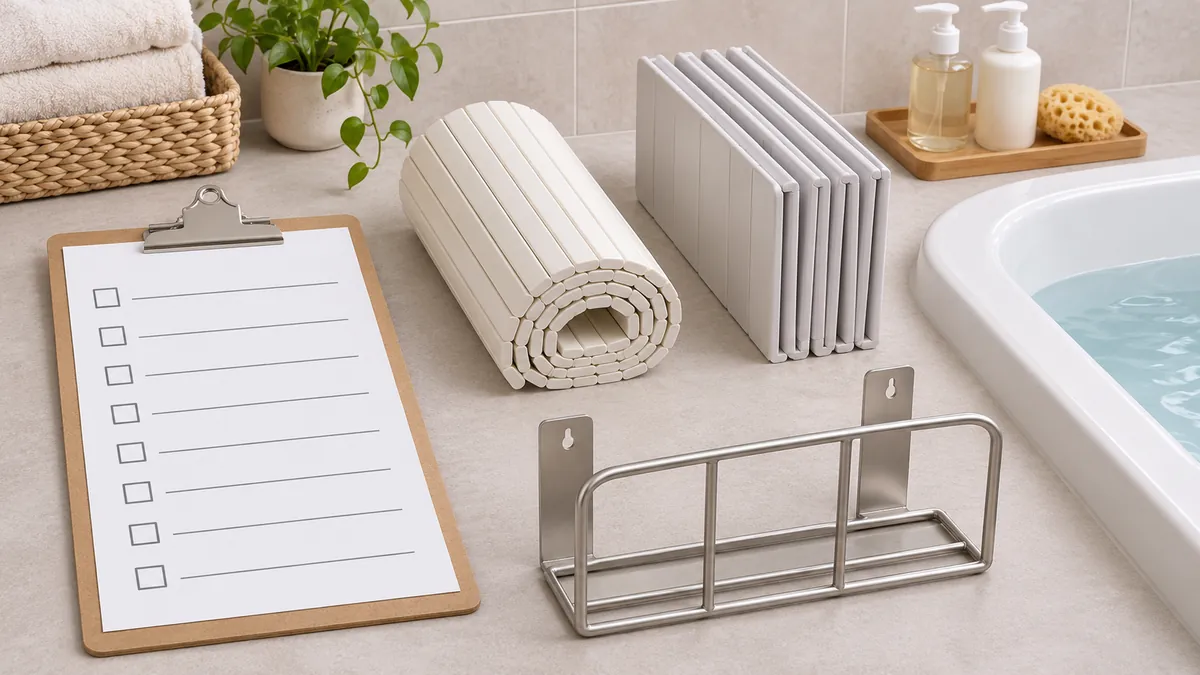
- Identify the exact cover construction and representative model.
- Record the folded or rolled envelope, contact points and approximate mass.
- Define whether storage is intended for a dry, damp or other state.
- Verify placement, removal, floor clearance and nearby fixture access.
- Check contact surfaces, edges, fasteners and finish for snagging or abrasion.
- Avoid drainage, corrosion or load claims without appropriate evidence.
- Confirm mounting instructions, supplied parts and wall-substrate limits.
- Align product imagery, compatibility language, carton and approved sample.
- Record revisions and cover changes that trigger a targeted recheck.
Frequently asked questions
Can one holder fit rolled and folding bathtub covers?
Only if the design has been checked against both formats. Rolled and segmented covers have different envelopes and contact points. Test representative samples and state which combinations are supported.
Should buyers assess the holder with a wet cover?
If the intended use involves storing a damp cover, include that state in the review and define the handling assumptions. A visual check does not establish long-term corrosion, drying or hygiene performance.
Does an open rack prove that water drains completely?
No. Drainage depends on the cover orientation, holder geometry, installation level and use conditions. Treat drainage as a separate claim that needs a defined test.
Is a wall fixing kit suitable for every bathroom surface?
No. The substrate, wall construction, fastener and installation method must be matched. State the supplied kit’s intended use and any exclusions.
Does this guide confirm Koitor makes bathtub-cover holders?
No. It is a buyer-side fit framework for an adjacent product. Confirm current capability for the exact project before requesting a production commitment.
Discuss a Relevant Metal Hardware Project
Share the product scope, drawings or samples, quantities and requirements relevant to this decision. Koitor can clarify whether a metal hardware project fits its confirmed production scope. The bathtub cover storage holder specification should state the intended interface and review conditions.
OEM / PRIVATE LABEL
Turn this sourcing guide into a product brief
Share your target product, size, finish, order quantity and packaging requirements. Your team receives a practical manufacturability review before quotation.


 English
 Español
 Português
 Français
 Deutsch
 العربية