

Blueprint rack hanging clamp compatibility should be approved as a rack-and-clamp system, not inferred from the rack’s position count. Buyers need to name the clamp supplier and model, distinguish usable clamping length from overall length, select fixed or pivoting supports, and review occupied-sheet drop and retrieval. Some commercial racks are sold separately from their clamps, and fixed-width and mixed-width configurations may use different support arrangements. A sample can establish the fit of named parts; it does not establish load, archival protection, wall fixing, or compatibility with every clamp brand.
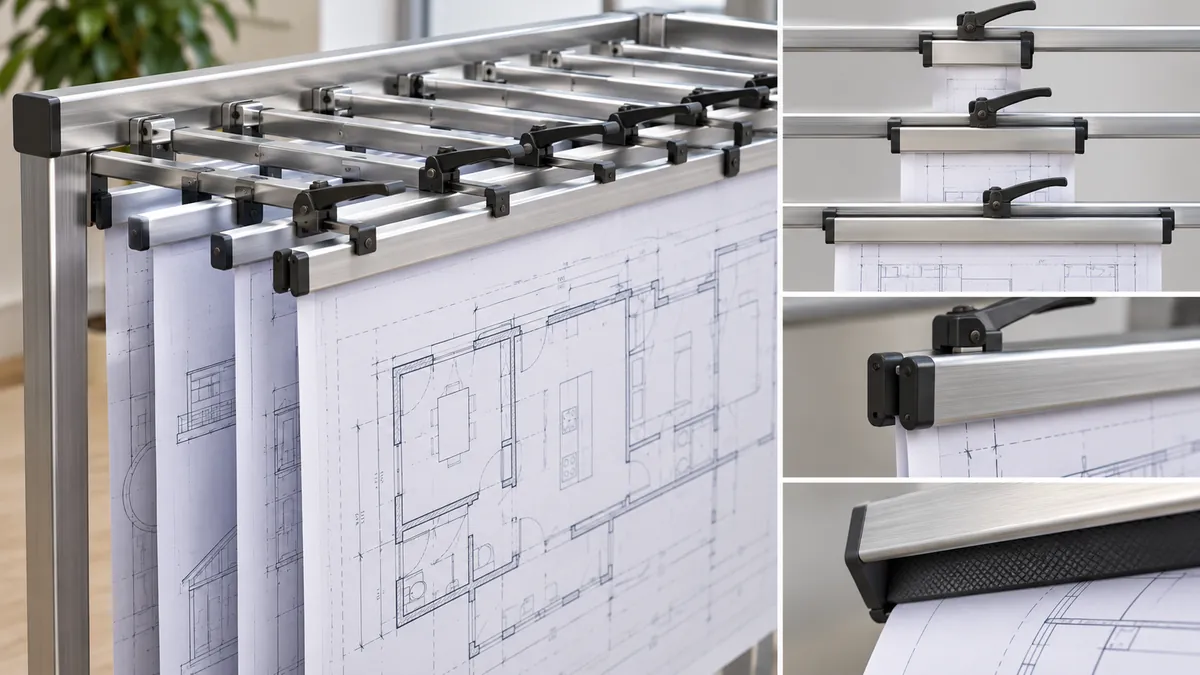
Why does blueprint rack hanging clamp compatibility need a paired specification?
A rack may display multiple positions while leaving the compatible clamp, document format, or support movement to a separate product selection. If the importer quotes only the rack, the buyer may still need to source clamps that fit the support and hold the intended drawing size. If the quote includes both, the buyer needs the exact clamp model, quantity, and paired configuration. A position count is not the same as a clamp count or a guaranteed sheet capacity.
Manufacturer catalogs document this system-level distinction. One commercial wall rack is described with pivoting brackets, while clamps are ordered separately and may be offered in multiple lengths. Another catalog shows fixed-width arrangements as well as swing-out systems intended for a mix of clamp widths within its own product family. Those observations apply only to the products described. They do not establish that another brand’s clamps fit, that every pivot rack supports mixed widths, or that Koitor currently manufactures the system. Blueprint rack hanging clamp compatibility should therefore be documented for the specific paired parts, settings, and occupied assortment shown in the approved sample.
For office-storage importers, the central decision is whether the chosen rack arrangement supports the buyer’s clamp assortment and retrieval workflow. The answer must name both sides of the interface. A drawing of the rack alone may not show the clamp seat or the useful length available after the clamp’s support ends are engaged. A supplier listing that shows clamps nearby may also depict optional accessories rather than included parts.
How should buyers define clamp dimensions and document formats?
Use the clamp supplier’s controlled drawing or current specification. Record usable clamping length separately from overall clamp length. The total dimension may include end features, pivots, or attachment sections that do not hold paper. Do not assume that a named sheet format automatically corresponds to a particular clamp length across suppliers; verify the actual clamp reference and the intended paper orientation.
List the sheet width and height, whether documents are stored portrait or landscape, and whether the buyer intends to hang single sheets, sets, or a defined stack. This is a configuration description rather than a universal capacity claim. The clamp maker’s information should govern its paper interface and operating limits. A rack supplier can confirm its support geometry, but should not invent a clamp rating if the clamp is sourced elsewhere.
If the assortment uses several clamp lengths, state whether the rack positions are fixed to one width or intended to accept a mixed-width set. The buyer should check that the support, pivot, and adjacent positions accommodate the selected lengths. A model that accepts one catalog clamp length does not necessarily accept another length or a third-party item with a similar nominal dimension.
Also identify who supplies each part. If clamps are separately purchased, show this in the quote, product description, and pack list. If brackets or hanger supports are sold separately, assign a reference and quantity. A complete system BOM should state the number of racks, supports, clamps, end parts, and fixings included, with separate lines for optional items.
| Buyer record | What to identify | What it helps prevent |
|---|---|---|
| Clamp model | Supplier, reference, revision, and source drawing | Assumed cross-brand compatibility |
| Usable length | Clamping length distinct from overall length | Selecting by a misleading outside dimension |
| Document set | Sheet format, orientation, and intended contents | Confusing paper format with proven capacity |
| Rack architecture | Fixed or pivoting, with position arrangement | Assuming every rack accepts mixed clamp widths |
| Supply scope | Rack, brackets, clamps, hardware, and quantities | Treating optional items as included |
| Retrieval | Occupied drop, swing envelope, adjacent obstruction | Approving a static layout that cannot be accessed |

When is a fixed or pivoting support appropriate?
A fixed support may be selected for a controlled clamp width or a simpler stationary layout, while a pivoting arrangement may allow positions to move for access in some product systems. These are general configuration descriptions, not guaranteed performance outcomes. The buyer should use the rack manufacturer’s current instructions to understand the actual movement and intended clamp range. Do not infer a locking behavior, pivot friction, or capacity from the appearance of a hinge.
Decide whether all hanging positions use one clamp width or whether the order includes a mixed assortment. If widths are mixed, draw the intended order across the rack and identify each clamp. Check whether a long clamp blocks a shorter one, whether a pivot can move with adjacent positions occupied, and how much room the document sheets require below the support. The sample and product claim should reflect the actual mixed arrangement rather than a picture of empty brackets.
If a buyer expects swing-out access, identify the movement path and any surrounding wall, neighboring rack, or document obstruction. Ask what positions can move independently under the maker’s instructions. A static drawing can help identify possible interference but cannot demonstrate access. A physical sample is the better way to document the nominated layout.
How should the paired rack and clamp sample be checked?
Request the rack, brackets, and clamps that match the quote and proposed BOM. Check the model and revision for each part. If a sample substitutes a clamp or uses a different bracket, record the substitution and decide whether it is representative before accepting it. Do not permanently approve a system from a product image that shows a different clamp family.
Install or assemble the sample only following the manufacturer’s current instructions. Place the nominated document references in the selected clamps and hang them in the intended rack positions. Observe whether the clamp seats on the support as documented, whether the full clamp envelope clears neighboring positions, and whether the paper drop interferes with the shelf, floor, or another rack. Do not force a pivot or alter parts to make the setup appear to fit.
Review both full and partial occupancy if they represent the buyer’s use. A crowded rack may create a different retrieval path from one with only a single clamp. Where pivoting is selected, observe the specific intended movement and document the state; do not transform a brief movement check into a load, cycle-life, or durability claim. If the clamp supplier specifies a maximum sheet stack or operation, use that source and keep it distinct from the rack’s evidence.
Capture the rack ID, clamp ID, drawing revisions, sample ID, document references, support settings, and photographs. List what was verified and what remains open. A good approval record allows the buyer to reorder the same system and shows which components must remain controlled. It also prevents a later product-page edit from implying that the rack alone includes clamps or accepts every brand.
Which product claims should remain separate?
Compatibility does not establish a load rating. The count of positions, clamp length, or a visual impression of metal thickness does not prove how many sheets can be carried. Any load claim must come from product-specific evidence for the actual rack, supports, clamps, mounting, and configuration. Do not import an advertised capacity from a different manufacturer’s system.
Wall mounting is separate too. A rack fitting its clamps does not prove the wall or anchors are suitable. Use the manufacturer’s current product-specific mounting documentation and have the intended substrate and installation reviewed by responsible qualified parties. This guide does not set anchor sizes, drill patterns, installation procedures, or safe loads.
Likewise, a metal rack does not automatically preserve archival documents. The support interface and metal construction do not establish material neutrality, humidity control, light protection, or conservation suitability. Avoid archival claims unless they are separately supported by qualified evidence. The buyer can specify intended room conditions and document handling requirements, but a clamp-fit sample cannot validate them.
Do not describe mixed-brand compatibility unless it has been verified for the exact rack and clamp pairing. If supplier approval covers only one family, name that family and exclude other references. Change control should be triggered if the clamp, support bracket, pivot, finish, or rack geometry changes after approval.
What should importers avoid during assortment planning?
Do not calculate system capacity by multiplying bracket positions by a assumed sheet count. Position count describes locations; the clamp supplier’s approved use and the specific rack configuration govern any resulting claim. Keep the rack’s physical positions, supplied clamp quantity, document formats, and any evidence-backed capacity language distinct.
Avoid ordering brackets and clamps under vague descriptions such as “standard blueprint holder.” The phrase may conceal different widths, attachment types, or supply scopes. Include model references, drawings, and quantities in the RFQ. If the supplier does not confirm that a clamp fits, leave the pairing open instead of using a generic compatibility claim.
Do not confuse pivoting with universal adjustability. A swing-out component can improve access in a specific design, but it does not prove compatibility with all widths or an unrestricted movement envelope. Review the selected layout and occupied sample.
Finally, ensure packaging and parts identification preserve the approved system. Label racks and clamp packs with matching references. If sold separately, do not use a hero image that makes optional clamps appear included without a clear disclosure. Keep product photos, BOM, carton contents, and instructions aligned with the final offer.
How can buyers scope a metal storage inquiry?
Koitor Hardware is a family-owned custom metal hardware manufacturer specializing in bathroom and home storage hardware. Current blueprint rack production, aluminum extrusion, pivot mechanisms, clamp manufacture, archive qualification, and load certification are not confirmed. Buyers should approach this as an adjacent metal storage concept and request project-specific feasibility confirmation rather than assume an existing SKU.
Provide a lawful frame drawing or concept, clamp supplier references, document format, fixed or pivoting preference, intended position mix, finish, mounting context, and packaging scope. Identify whether clamps, pivots, brackets, and wall hardware are supplied by the buyer or third parties. Ask which metal parts Koitor could confirm within the project scope and who owns clamp compatibility, wall installation, and archive claims.
The literature rack guide covers face-out publication pockets, and the merchandising display guide concerns a different product and use. Neither replaces this large-format document clamp pairing. For general metal storage OEM scope, review Koitor’s home storage hardware information and confirm product feasibility and bought-in component responsibility before quotation.
What should the buyer include in a clamp assortment worksheet?
- Rack supplier/model/revision and fixed or pivoting architecture.
- Clamp supplier/model/revision and usable clamp length from its source drawing.
- Intended sheet format, orientation, and any defined stack or use limit.
- Number and order of positions, with mixed widths identified separately.
- Bracket or pivot mating interface and current supplier instructions.
- Occupied retrieval and swing observations from the paired sample.
- Complete BOM showing separately supplied racks, brackets, clamps, and fixings.
- Exact sample IDs, drawing revisions, photographs, exceptions, and sign-off.
- Separate evidence owners for load, wall fixing, and archival claims.
- Product-page and pack-list wording that matches the sold components.
Frequently asked questions
Are blueprint rack clamps always included?
No. Some manufacturers sell brackets and clamps separately. Confirm the exact BOM, quote, and carton contents for the selected model.
Does a rack with ten positions hold ten full document sets?
Not necessarily. Position count does not define the clamp supply scope or a sheet-capacity claim. Confirm each component and its supported use.
Can a fixed rack hold mixed clamp widths?
That depends on the specific rack design and supplier documentation. Review the exact clamp widths and occupied layout rather than generalizing across products.
Does a fitting clamp prove the wall fixing is adequate?
No. Interface fit and wall/substrate installation are separate questions requiring current product information and qualified project review.
Does Koitor currently offer blueprint racks or clamps?
No current blueprint rack, pivot, or clamp capability is confirmed. A buyer may submit a lawful metal frame concept for project-specific feasibility discussion.
Discuss a Defined Metal Storage Brief
Share a lawful rack concept, clamp references, document formats, purchased-component scope, and packaging needs for a feasibility discussion.
OEM / PRIVATE LABEL
Turn this sourcing guide into a product brief
Share your target product, size, finish, order quantity and packaging requirements. Your team receives a practical manufacturability review before quotation.


 English
 Español
 Português
 Français
 Deutsch
 العربية