
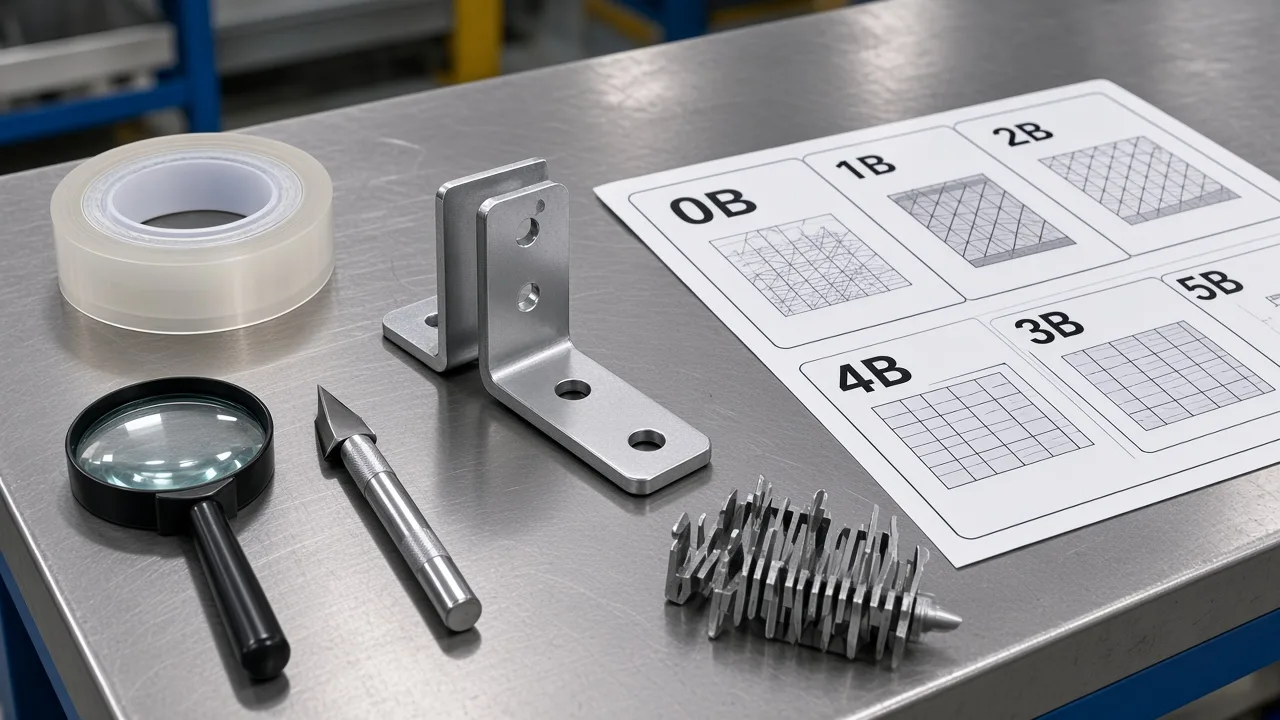
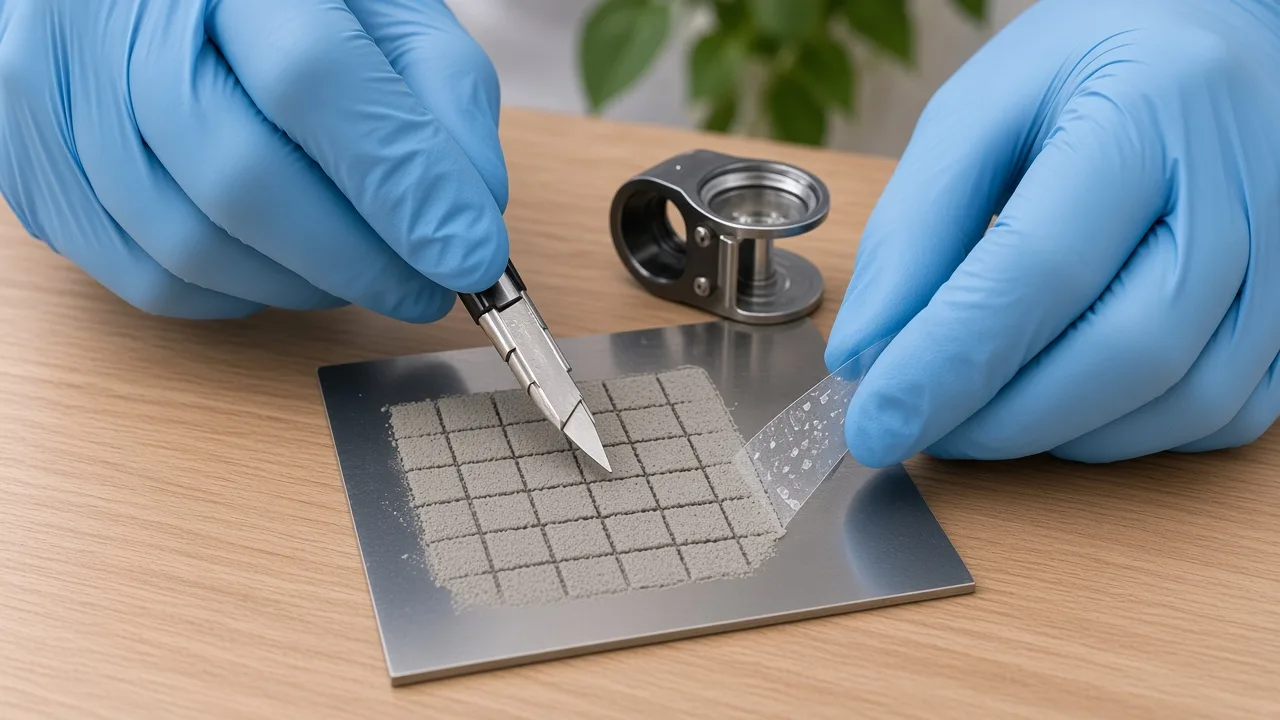
Quality teams who treat the powder coat cross hatch test as a one-time PPAP photo inherit field peels that never fail cosmetic AQL. This article freezes buyer and OEM IQC language for cross-hatch (cross-cut) adhesion on powder-coated bathroom and kitchen hardware—method choice, blade and tape control, zone maps, grading photos, and disposition—so every lot uses the same steps.
It is deliberately complementary to powder science pillars, humid-bathroom coating controls, and visual defect catalogs. Those pages explain process and defect names. This page is the method execution post for IQC. Photos are generic. Koitor Hardware supports powder-coated storage hardware programs from Jiangmen, China, with practical lab-instruction language for importers and private-label teams.
In this guide
- Why Powder Coat Cross Hatch Test Belongs in IQC, Not Only Lab Brochures
- How to Freeze Powder Coat Cross Hatch Test CTQs
- 8 Essential IQC Steps for Powder Coat Cross Hatch Test
- Accept, Rework, or Reject: Cross-Hatch Disposition
- RFQ Checklist Language for Method, Tape, and Grades
- FAQ
- Send Your Spec
Why Powder Coat Cross Hatch Test Belongs in IQC, Not Only Lab Brochures
Factories that treat the powder coat cross hatch test as a brochure photo inherit lot peels that never appear on cosmetic AQL sheets.
Cross-hatch (cross-cut) adhesion is a method post: how to cut, tape, pull, grade, and retain evidence. It complements coating science pillars and defect catalogs without rewriting them.
Bathroom wire and accessory buyers need powder coat cross hatch test language that IQC can run on coupons and selected production zones every lot—not only during PPAP.
Freezing method details stops supplier–buyer arguments about “our lab got 5B / your lab got 3B.”
How to Freeze Powder Coat Cross Hatch Test CTQs
Start powder coat cross hatch test with method standard, spacing/blade count, tape identity, dwell, pull angle, min classification, zones, and photo retain rules.
State whether tests run on dedicated coupons, sacrificial production parts, or both. Wire OD testing needs adapted technique notes.
Link but do not duplicate process pillars: powder coating science, humid bathroom powder coating, and powder coated shower caddy defects.
Primary external method references: ASTM D3359 und ISO 2409. Pick one as PO primary.
8 Essential IQC Steps for Powder Coat Cross Hatch Test
Eight steps keep every powder coat cross hatch test run auditable.
Do not cross-hatch undercured parts as a color check. Note DFT map reference beside adhesion.
Flat, edge, weld, Faraday interior—follow the map. Random easy flats fake confidence.
Blade change schedule is part of powder coat cross hatch test control. Dull blades leave bridges that look like 5B.
Before tape, document the cut. Photos settle disputes.
Freeze tape brand/type. Dwell too short or too long changes grades.
Yank angle variation is a common lab-to-lab gap.
Record class per zone. Attach after-pull photo.
Sign accept/rework/reject per frozen class rules. Retain tape and coupon per powder coat cross hatch test retention policy.
Accept when all required zones meet min class for the this adhesion method RFQ.
Rework means strip/re-pretreat/recoat with full re-test—not spot touch-up over failed lattice.
Reject when any critical zone falls below hard class, or when peel is already visible before cutting.
If labs disagree, audit tape, blade, pull angle, and lighting before changing the product.
This adhesion method blanks: standard ASTM D3359 Method __ / ISO 2409. Spacing ______. Tape ______. Dwell ______. Pull ______. Min class ______. Zones ______. Coupon policy ______. Photo retain ______. Retention days ______.
Lot sheet must show operator, blade lot/change, tape lot, classes by zone, and disposition signature.
Train new inspectors with a graded photo board before they sign live this adhesion method lots.
Multi-blade cutters speed flats; single knives may be needed on wire OD—document both.
Humidity conditioning before this adhesion method is optional but powerful for wet-room SKUs—state if required.
Accept, Rework, or Reject: Cross-Hatch Disposition
RFQ Checklist Language for Method, Tape, and Grades
Never reuse tape squares; adhesive pickup changes.
Dual plants must exchange physical grade boards for this adhesion method, not only PDFs.
Track cross-hatch fail PPM separately from orange-peel cosmetic PPM.
Oven profile changes require immediate this adhesion method re-FA.
Undercure can show as cohesive film tear that looks like adhesion fail—pair with cure checks.
Keep failed tapes in zip bags labeled with lot for this adhesion method MRB reviews.
Do not perform cross-hatch on the only marketing sample without a plan to refinish or scrap.
For matte black, loupe lighting angle matters—standardize lamps in the this adhesion method work instruction.
Coordinate with color IQC so adhesion coupons are not confused with ΔE masters.
Wire baskets: specify whether this adhesion method is on witness coupons coated on the same rack or on cut wires.
Third-party quotes must include your tape and class limits or results are not comparable.
Safety: cut-resistant gloves and eye protection belong in the this adhesion method WI.
Audit weekly: dull blades and expired tape are the top silent variables.
When grades sit on the 4B/3B border, require second inspector confirmation for this adhesion method release.
Link MRB actions to pretreatment audits when edge zones fail repeatedly.
Publish the classification chart at the bench—memory grading destroys this adhesion method integrity.
Close the loop: field peel returns should trigger a method audit, not only a supplier scolding.
Record DFT context beside each cross-hatch zone using practice consistent with ASTM D7091 so under-film thickness is visible in the same lot sheet.
Write change-control so chemistry, tooling, or bake edits cannot ship without a signed first-article pack.
Keep a sealed master and a working reference; replace working references on a calendar before they scuff into false fails.
Train inspectors with photo boards of borderline cases so two shifts grade the same way on Monday and Friday.
Separate cosmetic AQL language from method CTQs on the disposition sheet so teams do not waive the wrong gate.
Dual-source programs must exchange physical masters and gauges, not only PDF drawings, before the second plant ships.
Remote approvals need overnighted coupons or sealed masters; video calls under mixed room light are not lot release.
Scorecards should track finish or fit PPM separately from weld PPM so capital goes to the line that actually fails.
Packaging teams must not create scuffs that receiving later blames on finish or adhesion—align PE and separator notes.
First-article packages without photos, instrument IDs, and signatures create “we thought it was approved” disputes.
Seasonal rush cannot skip method checks; gauge capacity and lab time belong in the capacity plan with weld hours.
Field returns should trigger a method audit checklist, not only a supplier email, when the same fail repeats.
Marketing photography should use the same lighting mood as acceptance masters so catalogs do not oversell finish.
IFU warnings about cleaners and misuse protect both the buyer and the factory when returns arrive months later.
Retention policies for masters, tapes, and coupons need days and owners named—orphaned evidence helps no one.
Third-party labs require your exact method recipe in the PO; otherwise their grades are not comparable to yours.
Write change-control so chemistry, tooling, or bake edits cannot ship without a signed first-article pack.
Keep a sealed master and a working reference; replace working references on a calendar before they scuff into false fails.
Train inspectors with photo boards of borderline cases so two shifts grade the same way on Monday and Friday.
Separate cosmetic AQL language from method CTQs on the disposition sheet so teams do not waive the wrong gate.
Dual-source programs must exchange physical masters and gauges, not only PDF drawings, before the second plant ships.
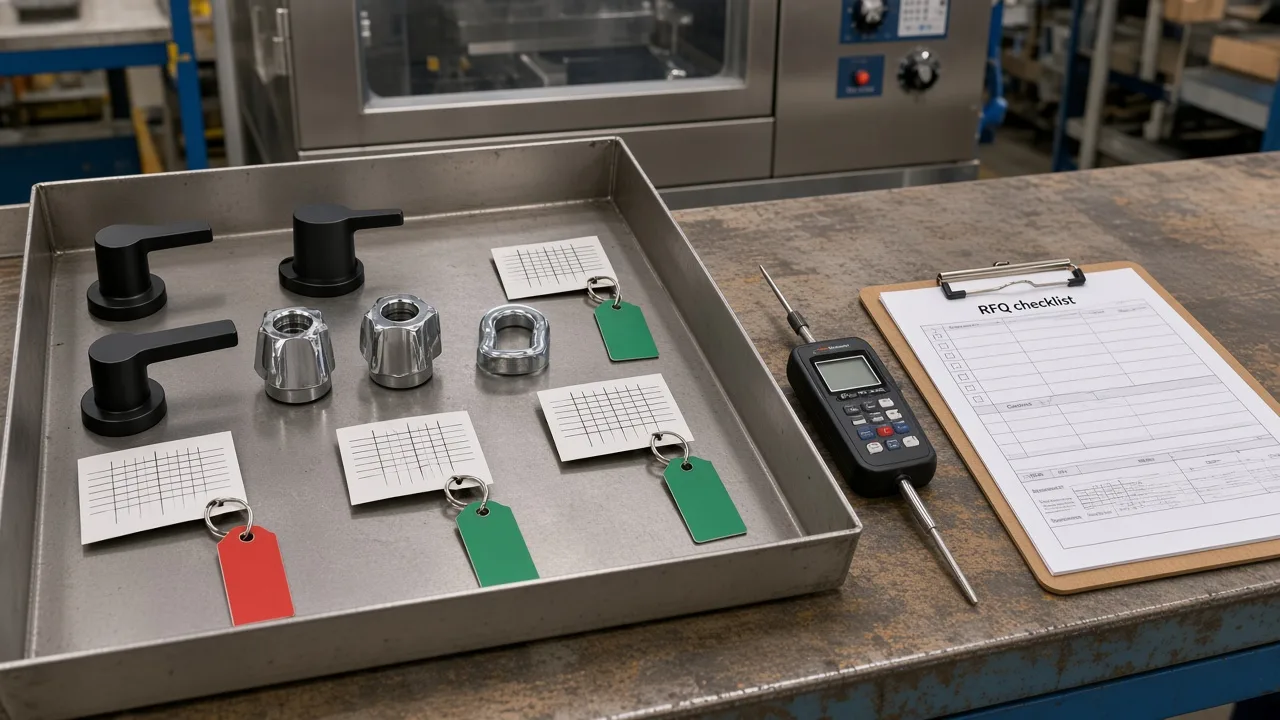
Third-party labs need your spacing and tape brand in the PO or their Class numbers are not yours. Keep owners named on the same page as the numeric CTQ.
Link cross-hatch frequency to risk: wet-room and outdoor SKUs need higher sample rates than dry décor. Keep owners named on the same page as the numeric CTQ.
Store cutters and tape in controlled cabinets; shop-floor heat ruins tape consistency. Keep owners named on the same page as the numeric CTQ.
Publish disposition rules: which Class fails the lot, which triggers rework, which is watch-and-trend. Keep owners named on the same page as the numeric CTQ.
Publish the exact ASTM D3359 procedure version, spacing, and tape on the IQC sheet before the first mass lot. Keep owners named on the same page as the numeric CTQ.
Cross-hatch is a method, not a vibe; photo the lattice next to a grade card every time. Keep owners named on the same page as the numeric CTQ.
Train operators on cutting force; deep cuts into soft substrate create false low grades. Keep owners named on the same page as the numeric CTQ.
Calibrate lighting for photo retention so gray powders and black powders read equally. Keep owners named on the same page as the numeric CTQ.
Use the same tape lot across shifts; adhesive strength drift changes grades without chemistry change. Keep owners named on the same page as the numeric CTQ.
Record dwell time and peel angle; “quick peel” and “slow peel” are different tests in disguise. Keep owners named on the same page as the numeric CTQ.
Edge lattices and flat lattices can diverge—state which locations are mandatory per SKU. Keep owners named on the same page as the numeric CTQ.
First-article packs without cross-hatch photos are incomplete even when thickness is perfect. Keep owners named on the same page as the numeric CTQ.
Dual plants must exchange graded photo boards quarterly so Class language stays aligned. Keep owners named on the same page as the numeric CTQ.
Do not waive adhesion because gloss or ΔE passed; those CTQs answer different failure modes. Keep owners named on the same page as the numeric CTQ.
Humidity and temperature at test time belong on the lot record next to the grade. Keep owners named on the same page as the numeric CTQ.
Reworked parts need a fresh lattice after re-bake; old cuts do not prove the new cure. Keep owners named on the same page as the numeric CTQ.
CAPA for peel returns should start with method audit before chemistry blame. Keep owners named on the same page as the numeric CTQ.
ISTA damage that scrapes coating is not an adhesion fail; keep categories separate on scorecards. Keep owners named on the same page as the numeric CTQ.
Buyer audits love method discipline; keep cutter blades replaced on a calendar with serial logs. Keep owners named on the same page as the numeric CTQ.
Matte textures can hide lift until tape pulls—use raking light during grading. Keep owners named on the same page as the numeric CTQ.
Third-party labs need your spacing and tape brand in the PO or their Class numbers are not yours. Keep owners named on the same page as the numeric CTQ.
Link cross-hatch frequency to risk: wet-room and outdoor SKUs need higher sample rates than dry décor. Keep owners named on the same page as the numeric CTQ.
Store cutters and tape in controlled cabinets; shop-floor heat ruins tape consistency. Keep owners named on the same page as the numeric CTQ.
Publish disposition rules: which Class fails the lot, which triggers rework, which is watch-and-trend. Keep owners named on the same page as the numeric CTQ.
Publish the exact ASTM D3359 procedure version, spacing, and tape on the IQC sheet before the first mass lot. Keep owners named on the same page as the numeric CTQ.
Cross-hatch is a method, not a vibe; photo the lattice next to a grade card every time. Keep owners named on the same page as the numeric CTQ.
Train operators on cutting force; deep cuts into soft substrate create false low grades. Keep owners named on the same page as the numeric CTQ.
Calibrate lighting for photo retention so gray powders and black powders read equally. Keep owners named on the same page as the numeric CTQ.
Use the same tape lot across shifts; adhesive strength drift changes grades without chemistry change. Keep owners named on the same page as the numeric CTQ.
Record dwell time and peel angle; “quick peel” and “slow peel” are different tests in disguise. Keep owners named on the same page as the numeric CTQ.
FAQ: Powder Coat Cross Hatch Test
Is cross hatch the same as pencil hardness?
No. Hardness ≠ adhesion. Keep this adhesion method separate from hardness CTQs.
Method A vs B in ASTM D3359?
Follow thickness guidance in the standard; freeze the choice in the PO.
Can IQC skip photos?
No. Photos are part of evidence for buyer disputes.
How often per lot?
Define sampling—commonly each powder lot / shift / AQL pull. Write the number.
How does this relate to coating pillars?
Complementary method post; pillars cover process/defects; this freezes IQC execution.
Send Your Powder Coat Cross Hatch Test Spec for Review
If you are freezing this adhesion method work instructions, send your current method notes and min grades. We can help align them to ASTM/ISO buyer language before mass PO.
Contact Koitor Hardware via the contact page or email simon@koitorhardware.com. Factory support is based in Jiangmen, China.
OEM / EIGENE MARKE
Verwandeln Sie diesen Beschaffungsleitfaden in ein Produktdossier
Teilen Sie uns Ihr Zielprodukt, die Größe, die Oberflächenausführung, die Bestellmenge und Ihre Verpackungsanforderungen mit. Ihr Team erhält vor der Angebotserstellung eine praxisorientierte Prüfung der Herstellbarkeit.
 English
 Español
 Português
 Français
 Deutsch
 العربية