
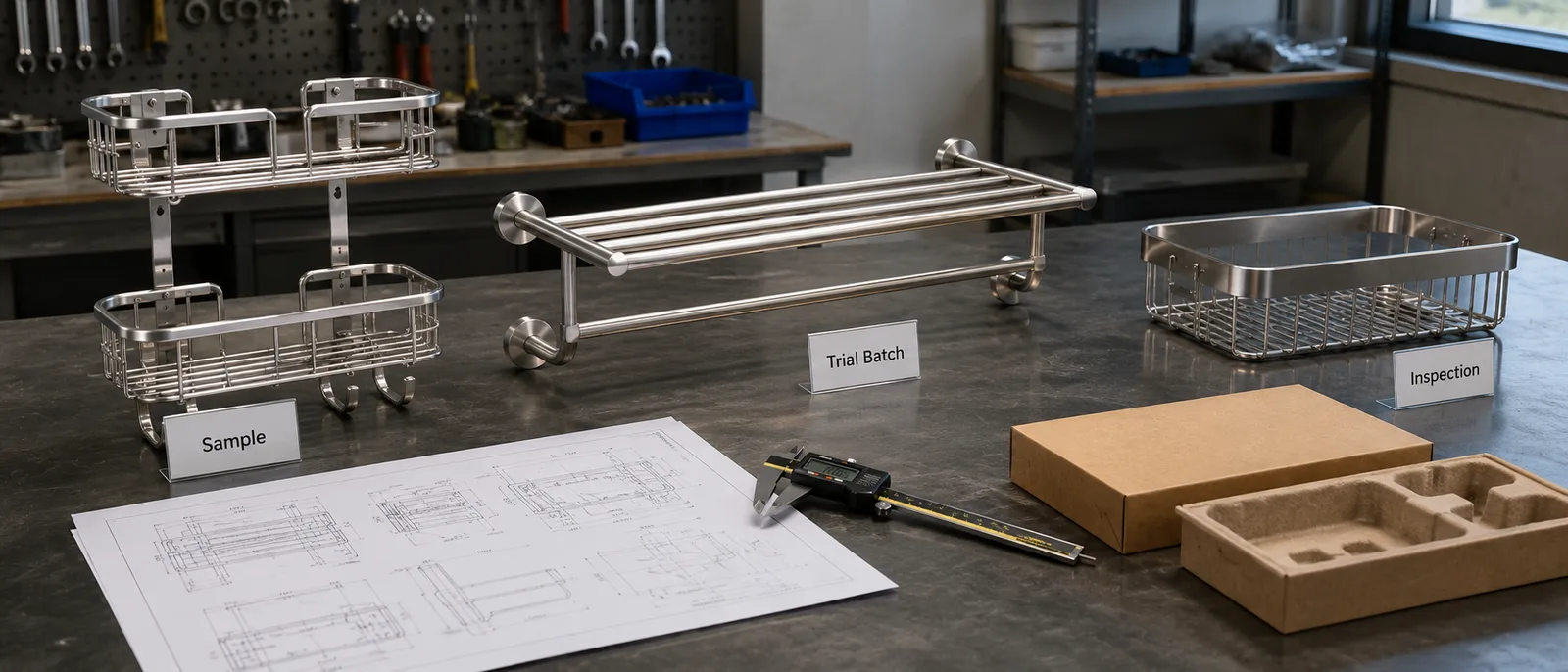
A practical process to test new bathroom hardware supplier candidates is to approve a representative sample first, place a controlled trial order with written specifications, inspect production consistency and packaging, and compare the result against pre-agreed acceptance criteria. The goal is not merely to receive a good sample. A useful trial order shows whether the supplier can repeat the approved construction, finish, assembly and packing method across a commercial batch while communicating problems clearly.
The trial should be large enough to expose repeatability and packing risks but limited enough to control commercial exposure. Product complexity, finish, tooling, packaging and material availability all affect a practical quantity. A low MOQ trial order can reduce risk, but only when the buyer records what is being tested and how approval will be decided.
How Should an Importer Structure a Bathroom Hardware Trial Order?
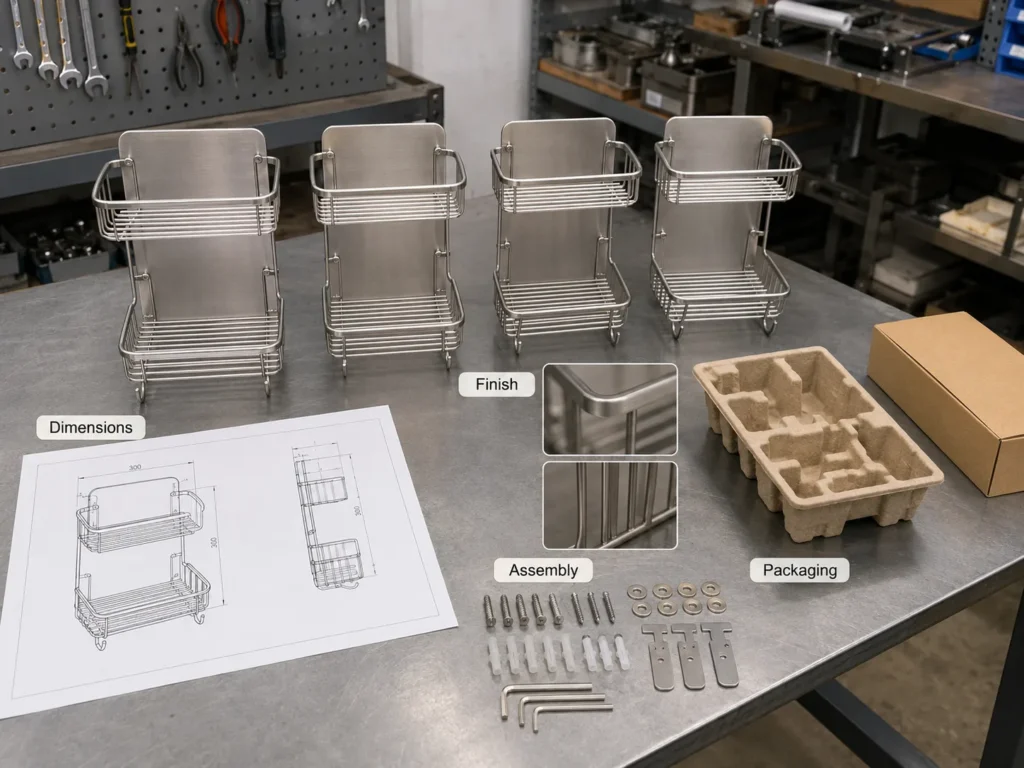
An importer should structure the trial around one defined product, one approved specification and a short list of measurable supplier risks. Mixing too many new products, finishes and packaging formats into the first order makes it difficult to identify why a problem occurred.
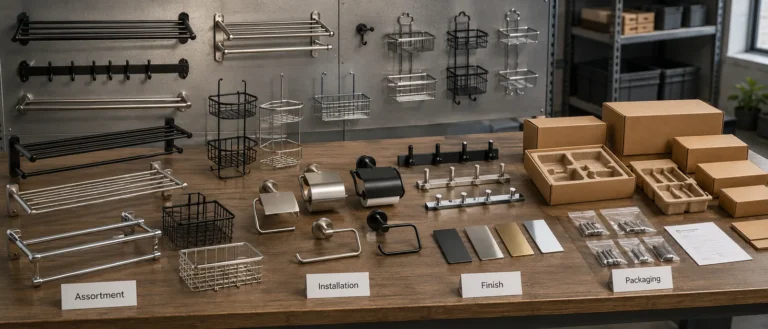
Start with a representative item. A wall-mounted shower caddy may test wire bending, welding, mounting dimensions, finish coverage and moisture-related design concerns. A towel rack may test tube alignment, bracket geometry, polishing or coating appearance, assembly and protective packing. Choose a product that reflects the processes the supplier may later handle for the wider range.
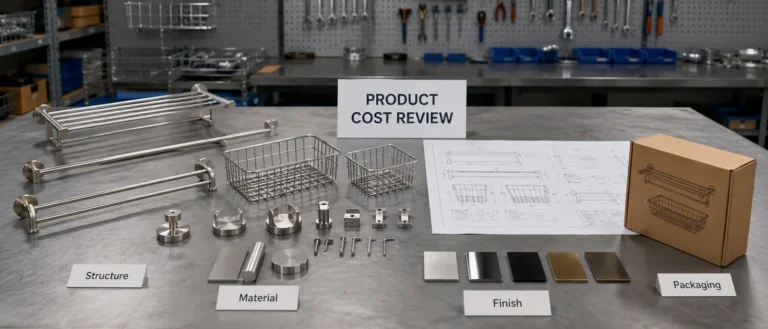
Freeze the approved reference before issuing the purchase order. The reference can include a signed drawing, approved physical sample, material description, key dimensions and tolerances, finish sample, mounting components, logo artwork, instruction file and packaging layout. Revision numbers and dates help prevent an old drawing from being used.
Define the purpose of the order in writing. One trial may test product repeatability; another may test retail packaging, carton efficiency or communication during a deadline. Keep the number of unknowns manageable. Buyers exploring custom bathroom hardware manufacturing should identify the processes and interfaces that matter most before requesting samples.
Set a Decision Before Production Starts
Write down what will happen after inspection. The possible decisions might be approve for a larger order, approve after corrective action, repeat a limited trial or stop development. This prevents urgency, sunk cost or personal impressions from replacing evidence when the goods arrive.
What Should Be Evaluated Before Placing the Trial Purchase Order?
Before placing the order, buyers should evaluate whether the supplier understands the product, identifies missing information and can convert the brief into a controlled manufacturing reference. To test new bathroom hardware supplier capabilities fairly, the buyer should send the same complete brief and use the same review criteria. A fast quotation is useful, but question quality is often more revealing than response speed alone.
- Product interpretation: Does the quotation match the requested size, structure, material, finish and packaging?
- Drawing control: Are dimensions, mounting centers, component interfaces and revision numbers clear?
- Sample evaluation: Does the sample match the approved structure, appearance and intended use?
- Manufacturing discussion: Does the supplier explain practical effects of wire diameter, tube size, welding position, polishing or powder coating?
- Commercial clarity: Are tooling, unit price, MOQ, sample charges, packaging and shipping terms separated?
- Timing assumptions: Does the schedule state when material, finish, packaging and artwork must be confirmed?
- Change handling: Is there a written method for approving substitutions or specification changes?
A supplier sample evaluation should include functional use, not appearance alone. Assemble the item using the intended hardware, place it against a representative wall or fixture, check contact points and use suitable test items. Any load or durability requirement should be defined and confirmed for the specific project rather than assumed from appearance.
For private-label programs, artwork and pack contents deserve the same control as the metal product. Buyers can review private-label bathroom accessories development when planning product, instruction and packaging requirements together.
How Do Samples, Trial Orders and Larger Orders Compare?
Samples, trial orders and larger orders answer different sourcing questions. A sample tests whether the concept can be made; a trial order tests repeatability and order execution; a larger order tests sustained control at the intended commercial scale.
| Stage | Main question | What to evaluate | What it cannot prove alone |
|---|---|---|---|
| Development sample | Can the design be manufactured? | Dimensions, fit, structure, finish direction, assembly and packaging concept | Batch consistency, production control or carton performance |
| Controlled trial order | Can the supplier repeat the approved reference? | Variation, workmanship, pack completeness, labeling, schedule and communication | Long-term capacity or performance across every future SKU |
| Larger commercial order | Can control continue at planned volume? | Incoming materials, in-process control, final inspection, carton consistency and delivery coordination | Automatic approval of new designs, finishes or packaging |
Do not treat the development sample as a miniature purchase order. It may receive extra manual attention and may use a limited process route. Ask which sample details will remain the same in production and which may change when fixtures, batch finishing or production packaging are introduced.
Koitor Hardware notes that trial quantities can start from around 100 pieces for some projects, depending on product structure, material, finish and packaging. Samples usually take about 5-7 working days after details are confirmed, while bulk production often takes about 4-6 weeks depending on quantity, complexity, material availability, finish and packaging. These are planning references, not fixed promises for every item.
How Should Buyers Inspect a Trial Order of Bathroom Accessories?
Buyers should inspect a trial order against the approved reference using a consistent checklist, representative sample selection and written records. The inspection should cover product identity, dimensions, workmanship, assembly, finish, accessories, labeling and packaging.
- Verify identity and quantity. Match the item code, revision, finish, pack count and carton markings to the purchase order.
- Check critical dimensions. Measure mounting centers, overall size, shelf spacing, bracket interfaces or other dimensions that affect installation and use.
- Review structure and workmanship. Look for alignment, wobble, sharp edges, incomplete or rough weld areas, grinding marks and component fit.
- Compare finish appearance. Review color, gloss, polishing direction, visible coverage and consistency under stable lighting. Acceptance should follow the approved sample or agreed reference.
- Assemble representative units. Confirm screws, anchors, caps, brackets and instructions are present and compatible. Do not approve only unopened units.
- Review packaging protection. Check product separation, contact points, loose hardware control, carton fit and whether visible surfaces can rub during transport.
- Record findings by type. Separate critical functional issues, major commercial issues and minor appearance observations using buyer-defined criteria.
Photographs should show the full product, the close-up issue, measurement method and packaging location. Record how many units were inspected and how many showed each issue. A statement such as “finish inconsistent” is difficult to investigate; a photo and count tied to a location and reference sample are more useful.
A trial is also a documentation test. Confirm that the supplier can maintain an approved drawing, finish reference, bill of packing components and artwork revision. Koitor Hardware, a family-owned custom metal hardware factory, can review welding points, finish, assembly and packaging with the buyer before trial production. This direct discussion helps make inspection criteria more specific.
How Can Importers Judge Communication and Corrective Action?
Importers should judge communication by accuracy, traceability and problem ownership rather than message volume. A reliable response identifies the affected requirement, explains what is known, asks for missing evidence and proposes a dated next step.
During the trial, keep a short issue log with the date, owner, evidence, decision and closure status. If the supplier proposes a material, component or process change, require approval before use. A verbal promise should not replace an updated drawing, sample or written specification.
When a defect appears, the first answer may be incomplete. The more important test is whether the supplier contains the issue, checks remaining stock, investigates the process and presents a corrective action that can be verified. “Workers will pay more attention” is not a complete control. A stronger response identifies the process point, adjustment, inspection method and responsible person.
Evaluate commercial behavior as well. Did the supplier disclose a timing risk early? Were additional charges explained before work started? Did shipment details match the agreed method? These points affect landed cost and launch planning even when product quality is acceptable.
What Common Mistakes Make a Supplier Trial Less Useful?
A supplier trial becomes less useful when the buyer changes many variables, leaves approval criteria vague or rushes from one good sample to a large order. The following mistakes can hide risk instead of reducing it.
- Choosing only by unit price: A low quotation may exclude packaging, accessories, finish requirements or inspection work.
- Testing too many SKUs: Multiple structures and finishes create too many causes when results vary.
- Approving photographs only: Images cannot fully confirm dimensions, fit, stability, surface feel or packaging protection.
- Using an uncontrolled reference: An undated sample or drawing makes later disputes difficult to resolve.
- Ignoring mounting hardware: A rack can look acceptable while supplied screws, anchors or brackets do not fit the product or target installation.
- Leaving packaging until the end: Inner protection, pack count and carton size can affect both damage risk and landed cost.
- Changing requirements during production: Late changes confuse responsibility and prevent a fair assessment of the original specification.
- Scaling before closure: Open issues from a trial should have documented dispositions before a larger purchase order.
The buyer should also avoid universal conclusions. Passing one powder-coated basket trial does not automatically qualify the supplier for polished stainless towel racks, no-drill mounting systems or complex retail kits. Validation should expand process by process and product family by product family. More sourcing guidance is available in the Koitor hardware sourcing resources.
What Should Be on the Final Supplier Trial Checklist?
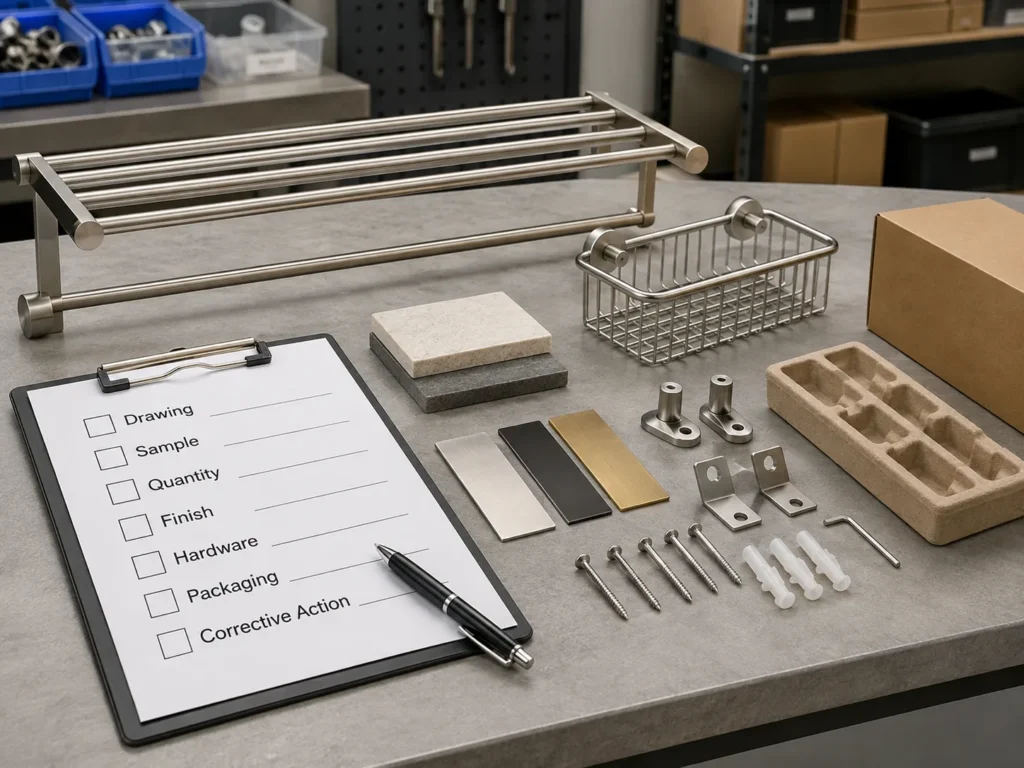
The final checklist should connect the buyer brief, approved sample, purchase order, inspection result and next-order decision. Importers who test new bathroom hardware supplier performance should use a checklist short enough to follow but specific enough that another team member can understand why the supplier passed, needs correction or should not proceed.
- One clearly identified product and intended sales channel
- Approved drawing or physical reference with revision date
- Confirmed material, structure, dimensions and finish reference
- Confirmed mounting hardware, accessories and assembly method
- Trial quantity chosen for the product and process risk
- Written unit price, tooling, packaging, payment and shipping terms
- Production schedule with confirmation dependencies
- Inspection criteria and representative sample plan
- Packaging layout, inner protection, labels and carton markings
- Issue log with photos, counts, owners and closure decisions
- Corrective actions verified before repeat or larger production
- Final decision: approve, conditionally approve, repeat trial or stop
A simple weighted score can support the decision, but it should not hide a serious functional problem. Buyers might score specification control, batch consistency, packaging, timing, communication and corrective action, then apply a separate mandatory stop for critical issues. Keep the scorecard stable across suppliers so comparisons remain meaningful.
Preguntas frecuentes
What is a trial order for bathroom accessories?
A trial order is a controlled commercial batch used after sample approval to evaluate production repeatability, workmanship, finish, packaging, documentation, timing and supplier communication. It is more informative than a single sample but does not qualify every future product automatically.
How many pieces should a low MOQ trial order include?
The quantity depends on product structure, material, finish, tooling, packaging and the manufacturing risk being tested. Koitor projects can start from around 100 pieces in some cases, but the suitable quantity should be confirmed for the specific product rather than treated as a universal MOQ.
Should an importer order a sample before the trial order?
Yes. A sample normally establishes the approved design, dimensions, finish direction, assembly and packaging concept. The later trial order then checks whether those approved details can be repeated across a batch.
Can a supplier be approved after one successful trial?
A successful trial can support approval for the tested product and process under defined conditions. New materials, finishes, structures, mounting systems or packaging formats may require additional validation because they introduce different risks.
What information should be sent when requesting a trial quotation?
Send a drawing or physical sample, target dimensions, material and finish preference, expected quantity, packaging idea, target market, required accessories, artwork needs and desired schedule. Clearly mark any details that are still open for supplier review.
Trabaja con Koitor Hardware
Planning a Controlled Bathroom Hardware Trial Order?
Send Koitor your drawing, physical sample, finish target, packaging idea and expected trial quantity. Our team can review the structure, manufacturing details, sample plan and small-batch production options before quotation.
OEM / MARCA BLANCA
Convierte esta guía de abastecimiento en un resumen del producto
Indícanos el producto que deseas, el tamaño, el acabado, la cantidad del pedido y los requisitos de embalaje. Tu equipo recibirá un análisis práctico de la viabilidad de fabricación antes de recibir el presupuesto.
 English
  Español