
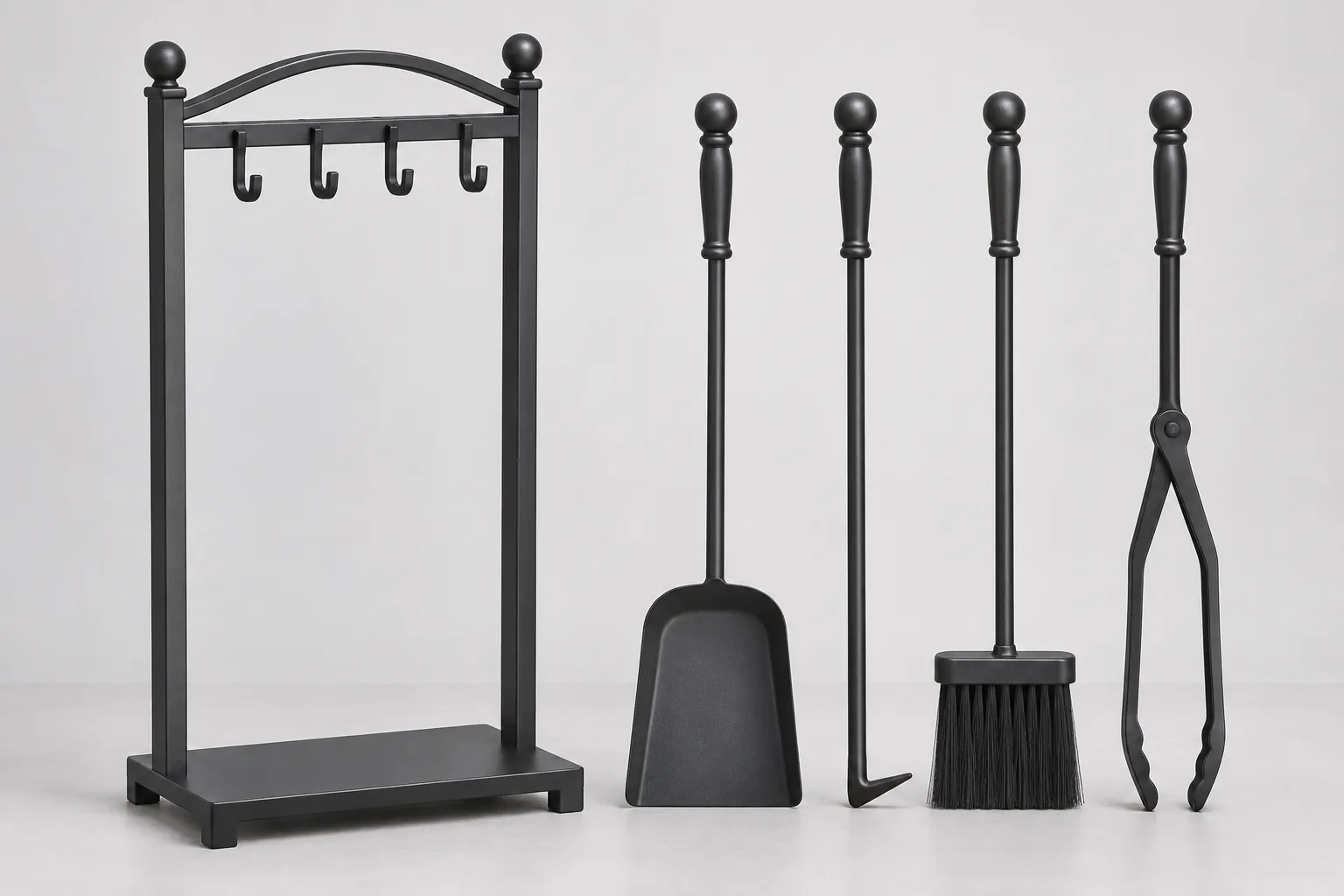
Fireplace tool stand specification should identify the actual tools, the supplied stand variant, and the support point for each tool before a buyer approves a complete set or replacement stand. A set’s advertised piece count may include the stand, while another version may include a different number of tools or a distinct attachment feature. Importers should tie every tool to a named hook, rest, or other documented support and observe individual retrieval on the intended sample. This fit review does not approve fire use, hot-tool handling, tipping resistance, or a safety distance.
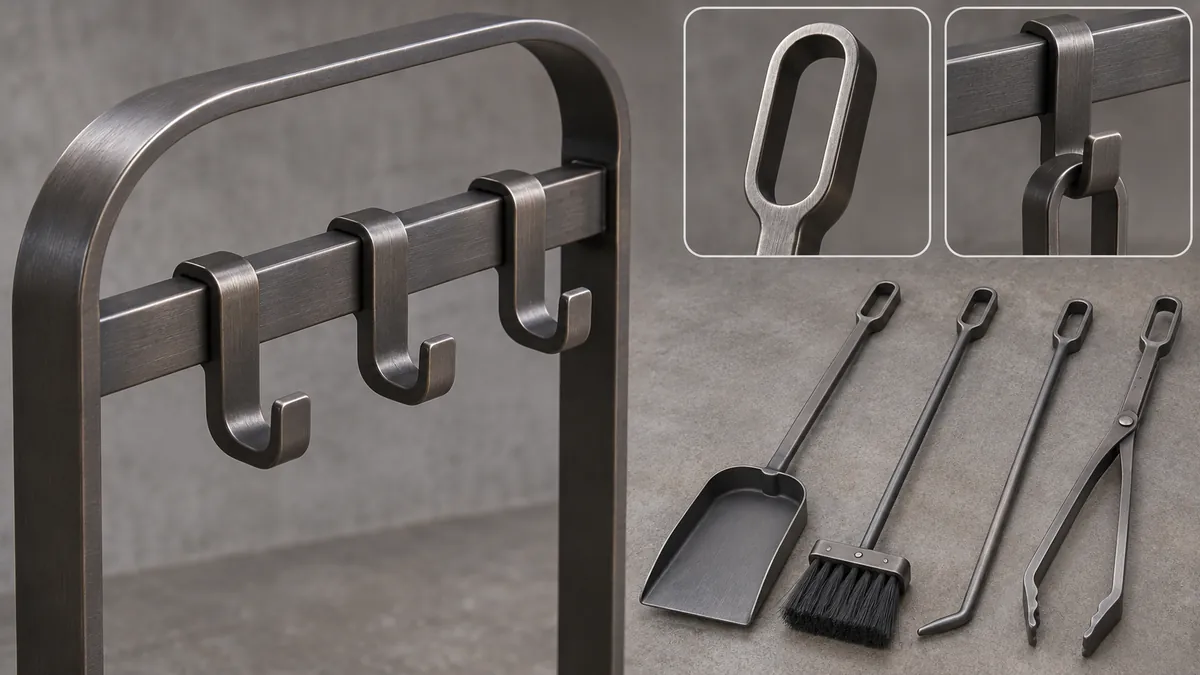
What does a fireplace tool stand specification need to identify?
A product family can include a complete fireside set, a stand sold separately, replacement tools, or variations in handle and support design. Those options may share a style while differing in piece count, contact feature, finish, footprint, or inclusion status. If a distributor orders by a generic name alone, the quote may leave unanswered whether the stand is part of the set, which tools are included, and which tool-to-stand pairings were approved.
Primary product listings demonstrate this variation: one manufacturer sells a model-specific replacement stand separately from its associated tool set. Another product page describes a magnetic attachment between certain tools and a stand, while the selected product variant and its piece count must be read carefully. These are source-specific examples, not an industry standard or a design to reproduce. They do not show that all fireplace tools use magnets, that different brands are compatible, or that Koitor makes any such product. A useful fireplace tool stand specification records the set variant and each tool-to-support pairing on the same approval sheet.
For a buyer, the important unit of review is the configured SKU: exact stand model and revision, the tools included, their quantities, and the location where each one rests or hangs. A product photograph can show a plausible arrangement, but it does not establish that all variants ship with the same accessories. The controlled BOM, quotation, carton contents, and approved sample should use the same identity.
What should the quotation and BOM identify?
Record whether the order is for a complete set, stand only, individual tools, or a replacement kit. If a piece count is shown, define whether that count includes the stand, each tool, mounting hardware, and any accessory. Use a row per tool type and a separate row for the stand. Assign a unique buyer or supplier part reference to each component and record the approved revision.
For each tool, capture the actual mating feature: a loop, eye, hook, neck, magnetic surface, or another design documented by the supplier. Then identify the corresponding support on the stand and show the pairing in a drawing, photograph, or sample record. Do not infer that two pieces mate because they look alike. If the parts come from different suppliers, name the responsible source for interface dimensions and compatibility confirmation.
Record the tool’s overall length and the envelope of its handle or head where those features affect storage. Add the stand’s support position, floor/base clearance, neighboring-tool space, and removal path. A broad shovel head may occupy more room than a narrow poker, for example, but a buyer should use the actual reference rather than generalizing from the tool category. Leave dimensions blank or marked “supplier confirmation required” when no controlled source exists.
The buyer should also list included assembly hardware, instructions, finish, packaging, and private-label requirements. A replacement stand should be tied to the exact tool set or revision it supports. If the manufacturer has not documented cross-model fit, classify it as unconfirmed instead of marketing it as a universal replacement.
| Record field | Buyer should identify | Why it matters |
|---|---|---|
| Order scope | Complete set, stand only, tool only, or replacement kit | Prevents piece-count ambiguity |
| SKU variant | Model, finish, revision, and selected option | Connects the quote to the approved product |
| Component list | Tool identity and quantity per set | Defines the actual BOM |
| Mating feature | Tool attachment and matching stand support | Shows the intended interface |
| Storage envelope | Tool length/head area, base clearance, neighbors | Supports an observable fit review |
| Replacement mapping | Compatible stand and named set revisions | Avoids unsubstantiated cross-model claims |
| Pack contents | Stand, tools, hardware, instructions, packaging | Aligns warehouse and customer-facing descriptions |

How should an importer review the physical sample?
Ask for a sample that matches the selected set and quotation. Confirm the stand revision and each tool’s identity before reviewing the interface. Place each tool in its assigned position following the product maker’s current instructions, then observe whether the tool rests or hangs as intended and whether it can be removed and returned independently. If the manufacturer’s instructions are not available, request them rather than inventing an assembly sequence.
Review the stand both fully occupied and with selected tools removed. A tool that fits alone may be obstructed by a neighboring handle or head when the complete set is arranged. Check whether a long tool contacts the floor or base and whether a wide head blocks another tool’s retrieval path. Record the observed layout and any exceptions. Do not use heated tools or conduct a fireplace-use demonstration as part of a storage-fit review.
The sample should be linked to an approved drawing or BOM. Photograph the stand and all supplied components together, then take closer views of each support pair. If the buyer expects a replacement stand to accept a previously purchased tool set, use the actual reference set or documented dimensions and label the scope. Similar style or brand family does not prove mating compatibility.
A successful sample establishes only the observed configuration under the review conditions. It does not prove tipping resistance, structural capacity, long-term retention, heat resistance, finish life, or safe operation near a fire. Those are separate product and site questions that require competent ownership and appropriate evidence. A stand intended for indoor storage should be described as such unless a broader use has been qualified by the responsible manufacturer.
What do hooks, rests, and magnetic features change?
Support architecture affects both fit and retrieval. A hook may require a matching loop or eye; a rest may depend on a defined tool neck or handle shape; a magnetic feature depends on the components and materials specified by its maker. The buyer should not assume that every item in a set uses the same attachment principle. Document the actual feature for each pair and seek supplier drawings when the mating geometry is not visible.
If the product uses a magnet, confirm whether it is part of the offered SKU and which tool or stand component contains it. Do not claim a specific retention force, magnetic strength, or compatibility with unlisted materials without evidence. If the stand uses hooks, verify the intended opening and tool feature from controlled information, not from a photo zoom. For any moving or removable support, request the responsible supplier’s assembly and care guidance.
Finish and material are separate from the mechanical fit. A dark coating or polished surface in an image does not identify a material grade, corrosion performance, temperature capability, or cleaning method. Obtain the actual material and finish specification from the product owner. The test scope should match the intended indoor storage conditions, and any fire-adjacent performance claim needs qualified, product-specific support.
Replacement compatibility deserves its own line item. The exact stand model may be offered alone as a service part, but a matching brand name is not enough to establish that it supports every tool set from that brand. Capture the named set, stand revision, and supported component list. If a supplier permits substitutions, record the approved alternative and how the sample or documentation supports it.
Which product claims should remain out of a fit article?
Do not infer fire safety, heat resistance, ember containment, or safe clearance from a stand’s appearance or material description. This article is about stored-tool identity and fit. It does not instruct readers how to tend a fire, dispose of ash, handle hot tools, or install a fireplace product. Any use and thermal limitations must come from the responsible manufacturer and applicable qualified project review.
Likewise, do not assume a heavy-looking base is tip resistant or that a metal stand has a particular load capacity. A visual review cannot establish a structural rating or support every tool combination. If these claims matter to retail release, define the product-specific evidence and person responsible for approval.
Avoid labeling a replacement stand as universal. A product-specific replacement listing shows that a stand can be sold independently; it does not show cross-brand or cross-model fit. Name the supported set and revision, or say that compatibility has not been confirmed. Keep product descriptions, spare part codes, and packaging consistent with that limited claim.
When a tool handle, head, magnetic part, support, finish, or stand geometry changes, review whether the prior sample still represents the released SKU. Update the part list and replacement mapping. Do not preserve an old fit claim automatically when a component revision changes the mating feature.
How should a sourcing team discuss an OEM possibility?
Koitor Hardware is a family-owned custom metal hardware manufacturer specializing in bathroom and home storage hardware. Current fireplace-tool stand production, functional fireplace tools, wood or leather components, magnet supply, heat-resistant finishes, and fire-related testing are not confirmed. A buyer should treat this topic as an adjacent metal-storage concept and request feasibility confirmation before assuming it is an available Koitor product.
For a project inquiry, provide a lawful stand drawing or concept, the actual tool references, the intended complete-set or stand-only scope, finish expectations, packaging, and the supplier responsibilities for bought-in components. Ask which metal frame, joining, finishing, assembly, and packaging tasks are within confirmed scope. Identify who owns the tool-to-support fit and any use-related claims. This makes the RFQ clear without implying the metal supplier has qualified a full fireplace system.
The existing metal firewood rack guide concerns log dimensions and firewood storage, not tool-to-stand pairings. A broom and mop holder guide addresses a wall-mounted radial grip, not a floor stand with a defined tool set. These pages can provide adjacent context, but they should not be used to infer fireplace product capability. For general project scope, see Koitor’s OEM home storage hardware information and confirm each proposed product route directly.
What should buyers include before requesting a quote?
- The selected stand model, revision, finish, and intended indoor storage use.
- A complete list of tools, quantities, and whether the stand is included in the piece count.
- A separate mating feature and stand support record for every tool type.
- Reference dimensions and retrieval envelope based on actual tools.
- Confirmation of any magnet, wood, leather, or other purchased component supplier.
- Replacement stand mapping to a named set and revision.
- Sample ID, photographs, observed storage positions, and open questions.
- Required assembly hardware, instructions, carton protection, and pack labeling.
- Separate owners and evidence for load, stability, finish, or thermal claims.
- Explicit exclusions for unreviewed tools, sets, uses, and cross-brand compatibility.
Frequently asked questions
Does a five-piece listing mean five tools plus the stand?
Not necessarily. Read the selected SKU description and confirm the complete BOM. A piece count can include the stand or vary by product version.
Can a replacement stand fit another brand’s tools?
Do not assume so. Require a documented interface or sample review for the named tool and stand combination.
Does a sample prove the stand is safe beside a fire?
No. A storage-fit check does not establish heat, fire, clearance, or operational safety. Use current manufacturer guidance and qualified review for those questions.
Does a magnetic attachment prove a particular retention force?
No. A product-specific magnetic feature does not provide a universal force value. Request the responsible supplier’s documentation for the actual configuration.
Is this a confirmed Koitor fireplace accessory?
No current Koitor fireplace-tool stand or functional tool capability is confirmed. A lawful drawing can be discussed for project-specific metal feasibility.
Discuss a Defined Metal Storage Brief
Share a lawful stand concept, the actual tool references, set BOM, finish direction, and bought-in component scope for a feasibility discussion.
OEM / PRIVATE LABEL
Turn this sourcing guide into a product brief
Share your target product, size, finish, order quantity and packaging requirements. Your team receives a practical manufacturability review before quotation.


 English
 Español
 Português
 Français
 Deutsch
 العربية