
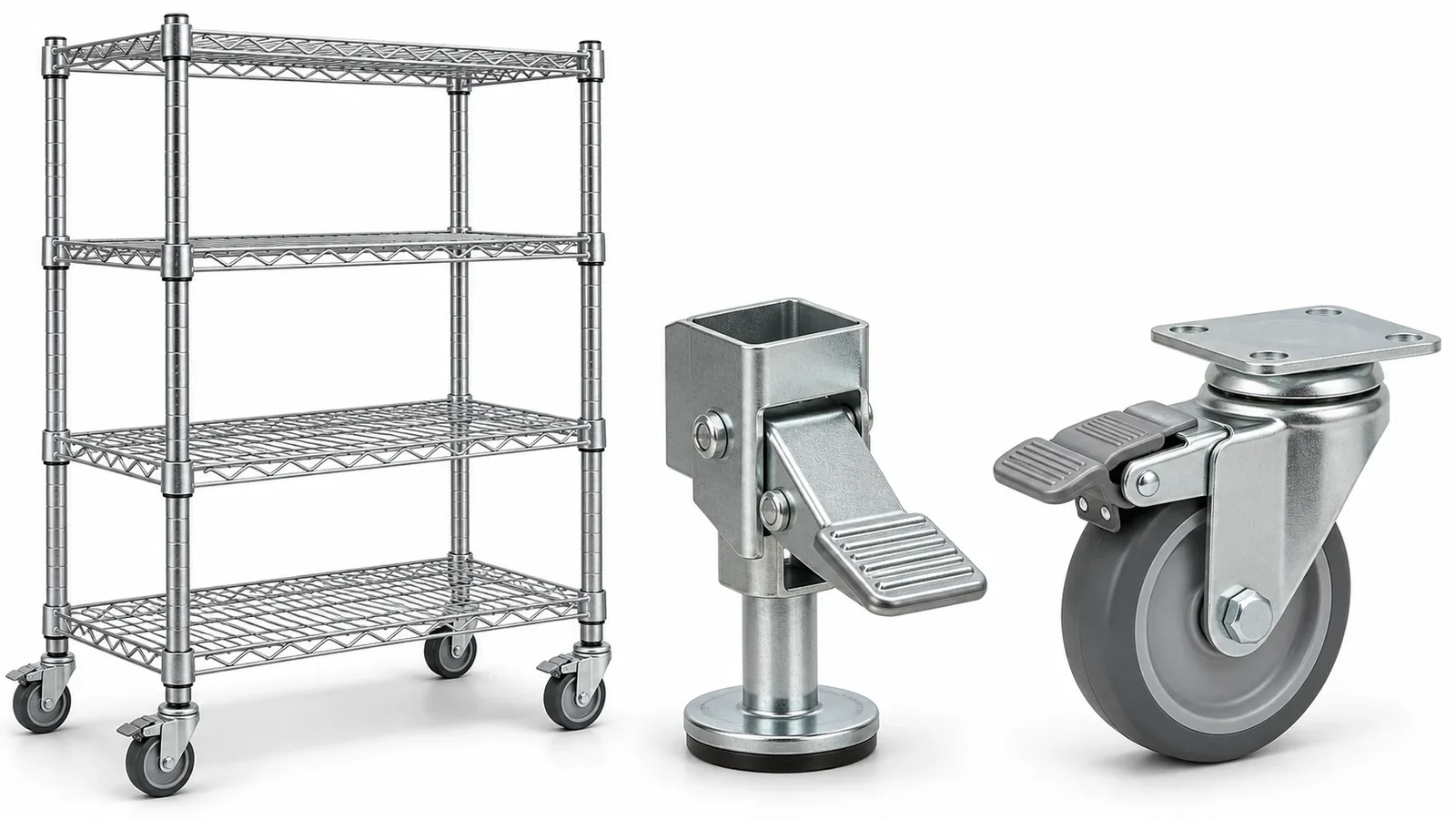
A floor lock versus caster brake comparison starts with the required function, not the component name. A caster brake may restrain wheel rotation, and a total-lock caster may address wheel and swivel movement; a separate floor lock can use a floor-contact shoe for a stationary parking function. These labels are not interchangeable, and a floor-contact device must not be assumed to lift equipment or stop moving equipment. Specify the exact function, component model, and current maker instructions before selecting a part for a mobile rack.
This is a functional sourcing guide for importers and product teams. It does not provide an equipment design, load rating, installation method, stopping-distance claim, or safety approval. The selected device maker and qualified project reviewers remain responsible for confirming a particular application.

What problem does a floor lock versus caster brake decision solve?
The buyer must translate an ambiguous phrase such as “lock the rack” into a specific component function. A project may mean stopping wheel rotation, limiting swivel, creating a separate floor-contact position, or something else that requires a different engineered system.
Mobile metal storage products often combine a fabricated frame with purchased casters and other positioning components. The frame supplier, caster maker, rack brand, and installation team may each use “brake,” “lock,” or “floor lock” differently. A quote that repeats the buyer’s term without defining the mechanism can therefore leave a critical scope question unanswered.
The distinction also matters because the word “stationary” is not itself a technical rating. A buyer may want the rack to remain in a parked position during ordinary use. That desire does not prove that any given brake or floor-contact accessory is suitable for a slope, a moving load, a particular floor surface, a specific load, or a particular use environment. Such conditions require evidence for the exact model and application.
The Hamilton caster maker’s floor-truck-lock description is a primary-source example of a separate shoe that is operated into and retracted from floor contact. The associated catalog sheet explicitly excludes lifting equipment and slowing or stopping moving equipment from the described floor-truck-lock function. This maker-specific statement is useful because it shows why a product name cannot be expanded into other functions. It is not a universal standard for every floor lock, a current test report, or a substitute for the selected model’s current instructions.
The buyer decision should therefore be captured in three separate columns: the function requested, the function documented for the selected component, and any function expressly excluded or still unverified. Do not let a line item called “lock” collapse those separate questions into one.
What should importers identify before comparing components?
Before choosing a device, define the movement or condition the product brief is intended to address. Then identify the current maker documentation for the proposed unit. The description should be precise enough that another team can distinguish a wheel brake from a separate floor-contact shoe.
Use a function-first intake record:
- Product context: identify the rack or cart model, its revision, and whether the request concerns the complete mobile product or one purchased component.
- Movement or stationary objective: describe whether the request concerns wheel rotation, caster swivel, a separate parking contact, or another requirement. Avoid treating “lock the rack” as a complete engineering specification.
- Proposed part: record the caster or lock maker, model, configuration, and current documentation revision.
- Documented function: quote or summarize only the maker’s stated purpose for that model.
- Explicit exclusions: capture any use the maker says the part does not cover, and any major question the document leaves unanswered.
- Operating assumptions: note the floor, intended use, load, movement state, and other project conditions that the responsible supplier says must be reviewed.
- Responsibility: identify who supplies the component and who confirms compatibility with the rack frame and project use.
An importer should distinguish product taxonomy from application approval. For example, a caster with a wheel brake is not automatically a total-lock caster. A total-lock model may restrain additional movement according to its maker’s specification, but the name still needs confirmation against the exact model. Likewise, a separate floor-contact lock is a different component architecture; it is not just another name for a wheel brake.
| Buyer request | Component question | Evidence to obtain |
|---|---|---|
| Reduce wheel rotation | Does the named caster brake address wheel movement on this model? | Current maker data for exact caster model and configuration |
| Address wheel and swivel movement | Is the quoted unit documented as a total-lock configuration, and what does the maker include in that term? | Model-specific operation description and limitations |
| Provide a separate stationary contact | Is a floor-contact shoe offered for this rack and defined use? | Current instructions, intended function, exclusions, and interface confirmation |
| Slow or stop moving equipment | Is the proposed product explicitly rated and documented for this dynamic purpose? | Specific maker approval and qualified engineering review; do not infer it from “lock” |
| Lift or support a rack | Is the device designed and approved for a lifting or load-support function? | Dedicated product documentation and review; a parking label is insufficient |
How do caster brakes and floor locks differ in function?
A caster brake acts within the caster assembly, while a floor lock can be a separate device that brings a shoe into contact with the floor. This distinction describes component architecture and named maker functions; it does not rank performance.
The Koitor serving-cart specification guide explains the related distinction between wheel rotation restraint and the broader caster movement addressed by a total-lock design. A buyer considering a separate floor lock needs one more question: does the product brief require a device outside the caster assembly that the maker documents as a floor-contact parking component?
Hamilton’s product page describes a floor-truck-lock shoe that is lowered or retracted through a pedal arrangement. Its catalog sheet also draws a clear boundary: the named device is not intended to lift equipment or slow/stop equipment while it is moving. The exact model, current instructions, and application conditions must still be reviewed before a buyer relies on this example.
The following function matrix is deliberately high-level. It helps route the question to the responsible supplier; it is not a component selection chart with load or surface limits.
| Component family | Basic distinction to confirm | Do not assume |
|---|---|---|
| Caster with wheel brake | The maker identifies a brake action associated with the wheel | That swivel is also restrained or that the whole rack is immobilized in every condition |
| Caster total-lock configuration | The maker identifies a configuration addressing more than wheel rotation | That every product using “total lock” has the same mechanism or ratings |
| Separate floor lock | A distinct device is documented to apply a floor-contact shoe for a stated stationary function | That it is a jack, moving brake, universal restraint, or load-support device |
| Leveling foot | A support or leveling function is defined for the exact model | That it is a mobility brake or can replace a separately specified lock |
Product names may overlap in catalogs, so read the actual model documentation. Do not transfer dimensions, pedal operation, surface assumptions, materials, load values, or installation guidance from one maker to another. If a catalog page is old, incomplete, or hard to interpret, request the current instruction sheet for the selected model.
What should the responsibility matrix record?
The most useful buyer asset is a stationary-function responsibility matrix that separates required behavior from proven product scope. The matrix helps purchasing, engineering, quality, and the rack supplier work from the same request without inferring an unsupported capability.
| Function request | Proposed component/reference | Maker-stated use | Explicit exclusions or open points | Responsible party / next action |
|---|---|---|---|---|
| Wheel rotation restraint | Exact caster model and brake configuration | Record the maker’s wording | Swivel behavior, floor conditions, load, and other limits not established here | Caster maker confirms the exact use |
| Swivel restraint | Exact total-lock or swivel-control model | Record what the selected maker means by the term | Do not infer that a separate floor shoe is included | Caster maker identifies mechanism and limitations |
| Separate floor-contact parking action | Exact floor-lock model and mounting reference | Record stated stationary purpose | No implied lifting, dynamic stopping, or universal surface suitability | Floor-lock maker and rack designer confirm interface |
| Lifting/support request | Dedicated component reference, if any | Require explicit maker-approved function | A parking shoe is not proof of a lifting device | Responsible equipment supplier and qualified reviewer decide |
| Moving-equipment braking request | Dedicated dynamic system, if any | Require explicit model-specific documentation | A “lock” label does not establish stopping capacity | Qualified equipment specialist confirms requirements |
For each row, attach the source page, document revision, and date checked. If a document has not been retrieved or does not address a requested function, write “not established” instead of filling the cell with an assumption. This small discipline prevents a marketing name from turning into an engineering statement as it travels through an RFQ, product listing, and purchase order.
The matrix also helps separate product responsibility. Koitor may review a metal frame, drawing, finish, or assembly interface when that work falls within its confirmed capabilities. A caster, floor lock, braking mechanism, or lifting device may be sourced from a separate specialist. The supplier responsible for the function should provide the controlling documentation and approve its use in the identified system.

How should the component interface be reviewed?
The rack and the purchased mobility component should be reviewed together, but the review must remain within the evidence supplied by their makers. A frame drawing can show the mounting interface; it cannot independently establish the caster’s or floor-lock’s performance.
First, identify the actual interface. Record the mounting pattern, available space, attachment method, and any clearance that the component maker requires. The present research sources do not establish universal dimensions or a mounting recipe, so obtain those values from current drawings for the selected part. Never copy a dimension from a similar-looking caster or floor lock.
Second, record any assembly dependencies. A floor-contact accessory may need a specific position relative to the rack or floor, but the cited catalog material does not support a general instruction for where or how to install one. Ask the maker or rack designer to define the interface for the actual product. Do not create an improvised linkage, retrofit, shim, or operating sequence from a generic illustration.
Third, keep the component revision aligned with the frame revision. A change to caster model, wheel configuration, lock body, pedal arrangement, frame member, or packaging can affect the compatibility review. The approval record should identify the full configuration rather than only the family name.
Fourth, separate sample observation from qualification. A buyer may inspect whether the received sample matches the approved model and whether the parts appear complete. That check does not establish holding force, incline use, dynamic stopping, fatigue life, floor-surface compatibility, load capacity, or safety compliance. Those require appropriate maker evidence and project-specific evaluation.
Fifth, request the current use instructions and limitations for the exact part. The custom metal storage-rack scope can help frame a buyer’s caster data request. For an uneven support condition, the separate drawing and sample preparation guidance covers another component decision; it should not be read as an endorsement of substituting leveling feet for a brake or floor lock.
What should buyers avoid assuming?
Avoid turning similar terms into a shared performance claim. A wheel brake, total-lock caster, floor-contact shoe, and leveling foot may all appear in a conversation about “keeping a rack still,” but each represents a different component question.
Do not assume that a floor lock is a jack. The cited Hamilton catalog specifically excludes lifting equipment for its named floor-truck-lock product. Apply that limit to the maker’s documented model, and require explicit current evidence before assigning any lifting function to another product.
Do not assume that a floor lock slows or stops a moving rack. The cited catalog explicitly excludes that use for the named product. Do not use a static parking description to infer a dynamic brake rating, stopping distance, or safe operating condition.
Do not assume that the word “brake” means the entire rack is immobilized. Determine which movement the model maker says is controlled. Wheel rotation, caster swivel, and floor contact are distinct concepts, and the product name alone may not tell the whole story.
Do not assume that a caster brake and a floor lock can be combined or substituted without review. The frame, component arrangement, load, surface, and operating conditions belong to the actual system and its responsible makers. A generic article cannot approve a combined configuration.
Do not assume that a catalog dimension is safe to use as a mounting instruction. In the Hamilton PDF reviewed for the research pack, some extracted numeric table glyphs were corrupted and the diagram was not visually inspected. Those numbers are intentionally excluded from this guide. Obtain a current, legible technical drawing directly from the maker.
Do not say that a passing sample proves all operating conditions. A sample comparison is bounded to the exact sample and observation; it does not establish durability, stability, compliance, or performance across a product range. Do not create an improvised test procedure in place of responsible supplier instructions.
Do not assign all responsibility to the metal frame supplier. The fabricated frame and purchased mobility components have different design and performance owners. Make sure the quote identifies who supplies each part, who confirms the interface, and who approves the function claim.
Buyer handoff and next steps
How can Koitor support a related mobile-storage project?
Koitor Hardware is a family-owned factory and custom metal hardware manufacturer with experience in metal forming, joining, finishing, assembly, and packaging preparation within its approved product scope. For a mobile rack inquiry, the buyer should define whether Koitor is being asked to review a fabricated metal frame or an unconfirmed mobility component.
When the request concerns a metal frame, provide the drawing or physical sample, revision, material and finish requirements, caster or floor-lock mounting references, quantity, and packaging needs. This allows the team to discuss the metal structure and interface information that is actually within scope. It does not make Koitor the manufacturer of the caster, floor lock, brake, lifting device, or a complete mobile system unless approved product facts establish that scope.
For a purchased caster or lock, name the component maker and model in the RFQ. Ask that supplier for the current technical documents and exact use limitations. If that supplier proposes a change, route the new reference back to the frame team so the mating details can be reviewed. A frame supplier’s ability to fabricate metal parts is not proof that a bought-in locking mechanism meets a particular use requirement.
Small-batch OEM development can support buyers evaluating a defined metal product or a clearly bounded frame customization. Koitor’s order information says MOQ can start from 100 pieces depending on the product; sample development usually takes 5–7 working days after details are confirmed; and bulk production usually takes 4–6 weeks depending on product, quantity, finish, and packaging. These are conditional planning ranges, not a guarantee for a floor-lock system or a product not confirmed as part of Koitor’s range.
The OEM home-storage hardware scope can help frame a project inquiry. Include the intended stationary function separately from the metal manufacturing request, and ask Koitor to confirm whether the proposed frame or component lies within current capability before treating it as a quotation-ready item.
Buyer checklist before requesting a quotation
Use this checklist to make the function and supply boundary visible in the RFQ:
- Identify the rack or cart model and drawing revision.
- State whether the requirement concerns wheel rotation, swivel, a separate floor-contact parking function, lifting, dynamic stopping, or another function.
- Identify the exact caster, total-lock, floor-lock, or leveling-foot model under review.
- Attach the current maker instructions and record their revision and date.
- Copy the maker’s documented intended function and any explicit exclusions.
- Record floor, operating, load, and use assumptions that the responsible maker must review.
- Identify the frame interface and which supplier approves it.
- Separate fabricated metal parts from purchased mobility components.
- List the parts, fasteners, packaging, finish, quantity, and sample expectations included in the quote.
- Mark unverified claims or missing documentation as open items.
- Require the responsible specialist to approve any lifting or moving-equipment function.
For quote comparison, make each supplier respond to the same function matrix. Ask for deviations, model substitutions, and exclusions in writing. If two suppliers use the same word but document different mechanisms, compare the actual function statements rather than the product label.
A purchasing specification should distinguish the moment when a mobile unit is being moved from the state in which it is expected to remain in place. State whether the request concerns restraint at a wheel, a separate contact with the floor, or another maker-defined function. The component name alone does not settle what the operator is meant to do, what part touches the floor, or whether the supplier’s cited product is suitable for the intended assembly.
For quote comparison, record the rack or cart model, the caster and lock models, the intended operating state, the supplied quantity of each part, and the maker document that describes the selected function. If the buyer expects one control to both hold a unit and stop it while moving, split those expectations into separate questions. The cited Hamilton material specifically distinguishes the floor-contact lock purpose from slowing or stopping moving equipment; keep that maker-specific boundary visible and ask the responsible supplier about any separate dynamic stopping requirement.
A sample review can confirm that the proposed parts and their stated interfaces are represented in the approved configuration. It does not establish a load rating, braking distance, long-term durability, or a safety result unless the responsible manufacturer provides evidence for that exact assembly and test. Record unresolved performance questions instead of using a product category label as a substitute for verification.
A floor lock versus caster brake specification should state which separate function the buyer expects at rest and which maker document confirms the proposed component.
Frequently asked questions
Is every floor lock a jack?
No. A product called a floor lock should not be assumed to lift equipment. The Hamilton catalog reviewed for this guide expressly excludes lifting for its named floor-truck-lock product. Confirm the current instructions for the exact model and do not assign a lifting function unless its maker explicitly supports it.
Does a floor lock mean the equipment can be stopped while moving?
Not by the name alone. The cited maker’s catalog explicitly excludes slowing or stopping moving equipment for its named floor-truck-lock. A buyer needing a dynamic braking function must specify it separately and obtain appropriate model-specific documentation.
Does a wheel brake also restrain caster swivel?
That depends on the exact caster configuration and the maker’s definition. Review the model documentation to distinguish wheel rotation restraint from a total-lock arrangement; do not infer swivel restraint from a generic brake label.
Does contact with the floor prove a load rating?
No. A floor-contact feature does not by itself establish a load rating, holding force, slope suitability, or system safety. Obtain the relevant current data for the exact product and have the responsible supplier or qualified reviewer confirm the intended use.
Work With Koitor Hardware
Define the Rack Frame and Bought-In Component Separately
Send the rack drawing, component maker and model, current instructions, required function, quantity, finish, and packaging scope. Koitor can confirm whether a defined metal-frame or hardware request fits its manufacturing scope while the responsible mobility-component maker confirms the lock function.
OEM / PRIVATE LABEL
Turn this sourcing guide into a product brief
Share your target product, size, finish, order quantity and packaging requirements. Your team receives a practical manufacturability review before quotation.


 English
 Español
 Português
 Français
 Deutsch
 العربية