

Galvanized vs zinc plated is a useful buyer question because a quotation may use “zinc-coated” as a broad label while leaving the actual process unclear. Both descriptions involve zinc protection on a steel substrate, but the route, coating structure, coverage, finish, dimensions, and evidence can differ. The terms should not be treated as interchangeable just because both parts look silver or because both suppliers quote a zinc coating.
For hardware, the exact component matters. A large bracket, threaded fastener, stamped plate, small insert, and wire basket present different coverage and fit questions. The buyer should identify the coating process and specification for the actual part, ask when coating occurs in the fabrication sequence, and confirm how threads, edges, recesses, and contact surfaces are handled. The American Galvanizers Association (AGA) describes several zinc-coating routes for fasteners and hardware in its zinc coatings for fasteners guide. Its typical values and comparisons are general guidance, not acceptance limits for an unidentified product.
What Do “Galvanized” and “Zinc Plated” Mean?
“Zinc plated” commonly refers to an electroplated zinc coating applied to a steel part. “Galvanized” is used in more than one way across supplier catalogs, but buyers often encounter it for hot-dip galvanizing or another zinc coating route. A quotation that only says “galvanized” may not tell the buyer which process was used. Ask the supplier to state the method, applicable specification, coating designation, and processor for the exact component.
Hot-dip galvanizing involves immersing a fabricated steel component in molten zinc; the coating is metallurgically bonded to the steel. Zinc electroplating applies zinc by an electrochemical process and is commonly used where a controlled, relatively thin coating and precise fit are important. Other mechanical, thermal diffusion, or proprietary coating routes may also be used for fasteners and hardware. The buyer should not assume one route from a color or a product name.
The AGA guide discusses hot-dip galvanized fasteners, zinc electroplating, mechanical galvanizing, high-temperature galvanizing, and thermal diffusion galvanizing. It notes that coating performance and abrasion behavior relate to thickness and how the coating is bonded. That is a process-level explanation for the fastener context described in the article, not a universal ranking for every bracket, rack, or assembled product. Request the route and evidence that apply to the part and intended service conditions.
For galvanized vs zinc plated procurement, keep the process name attached to the part and drawing revision. A useful RFQ asks the supplier to separate three items: steel substrate, zinc application process, and any supplementary sealant or topcoat. This lets the buyer compare the construction rather than infer it from “bright zinc,” “galvanized,” “silver finish,” or a photograph.
How Can Coating Route Affect Part Geometry and Fit?
Geometry and timing affect how the coating route interacts with the component. A part coated before forming may have a different surface history from one coated after stamping, welding, drilling, or assembly. Edges and cut faces may need specific consideration depending on the process and specification. Threads, holes, mating faces, small clearances, recesses, and internal surfaces can also affect how a coating is applied and inspected.
For a threaded fastener, coating thickness and thread fit are important purchase questions. A supplier should state how the coating route and thread class are controlled for the specified fastener. The AGA notes that zinc electroplating can be considered where precise fit is important, but that observation does not automatically approve an electroplated fastener for a particular product. The buyer must still state thread requirements, mating hardware, environment, finish, and any post-treatment restrictions.
For a bracket or storage accessory, ask whether coating occurs before or after fabrication, what surfaces are expected to be protected, and whether any areas are masked or excluded. If the product includes welds, the buyer should confirm how surface preparation and coating cover those features under the agreed process. If a component has drainage features or narrow gaps, ask whether liquid can be trapped or whether coating and inspection can reach the required areas. These questions should be answered by the process owner for the actual geometry.
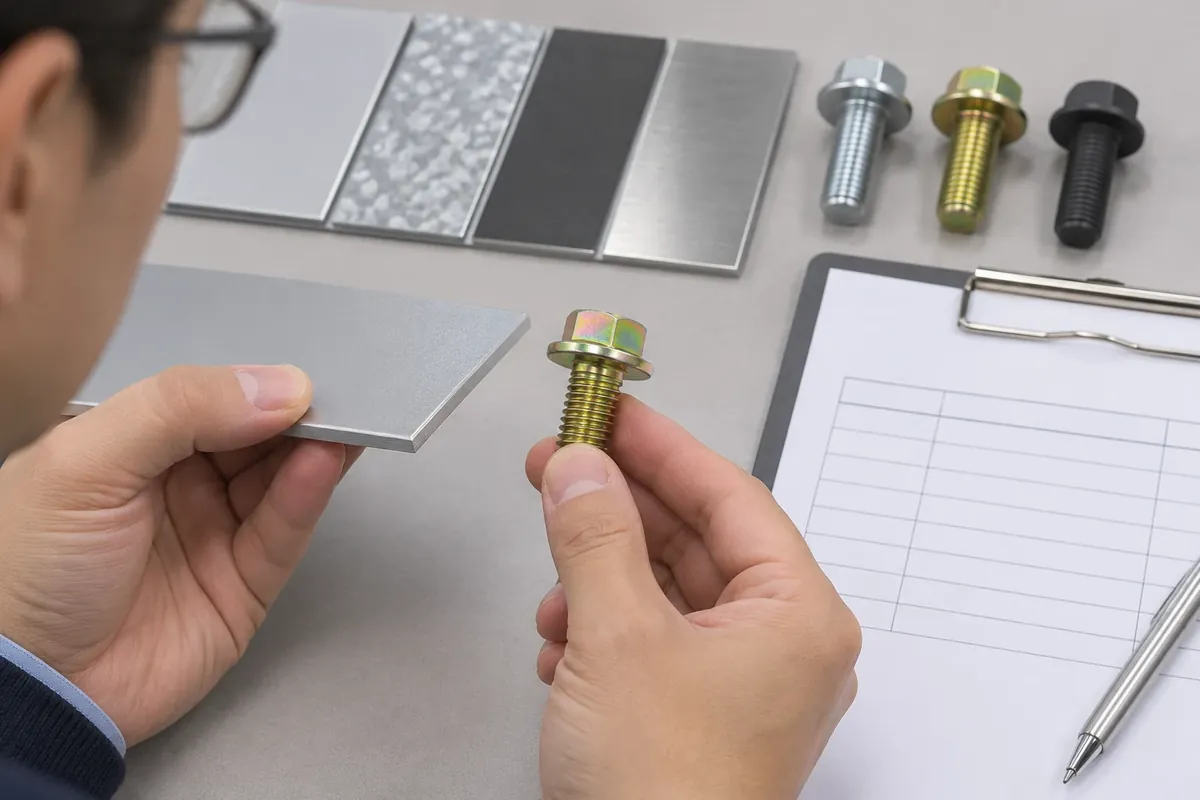
A coating can also change appearance and assembly. The sample review should include visible faces, corners, threads, hole edges, and contact interfaces. If the component mates to another part, inspect the assembled condition. A flat zinc-coated coupon cannot show whether the final part still fits, whether the finish is uniform in a recess, or how a fastener engages.
What Should Buyers Compare Beyond Color?
Appearance is one acceptance criterion, not a process definition. Zinc finishes may differ in brightness, texture, color, passivation or conversion treatment, and accepted variation. Similar silver color does not prove that two components use the same coating process, thickness, substrate, or surface preparation. If a buyer needs a coordinated appearance, request production-intent samples and define the viewing conditions and acceptable variation.
Corrosion-related claims require the same care. The coating route, thickness, surface condition, supplementary treatment, handling, exposure, and maintenance all matter. Do not convert a supplier’s typical process description into a guaranteed service life. If the purchase requires a particular test, state the test method, sample configuration, exposure, acceptance rule, and reporting scope. A result on a fastener or flat panel may not represent a welded assembly or a part with crevices and contact points.
Abrasion and handling are also relevant. A coated component may be scratched during forming, assembly, packing, or installation. Ask which surfaces are cosmetic, how components are separated in the carton, and how a damaged item is evaluated. A glossy or uniform appearance before assembly may not show how fasteners rub against adjacent surfaces during transit.
Maintenance must be tied to the actual finish. Request care instructions from the responsible product or coating supplier, especially where the zinc surface has a supplementary treatment. Do not assume that a cleaning chemical suitable for one finish is suitable for another. If a customer will see the care language, keep it consistent with the product evidence and supplier instructions.
How Should the Buyer Compare Supplier Quotations?
Ask suppliers to quote against the same drawing revision, quantity, substrate, coating route, finish target, thread or fit requirements, inspection, packaging, and environment. Require them to state assumptions and exclusions. If one proposal includes post-fabrication galvanizing and the other includes an electroplated fastener with a separate bracket, record that as a design and process difference, not as a direct price comparison.
| RFQ field | What the buyer should specify | What the supplier should confirm |
|---|---|---|
| Substrate | Steel designation or approved material declaration by component | Material identity and source record |
| Zinc route | Named process or agreed coating specification | Actual route, processor, and procedure revision |
| Timing | Whether coating follows forming, cutting, welding, or machining | Included sequence and any excluded operation |
| Critical features | Threads, holes, mating faces, edges, recesses, visible surfaces | Fit controls, masking, and inspection access |
| Supplementary finish | Required color, passivation, sealant, or topcoat if specified | Product-specific system and supplier responsibilities |
| Environment | Moisture, cleaning, location, service conditions, and contacts | Suitability statement and supporting evidence within scope |
| Acceptance | Sample, dimensions, coating evidence, appearance, and lot records | Inspection method, frequency, reporting, and exceptions |
| Packaging | Separation, surface protection, labeling, and lot traceability | Packaging sample and shipment records |
A galvanized vs zinc plated review should name the supplier route before the buyer compares appearance or cost. A quotation comparison should show total scope: steel, forming, welding, coating, supplementary treatment, inspection, assembly, packaging, and any outsourced processing. A lower price may exclude a step or use a different coating route. Ask the supplier to clarify rather than inferring that the less expensive finish is equivalent.
If the supplier cannot quote the requested route, ask which design or acceptance field needs adjustment and who approves that change. Maintain the original requested scope and the alternate proposal as separate records. This makes later technical and commercial review more reliable.
How Should Samples, Inspection, and Lot Records Be Managed?
A sample should represent the proposed production route closely enough to answer the buyer’s decision. Record whether it used production-intent substrate, coating sequence, supplementary treatment, geometry, and packaging. If the sample is only a flat coupon or prototype, note what it does not prove. Approve the sample against the drawing revision and specify visible surfaces, fit, appearance, and any required inspection.
At incoming inspection, match the product and documents to the purchase order. Check part number, revision, coating route, lot identity, and required reports. The inspection plan should identify which dimensions, threads, visual features, and process records are checked and how sampling is determined. Use the applicable specification and the buyer’s quality agreement; do not invent a universal sampling frequency for all parts.
If a report or certificate accompanies a shipment, verify the covered lot and component, specification or process reference, revision, results required by contract, and any exceptions. A document without lot traceability may not answer whether the delivered parts were processed as approved. Define how report numbers map to cartons, labels, or supplier travelers so the receiving and quality teams can retrieve them later.
Packaging review is part of finish acceptance. Look for separators, bags, contact points, and carton layout that keep the zinc surface from being damaged by other parts. Where a treatment can be affected by trapped moisture or contamination, agree on handling with the responsible supplier. If a packaging change is proposed, review it before production rather than after appearance complaints occur.

Which Route Fits a Particular Hardware Program?
There is no single route that fits every hardware program. The decision depends on part size and geometry, coating coverage, fit and thread requirements, environment, appearance, fabrication sequence, inspection evidence, quantity, and supplier capability. A buyer may use different routes for a large bracket and a small fastener in the same product, provided the assembly and specification define how those components work together.
For an item with tight threads or a close fit, ask the supplier to state how the coating and dimensional requirements are met. For a fabricated component with many surfaces or welded features, ask the process owner how the chosen route addresses the final geometry and what evidence is available. These are questions to resolve against the actual component, not rules that one process is always preferable.
Where corrosion performance is critical, identify the intended environment and acceptance endpoint with a technical owner. The process name alone is insufficient. Request the applicable specification, coating route, sample, test or inspection evidence, and limitations. If the evidence concerns a different component or substrate, state that it is an analogy rather than product proof.
The buyer should include change control. A supplier substitution from electroplating to hot-dip galvanizing or another route may affect fit, appearance, geometry, and inspection. Require approval before the alternative enters production. Keep the approved material and process records together so reorders remain comparable.
Translate Commercial Finish Names Into Process Questions
A catalog may use a short term such as “galvanized,” “zinc,” “bright zinc,” or “silver coating” because the product page is written for a broad audience. A purchase specification has a different job: it must let the processor and receiving team identify the required construction. If the supplier uses a commercial name, ask for the underlying process and the specification that controls it. Record any supplementary passivation, sealant, color treatment, or topcoat separately.
This clarification matters when two quotations use different vocabulary for what may or may not be equivalent. Ask the supplier to state whether the part is hot-dip galvanized, electroplated, mechanically zinc-coated, thermally diffused, or processed by another named route. If they cannot confirm the route, treat that as an open technical item rather than filling in the blank from a product photo. The question is especially important for a fastener whose thread, head, and bearing surfaces interact with other parts.
A buyer should also ask whether a coating designation refers to the complete assembly or only one purchased component. A product may combine a zinc-coated bracket with plated screws or a bare steel component inside a finished housing. Map each exposed and function-critical part, and ask which supplier is accountable for each coating record. Do not assume that a single invoice line describes every surface of a multi-part product.
Align Coating, Tolerance, and Assembly Requirements
Before approving a route, identify critical dimensions and how the coating can affect them. Thread engagement, hole size, sliding fit, press fit, and contact between plates may be affected by coating buildup or surface preparation. The responsible processor should confirm the controls appropriate to the process and part; the buyer should put the required dimensions and fit checks on the drawing. Do not apply a typical coating thickness from a general source as a universal drawing tolerance.
Review the assembly after finishing. A fastener may fit a test nut but fail with a production mating part, or a coating may change how two surfaces sit together. Confirm the approved screw, nut, washer, and substrate, then assemble a production-intent sample. For a kit, verify that all included parts and the installation instruction match the accepted construction. If a coating route requires a different fastener or assembly sequence, document it as a design change.
Consider packaging and handling at the same time. Small plated parts can rub against one another in a bulk bag, while a larger galvanized component can contact other products in a carton. Define separation, protective materials, labeling, and any limits on mixed-metal contact during storage. These controls do not replace the coating specification; they protect the approved parts between the processor and the buyer.
Decide Which Inspection Confirms the Requirement
The purchase order should say what evidence the buyer expects and which party provides it. This may include a process declaration, material record, dimensional inspection, visual criteria, coating-thickness measurement, or a test report where the governing specification requires one. The buyer should not request a test result without identifying the part, location, sampling basis, acceptance criteria, and report linkage. A measurement on a convenient flat area may not represent a thread, recess, edge, or welded joint.
If a supplier reports a general typical value, ask whether it is a process reference or a lot-specific measurement. Keep these apart in the record. If a test is performed on representative coupons, confirm how the coupon relates to the production component and what it cannot establish. The accepted method depends on the applicable specification and agreement; this article does not establish a universal test plan.
For a nonconformance, preserve the item, identify the lot, and compare it with the approved sample and process documents. A scratch, color variation, exposed edge, or thread issue may have different causes and corrective paths. Ask the responsible processor to determine whether rework is permitted and what inspection would verify it. Do not authorize a touch-up from a broad “zinc paint” description without technical confirmation of compatibility and acceptance.
How Can an OEM Buyer Clarify the Quotation?
An OEM buyer can send the manufacturer a drawing, quantity, finish sample, material notes, environment, fit requirements, inspection plan, and packaging expectations. Ask the factory to identify which operations it performs and which steps are handled by a specialist coating supplier. The person who controls coating must confirm its actual process and supporting data; the factory should explain how that information is tied to the finished component.
Koitor Hardware is a family-owned custom metal hardware factory focused on bathroom and home-storage hardware. Approved company information supports customization from buyer drawings or samples, fabrication planning, finishing requirements, assembly, and packaging discussions. It does not confirm a specific galvanizing or electroplating service as an in-house capability. The buyer should avoid assuming an operation is performed by the factory unless the project scope confirms it.
A clear handoff assigns responsibility for sample approval, process revisions, lot records, packaging, and change notification. If the supplier proposes an alternate zinc route, compare the complete finished part and re-evaluate thread fit, visible appearance, corrosion evidence, and assembly. Keep the decision linked to the product revision and purchase order.
Review Koitor’s custom bathroom hardware manufacturing page and OEM home-storage hardware page. Send the quotation, drawing, or coating question through the contact page. The supplier can help clarify the part scope; the coating processor must confirm its specific process and data.
Frequently Asked Questions
Is galvanized steel the same as zinc plated steel?
Not necessarily. Both involve zinc on steel, but the application route, coating characteristics, part fit, and specification can differ. Ask for the actual process name and applicable requirement.
Is zinc plating a type of galvanizing?
Terminology varies among suppliers. For a purchase order, avoid relying on a broad label. State the required route or specification and have the processor confirm it.
Which route is better for fasteners?
That depends on the fastener, thread and fit requirements, environment, coating specification, supplementary treatment, and evidence. AGA describes several routes; it does not approve one for every fastener.
Does a thicker zinc coating always last longer?
Coating thickness is relevant, but the process, surface condition, environment, abrasion, handling, and product design also matter. Use product-specific evidence rather than a universal lifetime claim.
Can the two finishes be compared by color?
Color can help assess appearance but does not establish the process, substrate, coating thickness, or fit. Request the specification and approve a production-intent sample.
What should a buyer ask about threads?
Specify the thread and fit requirement, then ask how the proposed coating route controls dimensions and inspection. Confirm the mating hardware in an assembled sample where needed.
What if the quotation only says “zinc finish”?
Ask the supplier to identify the substrate, coating route, supplementary treatment, specification, processor, and evidence. Keep the quote on hold until its scope is clear.
Can a zinc-coated component be reworked after damage?
Do not assume a repair method. The responsible supplier should assess the exact substrate and coating, then approve any corrective route and inspection.
Work With Koitor Hardware
Share the drawing revision, component material, requested zinc route, fit requirements, service environment, sample, and inspection scope. Koitor can help clarify custom hardware and supplier coordination; the coating processor must confirm the process and evidence for the exact part.
Name the Coating Route in the RFQ
Send the drawing, coating description, fit requirements, and approved sample for review.
OEM / PRIVATE LABEL
Turn this sourcing guide into a product brief
Share your target product, size, finish, order quantity and packaging requirements. Your team receives a practical manufacturability review before quotation.


 English
 Español
 Português
 Français
 Deutsch
 العربية