

Bronze vs brass is not a reliable product specification when the buyer has only a color name or a supplier’s informal description. Brass generally refers to copper-zinc alloy families, while bronze is a broad historical and commercial name used for different copper-alloy compositions. Trade names can overlap with formal alloy classifications. The Copper Development Association lists C22000 as “Commercial Bronze” while placing it among wrought brasses; that example shows why a name alone may not identify the exact chemistry or product. It does not prove that every bronze is brass or identify a particular delivered part. A careful bronze vs brass comparison therefore begins with the supplier declaration, not a color guess. Later sections apply that same distinction to finish approvals and RFQ records.
For an OEM hardware decision, request the alloy designation or supplier material declaration, product form, finish route, application, and sample. Then compare the complete component and supplier scope. Neither bronze nor brass is universally stronger, more corrosion resistant, less expensive, or better looking in every hardware application. The International Copper Association also describes brass as a family with varying properties; buyers should link claims to the actual alloy and finished part.
What Do the Names Brass and Bronze Identify?
Brass is commonly used for copper-zinc alloys, but composition and properties vary by grade, product form, and processing. Bronze is used for a variety of copper alloys, including alloys that are not simply a single fixed formula. In commercial catalogs, product names may refer to color, an alloy, a finish family, or a historical trade term. The buyer should ask what the supplier means for the exact product rather than infer composition from the word.
The C22000 example is useful because its formal Copper Development Association entry uses the name Commercial Bronze while classifying it among wrought brasses. That specific classification does not make all bronze materials brasses. It demonstrates that commercial naming is not a substitute for a recognized designation and material record. Review the CDA C22000 entry for that alloy-specific example and the International Copper Association overview for the broader point that brass composition varies.
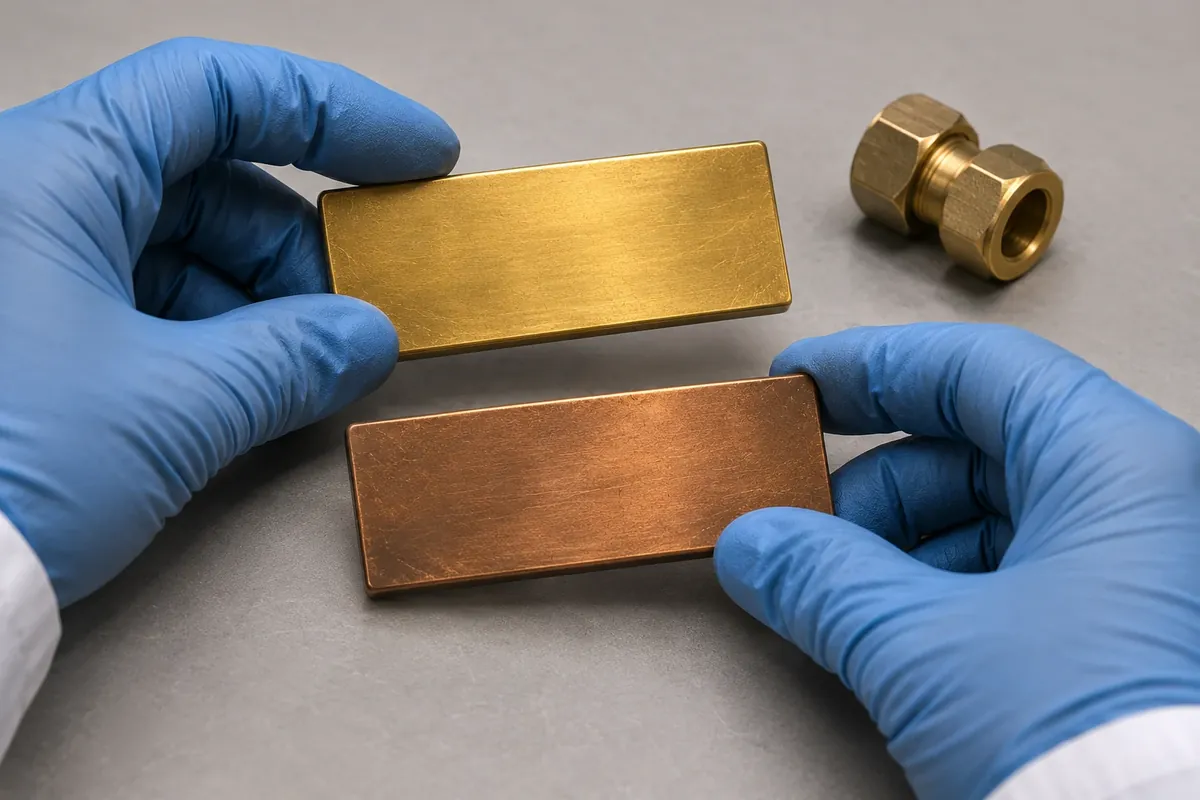
A bronze vs brass review should begin by asking what the supplier means by each term. A supplier may use “bronze” to describe a material, a decorative finish color, or a product family. Ask the supplier to separate base metal from surface treatment. A brass substrate can receive a different visible finish, and another substrate can be given a bronze-colored coating. A photograph, magnet, patina, or warm brown appearance cannot reliably distinguish these constructions.
Use the material designation appropriate to the purchase and regulatory documentation. If a buyer’s drawing says only “bronze,” request clarification before quoting. The responsible supplier should identify the material record and any limits on what that record covers. If the term describes appearance rather than composition, state the actual substrate in a separate field.
How Should a Buyer Verify the Alloy Identity?
Start with the component and revision. Identify whether the part is sheet, tube, wire, machined stock, casting, forging, or a bought-in fitting. Then ask for the alloy designation or supplier declaration that applies to that specific form and part. A general company brochure or a color sample is not enough to tie the material to a production lot.
If the product is an assembly, map material by component. A decorative body, threaded insert, screw, washer, mounting plate, and cap may come from different sources. The bill of materials should state which pieces are brass, bronze, another copper alloy, steel, or a coating over a different substrate. That mapping helps sourcing teams compare proposals and quality teams investigate changes or field concerns.
Material records should identify the supplier, grade or alloy designation, document revision where applicable, and the parts or lots covered. Ask whether the declaration is based on supplier certificates, controlled purchasing, or another traceability method. The buyer’s required evidence depends on the intended claim and quality agreement. Do not claim that a visual test or an informal name proves composition.
A suitable verification path should be agreed before production release. Where a product requires a particular composition, the responsible technical owner can specify what document or test is appropriate and which party performs it. If the material remains unknown, record the field as open and hold decisions that depend on the alloy. Do not substitute one trade name for another simply because the colors look similar.
How Do Product Form and Manufacturing Route Matter?
Copper alloys are selected and processed in specific product forms. A comparison for a machined threaded fitting does not automatically apply to a stamped bracket, wire hook, decorative tube, or complete towel accessory. Geometry, wall thickness, bends, threads, joining features, and visible surfaces shape the manufacturing route. If the buyer changes alloy, the supplier should review whether the same route and dimensions remain appropriate.
Potential operations can include cutting, stamping, bending, machining, casting, welding or brazing, polishing, coating, plating, assembly, and packaging. Which ones apply is product-specific. Ask the supplier to identify included steps and any specialist processes. A quoted “brass product” might contain purchased fasteners or components made by another supplier; confirm who controls their material and finish.
Joining may affect appearance and function. Confirm whether joints are visible, whether the finish is applied before or after assembly, and whether finishing access is available around the joint. A material alternative may change how a feature is formed, threaded, machined, or joined. Review the production-intent part rather than assuming a prototype produced by a different process represents serial manufacturing.
The manufacturing route also changes the basis for comparing cost. A machined part and a formed part may use different equipment, labor, scrap handling, tooling, finishing, and inspection. Quantity and supplier scope matter. Do not use an alloy-family generalization or a dated price example from another product to estimate the cost of the actual bathroom or storage hardware. Request comparable quotations with the same drawing and assumptions.
How Should Finish, Patina, and Appearance Be Specified?
Appearance should be defined separately from alloy identity. State color, gloss, texture, visible faces, grain direction where relevant, edge condition, and accepted variation. If the buyer expects natural aging or a particular patina, define the desired appearance and maintenance expectation with the product owner. A decorative term such as “antique bronze” may describe a finish rather than a bronze substrate.
Approve a representative sample in the intended construction. A flat coupon helps review color and texture, but it may not show a machined thread, bend, joint, or complete assembly. Compare samples under consistent lighting and record the sample ID, product revision, substrate, finish route, and supplier. If a finish is applied by an outside processor, confirm how that processor receives the approved reference and how changes are controlled.
A finish may affect cleaning and care instructions. Ask the responsible product or surface supplier for guidance for the actual alloy and treatment. Do not recommend aggressive polishing, acid cleaning, or abrasive pads merely because a material is called brass or bronze. The product may be plated, coated, lacquered, or otherwise treated, and an unapproved cleaning method could change the appearance.
Packaging should protect cosmetic surfaces. Review whether parts touch each other, whether fasteners can scratch a visible face, and whether protective films or bags are compatible with the finish. Approve packaging with the product sample when retail appearance matters. A finish sample approved outside the package may not reflect the condition in which the distributor receives the product.
How Should Buyers Compare Bronze and Brass Proposals?
Use one comparison record for the same intended product and commercial scope. Ask each supplier for the alloy designation, product form, manufacturing route, finish, assembly materials, environment assumptions, inspection evidence, packaging, quantity, and exclusions. If a supplier cannot offer the same route, ask them to show the alternate design or process as a separate proposal.
| Comparison field | Supplier proposal A | Supplier proposal B | Evidence to retain |
|---|---|---|---|
| Alloy identity | Designation or declaration by component | Designation or declaration by component | Material record linked to part and lot |
| Product form | Sheet, tube, wire, machined, cast, or bought-in part | Same function and geometry stated | Drawing and supplier process review |
| Surface finish | Color, texture, sheen, coating, and treatment | Same appearance requirement or noted deviation | Approved production-intent sample |
| Fabrication | Forming, machining, joining, polishing, and assembly | Route and any changes stated | Process scope and drawing revision |
| Environment | Location, moisture, cleaners, contacts, maintenance | Same stated use conditions | Product-specific requirements |
| Quality evidence | Material traceability, dimensions, appearance, tests | Same acceptance basis | Agreed inspection plan and lot reports |
| Commercial scope | Quantity, tooling, finish, packaging, exclusions | Comparable assumptions | Revised quotations and change record |
Do not compare a solid brass part with a bronze-colored plated component and call the difference a material trade-off. First determine substrate and finish for each option. Also confirm whether the quote includes mounting hardware, protective treatment, assembly, inspection, and packaging. Different suppliers may use the same color name while offering different constructions.
The table helps expose unanswered questions; it is not an engineering ranking. The buyer should state what matters most, such as color matching, a particular composition, thread fit, repair access, or supplier traceability. If the choice depends on a performance property, request evidence for that exact alloy and finished part. Keep generalized material data in its source context and do not extend it to an unsupported field claim.
What Should Be Approved Before Production and Reorders?
Before production, approve the drawing and sample together. The drawing should state the component material or identify the required declaration, finish, dimensions, mating parts, visible surfaces, and applicable inspection points. The sample should be traceable to the same revision and proposed route. If the prototype does not use the production process, record that difference and identify the remaining qualification step.
For a new supplier or material route, agree how changes are handled. Require notice before a supplier, alloy, product form, finish processor, or bought-in fastener changes. Decide whether a new sample, revised documents, or additional inspection is required. Update the bill of materials and purchasing notes when approved. This avoids later confusion between an exploratory sample and the released construction.
For reorders, confirm that the supplier still uses the approved alloy declaration, finish specification, and component sources. A prior approval does not automatically cover a different processor or modified product. Keep records linked to the order and lot, and identify the approved sample reference. These controls support repeatability without promising that every lot is visually identical beyond the agreed acceptance criteria.
If a material question arises after delivery, preserve the item and gather its code, lot, photographs, installation and cleaning information, and purchase record. Do not diagnose composition from color alone. The supplier or qualified technical owner should decide what examination is appropriate. Keep the reported observation separate from suspected causes until evidence supports a conclusion.

How Can an OEM Buyer Coordinate the Decision?
A custom hardware factory can review the drawing, sample, material identity, finish, assembly, and packaging requirements. Koitor Hardware is a family-owned custom metal hardware factory focused on bathroom and home-storage hardware. Approved company facts support customization from buyer drawings or samples and discussion of fabrication, finishing requirements, assembly, and packaging. They do not confirm that Koitor produces every copper alloy component, performs all casting or machining, or operates a material testing laboratory.
Send the target product, drawing revision, quantity, finish reference, installation or service environment, and the specific alloy question. Ask the manufacturer to distinguish its fabrication work from purchased components or outside processing. If a specialist supplier owns a finish, clarify how the accepted sample and change notice are passed across the supply chain. The factory can help identify manufacturing questions, while the material supplier must confirm the alloy designation and supporting record.
For projects where finish matching matters, provide the existing sample and identify the surfaces customers see. For projects where composition matters, provide the required designation or ask the technical owner to define the evidence before RFQ. Do not rely on a marketing color name as a substitute for a material decision.
Review Koitor’s custom bathroom hardware manufacturing scope and OEM home-storage hardware page. Send the drawing and sample through the contact page. Koitor can help clarify custom hardware scope; the alloy and finish suppliers must confirm their product-specific information.
How Should a Buyer Specify Copper-Alloy Identity in an RFQ?
Start with the part and the buyer decision, then ask the supplier to identify the material at the level needed to control purchasing and acceptance. A useful record separates the alloy designation, product form, temper or condition where relevant, manufacturing route, surface finish, and any decorative treatment. The exact fields depend on the component. A cast decorative fitting and a formed sheet-metal bracket do not necessarily use the same material specification or evidence. Ask the material supplier or processor which declaration applies to the selected form.
Do not let a color sample substitute for the alloy record. A bronze-colored coating, brushed surface, aged finish, lacquer, or patina can be applied to different substrates. Conversely, a copper alloy may have a surface appearance that changes through polishing, aging, handling, or clear coating. In the purchase file, keep the finish sample and the substrate declaration as distinct approvals. Name the sample identifier, date, and drawing revision so a later production lot can be compared with the approved version.
The buyer should also state whether the intended requirement is appearance, chemical identity, formability, machining, joining, corrosion behavior in a defined environment, or some combination. A finish supplier may be able to match appearance without confirming the underlying alloy, while a material certificate may identify chemistry but say nothing about the desired aged look. Assign each requirement to the party with the evidence to confirm it. If a supplier uses a commercial name such as “commercial bronze,” ask for the recognized designation and the actual product specification rather than inferring the composition from the wording.
| Requirement | What to put in the RFQ | What the evidence can establish |
|---|---|---|
| Alloy identity | Designation or approved material specification by component | The declared alloy scope, if tied to the supplied lot |
| Product form | Sheet, bar, casting, extrusion, tube, or other applicable form | Which specification and processing route are relevant |
| Finish | Color reference, texture, sheen, aging or coating expectation | Appearance under the agreed viewing and sample conditions |
| Fabrication | Forming, machining, casting, joining and polishing expectations | Process scope and sample-specific construction |
| Environment | Location, moisture, cleaning and contact conditions | Context for a product-specific technical review |
| Lot control | Traceability identifier and required report | Which shipment or production lot the records cover |
This format does not force a particular copper alloy. It keeps an attractive catalog label from becoming an ambiguous engineering instruction. If the buyer has no required grade, the RFQ can state that the supplier should propose an alloy and submit the designation, sample, and technical rationale for approval before production. The proposal should remain a proposal until the buyer accepts it.
What Can Appearance and Simple Shop Checks Tell You?
Color is a screening observation, not a reliable alloy identification method. Lighting, polishing, oxidation, plating, lacquer, contamination, and image processing can all change how a surface looks. A magnet test is also not a general proof of copper-alloy identity or quality; it can only provide limited information about the tested item and its construction. An assembly may contain steel screws or inserts even when the visible body is a copper alloy. Do not use a quick visual or magnetic check to accept an undocumented material substitution.
If identity is critical, use documentation and an inspection method selected by a qualified person for the actual alloy and product form. Some analytical methods can identify elements at a surface, but interpretation may depend on calibration, geometry, coatings, and the target specification. A reading on a finished or plated surface may not represent the bulk substrate. The buyer should establish the method, sampling location, acceptance basis, and responsible laboratory or inspector before relying on a measurement.
Appearance review still matters when the finish is part of the product promise. Inspect under agreed lighting and compare the same surface area, viewing angle, and sample condition. Record whether variation from piece to piece is acceptable and how aging or patina is expected to change with use. A photograph or small coupon can support a first discussion, but a production-intent component gives a stronger basis for checking edges, joints, reflections, and finish continuity.
For an OEM assortment, identify which surfaces are customer-facing and which are hidden after installation. This can guide the finish sample and cosmetic criteria without pretending every face has identical visibility. Keep the accepted sample in a controlled location and identify it in the order documents. If the supplier proposes a new substrate, finishing shop, or polishing sequence, request a new comparison sample rather than assuming the old appearance approval still applies.
Keep the Performance Comparison Conditional
Bronze and brass each cover families of alloys, not one universal material with fixed strength, corrosion resistance, machinability, or price. Those outcomes depend on composition, product form, heat treatment or condition where applicable, geometry, joining, finishing, and service exposure. A general comparison can explain the distinction between copper-zinc and copper-tin families, but it cannot establish that every brass part is stronger, cheaper, more corrosion-resistant, or easier to manufacture than every bronze part. Avoid a one-row winner table unless the alloys and product conditions are defined.
For bathroom and home-storage hardware, the assembly can change the relevant trade-off. A small hook, hollow tube, cast decorative fitting, screw, and mounting plate face different forming, machining, joining, and load paths. The product designer should specify the function and geometry before comparing alloy properties. If a bracket bends under a particular load, a label such as bronze or brass is not enough to diagnose the design. The buyer needs the dimensions, support arrangement, material record, production sample, and agreed test or inspection criteria.
Likewise, a claim about outdoor or wet-area use should be tied to the selected alloy, finish, environment, cleaning, and maintenance. Salt exposure, trapped moisture, dissimilar-metal contact, and surface damage can alter outcomes. Ask the supplier for evidence relevant to the actual assembly. If a test is performed on a different alloy, flat coupon, or finish, describe that limitation rather than using it as proof for the finished product.
A disciplined comparison therefore has two stages: first establish what the supplier is offering, then decide whether that construction satisfies the defined product need. If the alloy identity is uncertain, hold the material decision. If identity is known but performance remains uncertain, define the application-specific evaluation. These are different open questions and should be tracked separately in the sample or change-control record.
Frequently Asked Questions
Is bronze always different from brass?
The words are used for different alloy families, but commercial naming can overlap. CDA’s C22000 entry calls that alloy Commercial Bronze while classifying it among wrought brasses. That example is specific and does not make all bronze brasses.
Can a buyer identify brass or bronze by color?
Color alone is not reliable. Finish treatments, plating, patina, lighting, and supplier naming can obscure the substrate. Request the material declaration and finish specification.
Is bronze stronger than brass?
A family-level label is not enough to determine a product’s mechanical behavior. The exact alloy, form, geometry, processing, and load requirements matter. Use evidence for the actual part.
Is brass always cheaper?
No. Cost depends on alloy, product form, geometry, route, finish, quantity, inspection, packaging, and supplier scope. Compare like-for-like quotations.
Can a bronze finish be applied to brass or another substrate?
A bronze-colored appearance may be created by a surface treatment on a different substrate. Confirm whether “bronze” names the base alloy or the finish for that SKU.
What should a buyer request from the supplier?
Ask for the alloy designation or material declaration, part mapping, finish route, approved sample, quotation assumptions, and lot traceability required by the project.
Does a sample prove the alloy composition?
A sample can support appearance, geometry, and assembly review. Composition should be supported by the appropriate supplier document or agreed verification method.
What should change control cover?
Specify approval for changes to alloy, component source, manufacturing route, finish processor, fasteners, and packaging when those changes can affect requirements.
Work With Koitor Hardware
Share the drawing revision, material declaration, finish sample, product environment, quantity, and the buyer decision that remains open. Koitor can help clarify custom metal hardware and supplier coordination; the responsible material supplier must confirm the alloy record.
Specify the Alloy and the Finish Separately
Send the drawing, material record, finish reference, and sample for a project review.
OEM / PRIVATE LABEL
Turn this sourcing guide into a product brief
Share your target product, size, finish, order quantity and packaging requirements. Your team receives a practical manufacturability review before quotation.


 English
 Español
 Português
 Français
 Deutsch
 العربية