
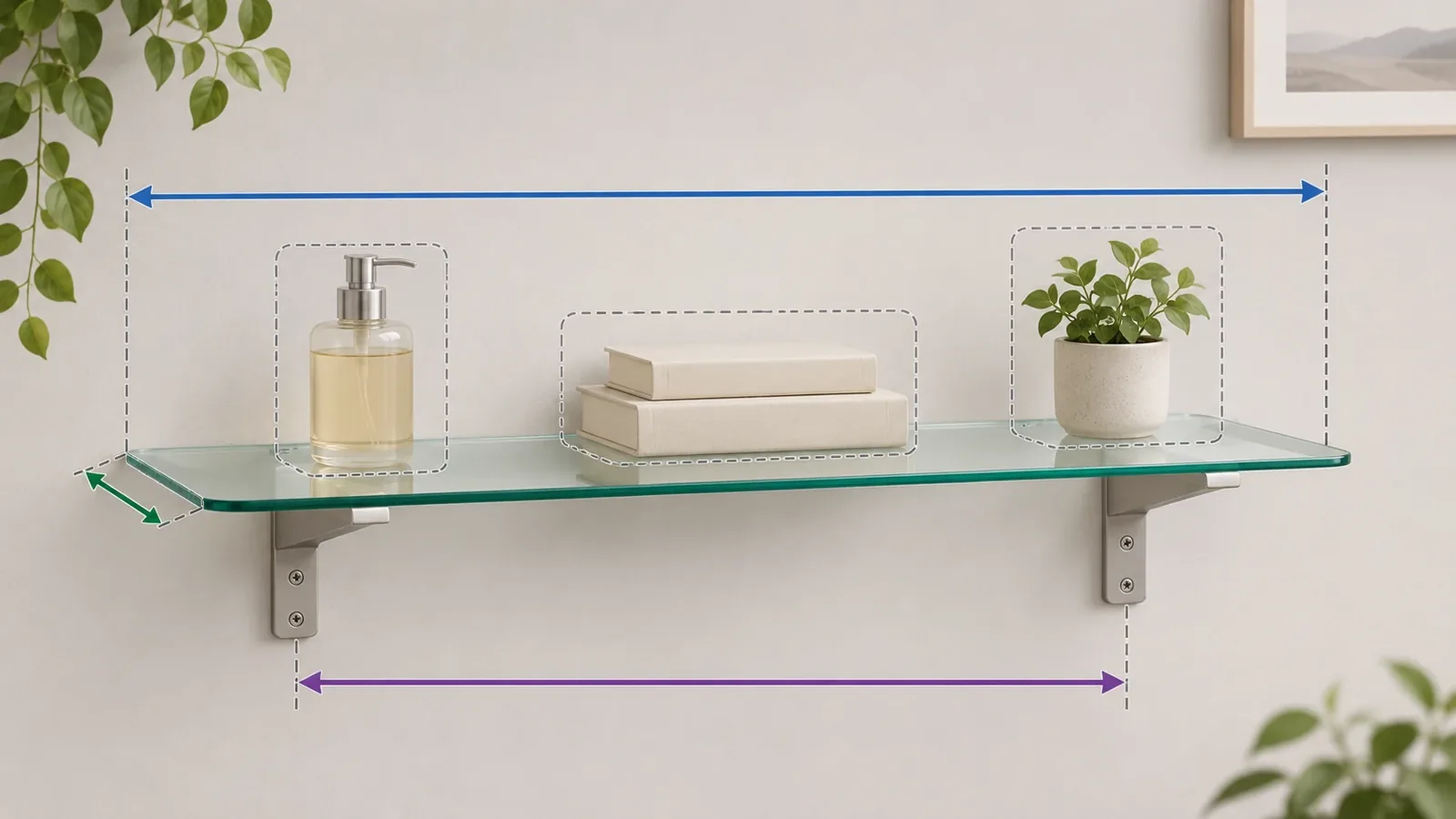
A glass shelf load capacity review should begin with a complete description of the proposed shelf and its use. Send the responsible glass or system specialist the glass construction and identity, finished dimensions, support arrangement, unsupported span, likely contents, and whether the load is concentrated or distributed. Ask the specialist to confirm which evidence applies to that exact configuration. A thickness label by itself does not establish that a shelf is suitable for a particular use.
This guide helps buyers prepare that handoff. It does not calculate capacity, recommend a thickness, define a safe span, or approve an installed assembly. Glass construction, edge condition, support geometry, loading, product design, and the applicable review method belong to a qualified glass or system specialist. Metal brackets and the broader installed assembly have separate evidence and responsibility questions. Keep those boundaries visible in the RFQ rather than turning a catalog value into a project approval.
Why is thickness alone not enough for a glass shelf load review?
Thickness is one input, not a complete description of the shelf system. A specialist needs to understand what glass is proposed, how it is supported, what span and dimensions apply, and where expected contents place force on the shelf. Without those conditions, a thickness value cannot be meaningfully matched to evidence.
Pilkington’s Specification Checklist, section 7 Shelves says its shelf calculation scope is for shelves supported at both ends. It asks for glass size and likely carried weight, and says it is useful to know whether loading is at one point or distributed over the length. This is the manufacturer’s stated advisory scope, not a universal formula for every shelf configuration.
The limitation matters in product development. A wall shelf on discrete brackets, a shelf retained in a continuous profile, and a cabinet shelf resting on several supports do not automatically share one support condition. Their load paths and interfaces differ. Describe the actual arrangement and ask the responsible specialist whether the proposed review method covers it. Do not assume that a chart for one arrangement transfers to another because both products are called glass shelves.
Thickness-only comparisons can also conceal a material mismatch. A table may apply to one glass construction while the quotation proposes another. If the source and proposal differ, identify the mismatch and request applicable evidence. Do not apply a guessed adjustment, select a thicker panel by intuition, or reuse a figure from a visually similar product.
Which glass identity and construction details should buyers provide?
Identify the proposed glass as precisely as the project documents allow, and attach the source document that defines it. If the construction is undecided, say that it is provisional and ask the specialist which alternatives can be assessed. Do not let generic words such as “tempered,” “safety,” or “clear” stand in for a complete product definition.
A useful glass record can include the supplier and product designation; monolithic, laminated, or other construction using the supplier’s terminology; heat-treatment status when specified; finished dimensions, outline, cut-outs or notches; documented edge treatment and corners; drawing number, revision, units and date; intended environment and use; any appearance requirement; and the person responsible for confirming the glass specification. These fields are an RFQ handoff, not an engineering specification. The specialist may require different or additional information.
Do not infer construction from appearance or marketing photography. An image can identify a concept, but it does not establish glass type, processing, edge condition, or review scope. If a designation is unfamiliar, copy its wording and ask the supplier to define it rather than translating it into another term.
Source date and scope matter. Virginia Glass Products’ TG-19, “Permissible Load for Glass Shelves” is dated 2012 and expressly concerns monolithic annealed glass. Its explanatory text identifies variables such as support mechanism, item position, thickness, and distance between supports. The bulletin demonstrates why buyers must check applicability. Its numerical table is not reproduced here, and its guidance must not be transferred to tempered, laminated, or another construction without applicable specialist review.
| Evidence item | What to record | Why it matters |
|---|---|---|
| Glass identity | Exact construction and supplier designation | Keeps evidence for one construction from being applied to another |
| Source scope | Material, support arrangement, product configuration, stated limits | Shows which proposal the source may inform |
| Source version | Title, revision or date when given, and access date | Distinguishes project evidence from an older reference |
| Open difference | Any mismatch between source and proposed shelf | Gives the specialist a specific question |
| Decision owner | Supplier or qualified reviewer responsible for the conclusion | Prevents implied approval by the buyer or hardware supplier |
This is a suggested purchasing record, not an existing Koitor test form or a glass-design standard. Preserve the original source and specialist response with the product file.
How should span, support arrangement, and dimensions be described?
Show the shelf as a dimensioned part and show its support arrangement in the same review package. Identify the supported edges or points, distance between supports, any overhang shown in the design, and shelf orientation. The drawing should make clear whether a dimension refers to the glass, support locations, or installed assembly.
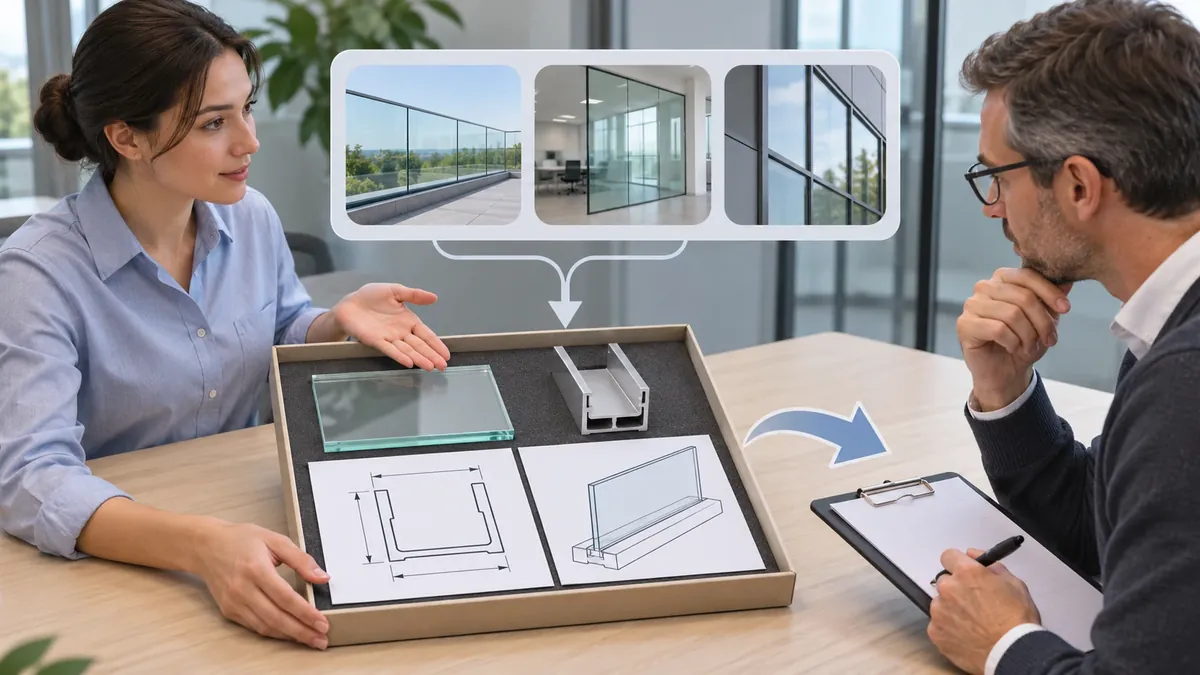
A plan view and section or side view can help. Label the support components and identify which parts contact or retain the glass. If the support method is undecided, show each candidate arrangement separately instead of combining them into one ambiguous sketch. Mark whether a diagram is conceptual or a controlled drawing.
Describe support hardware by supplier and model when selected. If it is a custom metal bracket, include its drawing and identify which dimensions the metal supplier controls and which need glass-specialist review. A bracket catalog does not establish that a glass panel suits the intended load. A glass review does not automatically verify the bracket, wall connection, or complete installed system.
Bohle’s glass shelf support profile BO5201850 is a product-specific example of conditional data: the supplier presents load information alongside shelf-depth conditions and details for that profile. The buyer lesson is not to copy a capacity number. Preserve the profile identity and conditions accompanying the supplier’s data. Those conditions cannot approve a different profile, support spacing, shelf, fixing arrangement, or project.
When drawings are preliminary, label them as such and list expected changes. A specialist response based on one geometry should not silently follow a revised geometry into a later sample or production order. If no drawing exists, state known overall dimensions, support locations, support type, unsupported region, and orientation. Mark each item confirmed, estimated, or pending. A visible list of unknowns is more useful than false precision.
Why must buyers describe where the load will sit?
The location and distribution of expected contents are part of the review question. State likely objects or use, approximate total weight if known, and whether the weight is expected across the shelf or concentrated in a smaller area. If use is uncertain, describe plausible use cases and ask the product owner and specialist which one the design should cover.
Pilkington’s checklist directly asks whether loading is at one point or evenly over the shelf length. That is a useful buyer prompt. It does not mean every actual shelf load is perfectly concentrated or uniform, and it does not provide a universal method to translate a product assortment into a safe load. Describe intended contents and let the responsible specialist decide how use should be represented.
A bathroom shelf may hold several containers, one heavier container, or objects grouped toward one end. These examples help explain use; they are not evidence of a particular capacity. Do not claim a shelf is safe for a bottle, a person, or a generic “bathroom load” unless the exact product has appropriate substantiation and the responsible party has approved the claim.
For a distributor or private-label buyer, separate intended use from marketing copy. A brief may say “for toiletries,” while a product listing may later imply a load limit or suitability for a particular object. Those are different decisions. Review the intended use with the specialist; any public capacity statement needs its own evidence, scope, and approval.
| Buyer input | Useful description | What the specialist still decides |
|---|---|---|
| Intended objects | Toiletry containers on a bathroom storage shelf | Whether this is an appropriate design use |
| Approximate total weight | Buyer estimate, explicitly labeled as such | Whether the estimate and representation are suitable |
| Placement | Several objects across the shelf or one heavier item in one area | How placement should be assessed |
| Use variation | Normal assortment plus a plausible concentrated placement | Which case governs the review |
| Claim request | Whether packaging or a listing will state a capacity | What evidence supports approved wording |
These examples explain communication, not what load the glass should carry. Do not add a load value to product copy because a team member estimated the weight of ordinary objects. The specialist’s written conclusion should identify the configuration and conditions it covers; the product claim owner should make sure public wording does not exceed that scope.
What should buyers ask a qualified glass or system specialist to confirm?
Ask the specialist to identify the reviewed configuration, sources relied on, assumptions, limitations, and changes that would require another review. The response should make clear whether it addresses glass alone, supports, or the complete shelf assembly.
A practical request can ask whether the source applies to the named construction and dimensions; whether it covers the support arrangement shown; which span, overhang, and contact conditions were reviewed; how the stated load placement should be represented; what information is still missing; who assesses the metal support and its connection; whether the review covers the complete assembly; which assumptions and limitations belong in the record; what changes require renewed review; and whether any proposed capacity statement is supported by the evidence.
These questions concern scope and responsibility; they do not prescribe the engineer’s method. The qualified reviewer may request other information. Do not turn the reply into an independent safety determination.
If the response says “approved,” clarify what exactly was approved. Was it one glass construction, one drawing revision, the glass-and-support pair, or the complete installed product? Record the boundary in the purchasing file. If the reply does not address the support geometry or load placement supplied, request clarification before treating it as a product decision.
Keep the response connected to the reviewed drawing and product identity. An email about an earlier prototype should not approve a changed outline, another support, or different glass construction unless the responsible specialist confirms that the earlier conclusion still applies.
How do support products and glass evidence fit together?
Treat the shelf as a system with separate evidence owners. Glass selection and loading assessment belong to the qualified glass or system specialist. The support manufacturer supplies product-specific information for its named support. A metal hardware supplier can confirm details about its own verified component and manufacturing scope, but should not be represented as approving glass capacity unless that role and evidence are confirmed.
This division helps importers ask precise questions. For a bought-in shelf support, use the manufacturer’s current model documentation and retain the product identity. For a custom bracket, identify the metal part, drawing, finish, and contact interface; then ask the glass reviewer which hardware information is needed. For a wall connection and installation conditions, name the responsible project party. These may be different organizations.
Supplier comparison also depends on scope. One offer might include a specific glass panel and proprietary profile, while another quotes only a metal bracket. Their commercial scope is not equivalent. Record which components, evidence, and responsibilities each offer includes before comparing price or material.
Do not use one support product’s data to rate another assembly. Bohle’s profile example includes product-specific shelf-depth conditions; it is not a generic approval for different depths or support architecture. A glass manufacturer’s table cannot verify a support product unless its stated scope includes that arrangement. Link each source to the component and conditions it addresses.
| Decision area | Typical evidence owner | Buyer’s record |
|---|---|---|
| Glass identity and construction | Glass supplier or qualified glass specialist | Exact designation and document revision |
| Dimensions and outline | Product drawing coordinated with specialist | Drawing number, units, revision, shape notes |
| Support geometry | System or support supplier with glass reviewer | Model, contact locations, span, support state |
| Intended use and load placement | Product owner or buyer, reviewed by specialist | Contents, location, distribution, assumptions |
| Metal component details | Verified metal hardware supplier | Part identity, drawing, material and finish scope |
| Wall or furniture interface | System designer, installer, or project reviewer | Interface owner and open conditions |
| Product claim or rating | Product claim owner with substantiation | Wording, evidence scope, approval record |
This map does not assign legal liability or replace a contract. It helps identify who needs to answer each technical question.
What records should remain with the RFQ and sample?
Keep the proposal, drawing, product data, specialist response, and change history together under one product or project identifier. Traceability lets a future buyer or quality reviewer see which configuration was assessed and which conditions remained open.
For an RFQ, retain the original glass source file, support documentation, drawing revisions, load-use description, and written questions. Mark preliminary information. If a supplier proposes another construction or support system, update the record rather than editing the original description to make unlike proposals appear equivalent.
At sample review, compare component identities and configuration with the approved records. A sample can help confirm physical interfaces and visible dimensions. It does not by itself prove load performance, glass construction, hidden material details, long-term use suitability, or complete assembly safety. Ask the specialist which inspection or documents close the review for sample and production versions.
Keep revision changes explicit. If glass, support profile, bracket geometry, edge detail, or intended use changes, record the date, affected field, new document, and review owner. The change may be acceptable, but earlier evidence must not automatically be assumed to cover it. This control is useful when product development, purchasing, quality, and marketing are handled by different teams.
Suggested internal status labels are:
- Confirmed: supported by an identified source or written specialist response.
- Pending: information or review has not been received.
- Changed: a previously reviewed input was revised.
- Not applicable: the responsible specialist explained why the field does not apply.
- Out of scope: the current reviewer is not assessing that component or condition.
These are recordkeeping suggestions, not formal industry classifications. Use the project’s controlled terms if available. The key is to avoid one green “approved” cell when some parts of the assembly remain unreviewed.
What review mistakes should buyers avoid?
The central process mistake is treating a document as broader than its stated scope. A source may be useful for one glass type, support arrangement, or product model. Compare those conditions with the proposal before relying on the source.
Avoid selecting thickness from a generic chart without defining construction and support; applying an annealed-glass table to another construction without specialist confirmation; treating support data as a rating for another bracket or profile; omitting whether weight is concentrated or distributed; sending only a catalog image when actual dimensions are needed; assuming a wall connection was assessed because glass was reviewed; treating a sample fit check as proof of performance; turning a weight estimate into a public capacity claim; copying values without the model and conditions; or closing a review when the reply does not identify the configuration it covers.
Each shortcut can make a file appear complete while hiding an assumption. If data are uncertain, label them uncertain. If evidence does not match, request applicable evidence or a revised assessment. A buyer’s role is not to make structural calculations independently; it is to describe the product accurately and obtain a decision from the responsible reviewer.
A useful supplier comparison sheet includes both confirmed information and open questions. Do not remove a column simply because one bidder did not answer it. An unanswered field is meaningful: it can show that the quote does not yet establish the proposed configuration. Keep the response gap visible so purchasing does not mistake silence for acceptance.
How does this guidance apply to Koitor metal hardware projects?
Koitor Hardware is a family-owned custom metal hardware factory focused on bathroom and home-storage hardware, with flexible OEM production and direct factory communication. That positioning supports discussion of relevant metal parts, drawings or samples, and the manufacturing interface when the specific project is confirmed to be within scope. It does not establish that Koitor manufactures glass, performs glass engineering, operates a glass testing laboratory, or approves shelf load capacity.
For a project involving a metal support or related bathroom hardware, identify the metal component and provide the lawful drawing or physical sample, finish, assembly interface, packaging needs, target market, and expected quantity. Koitor can first confirm whether the requested metal component is within verified scope. Glass identity, load assessment, and any capacity claim remain with the qualified glass or system specialist and product claim owner.
See the custom bathroom hardware manufacturing overview and OEM home-storage hardware overview for general company context. These pages are not evidence of glass design or performance. For a confirmed metal-hardware project, use the Koitor contact page and state which parts are metal, which are bought in, and which review belongs to another supplier.
A clear sourcing email could state: “We are developing a glass shelf with the attached metal support concept. Please confirm whether the metal component is within your production scope. Our glass supplier will review the glass construction, span, support arrangement, and intended load placement. Please identify any metal-part drawings or interface information your team can provide for that review.” This phrasing avoids asking a metal supplier to certify a glass assembly and helps each party respond within its role.
Buyer checklist before requesting a glass shelf load capacity review
Before sending the RFQ, confirm that the package includes a named glass supplier or a clear statement that construction remains open; exact construction terminology and source documentation where available; finished dimensions, outline, units, drawing number and revision; plan and side views of the support arrangement; support locations and span; selected support model or bracket drawing; intended objects and whether placement is spread or concentrated; any weight estimate clearly labeled as an estimate; intended environment and use; source documents and scope; a request for assumptions and limitations; separate status for glass, supports, wall interface and product claims; changes that would trigger another review; and an owner for every unresolved question.
This checklist helps submit a reviewable question. It does not establish suitability or prove that the documents are sufficient. The responsible specialist determines whether information is complete and which evidence can support the product decision.
Frequently asked questions
Does thicker glass automatically mean the shelf has enough capacity?
No. Thickness is only part of the configuration. A specialist also needs construction, dimensions, support arrangement, span, intended loading, and applicable evidence. This article does not recommend a thickness or capacity.
Can an annealed-glass table be used for a tempered shelf?
Do not assume that it can. Virginia Glass Products TG-19 identifies its scope as monolithic annealed glass. A different construction requires applicable evidence and confirmation from the responsible specialist.
Does a clamp or bracket establish glass shelf load capacity?
No. Support data apply to the identified model and stated conditions. They do not automatically establish suitability of a different glass panel or complete installed assembly.
What should I tell the glass specialist about the load?
Describe intended objects, likely total weight if known, and whether contents may be distributed or concentrated. Label estimates and let the specialist decide how the use should be assessed.
Does a sample prove that the shelf is safe?
No. A sample can help confirm component identity and visible interface details. It does not by itself establish construction, load performance, long-term suitability, or complete system safety.
Who should approve a product capacity claim?
The product claim owner should use suitable evidence and the responsible specialist’s written conclusion for the exact configuration. Do not publish a rating based only on visual inspection, a generic thickness chart, or an unrelated support catalog.
Work With Koitor Hardware
Discuss a Metal Support for Your Bathroom Hardware Project
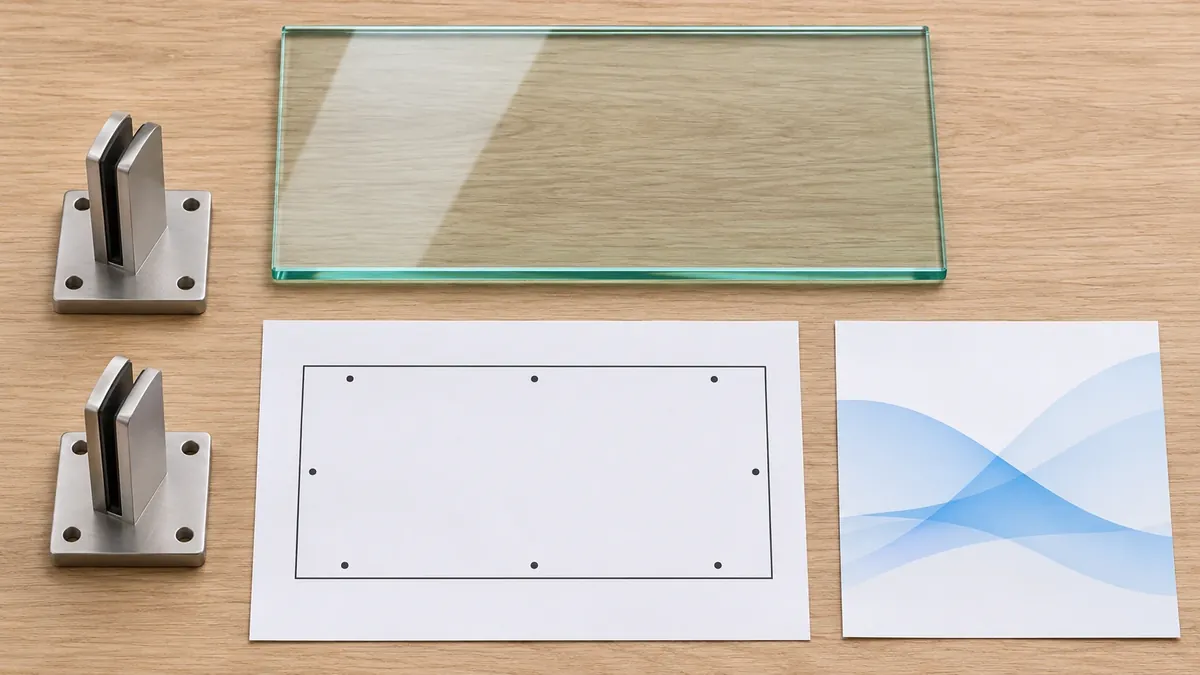
Send Koitor the lawful drawing or sample for the metal component, with finish, assembly interface, packaging needs, target market, and expected quantity. Koitor can first confirm whether the metal part is within verified production scope. Glass construction, load assessment, and capacity claims remain with the qualified glass or system specialist and product claim owner.
OEM / PRIVATE LABEL
Turn this sourcing guide into a product brief
Share your target product, size, finish, order quantity and packaging requirements. Your team receives a practical manufacturability review before quotation.


 English
 Español
 Português
 Français
 Deutsch
 العربية