
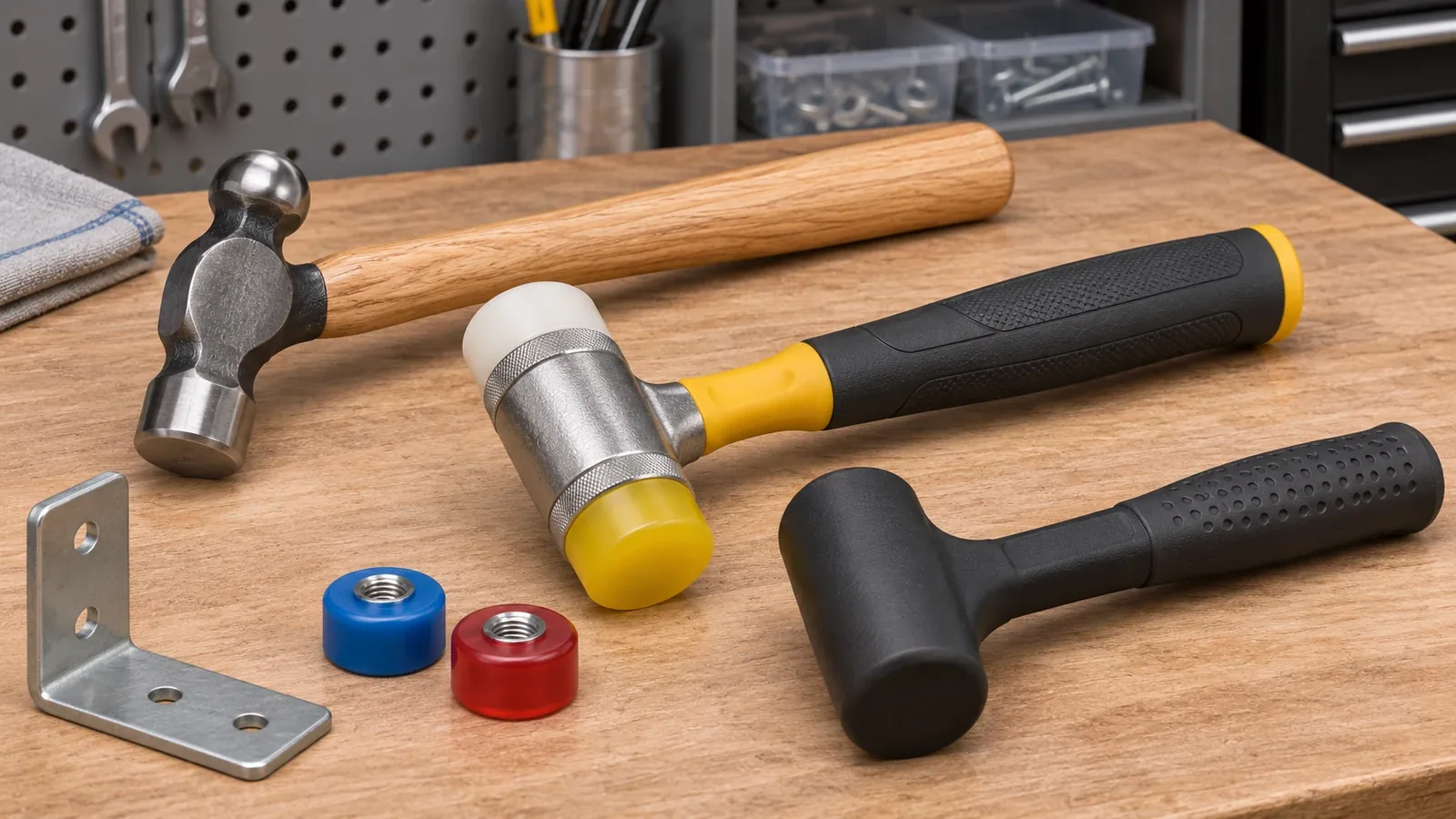
The types of hammers are easier to understand when three different questions are kept separate: what shape the head has, what material forms the striking face, and what task the tool is intended to perform. A claw hammer, ball-pein hammer, sledgehammer, and mallet are common names, but they do not all classify tools along the same axis. Some names describe a feature at one end of the head; others signal a broad size or use family; “mallet” often calls attention to a non-steel or softer face. For buyers documenting assembly or evaluating a supplier’s process vocabulary, that distinction prevents a tool label from becoming an unsupported quality or safety claim.
This guide maps familiar hammer names without assigning universal weights, impact limits, non-sparking approval, or safe-use instructions. A tool name alone does not establish that a particular hammer is appropriate for a coated metal part, a threaded fastener, an adjustment operation, or a production standard. The actual tool, face, workpiece, task and controlled instruction must be considered together.
What does a hammer type name tell a buyer?
A hammer has a head, one or more striking surfaces, and a handle or other means of holding and directing the tool. Trade and catalog names can emphasize different pieces of that construction. Some names are based on head geometry. Others emphasize the face material or the general scale and purpose of the tool. Consequently, a list of hammer types is not a single neat classification where every label is mutually exclusive.
The word “claw” refers to a head form that includes a striking face and a claw-like opposite end commonly associated with nail removal. “Ball-pein” identifies a rounded pein opposite a flatter face. “Sledgehammer” is used for a larger striking-tool family. “Mallet” commonly refers to a hammer-like tool whose face is made from a softer or non-steel material, such as rubber, wood, plastic or another material specified by its maker. Those labels help a buyer identify the broad tool design, but they do not by themselves define the exact model, mass, face hardness, handle, intended workpiece or operating method.
The same tool may be described using more than one attribute. A buyer might encounter a mallet with a particular head shape and replaceable faces, or a hammer described by both a specialty head form and a face material. A catalog classification and a work instruction can therefore answer different questions. The catalog tells a reader what the supplier calls the tool; the work instruction identifies which tool is permitted for a defined operation.
| Axis | Typical question | Example of a descriptor | What the descriptor does not prove |
|---|---|---|---|
| Head form | What geometry is on the ends of the head? | Claw or ball-pein | Suitability for every striking task |
| Face material | What material contacts the work? | Steel, rubber, wood or plastic | That the surface cannot mark or damage a part |
| Tool family or scale | What broad type of work is it associated with? | Sledgehammer or mallet | A particular weight, force or safe-use limit |
| Application | Which operation and workpiece are specified? | A named assembly step | That the same tool is approved for another step |
Common types of hammers by head form
A claw hammer is recognized by the split claw at one side of its head. The opposite face is used for striking in applications defined by the tool maker and the work instructions. The claw shape is often associated with pulling nails, but the name does not mean every claw hammer is interchangeable or suitable for a production adjustment. A buyer should identify the intended tool and task instead of assuming that “claw hammer” specifies all design dimensions or quality criteria.
A ball-pein hammer has a rounded pein opposite a flatter striking face. The rounded end gives the head a distinct geometry and is associated with certain metalworking tasks in tool references. That broad association does not authorize a buyer to apply a ball-pein hammer to a finished bathroom accessory or to infer a particular forming result. If a process instruction refers to a ball-pein hammer, the buyer should clarify the operation, material, contact surface, required result and any controls that the responsible production team has established.
A cross-pein or straight-pein description identifies the orientation and form of a narrow pein relative to the handle or head. These terms can appear in catalogs and specialist tool lists. Because naming conventions may differ slightly among suppliers and regions, check the specific product drawing or catalog description when the orientation matters. Do not use a generic label as a substitute for a defined tool identity on a controlled process document.
A sledgehammer is a broad family name for a heavier striking tool, generally with a large head. The name signals a different scale from small hand hammers but does not give the exact mass, handle length, head composition, intended material, or safe operating envelope. A purchasing specification should state a model or measurable attributes when they matter; the family name is only a starting point.
Other specialized heads may include combinations of faces or shapes intended for particular trade tasks. The details are product-specific. Rather than trying to memorize every catalog term, a buyer can ask: what geometry is present, which surface contacts the work, what material is that surface, and which defined operation calls for it? That short sequence is more reliable than treating all head names as direct descriptions of performance.
Face material is a separate classification
The striking face is the interface between the tool and the workpiece. Steel is common on many traditional hammers, but other hammers use rubber, wood, plastic or replaceable face materials. Tool makers may offer variations for different work contexts. The face material is important, but it is not enough by itself to prove that a tool will leave a surface undamaged.
A soft-face label is relative to a particular tool and application. It does not mean that the face can never mark, dent, transfer material, deform, or affect a coated surface. A mark can depend on the material and condition of the face, the workpiece finish, geometry, contamination, contact, and how the operation is carried out. A buyer should not convert “soft face” into “no damage” without application-specific evidence and acceptance criteria.
Replaceable faces introduce another specification question. A tool may accept replaceable faces, but the interface, replacement part, material and supplier instructions need to match. Do not assume every face fits every head, or that a replacement has the same characteristics as the original. Record the correct tool and approved replacement part if the task depends on it.
For a coated metal component, the contact interface deserves particular care. A finished surface may be cosmetic or functionally important, and a tool that is acceptable for a bare workpiece may be inappropriate after finishing. The safest procurement record distinguishes the production stage, contact area, approved method and visual criteria. It should not instruct workers to strike a finished item unless the authorized process owner has defined that operation.
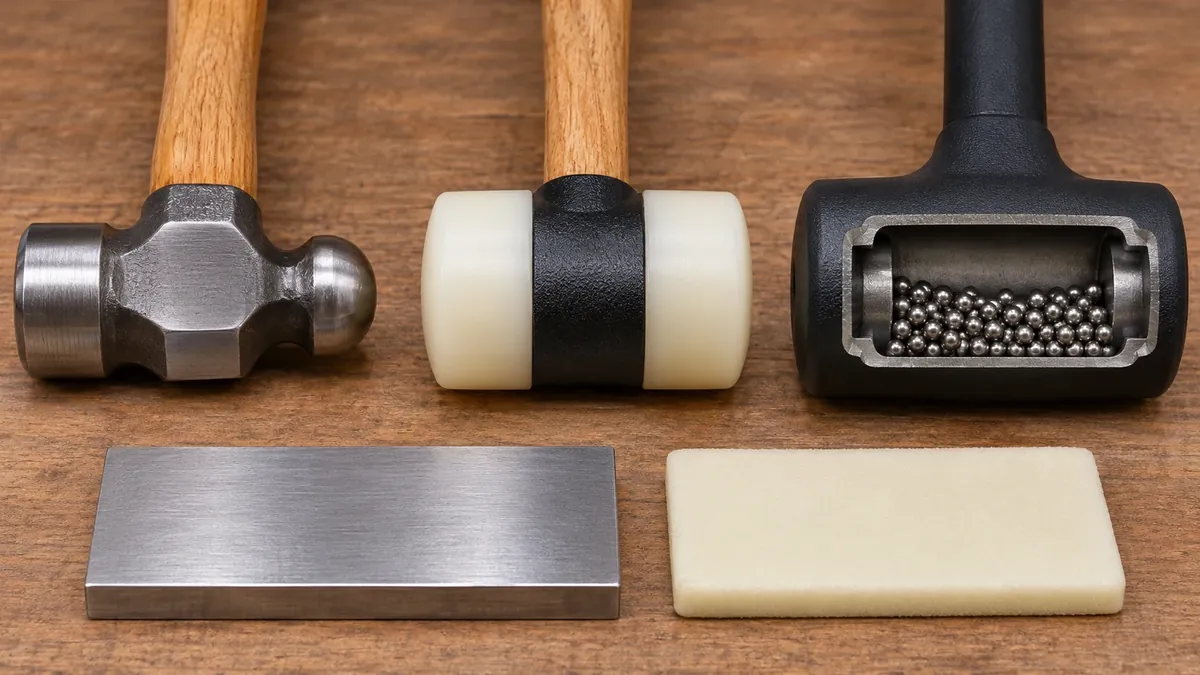
Match the tool description to the task
A useful buying or process review starts with the operation, not the broadest tool category. Ask what is being struck, what outcome is required, whether the workpiece is raw or finished, what contact surface is expected, and which instruction or drawing defines acceptance. The answer may be that no hammering operation belongs in the process; a generic tool list should not introduce one.
For a hypothetical metal storage bracket assembly, an operator might need to position a component before fastening. That example is not a claim about Koitor’s actual production sequence. The buyer would need to establish whether impact is allowed, where it may be applied, what surface is involved, and how the resulting fit is judged. A hammer type cannot answer those process questions. The tool may be merely present at a workbench and not be part of the approved method.
In another hypothetical case, a buyer might be comparing tool descriptions appearing in a supplier audit or work instruction. The record should distinguish the catalog term, the exact model or approved equivalent, the task, the workpiece state and the acceptance check. If two suppliers use different names for tools that seem similar, ask for photographs or product data and confirm the matching attributes instead of treating vocabulary as proof of process equivalence.
The phrase “for metalworking” is also broad. It may cover different operations and workpiece conditions. It does not say whether a tool should contact a finished surface or which impact should be applied. A tool reference can explain categories, but the buyer’s own qualified process owner must define operation-specific instructions and safety controls. This article deliberately does not prescribe technique, force, hammer weight or worker safety procedure.
| Buyer scenario | What to identify | What to keep open until confirmed |
|---|---|---|
| Reviewing a supplier tool list | Exact catalog name, model and image | Whether that tool is part of a controlled operation |
| Specifying a soft-face tool | Face material and replacement system | Whether it avoids marks on the actual finish |
| Comparing work instructions | Operation, part stage and contact point | Acceptance method and authorized process |
| Buying a production tool | Supplier, model and approved attributes | Any performance or safety claim not in the product data |
How to read hammer categories without mixing them
A simple matrix prevents category labels from being mistaken for equivalent specifications. “Claw” and “ball-pein” are head-form terms, while “soft-face” centers the material at the contact surface. “Sledgehammer” describes a broad tool family and scale. “Mallet” often communicates a face or tool construction distinct from a conventional steel-faced hammer. These descriptions can overlap because they answer different questions.
Consider a product catalog that lists a ball-pein hammer and a rubber mallet. The first name directs attention to a rounded pein. The second directs attention to a different face construction. It would be inaccurate to conclude from the names alone that one is stronger, gentler, safer, more precise, or better for a particular metal part. Those claims would need evidence tied to the exact products and operation.
Similarly, a sledgehammer label should not be read as a complete specification. If the buyer needs to distinguish models, obtain the exact product number, dimensions, mass and maker’s intended use where those attributes matter. This does not mean every purchase requires an extensive engineering document. It means the buyer should specify only the characteristics that affect the decision and leave irrelevant details out.
When a work instruction contains a generic name, ask whether a particular model is approved or whether a controlled equivalent is allowed. When it names a model, verify that the purchased tool matches the stated identity and that the instruction remains current. If production changes the tool, record whether the process owner reviewed the substitution. Do not treat a tool photograph or a catalog family as approval of a manufacturing method.
A practical buyer checklist for tool review
A buyer evaluating tool vocabulary can use a short checklist:
- Identify whether the name refers to head form, face material, tool family or application.
- Capture the exact maker and model where the distinction matters.
- Record the intended task and the workpiece stage.
- Identify the contact surface and whether the part is finished.
- Check the current product information and the responsible work instruction.
- Ask who approves an equivalent or replacement face.
- Keep performance, safety and quality conclusions within the evidence supplied.
This checklist is for documentation and purchasing clarity, not a safe-work procedure. Workplace tool selection and use must follow the manufacturer’s instructions, applicable workplace requirements, and the site’s authorized controls. A blog taxonomy cannot replace training or hazard assessment.
When a buyer compares supplier capabilities, a tool’s presence is weak evidence by itself. It does not establish that a supplier has a repeatable process, trained operators, calibrated equipment, suitable inspection, or a particular finished-product performance. Ask for relevant process records when the requirement calls for them. If the actual decision concerns a custom metal bathroom or home-storage product, share the drawing or sample, critical dimensions, finish, assembly requirement and inspection expectation with the manufacturer rather than assuming a hammer label proves capability. Koitor’s scope is described on the OEM home-storage hardware manufacturer page.

Keep tool identification separate from process evidence
In a supplier review, the buyer may see a hammer on a production bench, a tool list in a process document, or a photograph attached to an audit response. These sources answer different questions. A photograph can show that a certain tool was present at the time the image was taken. A list can show the name or model that a supplier chose to record. A controlled instruction can define the operation and approved method, if it is current and applies to the product and process under review. None should be silently substituted for another. When the purchase requirement depends on process control, ask for the evidence that corresponds to that control rather than assuming a tool image demonstrates repeatability.
A useful record can also distinguish a requested fact from a conclusion. For example, “supplier identified a rubber-faced mallet, model pending” is a factual status. “The tool cannot mark the coating” is a performance conclusion and requires product- and application-specific support. Likewise, “the work instruction names a ball-pein hammer” reports document content; it does not establish that the instruction is current, authorized, or suitable for a different part. Label assumptions clearly and assign unanswered items to the responsible technical reviewer.
This distinction is valuable when teams compare quotations or audit documents from different factories. One supplier may identify a tool by a familiar market name, another by a model number, and a third by a local-language term. Instead of judging sophistication from vocabulary, request a photo or product sheet where identity matters, then ask how that tool connects to the stated operation. The comparison should focus on relevant evidence and outcomes, not on whether every supplier uses identical terminology.
Decide when the exact model belongs in a specification
Not every hand tool needs to appear in a buyer-facing specification. Include its exact model or measurable attributes when the tool affects a defined product feature, approved appearance, assembly result, inspection method, or contractual requirement. If the work step is not critical to the buyer and no approved requirement depends on that tool, a long list of minor tools can create administrative detail without improving control. Scope the request to the decision being made.
Where a model is recorded, clarify what happens if it is unavailable. A substitution may be acceptable only after the process owner confirms that the replacement preserves the relevant interface and task. “Equivalent” should refer to specified characteristics, not an assumption that tools with similar names behave the same. Keep supplier claims, buyer requirements, and internal process decisions in separate fields so a reader can see who established each item.
If a part design changes, the earlier tool review may no longer answer the same question. A revised hole, formed edge, weld, coating, or assembly access can change the contact point or make a previously described operation irrelevant. Treat the tool record as one element of the affected process documentation and decide whether a review is warranted. Do not claim that every product change requires requalification; assess impact against the actual operation and the organization’s approved change-control system.
Use neutral language in audits and corrective actions
Hammer vocabulary can enter a nonconformance investigation when a mark, deformation, loose assembly, or cosmetic concern is observed. The investigation should establish facts before attributing cause. Record the affected part and revision, observed condition, location, quantity reviewed, inspection method, and available traceability. If a tool is a possible cause, capture its identity and the relevant instruction, but do not conclude that “a hammer caused the defect” solely because one appears in the area. Other process stages, handling, fixtures, packaging, and pre-existing conditions may also need review.
A corrective-action response should distinguish containment, cause analysis, and verification. This article does not prescribe a specific method or guarantee a corrective outcome. It recommends that buyer questions remain tied to evidence: what was observed, which operation could be relevant, what records were checked, what controlled change was made, and what subsequent evidence supports effectiveness. The responsible quality and manufacturing teams determine their own approved methods and acceptance criteria.
For a product sourcing team, the practical benefit of separating head form, face material, model, task, and process evidence is a cleaner request. It reduces misunderstanding without pretending that tool terminology alone controls product quality. The buyer can then direct a focused question to the correct person, preserve open items, and avoid converting a generic catalog description into an unverified factory claim.
Frequently asked questions
What is the difference between a claw hammer and a ball-pein hammer?
The names emphasize different head geometries. A claw hammer includes a claw opposite its striking face; a ball-pein hammer has a rounded pein opposite a flatter face. The labels do not determine which tool is right for a buyer’s operation.
Is a mallet always made of rubber?
No. A mallet may use wood, rubber, plastic or another specified face or head material. Check the exact product construction rather than relying on the generic word.
Does a soft-face hammer guarantee that a part will not be marked?
No. Face label alone cannot guarantee a no-mark result on every surface. The actual face, its condition, workpiece finish and operation need to be considered under the relevant process and acceptance criteria.
Does a hammer name specify the tool’s weight?
Not necessarily. A family name is not a complete product specification. Where size or mass matters, use the manufacturer’s model data or a buyer-defined attribute.
Can a supplier’s hammer list prove its production capability?
No. A list can show that tools are identified or available, but it does not demonstrate process control, operator qualification, inspection results or product performance. Request evidence that matches the buyer’s requirement.
Should a hammer be used to adjust a finished bathroom accessory?
This guide cannot decide that. The approved work instruction and process owner must determine whether the operation is allowed, which tool is specified and how acceptance is verified. Do not infer permission from a general tool category.
Keep head form, face and task distinct
The most useful way to compare types of hammers is to separate what the head looks like, what contacts the work, and what operation the tool is intended to support. Claw, ball-pein, sledgehammer and mallet are helpful names, but they do not replace an exact model or process instruction. Face material is also an attribute, not a guarantee against damage or a ranking of quality.
For hardware buyers, this vocabulary supports better supplier questions. Identify the tool description, workpiece condition, process stage and requested evidence. Keep operation-specific methods and safety direction with the qualified process owner. For project-specific product development or manufacturing questions, use the Koitor OEM manufacturing page or contact Koitor with the controlled drawing or sample.
Discuss Your Metal Hardware Specification
Send the controlled drawing or sample and the actual product requirements so relevant assembly, finishing, and inspection questions can be scoped for your project.
OEM / PRIVATE LABEL
Turn this sourcing guide into a product brief
Share your target product, size, finish, order quantity and packaging requirements. Your team receives a practical manufacturability review before quotation.


 English
 Español
 Português
 Français
 Deutsch
 العربية