

A hook that clears the door frame does not settle over door spice rack sag. After a named jar set is loaded, a thin cabinet or pantry door can droop or close out of square even when swing clearance and hook fit already pass. Freeze a sag and close observation against that jar set and the actual door construction, and keep any implied hinge rating off the listing.
This guide is for importers and private-label teams writing over-door spice-rack artwork, first-article checks, and after-sales answers. It is not a hook-failure reprint, not a jar-height spacing page, and not a freestanding tip-over file. The decision is whether the door leaf stays within an agreed sag and close after the agreed jars are in place.
Koitor is a family-owned custom metal hardware factory. We can review the rack geometry, the named jar set, and the wording you want to print. We do not rate cabinet hinges, and we do not invent a kilogram figure for a door we did not observe.
Why swing clearance and jar height do not close door-leaf sag
Swing clearance answers a different question: can the loaded door open, clear the frame, and close without the hook or the rack hitting an obstacle, including the hinges as obstacles. That file can pass while the door leaf itself twists or drops under the mass of the rack and jars.
Shelf spacing and kitchen spice rack jar clearance answer a third question: can a lid, a jar height, or an adjacent twist fit the shelf pitch. A door can still droop after those fit checks are written. Keep lid height and adjacent rotation on those files. This page owns the door leaf after a named load.
A crash video of an organizer falling to the floor is usually a hook or drop failure, not door-leaf sag. If the rack leaves the door, write that on a hook-retention or hook-fit file. If the rack stays on the door and the door corner drops, or the latch no longer meets, you are on this page.
A pull-down spice rack loaded-motion checks file is also a different architecture. A pull-down unit travels inside a cabinet on its own hardware. An over-door rack hangs from the top edge of a swinging door and adds a moment at the hinges of that door. Do not borrow a motion check, a load line, or a close rule from a pull-down SKU and print it on an over-door listing.
Freestanding tip-over is a fourth neighbor. A countertop rack can rock on its base. An over-door rack does not have that base. If your listing photograph shows a rack standing on a counter, you are not writing this product. Keep the two silhouettes separate in the brief and in the sample plan.
The useful split is cause, not vocabulary. People may say the door “sags” when they mean the hook walked, the rack hit the frame, or the jars no longer unscrew. Write the cause you can photograph. Door-leaf droop and out-of-square close are the only outcomes this page is willing to freeze.
How should the door construction and the jar set be named?
Name the door before you name a result. “A kitchen door” is not a construction. Record whether the sample door is a thin hollow pantry door, a solid or semi-solid cabinet door, an overlay or inset door, and how the hinges are described by the door supplier. Record door width and height as measured on the sample, and which edge is hinged.
Do not turn that description into a hinge rating. Hinge capacity belongs to the door supplier or to a project test the buyer has already written. The rack file can say which door was used. It cannot print a safe door mass or a kilogram hinge claim unless the project already has written evidence from the door side.
Name the jar set with the same care. Record the number of jars, which shelves they occupy, whether they are glass or plastic, whether they are empty, filled with a named filler, or filled as they will be sold, and whether lids stay on during the observation. A photograph of mixed jars from a styling kit is not a named set.
If the listing will show a full three-shelf load, do not approve the sag line from a one-shelf sample. If the retail set is twelve glass jars of a stated size, do not substitute eight empty plastic jars and call the door unchanged. The mass and the moment arm change when the fill and the shelf map change.
Record how the rack hangs: hook style, hook spacing, how far the shelves sit from the door face, and whether a bumper or pad is specified between the rack and the door. A rack that stands farther off the door increases the moment at the hinges even when the jar count is unchanged. That geometry belongs in the brief, not only in a pretty photograph.
If the rack will be sold with a recommended jar assortment, freeze that assortment as the primary load. If the buyer also wants a “customer may fill any jars” line, that is a wider claim and needs either a heavier agreed fill or an exclusion. An open-ended household fill is not the same observation as a named factory set.
Overlay and inset doors also close differently. An overlay door can still look “shut” with a slightly changed reveal. An inset door may rub the frame or miss a flush close with a smaller movement. Record the door type so the close criterion matches the construction you actually have on the bench.
What sag and close observations can be agreed?
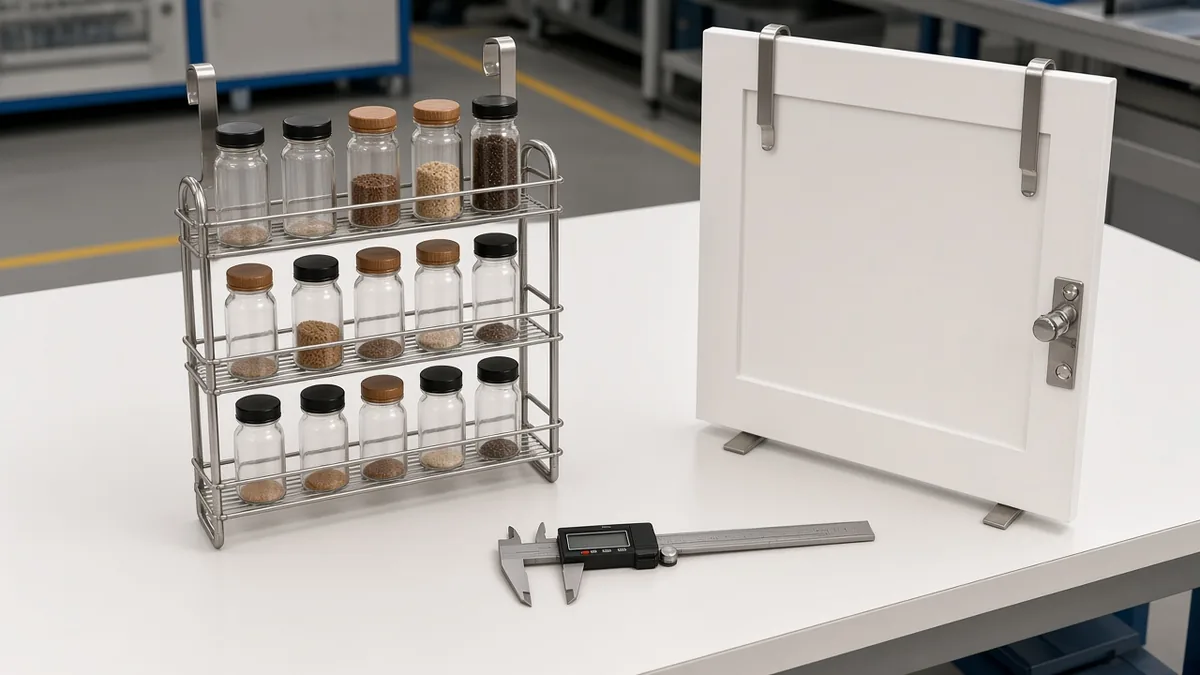
Agree a datum before anyone argues about a dropped door. Typical project choices are the free bottom corner of the door relative to the adjacent door or frame, a mid-height gap at the latch edge, and whether the door still meets the catch or latch after the load is applied. Pick the points on the actual sample, and photograph them before the jars go on.
Then apply the named jar set, wait the agreed time, and photograph the same points again. A door that looks acceptable the moment the last jar is placed can still move after a longer hold. The hold time is a project choice. Do not invent a Koitor hour, and do not copy a hold time from another furniture test that was never written into this brief.
Separate temporary spring-back from a lingering out-of-square close. If the door corner drops under load and returns when the jars come off, record both states. If the door stays out of square, or the latch no longer meets, record that as a lingering close issue. Those two outcomes should not share one casual note that the door sagged a little.
Close is part of the same observation, not a leftover decorative check. An out-of-plane door can miss a magnetic catch, rub a neighboring door, or leave a visible reveal that retail buyers will call a defect even when the hook never slipped. Write the close condition next to the sag datum, using the same door and the same jar set.
If the buyer will sell into both thin pantry doors and heavier cabinet doors, either observe both constructions or write an exclusion for the construction you did not observe. Silent artwork that implies any kitchen door is how a bounded trial on a solid door becomes a return on a hollow pantry door.
Keep the camera, the tape, or the gauge on the same marks. A new camera angle can make a reveal look larger or smaller without the door having moved. The before and after photographs should share a stand-off, a background edge, and the same lighting so the file can be reviewed later without an argument about perspective.
If the door already had a reveal or a weak latch before the rack was hung, record that pre-existing condition. Otherwise a later complaint will be blamed on the rack when the door was already out of square. The sag file is a change against a starting state, not a promise that every used pantry door will close like a new one.
What must never be printed as a hinge rating?
Do not print that the rack will not sag the door, is safe for any cabinet hinge, or holds a stated door mass. Those lines turn a rack SKU into a hinge rating the factory did not issue. A family-owned OEM can help you describe the observation. It cannot certify a hinge it did not manufacture.
Do not borrow a kilogram or pound figure from a hinge catalog, a competitor listing, or a prior project and drop it onto this artwork. If a buyer later wants a rated door system, that rating has to come from the door and hinge evidence, written into the project, not from a spice-rack bullet.
Safer listing language stays inside the observation: the named jar set, the named door construction, the agreed wait, and the agreed sag or close limit. If that evidence is not in the file yet, the safer path is to omit the sag claim, or to print an exclusion, rather than to invent a confident number.
The same caution applies to after-sales scripts. A sentence that the door should not sag is not a response you can defend without the observation. A sentence that the sample door and the named jar set stayed within the agreed close is a sentence you can point back to. Train the script on the brief, not on a slogan.
Seasonal door movement is another trap. A wooden door can change with humidity even when the rack and the jars stay the same. Unless the project observed a stated climate condition, do not print a year-round close promise. An exclusion is more honest than a slogan that the door will always meet the same reveal.
What belongs on the hook-fit or clearance page instead?
Hook fit, hook retention, and loaded swing around the frame belong on the clearance or hook file. If the rack falls, the hooks walk, or the door cannot open because the rack hits the frame, do not force those failures into this sag page just because a searcher said the door went wrong.
Jar-lid height, shelf pitch, and adjacent jar twist belong on the spacing or clearance pages already used for those decisions. Mention them only to send the reader to the right file, not to rewrite those answers here.
If a buyer arrives with a mixed complaint — the hook loosened and the door also looks low — split the file. Fix or record the hook condition first, then repeat the sag observation with the hook in the agreed state. Otherwise one failure masks the other, and the artwork gets a sentence that fits neither cause.
Bumper pads, anti-scratch felt, and hook sleeves can change how the rack sits, but they are not a hidden hinge rating. If a pad is required for the observed close, put the pad in the bill of materials and in the sample. Do not assume a later shipment without pads will repeat the same door result.
What should the importer freeze before artwork is approved?
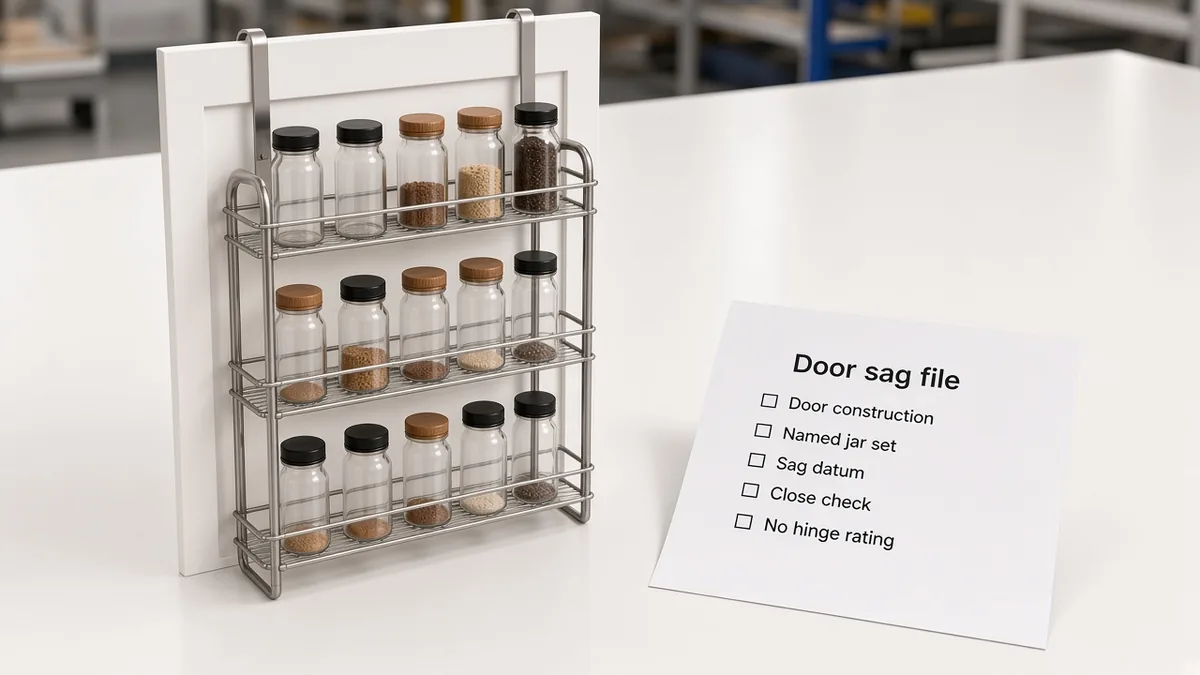
Use a written sag file, not a hallway opinion. The checklist and the matrix are reminders of the decisions this page asks you to freeze. They are not a substitute for the photographs, the named jar set, and the door description in the project folder.
A first-article pack should include the door description, the jar map, the hook geometry, the before-and-after datum photographs, and the wait you actually used. If a later production lot changes hook spacing, shelf depth, or the shipped jar assortment, the sag file needs a new observation, not a copied photograph from the pilot lot.
Do not approve an over door spice rack sag line until that pack exists. A factory can quote the rack while the door observation is still being written, but the listing sentence should wait. Artwork that ships ahead of the sample door is how a careful brief becomes an unbounded retail claim.
If the buyer will also install the rack on doors already hanging in a home, say whether the sample was a new door on a bench or a door already in service. A used door with worn hinges is a different starting state. Either observe that condition or keep the in-service promise off the artwork.
| Claim impulse | What to freeze | What the sample should show | What to keep off artwork until then |
|---|---|---|---|
| Door will still close after loading | Named door construction, jar set, wait, and close datum | Latch or reveal still meets the agreed condition after the wait | A line that any kitchen door will close with a full rack |
| Corner does not drop | Free-corner or mid-edge datum and a before/after photo pair | Any remaining drop stays inside the agreed limit on that door | An unbounded sentence that the door will not sag |
| Suitable for pantry doors | The actual pantry or cabinet door used, or an exclusion | The observed construction only, unless a second door was run | A hinge kilogram or a universal door-mass rating |
| Looks fine in the listing photo | The same jar map as the merchandising image | The merchandising load was the load you observed | A styled half-load used as proof of a full-load door |
| Hook held, so the door is fine | A split between hook retention and door-leaf sag | The rack stayed on the door, and the door was judged separately | A hook-pass treated as a sag-pass |
- Write the product as an over-door spice rack that hangs from a swinging cabinet or pantry door, not as a freestanding or pull-down unit.
- Name the sample door construction, width, hinge side, and overlay or inset condition, without converting that description into a hinge rating.
- Name the jar set: count, shelf map, glass or plastic, empty or filled, and whether lids stay on.
- Record hook style, hook spacing, and how far the shelves sit from the door face.
- Photograph the sag and close datums before the jars go on, and again after the agreed wait.
- Separate a temporary drop that springs back from a lingering out-of-square close.
- Keep hook-drop, frame clearance, and jar-height spacing on their own files.
- If only one door construction was observed, write an exclusion for the constructions you did not run.
- Keep any kilogram, pound, or safe-for-all-hinges line off the listing unless the door-side evidence already exists in the project.
- Send the brief, the door description, and the jar set you want reviewed before the artwork is locked.
How can a family-owned OEM review the sag brief?
Koitor can review the rack drawing or sample, the hook geometry, the shelf map, and the wording you want to use for a named door and a named jar set. That is a construction and acceptance discussion, not a hinge certification.
If you already have a sample door, say so. If you only have a photograph of a showroom door, say that too. We can help you tighten the observation outline, but we will not invent a rating to fill a blank in the listing.
The commercial path is ordinary OEM work: agree the rack, the jar set, and the language, then quote the metal hardware. تصنيع رفوف تخزين مخصصة للمطابخ is the place to start when you also need a custom shelf map or hook spacing. For a sag-file review, send the door and jar-set brief to Koitor with the drawing and the door note attached.
MOQ, sample timing, and bulk lead time stay on the quotation path and depend on the product, the finish, and the order. They are not a substitute for the sag observation, and they do not become a hinge rating.
الأسئلة الشائعة
Can over door spice rack sag be cleared by a hook-fit photo alone?
No. A hook that stays on the door does not tell you whether the door leaf drooped or missed the latch. Take the hook record, then take the sag and close record on the same loaded door.
Do we need a hinge kilogram to sell the rack?
Not from this article, and not as an invented Koitor figure. You need a named door, a named jar set, and an agreed observation. If a later project wants a rated door system, that evidence has to come from the door side and be written into the project.
How is this different from jar clearance or loaded pull-down motion?
Jar clearance is about lid height and adjacent rotation on the shelf. Pull-down loaded motion is a different cabinet mechanism. This page is the swinging door leaf under an over-door rack. Use the neighbor pages for their decisions, not as a substitute here.
What if the merchandising photo uses fewer jars than the retail set?
Then the photo is not the sag sample. Either observe the retail set, or keep a sag claim off the artwork that shows a lighter load. Styling shortcuts are how a door that looked fine in a studio becomes a close complaint in a pantry.
Can we say the rack is ideal for thin pantry doors?
Only if a thin pantry door was the sample, and only within the sag and close you actually recorded. If you observed a heavier cabinet door, write that construction, or add an exclusion, rather than upgrading the sentence to every thin door in the market.
Can Koitor write the door-sag listing sentence for us?
Koitor can review that sentence against the named jar set, the door construction, and the sag photographs, as a construction and acceptance discussion. The buyer still owns what is printed. If the leaf observation is not in the pack, the safer path is to narrow or drop the line.
اعمل مع شركة «كويتور» للأدوات
Need an over-door sag brief reviewed?
Send Koitor your over-door spice-rack drawing or sample, the named jar set, and the door construction you want used in the observation. Our team can review hook geometry, shelf map, and claim wording as a construction and acceptance brief before quotation. MOQ can start from about 100 pcs depending on the product; samples usually take 5–7 working days after details are confirmed; bulk production usually takes 4–6 weeks depending on the project.
OEM / العلامة التجارية الخاصة
حوّل دليل التوريد هذا إلى موجز منتج
يرجى إطلاعنا على المنتج المستهدف، والحجم، والتشطيب، وكمية الطلب، ومتطلبات التغليف. وسيتلقى فريقك تقييمًا عمليًّا لإمكانية التصنيع قبل تقديم عرض الأسعار.

 English
 Español
 Português
 Français
 Deutsch
 العربية